
The pokies that pay back the most — a 2026 ranking for Australian players
Current as of 22 November 2026 · Verified against the ACMA prohibited-services register

Table of Contents
- What “best paying” actually means for Australian punters
- The highest-RTP pokies available to Australian players in 2026
- Where to play these pokies — the AU-facing casinos compared
- How fast your winnings actually reach you
- Are online pokies legal in Australia? What the law actually says
- Staying in control — player protection that works, and the gaps you need to know
- How we evaluated and ranked the pokies on this page
- What the RTP percentage means for your next session
- Frequently asked questions
What “best paying” actually means for Australian punters
The phrase sits everywhere in the marketing for offshore casinos. “Best paying pokies.” “Highest payout.” “97%+ RTP.” The number looks like a promise. It is closer to a coin with two faces.
Return-to-player is a theoretical figure. A pokie with a 99% RTP does not give you A$99 back for every A$100 you deposit. Across an asymptotic stretch of spins, the game’s payout function returns roughly that share of all money wagered to all players combined. Your Friday-night session is not asymptotic. It is thirty minutes long, with whatever streak luck delivers.
This page is for Australians who already understand that distinction and want the rest of the picture. Which pokies actually publish the highest theoretical returns. Where an Australian player can access them. And what the search for “best paying” costs in everything except the RTP figure itself.
Australia’s online pokie landscape — what a punter actually faces
The headline is short. No online casino licence exists in Australia. The Interactive Gambling Act 2001 prohibits providers from offering online casino games and online pokies to anyone in Australia. There is no state, no territory, no federal licence category that lets an operator run an online slots product legally here.
What is legal: wagering on races and sporting events placed before the event starts, lotteries, keno, and the land-based casinos in Melbourne, Perth, Sydney and the Crown network. What is not: an online slots lobby, run from anywhere in the world, accepting Australian players.
The practical consequence is that every “best paying online pokies Australia” search leads offshore. The brands in the comparison table later on this page are offshore casino operators. They are not licensed by the Northern Territory Racing and Wagering Commission, by Licensing NT, or by any Australian regulator, because Australian regulators cannot issue that licence. An offshore brand accepting an Australian deposit is offering a product that the Australian provider prohibition targets. The Australian Communications and Media Authority has been blocking these sites since November 2019 — over 1,564 of them — and the catalogue of voluntary withdrawals by operators themselves runs past 225 services. None of that is a footnote. It is the framework around every recommendation below.
Real-money play and what it means for your bankroll
Real money changes which RTP figures matter. In demo mode the theoretical edge is academic — you cannot lose what you did not stake. The moment a real bankroll sits behind a spin, the house edge starts charging a fee per spin, in dollar terms, that compounds across a session.
The math is straightforward. A 99% RTP pokie keeps 1% of every dollar wagered as house edge, on average, over the long run. A 96% title keeps 4%. The difference looks small. Across A$500 in total wagers — say a session of 250 spins at A$2 each — the 99% title’s expected loss is around A$5. The 96% title’s expected loss is around A$20. Neither number describes what will happen in any given session, but the long-run cost difference is four-fold, and the four-fold spread compounds further with each additional session.
Most offshore casinos offer demo play on the same titles that take real money. The catalogue is the same; the stakes are not. Demo is the right place to test a title’s volatility and feature frequency before committing a bankroll. The trade-off is that demo play never triggers the bonus-wagering terms that apply to a real-money session — the “best paying” question on demo is purely about the title’s behaviour, not about how a bonus interacts with it. Research for this page did not confirm which of the operators below run demo modes this run, but the offshore market largely treats demo as a standard feature.
Playing on your phone — apps, browsers and the mobile experience
There is no App Store category for offshore casino apps in Australia. Apple and Google both enforce restrictions on real-money gambling applications in markets where the product is unlicensed locally. An Australian player searching “best paying pokies app” lands on a mobile browser, not an installed binary.
Modern pokies are built mobile-first. Touch-optimised reels, swipe-based bet adjusters and portrait layouts are now the studio default rather than an afterthought. The experience on a current iPhone or Android device, played in Safari or Chrome, is broadly equivalent to desktop — the games themselves load from the same provider servers, run the same random number generator, and pay out through the same wallet. The two practical constraints on mobile play are data consumption and connection stability. A live pokie session over a patchy 4G link can drop mid-spin, and most operators handle a connection loss by completing the spin server-side on reconnect.
What mobile cannot solve is the offshore problem itself. The casino you reach from your phone is the same offshore brand as on desktop, with the same lack of Australian consumer protection. The screen size changes; the legal status does not.
The highest-RTP pokies available to Australian players in 2026
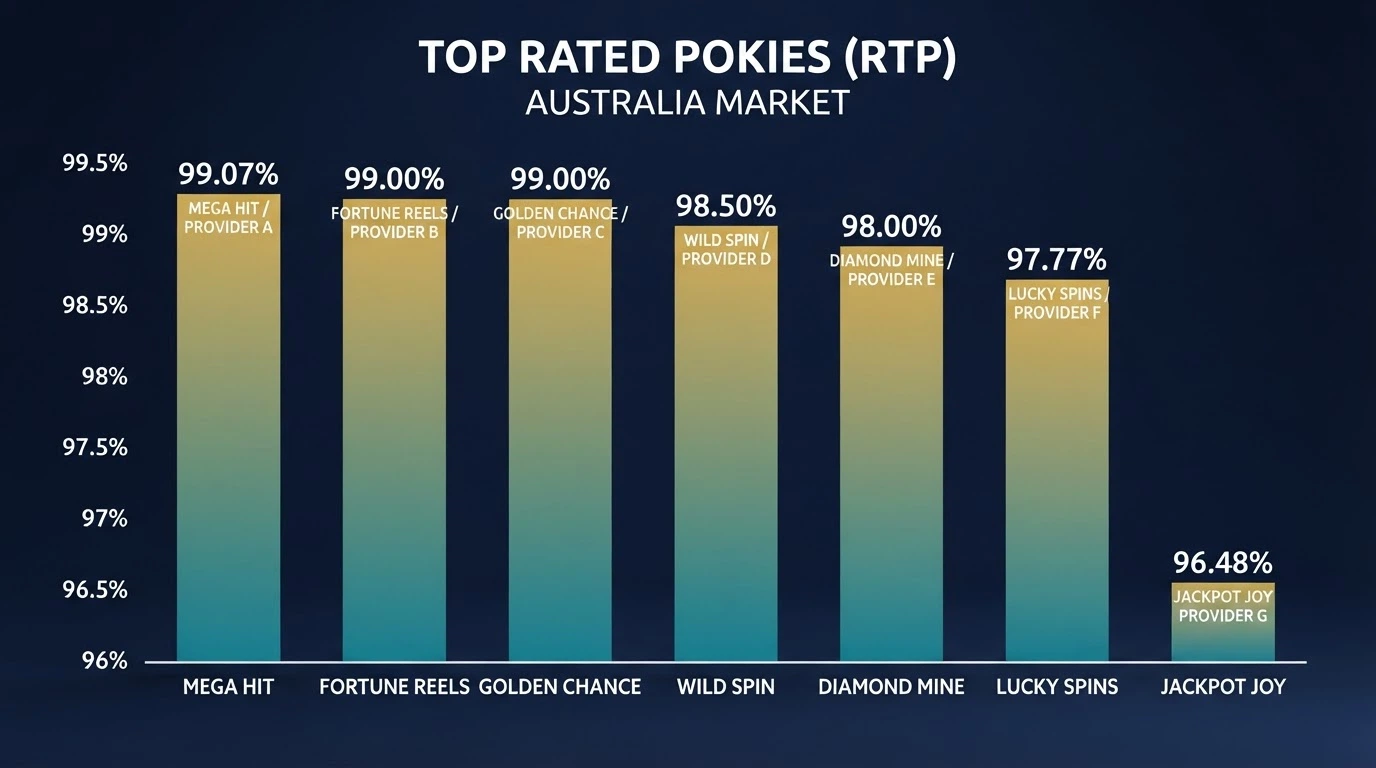
The table that follows ranks the seven highest-RTP titles from providers whose games appear across the AU-facing offshore market. Where research carries an RTP figure for a specific title, it is shown. Where research carries no confirmed figure, the cell carries an em dash.
| Pokie Title | Provider | RTP | Volatility | Max Win |
|---|---|---|---|---|
| Ugga Bugga | Playtech | 99.07% | — | — |
| Book of 99 | Relax Gaming | 99.00% | — | — |
| Mega Joker | NetEnt | up to 99.00% | — | — |
| 1429 Uncharted Seas | Thunderkick | 98.50% | — | — |
| Blood Suckers | NetEnt | 98.00% | Low | — |
| White Rabbit Megaways | Big Time Gaming | 97.77% | High | 3,000x stake |
| Sweet Bonanza | Pragmatic Play | 96.48% | Max (5/5) | 21,100x stake |
A note on the table’s lower rows. Sweet Bonanza’s bonus-buy feature carries an RTP of 96.70% — marginally higher than the base game’s 96.48%, and worth knowing for players who buy features directly. Progressive jackpot titles like Mega Moolah show a base RTP of 88.12%, with the jackpot portion adding roughly 3–4 percentage points across millions of spins; that figure lands outside the high-RTP range this ranking is built around.
RTP explained — what the percentage actually tells you
A 96% RTP slot does not mean you keep A$96 of every A$100 you put in during your Friday-night session. It means that across an asymptotic infinity of spins, the game’s payout function returns roughly 96 cents on the dollar. The qualifier matters. “Asymptotic” describes a mathematical limit the game approaches as the spin count grows without bound. A hundred spins is not asymptotic. Ten thousand is closer but still not infinity. The figure is a destination the game is approaching, never a description of any finite number of spins.
The flip side of RTP is the house edge — the share of every wagered dollar the casino keeps on average. A 99% pokie has a 1% house edge. A 96% pokie has a 4% house edge. Across an AU-facing offshore market where published RTPs range from roughly 88% at the worst to 99% at the best, the house edge ranges from 12% down to 1%. That is the spread the ranking on this page lives inside. The percentage is also a population average — it describes the outcome over every player, not over you.
Online vs land-based — why the RTP gap is larger than most punters realise
The worst land-based pokies in Australia run at roughly 88% RTP. The best online titles reach 99%. The 11-percentage-point gap is not a quirk — it reflects the structural difference between a venue with rent, staff, and a poker-machine licence, and a server-hosted game with no physical footprint.
Land-based venues pay for the floor space, the machine itself, the compliance overhead and the staff to clear the cash. That cost comes out of the RTP. Online pokies pay for bandwidth and a studio licence fee, and the rest returns to players as theoretical payout. The operational economics of the two products explain the gap better than any marketing claim about “online is better” ever will. A Crown or Star gaming floor offers atmosphere, food service and the social context of a venue; it does not offer theoretical returns comparable to what the offshore catalogue runs.
For an Australian punter the practical effect is that the highest-RTP titles anywhere on the market are online. And in Australia, that means offshore.
Volatility and variance — why they matter more than RTP for your session
Volatility is the spread of outcomes around the average. A low-volatility pokie returns frequent, small wins that keep the balance ticking over. A high-volatility pokie returns sparse, large wins — and long dry spells in between.
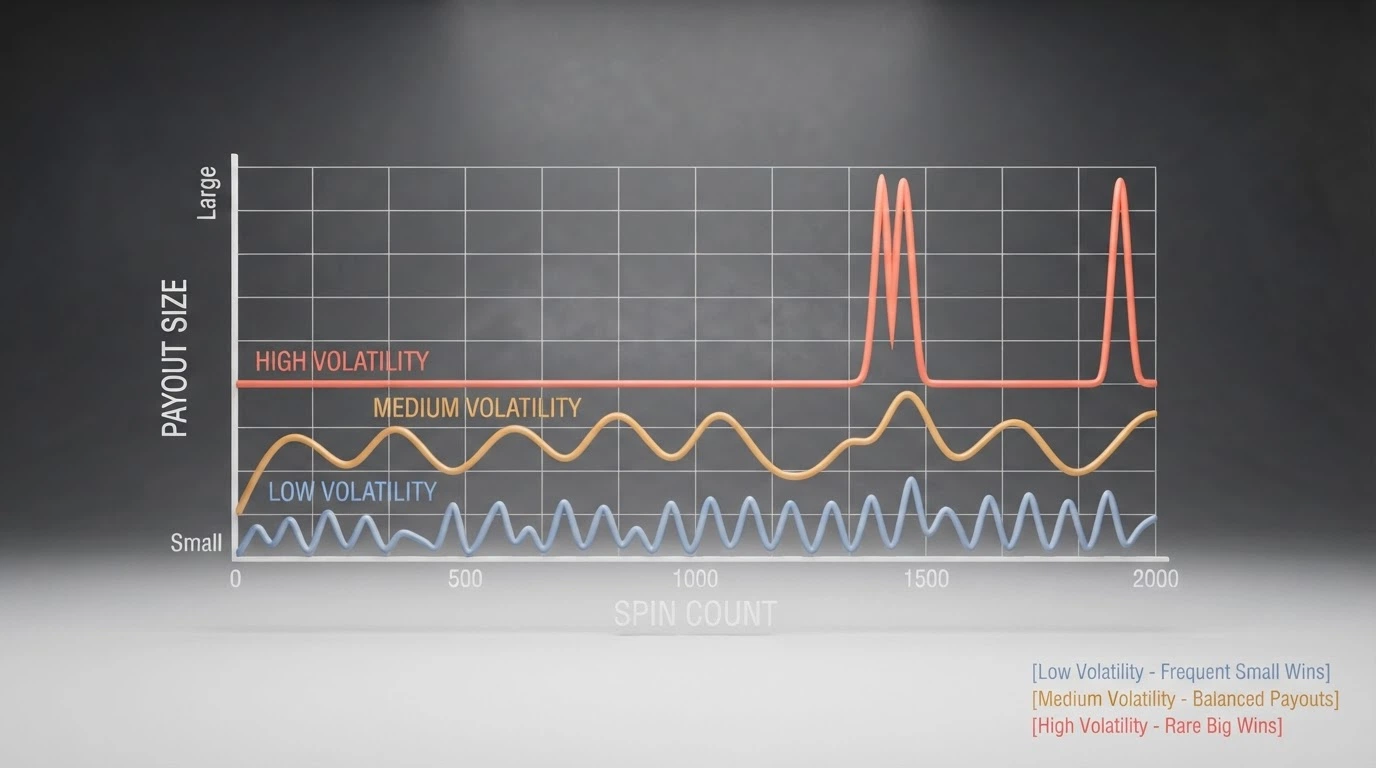
Blood Suckers sits at the low end of the ranking. Its 98% RTP is delivered through frequent small hits that bleed the bankroll slowly. A session of two hundred spins is unlikely to produce a jackpot-sized win but is also unlikely to drain a moderate bankroll — the balance tends to drift down rather than cliff-edge. White Rabbit Megaways, by contrast, can run two hundred spins without a meaningful return and then pay 3,000x stake on a single bonus trigger. Sweet Bonanza sits at the maximum volatility Pragmatic rates — 5/5 on the studio’s own scale — and combines that with a 21,100x max-win multiplier. The asymmetry is the point.
A 99% RTP pokie with high volatility will drain a session bankroll faster than a 96% low-volatility title, even though the long-run return favours the high-RTP game. For a player with a fixed session budget, volatility often decides the experience more than RTP does. The high-RTP / high-volatility combination is a gamble on time as much as money: you need enough spins to outlast the dry periods, and a session that ends in the first hundred spins of a high-volatility title rarely returns anything close to the published RTP.
Bonus traps — wagering rules that lock high-RTP pokies out
The bonus terms at most offshore casinos exclude or de-weight the very titles this page ranks highest. Blood Suckers and Mega Joker are commonly either removed from bonus wagering entirely or counted at 10% of stake value. A A$1 spin on Blood Suckers, during bonus play, contributes A$0.10 toward the wagering requirement rather than A$1. A 40x wagering target that would clear in 250 spins of full-weight play turns into 2,500 spins of de-weighted play — and a bankroll that lasts a fraction of the time, with no closer return at the end.
The reason casinos do this is mechanical. High-RTP, low-volatility titles like Blood Suckers are the easiest games in the catalogue to grind a bonus clear on. If they counted at 100%, bonus abuse would drain the offer. The 10% weighting, or the outright exclusion, restores the edge by making the bonus harder to clear on the games the player most wants to play.
The practical check is the casino’s bonus terms page, listed under “contribution”, “weighted games” or “excluded games”. Reading that list before depositing takes five minutes and is the single best defence against a bonus that looks bigger on the banner than it plays in practice. Most operators bury the exclusion list at the bottom of a multi-page terms document; if it is not visible from the bonus page itself, that is information in itself.
Reduced-RTP configurations — the version you play may not be the one you read about
A “96%” figure is the studio’s marketing default. The version a given AU-facing casino runs can be lower. Studios publish multiple RTP configurations of the same title — 96.48%, 95%, 94%, sometimes lower — and operators pick which one to host. The choice is theirs. The player usually never sees the configuration unless they go looking.
The check is mechanical. Most pokies display the RTP inside the game’s information or help screen, reached from a “?” or an “i” icon inside the title. If the figure shown there matches the published figure from the provider, the configuration is the studio’s top version. If it is lower, the operator has selected a reduced configuration. Several percentage points off the top of an RTP ranking can put a 97.77% title into the mid-90s, where its claim to “best paying” looks considerably weaker. The reduced-config practice is widespread enough that the published ranking on this page is a ceiling, not a guarantee.
Where to play these pokies — the AU-facing casinos compared
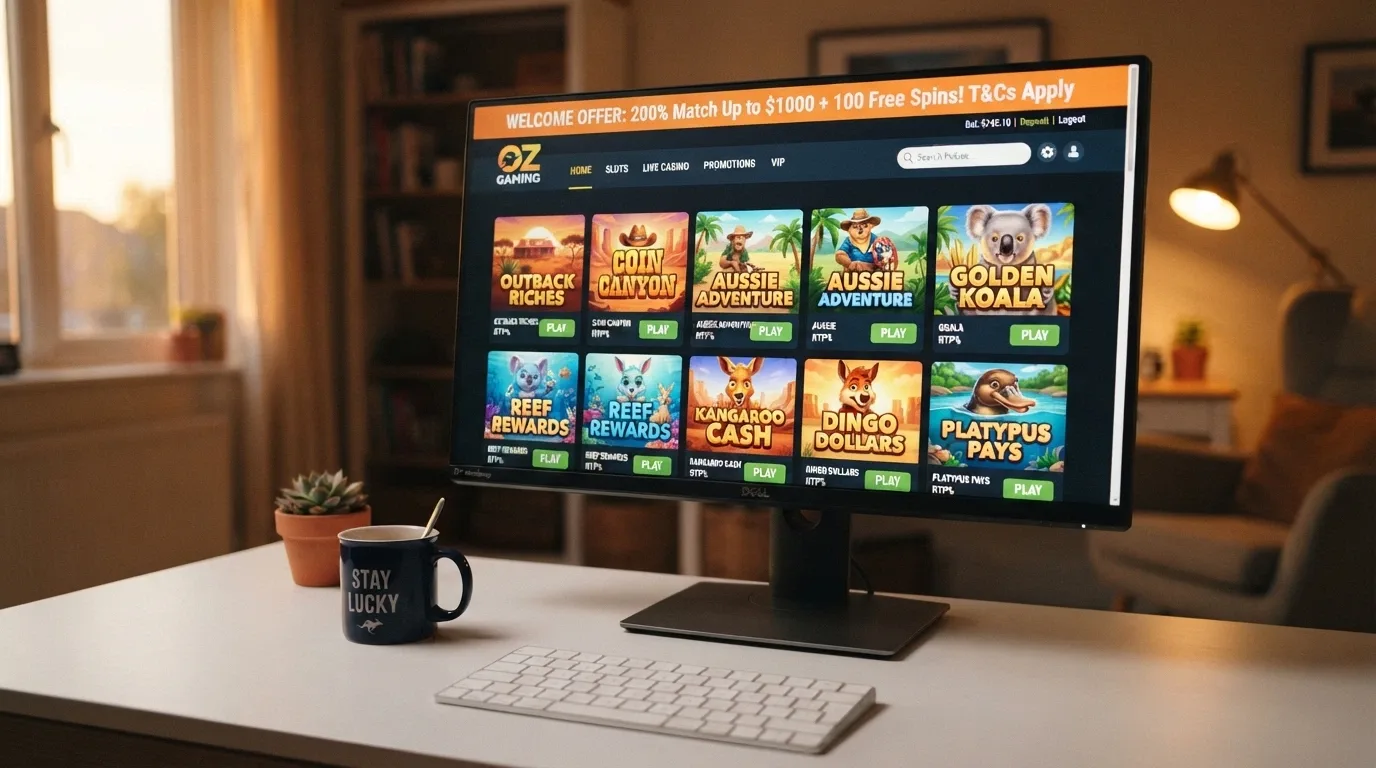
Every casino listed below is offshore. None holds an Australian online casino licence, because no such licence can exist. The ranking reflects published RTP, AU traffic and the bonus terms research confirmed; it is not an endorsement.
| Casino | Market Share (AU) | Licence Status | Welcome Bonus | Wagering |
|---|---|---|---|---|
| Rocket Play | 9.4% | Offshore | 100% up to A$500 + 100 FS (1st), 200% up to A$500 (2nd) | 40x |
| Skycrown | 8.55% | Offshore | Up to A$4,000 + 350 FS across 5 deposits | 30x–40x |
| Royal Reels | 2.51% | Offshore | 100% up to A$500 + A$10 no-deposit | 30x–40x |
| WinSpirit | 1.55% | Offshore | 200% match + 25 FS | 40x |
| Stake | 1.28% | Offshore | Rakeback/VIP model (no traditional welcome) | — |
| Rainbet | 1.28% | Offshore | — | — |
| Scream Casino | 0.99% | Offshore | — | — |
| Fair Go Casino | 0.8% | Offshore | 100% up to A$200 × 5 deposits (A$1,000 total) | 30x–40x |
| Bizzo Casino | 0.57% | Offshore | 30 no-deposit FS (until 31 Dec 2026) | 40x |
| Rocket Casino | 0.57% | Offshore | — | — |
How to read this comparison — what each column tells you
Market share is a proxy for AU traffic — the share of gambling traffic from Australian IPs that lands on this brand. Higher share means more Australians are using the site, not that the site is better. A brand with 9% share has more players seeing its bonus terms than a brand with 0.5% share, which has practical consequences for withdrawal queues, game availability at peak times, and the depth of community discussion around bonus terms. It carries no licensing information.
Licence status is “Offshore” for every entry on this page. The column exists because the absence of an Australian entry is the single most important fact about any of these operators. An offshore licence in Curaçao, Malta or Anjouan does not provide Australian consumer protection, no matter how authoritative the badge looks on the operator’s footer. ACMA does not recognise those licences for the purpose of providing online casino games to Australians. The credit-card and crypto payment ban — covered in the legality section — applies to the licensed Australian side of the market, and is one of the easier tells for a punter distinguishing between the two.
Welcome bonus is the headline number the casino advertises to new sign-ups. The figure is usually the maximum match — “100% up to A$500” means a A$500 deposit gets matched by A$500 in bonus funds. The actual cost of claiming that bonus is the wagering multiple, not the headline number. A A$500 bonus with a 40x wagering requirement means A$20,000 in real-money wagering before the bonus and any winnings become withdrawable. That figure is the floor, not the ceiling — additional bonus terms (game weighting, max bet, time limit, max cashout) can stretch the cost further.
Wagering is the figure that decides whether a bonus is worth claiming. By way of illustration: a A$500 bonus at Rocket Play carries a 40x wagering requirement, producing A$20,000 in required turnover. Played on Ugga Bugga — the top of the RTP ranking at 99.07% — the expected loss across that turnover is around A$186. That is the average over many spins; the actual outcome for any single session sits on a much wider distribution. On a 96% title, the same A$20,000 turnover produces an expected loss closer to A$800. The gap between the headline bonus and the cost of clearing it is the wagering multiple doing its work.
Skycrown
The largest headline package on this page: up to A$4,000 in matched funds plus 350 free spins across the first five deposits, with a 10% crypto cashback and a 1% rakeback layered on. Another description of the same brand — circulated separately across the offshore market — frames it as 100% up to €100 plus 100 free spins on the first three deposits with a 40x wagering requirement. A third lists 100% up to A$200 plus free spins on the first three deposits at 30x wagering. The consistent terms across these descriptions are 30x–40x wagering and a 7-day bonus expiry.
Seven days is tight. A player who deposits the maximum across five deposits and then plays occasionally will struggle to clear a 30x requirement before the bonus expires. The terms are workable for a player who can dedicate a focused session to clearing the playthrough, but punitive for anyone who treats a bonus as a side bet to their regular play. The 5-deposit structure is also a slow burn — a player who moves on after the second deposit leaves most of the package unused, and the remaining bonus credits expire with the package. Max cashout from the Skycrown welcome offer was not confirmed this run, leaving the player to verify the ceiling against the operator’s own terms before depositing.
Rocket Play
Two deposits, two different structures. The first deposit is a 100% match up to A$500 plus 100 free spins; the second is a 200% match up to A$500. Minimum deposit on the second is A$50, wagering is 40x on the bonus amount, and the maximum bet during playthrough is A$7.50.
That A$7.50 cap is worth noticing. During bonus play, a player cannot stake more than A$7.50 per spin. The cap rules out high-roller bonus grinding and protects the operator’s edge, but it also caps the rate at which a player can work through the wagering requirement. At A$7.50 per spin and a 40x playthrough on a A$500 bonus, the volume of play required is around 667 spins — roughly 56 minutes at a five-second spin interval. Across a 14-day validity window that is a manageable pace, though not an easy one. Max cashout from the RocketPlay welcome offer was not confirmed this run.
The expected cost of claiming RocketPlay’s A$500 first-deposit bonus on Ugga Bugga, by way of illustration: A$20,000 in required turnover at a 99.07% RTP produces an expected loss of around A$186. That is the average over many spins. A player who clears the bonus on a 96% RTP title instead — Blood Suckers excepted, because Blood Suckers typically contributes only 10% — sees an expected loss closer to A$800. The same bonus, played on a different title, costs four times as much in expectation.
Royal Reels
The only operator in the ranking with a confirmed no-deposit offer: A$10 free credit for new sign-ups, plus a 100% match up to A$500 on first deposit. Wagering runs 30x–40x on the bonus amount. The library is the largest on this page at over 2,000 titles from more than 30 providers, including Pragmatic Play, Evolution Gaming, Yggdrasil and Hacksaw Gaming.
A no-deposit bonus removes the upfront risk on the small-print check. A player can sign up, claim the A$10, read the wagering terms against the actual playthrough, and walk away without staking their own money if the terms do not suit. That is the underrated use of an A$10 credit. It is also a low-cost trial of the catalogue before committing a A$30 minimum deposit to the matched bonus. Bonus validity and max cashout from the Royal Reels offer were not confirmed this run; the gap is meaningful given that the no-deposit credit has the most to lose from a tight max-cashout clause.
WinSpirit
The highest percentage match on the page: 200% on the welcome bonus, with 25 free spins and a 40x wagering requirement. The headline rate is aggressive. A A$100 deposit produces A$200 in bonus funds plus 25 spins; the wagering target is A$12,000 before withdrawal.
What the 200% headline hides is the relatively small free-spin bundle. Twenty-five spins on a typical high-RTP title produce A$12.50–A$25 in real-money winnings at best, before wagering. The headline rate and the spin bundle tell different stories. Provider list and max cashout from the WinSpirit offer were not confirmed this run, leaving the player to verify both before depositing. The 200% match suits a player who plans to grind a long bonus session on a single mid-volatility title; it suits less a player chasing the highest-RTP end of the catalogue, where bonus weighting frequently de-prioritises the very games the title suggests.
Stake
The only operator on this page built around a rakeback and VIP model rather than a traditional welcome bonus. Stake does not advertise a headline match to new sign-ups; the structure rewards volume and activity rather than a first deposit. Rakeback returns a percentage of house edge or wagering volume back to the player over time, accumulating across sessions rather than attaching to one bonus event.
That structure suits a particular player. A high-volume pokie player who would clear a welcome bonus inside a week gets more out of a rakeback percentage than out of a one-shot match. A casual player depositing once a month for a short session gets almost nothing from this model — there is no welcome credit, no free spins to stretch a session, no sign-up incentive at all. Research did not confirm Stake’s bonus terms, payment-method specifics or provider list this run, so the player who picks Stake is choosing on the model, not on confirmed numbers. The lack of confirmation cuts both ways: it leaves the operator’s actual offering as a thing to verify on the operator’s own pages before depositing.
Rainbet
A smaller operator at 1.28% of AU traffic. Research did not confirm a welcome bonus, wagering terms, free-spin bundle, or provider list this run.
The minimum reasonable assumption is that Rainbet runs a typical offshore bonus structure, but “typical” is not a confirmation. A player who picks Rainbet over the better-documented operators on this page is making a deliberate choice to trade verification for variety. That trade is legitimate, but it should be made with eyes open — the offshore caveat at the top of this section applies in full, and an under-documented operator is harder to evaluate against the bonus traps discussed earlier. Players who value third-party confirmation of terms will find stronger coverage on the larger entries above.
Scream Casino
The thinnest entry on the page. 0.99% of AU traffic, no confirmed welcome bonus, no confirmed wagering terms, no confirmed provider list. A name without a profile.
Players who reach Scream Casino through affiliate links or word of mouth should treat the bonus terms and game catalogue as unverified until they read them on the operator’s own pages. The smaller market-share entries on this page are not worse for being small, but they are weaker for being undocumented. Verification work the larger brands have already had done for players — published reviews, community discussions, comparison-site entries — falls back onto the player here. The verification burden is the trade-off for picking a brand that the offshore market has not yet produced a written record on.
Fair Go Casino
A single-provider operator running on RealTime Gaming’s catalogue of 280 games. The welcome package is a five-tier 100% match up to A$200 on each of the first five deposits, totalling A$1,000 across the package, with 30–40x wagering on the deposit-and-bonus amount.
The trade-off is range. 280 RTG titles is a small library compared to Royal Reels’ 2,000+, and the catalogue is heavy on classic-style five-reel pokies rather than the high-volatility modern mechanics the highest-RTP table leans on. For a player who specifically wants an RTG experience — the studio’s bonus rounds, jackpot networks and US-style art direction — Fair Go delivers that niche. For a player hunting the very top of the RTP ranking, the catalogue is too narrow: Ugga Bugga and Mega Joker are not RTG titles, and the highest-RTP games on this page will not appear on the Fair Go library at all. Bonus validity and max cashout from the Fair Go offer were not confirmed this run. The no-deposit free spins offered alongside carry 30x wagering on winnings.
Bizzo Casino
A no-deposit free-spin offer: 30 free spins on signup with 40x wagering on the winnings. Validity runs until 31 December 2026, after which the specific offer expires. Research did not confirm Bizzo’s broader welcome package or its full provider list this run.
The 30 free spins let a player test the catalogue without an upfront deposit. The 40x wagering on winnings is steeper than Royal Reels’ 30x range, so the value of those 30 spins depends on what they hit. A player who lands a small win on a high-RTP title during the free spins can clear the 40x more efficiently than on a low-RTP title; a player who misses the bonus round on all 30 spins walks away with nothing. The hard expiry date is a constraint, not a feature — a bonus that disappears at the end of the year carries less long-term value than one tied to the operator’s standing terms.
Rocket Casino
The smallest operator on this page by market share, at 0.57%, sharing the bottom of the table with Bizzo. Research did not confirm a welcome bonus, wagering terms, free-spin bundle, provider list, or any other commercial detail this run.
The brand name overlaps with Rocket Play’s, but the two operators are separate entries with separate bonus structures. Rocket Casino should be approached as an unverified profile: market share suggests a real customer base, but the absence of confirmed bonus or game details means a player choosing this brand is relying entirely on what they find on the operator’s own pages. The smaller a brand, the less third-party verification exists, and the more the player carries the verification burden themselves.
How fast your winnings actually reach you
Payout speed at AU-facing offshore casinos runs in two distinct bands. E-wallets and cryptocurrency withdrawals typically clear within 0–24 hours of the casino approving the request. Bank transfers run 1–3 business days after approval. The difference is the payment rail, not the operator — the same casino can be a 12-hour withdrawal on Skrill and a three-day withdrawal on a domestic bank transfer.

The “approval” step is the qualifier most players miss. A casino can advertise “instant withdrawals” while taking 48 hours to approve the request internally. The advertised speed applies only after the approval lands. Offshore brands vary widely on approval time; the payment-method tier determines the speed from approval onward.
E-wallets, crypto and bank transfers — the real timelines
The fastest payout route is crypto, where supported. Bitcoin, Ethereum and stablecoin withdrawals at most offshore casinos are processed within hours of approval, with the on-chain confirmation adding minutes once broadcast. E-wallets — Skrill, Neteller, MiFinity — sit in the same band, clearing within the same day in most cases.
Bank transfers are the slow route. The 1–3 business day range covers both the casino’s processing time and the receiving bank’s clearance window. A Friday afternoon withdrawal request can spend the weekend in a processing queue before the bank sees it on Monday morning. The arrival window widens further across weekends and public holidays, and a withdrawal initiated late on a Friday may not land in the player’s account until the following Wednesday.
The choice of payment method is the single largest factor in payout speed. Two players on the same operator, withdrawing the same amount on the same day, can have a 12-hour gap or a four-day gap between them depending on the method picked at deposit. Operators that allow the player to switch payment methods between deposit and withdrawal sometimes restrict the withdrawal to the deposit method, in which case the original deposit method’s speed sets the floor.
What AU players can actually use to deposit and withdraw
The legal deposit routes for licensed Australian wagering are debit card, bank transfer, PayID/Osko and BPAY. Credit cards, credit-related products and cryptocurrency have been banned as payment for licensed online wagering since 11 June 2024, with penalties of up to A$247,500 for non-compliance.
That ban is a useful tell. A site asking for a credit card deposit or a crypto deposit is, by definition, not a licensed Australian wagering operator — it is an offshore brand. The credit-card and crypto ban applies to the licensed side of the market only; offshore operators have no such restriction and routinely accept both. A player landing on an offshore site that requests a credit card is seeing the operator ignore Australian rules it has no obligation to follow, because no Australian regulator has authority over it. Research did not confirm the specific payment methods each operator on this page accepts this run, so a player comparing them on deposit-route convenience needs to check the operator’s payments page directly before signing up.
Are online pokies legal in Australia? What the law actually says
The short version: no Australian online casino licence exists. The longer version, below, is the legal framework that produces that fact — and the enforcement record that backs it.
The Interactive Gambling Act — what it bans and what it leaves open
The Interactive Gambling Act 2001 (IGA), strengthened by the Interactive Gambling Amendment Act 2017, prohibits the provision of online casino games, online pokies and in-play sports betting to people in Australia. The prohibition targets the provider, not the player — an individual Australian punter using an offshore site is not prosecuted under the IGA. The provider commits the offence.
What the IGA leaves open: wagering on sporting events and races placed before the event begins (licensed by state and territory regulators, primarily the Northern Territory Racing and Wagering Commission, with Licensing NT as the de facto national licensor for online wagering), lotteries and keno, and land-based casinos. The minimum age for any commercial gambling activity in Australia is 18.
The provider-target structure is deliberate. The IGA aims its penalties at the supply side of the offshore market — the operators, their payment processors, their advertising partners — rather than at individual Australians who use the products. That design choice does not change the fact that the product itself is prohibited; it changes which party the criminal liability falls on.
ACMA enforcement — 1,564 sites blocked and counting
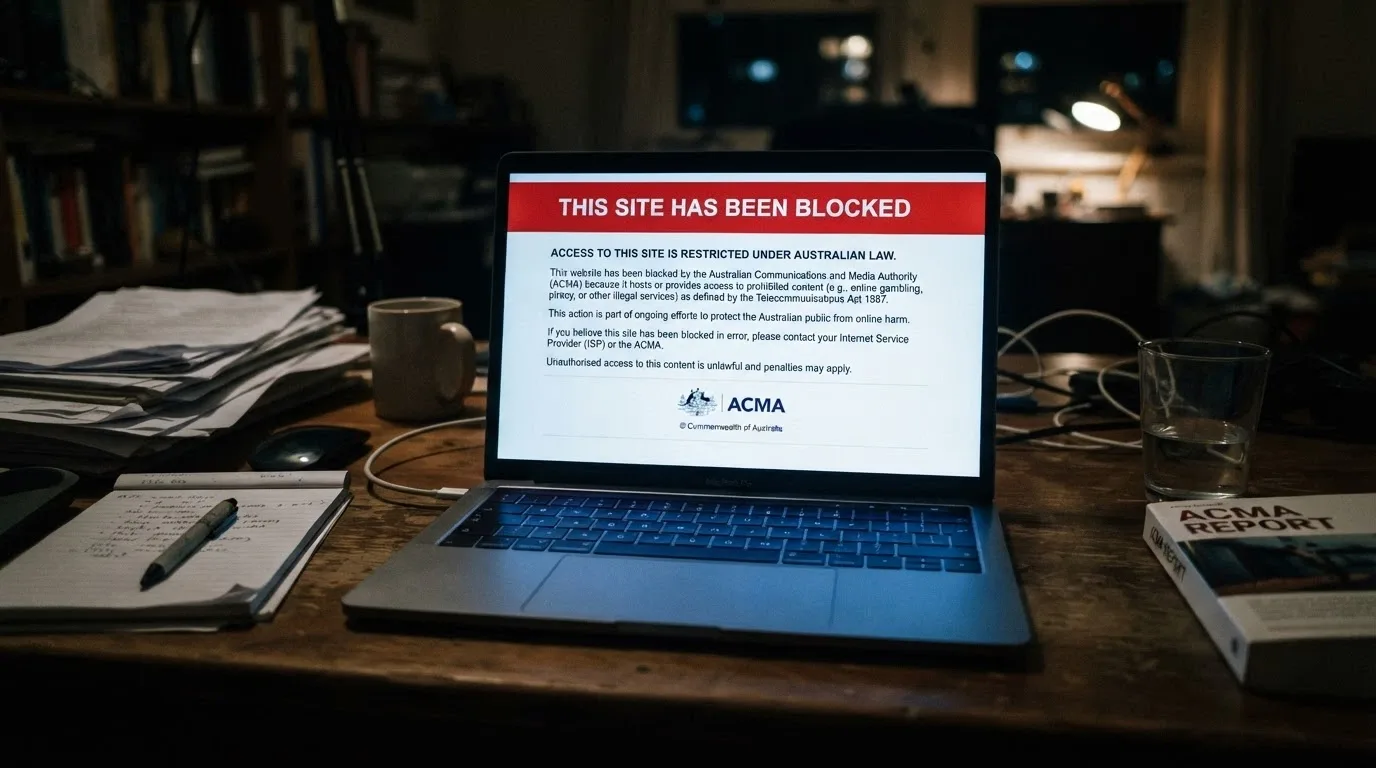
The Australian Communications and Media Authority (ACMA) is the federal regulator that enforces the online prohibition. Its tools include formal warnings, civil penalty proceedings, infringement notices, and the power to direct Australian internet service providers to block illegal sites at the DNS level under section 313 of the Telecommunications Act 1997.
The enforcement record is substantial. Since the first blocking request in November 2019, ACMA has blocked 1,564 illegal gambling and affiliate websites. Over 225 illegal services have voluntarily withdrawn from the Australian market since the ACMA started enforcing the new rules in 2017. The blocks are not all at once — they arrive in waves, with affiliate sites and mirror domains taken down alongside the operators themselves. The practical effect for an Australian punter is that the offshore brand they reach today may be unreachable next week, with any balance left on it stranded in the operator’s terms.
Offshore and unprotected — what no Australian licence means for your money
An offshore casino is not licensed in Australia. It is not connected to BetStop. There is no Australian Financial Complaints Authority recourse, no state or territory complaints body, and no Australian consumer law protection behind a withdrawal dispute. The site’s own terms govern the relationship.
The DNS blocking risk is the specific hazard. ACMA has the authority to direct ISPs to block illegal sites, and the blocks happen in waves. A player with a verified account and a real balance on an offshore casino can find the site unreachable at short notice. The balance is not refunded by ACMA — the regulator’s authority ends at the block, and the operator’s customer service is now the only path to the funds. The credit-card and crypto ban is the underlying tell: a site taking credit card deposits or crypto is operating outside Australian rules by definition, which is the same population of sites ACMA is actively blocking. Offshore casinos are not subject to the inducement marketing restrictions that bind licensed Australian wagering either, so the welcome bonus on an offshore site is the operator spending its own marketing budget to attract a customer it has no other legal right to serve.
The 2026 reform — what changes from 1 January 2027
The Interactive Gambling Amendment (Gambling Reform) Bill 2026 passed Parliament on 19 August 2026. Its measures commence on 1 January 2027. None of the changes legalise online casino or online pokies in Australia. They tighten the framework around the existing prohibition.
The headline changes: no more than three wagering ads per hour between 6:00 am and 8:30 pm, with a live-sport blackout from 15 minutes before until five minutes after a live sporting event. Athletes, celebrities and influencers are barred from promoting wagering products, and wagering ads inside sports venues or on uniforms are banned. Banks and payment providers gain express authority to block transactions to illegal gambling operators. Direct marketing of inducements is prohibited for 14 days after customer signup, for three months after BetStop deregistration, and indefinitely for at-risk customers. A single register allows Australians to opt out of wagering ads across online platforms, administered by ACMA.
For an Australian punter using offshore casinos, the most consequential change is the bank payment blocking authority. Transactions to illegal gambling operators can be refused at the banking layer. The effect on the offshore market is not yet clear, but the implication is that withdrawal routes and deposit routes may narrow, and offshore operators that currently rely on bank rails may find those rails harder to keep.
Staying in control — player protection that works, and the gaps you need to know
Player protection in Australia is real for licensed wagering. It stops at the offshore border.

BetStop — what the self-exclusion register actually covers
BetStop, the National Self-Exclusion Register, launched on 21 August 2023. As at 31 July 2026, it has recorded 67,480 registrations, with 41,290 exclusions still active — more than 60% of everyone who ever registered. 78% of registrants were under 40, and 38% chose a lifetime exclusion. By 31 March 2026 the register had recorded 59,830 total registrations with 37,247 active exclusions — a four-month delta of roughly 7,650 new registrations and just over 4,000 additional active exclusions, the kind of compound growth that suggests the register has stopped being a novelty and started being infrastructure.
The system does not cover offshore casinos. BetStop binds Australian-licensed wagering services only. An offshore casino is not licensed in Australia, is not connected to the register, and will continue accepting deposits from someone who has self-excluded through BetStop. That gap is the single most important limit to know about the system. Despite an estimated five million wagerers nationwide and an estimated 400,000 high-risk gamblers among them, just 30,000 have registered with BetStop. The people most at risk are the least likely to know the register exists: only about one in three wagerers (33.5%) is aware BetStop exists, and only about one in four Australian adults (26.5%) know about it.
Help services and the scale of gambling harm in Australia
- National Gambling Helpline: 1800 858 858 — free, confidential, 24/7, nationwide.
- Gambling Help Online (gamblinghelponline.org.au) — free 24/7 chat, email counselling and support.
- BetStop (betstop.gov.au) — National Self-Exclusion Register; minimum three-month to lifetime exclusion from all licensed online and phone wagering.
- Lifeline: 13 11 14 — free 24/7 crisis support.
- Gambling support services coordinated by the Department of Social Services (dss.gov.au).
- Australian Gambling Research Centre (AGRC) — research and policy recommendations, including the ten recommendations from the statutory review of BetStop.
The scale of harm behind those numbers: about 2.1% of Australian adults — roughly 430,000 people — experience problem gambling, with the Australian Institute of Health and Welfare putting high-risk gambling at 1.8% in 2022. The disparity is sharpest in the Indigenous population: 27.1% of Aboriginal and Torres Strait Islander peoples are at risk of gambling harm, compared to 14.6% of non-Indigenous Australians. The people most exposed to harm are the least likely to know the help exists, which is why the awareness gap matters more than the raw prevalence figures.
How we evaluated and ranked the pokies on this page
The RTP figures on this page are drawn from published provider data and independent testing records, cross-referenced against the AU-facing offshore market. Operators in the comparison table are selected from the AU market by traffic and revenue share.
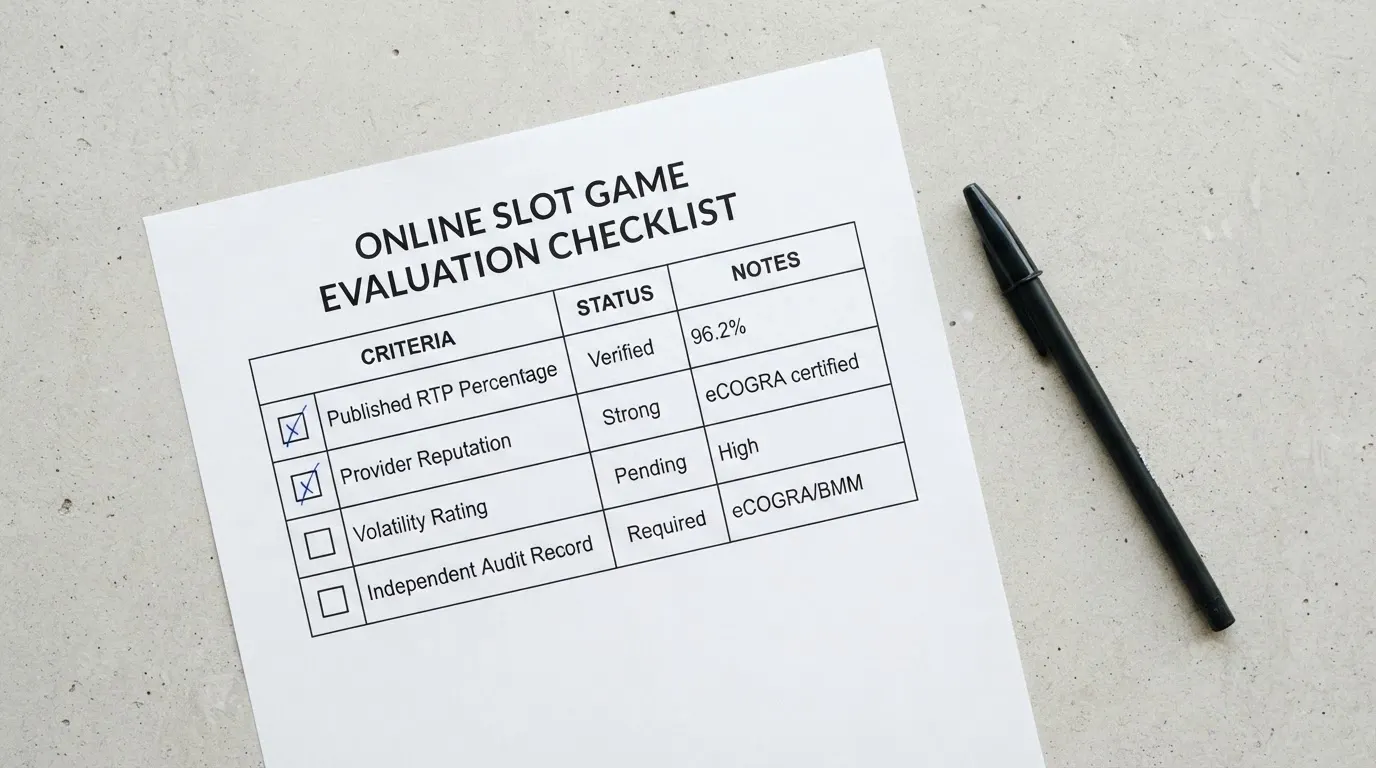
The ACMA prohibited-services register was checked. No operator on this page holds an Australian online casino licence, because no such licence can exist. The ranking reflects the published RTP — it does not guarantee that any given casino runs the configuration shown. Operators can and do run reduced-RTP versions of the same titles, and the version in play is only visible from inside the game itself.
The comparison columns that read as em dashes are gaps where research did not confirm a figure this run. They are not refusals to rank — they are honest empties. A player should treat any em-dashed cell as something to verify against the operator’s own page before depositing. The ranking’s source figures are ceiling numbers: the highest RTP the studio publishes, applied to the operator whose market share puts it on the AU player’s radar. The actual configuration in play at any given session is a separate question, and it is one only the in-game information screen can answer.
What the RTP percentage means for your next session
The ranking is a starting point, not a strategy. A 99% RTP title gives the house a 1% edge. A 96% title gives the house a 4% edge. Both edges compound across every spin, and both grow linearly with the bankroll exposed.
Pick a high-RTP title from the ranking — Ugga Bugga at 99.07% sits at the top of it, Sweet Bonanza at 96.48% sits at the bottom — and understand that the three-percentage-point gap between them is roughly a four-fold difference in house edge. Set a session bankroll you can afford to lose in full; house edge is a fee per spin, not a wager you can win back by playing longer. Read the casino’s bonus terms before claiming anything. Blood Suckers and Mega Joker contribute 10% per spin during bonus play at many operators, and a bonus that looks generous on the banner can be unobtainable on the very high-RTP titles the ranking highlights.
RTP is asymptotic. The figure does not guarantee a return on any session you play. The only number that matters more than RTP is the amount of money you can afford to lose, because that number decides how many spins you can take before the house edge finishes its work. A high RTP title played past your stop-loss is still a loss; a low RTP title played within your stop-loss is still a session you walked away from on your own terms.
Frequently asked questions
What does RTP mean and how does it affect my chances on a pokie?
RTP, or return-to-player, is the percentage of all wagered money a pokie is programmed to return to players across an asymptotic infinity of spins. A 99% RTP pokie keeps 1% as house edge on average over the long run. Your session is not long-run — a hundred spins is a sample, not a population. The figure tells you the fee the house charges per spin, not what you will win in any given session. Higher RTP is better, but it is not a promise for a single play session.
What is the difference between high-volatility and low-volatility pokies?
Volatility is the spread of outcomes around the average RTP. A low-volatility pokie delivers frequent small wins that drain a bankroll slowly. A high-volatility pokie delivers sparse, large wins with long dry spells in between — Blood Suckers is low, White Rabbit Megaways is high, Sweet Bonanza is at the maximum. The same RTP can feel very different at the two ends: a 98% low-volatility title and a 97% high-volatility title can produce radically different session experiences despite the one-percent edge difference.
Why do casinos block high-RTP pokies from bonus play?
High-RTP, low-volatility titles like Blood Suckers and Mega Joker are the easiest games in the catalogue to grind a bonus clear on. If they counted at 100% toward wagering, players could clear bonuses with minimal expected loss, eroding the casino’s edge. Casinos respond by excluding these titles from bonus play or de-weighting them — typically 10% contribution per spin — so a A$1 spin counts as A$0.10 toward the wagering target. The practice is industry-standard offshore. Reading the contribution table in the bonus terms is the only way to know which titles are affected.
Is BetStop connected to offshore casino sites?
No. BetStop binds Australian-licensed wagering services only. An offshore casino is not licensed in Australia, is not connected to the register, and will continue accepting deposits from someone who has self-excluded through BetStop. The register covers licensed sports books, licensed phone wagering, and licensed online wagering products — not the offshore casino sites the rest of this page is built around. That gap is the single most important limit on BetStop’s protection, and the reason offshore play requires its own safeguards.
What is the maximum win on popular pokies like Sweet Bonanza or Mega Joker?
Sweet Bonanza carries a maximum win of 21,100x stake, with maximum volatility on Pragmatic Play’s scale. Mega Joker’s Supermeter Jackpot Reels feature is where its headline RTP of up to 99% is delivered. The max-win multiplier for Mega Joker is not confirmed in the research for this page — the figure is title-specific and changes between game modes. White Rabbit Megaways, by way of comparison, runs a 3,000x stake maximum. Max-win figures are studio-set ceilings; in practice, hitting them requires the bonus feature to trigger at its most generous configuration, which the published RTP does not guarantee.
What payment methods can Australian players use at online casinos?
For licensed Australian wagering the legal deposit routes are debit card, bank transfer, PayID/Osko and BPAY. Credit cards, credit-related products and cryptocurrency have been banned as payment for licensed online wagering since 11 June 2024, with penalties up to A$247,500. Offshore casinos are not bound by that ban and routinely accept both credit cards and crypto — which is itself a tell that the site is not an Australian-licensed operator. The payment methods each offshore operator accepts on this page were not confirmed individually this run, so the operator’s own banking page is the place to verify.