
Best Online Casino Payment Methods For Australian Casino Players
 Available in AU
Every online casino accepting Australian players is offshore — unlicensed by any Australian regulator, outside the reach of Australian consumer protection. The Interactive Gambling Act 2001 prohibits online casino games, online pokies and in-play sports betting anywhere in the country. There is no online casino licence to hold. So when an Australian player deposits at an offshore casino in 2026, the payment method is the only part of the transaction the player actually controls. The right rail moves money fast and cheaply. The wrong one is slow, expensive, or irreversible when something goes wrong.

Verified 18 October 2026 against the ACMA register and current operator cashier data.
Table of Contents
- Why Your Casino Deposit Isn’t as Safe as You Think — The Offshore Payment Reality for Aussie Players in 2026
- The 10 Payment Methods Australian Players Actually Use in 2026, Ranked
- PayID / Osko
- Visa / Mastercard (Debit)
- Cryptocurrency (Bitcoin, ETH, USDT and Litecoin)
- Neosurf (Prepaid Voucher)
- PayPal
- Skrill
- Neteller
- MuchBetter
- MiFinity
- Bank Transfer (Direct / BSB)
- Every Payment Rail That Works for Aussie Casino Players — Sorted by Type
- How Fast Your Money Actually Moves — Casino Deposit and Withdrawal Timelines Compared
- Paying From Your Phone: What Changes at a Mobile Casino — and What Doesn’t
- Is Your Casino Payment Legal? The Australian Regulatory Reality in 2026
- Responsible Gambling Tools That Still Work — Even From an Offshore Casino
- How We Evaluated and Ranked These Payment Methods
- Your Payment Method Is the Decision That Outlasts Every Bonus — Choose It First
- Frequently Asked Questions
Why Your Casino Deposit Isn’t as Safe as You Think — The Offshore Payment Reality for Aussie Players in 2026
The starting fact is the one most comparison pages leave out. There is no licensed Australian online casino to deposit at. The Interactive Gambling Act 2001 makes it an offence for a provider to offer online casino games or pokies to a person physically in Australia, and no state or territory has issued a licence for one. The only legitimate online wagering products licensed in Australia are pre-event sports and race betting — TAB, Sportsbet, Ladbrokes, the licensed bookies — plus lotteries and keno. A site calling itself an online casino and accepting Australian players is, by definition, unlicensed and offshore.
That single fact rewrites what a payment method means in this market. In a licensed market, choosing a payment method is mostly a convenience decision. Here, it is a risk decision. The operator has no Australian regulator to answer to. BetStop, the National Self-Exclusion Register, binds licensed wagering services only — it does not touch offshore casinos. If the operator refuses a withdrawal, closes the site, or simply disappears, there is no Australian Financial Complaints Authority, no state gambling regulator, and no ombudsman a player can escalate to. The only avenue left is whatever the payment method itself allows — a chargeback on a card, an e-wallet dispute, or nothing at all if the player paid in crypto or by bank transfer.
So the payment method is, in practice, the player’s only contract. It sets the speed, the cost, and what rights survive if the operator stops responding.
What Counts as a Casino Payment Method — and What Doesn’t
The phrase “casino payment method” covers three different things that get conflated. A deposit method is what funds the casino balance. A withdrawal method is what cashes it out. And there is the third category — methods that work at the TAB or Sportsbet but do not work at offshore casinos, because the licensed wagering deposit routes (debit card, bank transfer, PayID/Osko and BPAY) reflect what the law allows, while an offshore casino cashier reflects what the operator can route around Australian acquiring rails.
Most Australian players in 2026 use a mix: PayID for fast deposits, Visa or Mastercard as the backup, and crypto on the side for the bigger and faster withdrawals. The exact mix depends on what the operator accepts, what the player’s bank will allow, and how much friction the player is willing to tolerate. Australians are not prosecuted for using offshore casinos — the IGA targets the provider, not the player — but they also have no statutory fallback when something goes wrong. That gap is what the rest of this page navigates.
Your Payment Method Sets Your Rights — Not the Casino
The shape of the protection available is fixed by the method, not the operator. A debit or credit card transaction carries a chargeback right — the card network will arbitrate if the merchant fails to deliver. That right exists whether the merchant is licensed or not. E-wallets carry a thinner internal dispute process. Crypto carries none. A bank transfer, once confirmed, cannot be reversed.
At a licensed Australian wagering operator, these dispute rights sit on top of statutory protection: AFCA for unresolved disputes, the state regulator, BetStop self-exclusion, mandatory deposit limits, identity verification at the cashier. At an offshore casino, the dispute rights are all there is. The method choice is therefore not “Visa or PayID” — it is “Visa with chargeback” or “crypto with nothing”. That is the trade-off every deposit decision in this market is making.
The 10 Payment Methods Australian Players Actually Use in 2026, Ranked
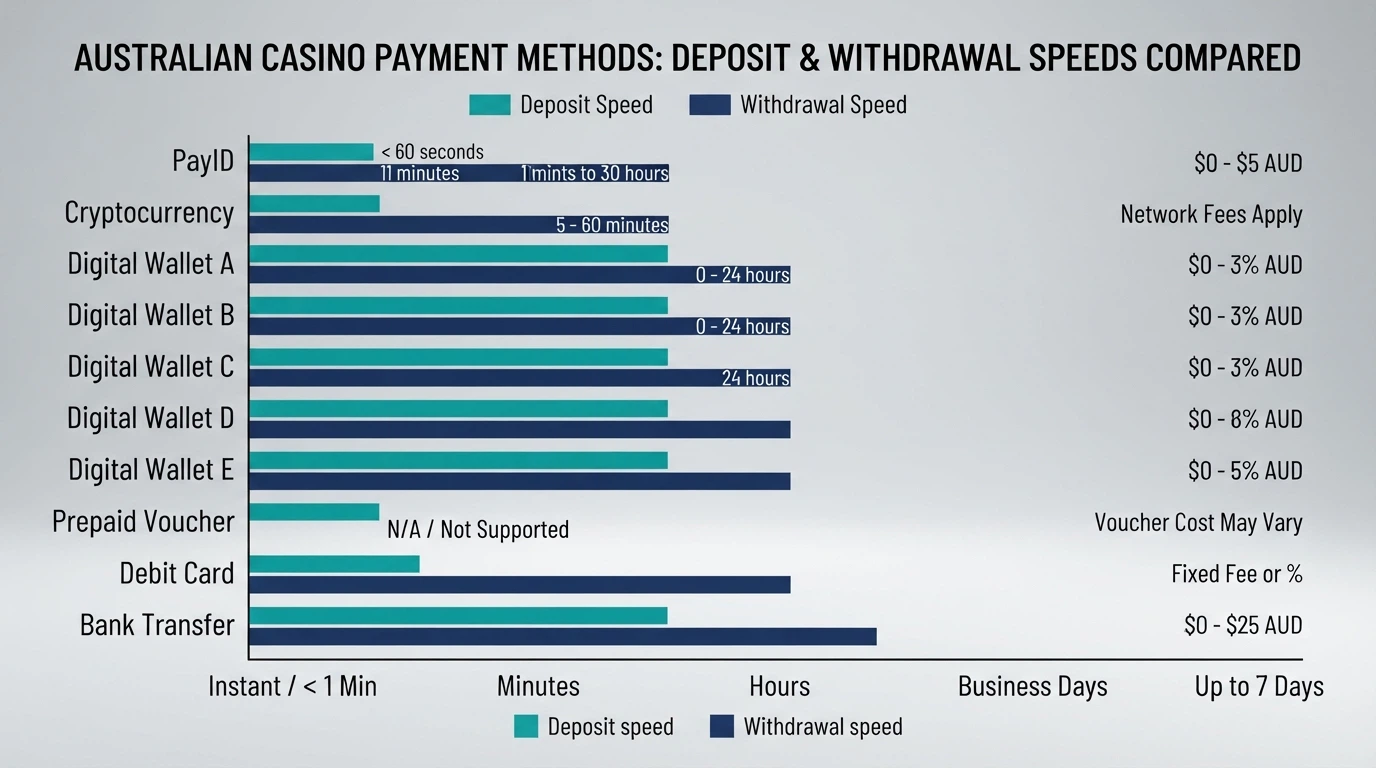
The table below ranks the ten payment methods that actually work for Australian casino deposits, ordered by the combination of speed and cost that matters most to a player moving real money. Each cell is filled from the data in the per-method section that follows.
| # | Payment Method | AU Licensed Wagering | Deposit Speed | Withdrawal Speed | Player Cost | Withdrawals Supported |
|---|---|---|---|---|---|---|
| 1 | PayID / Osko | Yes | Instant (under 60 sec) | 11 min–~30 hrs | None | Yes |
| 2 | Visa / Mastercard (Debit) | Yes (debit only) | Instant | 1–5 business days | 0–2% possible | Yes — slowest |
| 3 | Crypto (BTC, ETH, USDT, LTC) | No — banned | 5–30 min | 5–60 min | Network fees only | Yes — fastest |
| 4 | Neosurf (Prepaid Voucher) | Not typically | Instant | N/A | None casino; FX on USD billing | No |
| 5 | PayPal | Rarely | Instant | 2–8 hrs | Free A | Yes (limited) |
| 6 | Skrill | Rarely | Instant | 0–24 hrs | 2.5% top-up; 4.49% FX | Yes |
| 7 | Neteller | Rarely | Instant | 0–24 hrs | 2.5% funding; 4.49% FX | Yes |
| 8 | MuchBetter | Not typically | Instant | 0–24 hrs | 1.5% card funding | Yes |
| 9 | MiFinity | Not typically | Instant | 0–24 hrs | 1.95% card funding | Yes |
| 10 | Bank Transfer (Direct / BSB) | Yes | 1–3 business days | 2–7 business days | Usually none | Yes |
Two patterns jump out. The fastest withdrawal methods — crypto, PayID, the e-wallets — are also the ones most likely to be missing from licensed Australian wagering operators, where the menu is fixed by the regulator rather than by speed. The method with the strongest consumer protection (debit card, with chargeback) is the slowest to actually pay out. And the method with the lowest friction for the player (PayID) is also the cheapest, the most regulated, and the most useful for everyday banking — which is why it tops the ranking.
PayID / Osko
PayID is the standout Australian payment rail. It links a bank account to a phone number, email, or ABN through the New Payments Platform (NPP), and the underlying message protocol — Osko — settles in real time across participating banks. At an offshore casino, a PayID deposit usually arrives as a P2P transfer to a PayID alias rather than a direct gambling merchant transaction, which is precisely why it keeps working. A direct gambling merchant credit would be declined under the MCC 7995 gambling merchant code by a growing number of Australian banks. A P2P transfer to an alias is, technically, a transfer between two account holders — and the rail works.
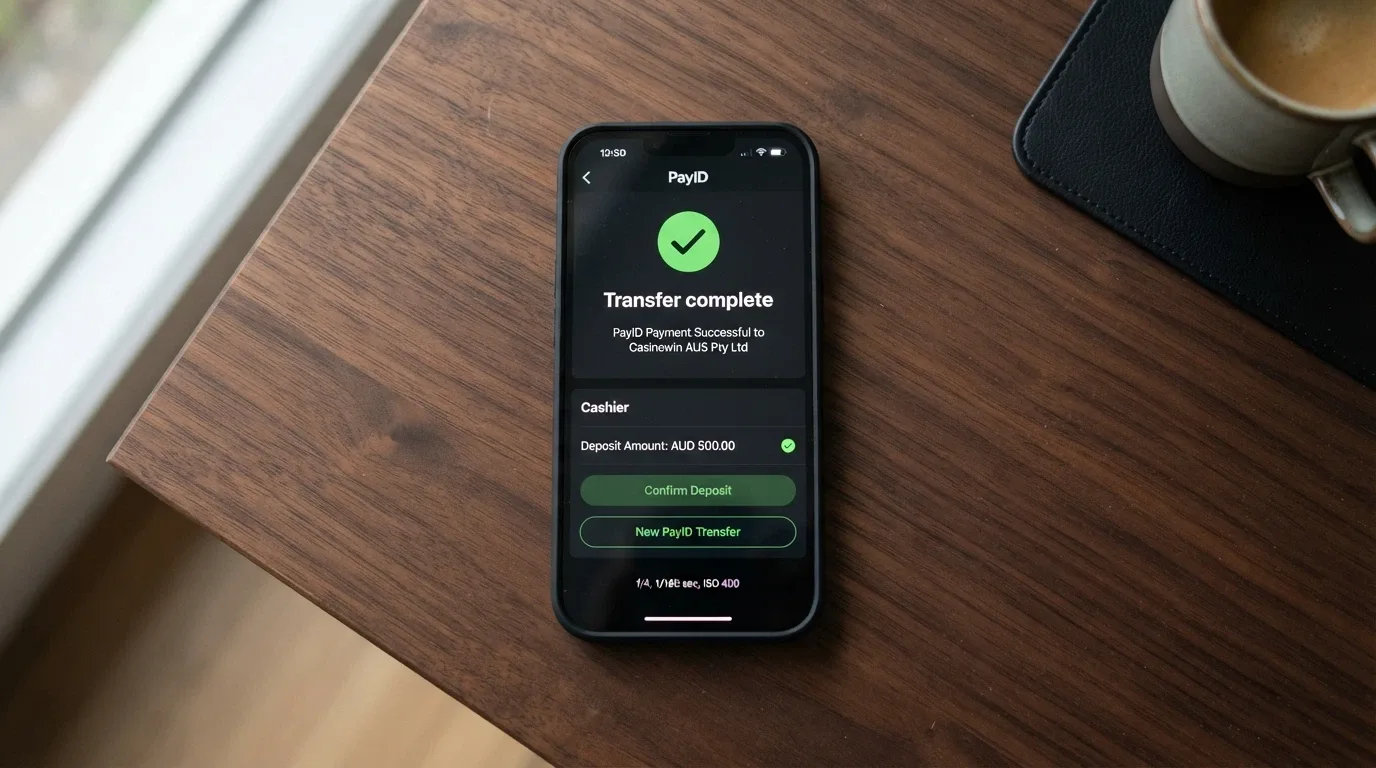
Deposits land in under 60 seconds. The minimum deposit at most casinos that accept PayID sits between A$15 and A$30. Casino-side fees are usually none, and bank-side fees are not a thing on NPP transfers. Daily withdrawal caps at the casino end typically run around A$4,000 — but on top of that, the player’s own bank applies its own daily PayID transfer cap, usually between A$1,000 and A$10,000 depending on the bank. The two limits stack. The casino’s limit is the higher ceiling; the bank’s limit is the one that actually bites if you hit it.
Withdrawal speed is where the picture gets genuinely interesting. One operator cleared an A$250 PayID withdrawal test in 11 minutes. The average across operators that support PayID cashouts is closer to 30 hours. So the rail itself is fast, but the casino’s internal processing still gates the payout — PayID can move money at NPP speed, but only once the casino has approved it. That is the gap between a 5-minute cashier experience and a 30-hour one, and it is the gap KYC verification fills or fails to fill.
The catch with PayID is not the rail. It is the casino list. PayID is a feature of the player’s own bank, and any operator can publish a PayID alias in its cashier. There is no Australian registry of “approved gambling PayIDs”. Players are essentially sending money to an account alias and trusting the operator to credit the balance — and, later, to honour withdrawals.
Visa / Mastercard (Debit)
Debit cards are the universal deposit rail. Almost every offshore casino accepting Australian players accepts Visa or Mastercard debit, deposits land instantly, and the player never has to think about anything more complicated than the 16-digit number on the front. The minimum deposit is typically A$10 to A$20, and the maximum sits anywhere between A$10,000 and A$50,000 depending on the casino.
The catch is on the way out. Card withdrawals are the slowest mainstream option. One to five business days is the normal range — three on average, longer at the slower operators. The casino processes the payout within 24 to 48 hours, and then the card network and the player’s bank take their time. The player has done everything right, the operator has approved the cashout, and still the money sits in limbo while the bank settles the credit.
There is also the MCC 7995 problem. Australian banks can decline a transaction coded to the gambling merchant category — code 7995 — without warning, with no obligation to explain, and at any point in the deposit or withdrawal flow. The deposit can go through at 9am and be reversed at 11am. A withdrawal the player has been waiting three business days for can bounce because the issuing bank has decided it does not want its customer’s money at a casino today. There is no appeal.
Credit cards are a separate story. Since 11 June 2024, credit cards and credit-related products have been banned as a payment method for licensed Australian online wagering, with penalties of up to A$247,500 for non-compliant operators. The ban does not apply to offshore casinos — most still accept credit cards — but it tells the player something important: a method licensed operators are forbidden to take is, by definition, an offshore signal. If a casino cashier offers a credit card deposit, the player is dealing with a site that has opted out of the Australian rules.
Cryptocurrency (Bitcoin, ETH, USDT and Litecoin)
Crypto is the fastest withdrawal method at every operator tested. Bitcoin confirmation takes 10 to 30 minutes, Ethereum five to 15 minutes, and once the casino has approved the cashout, the funds are in the player’s wallet within the hour. The casino-side cost is zero at every operator tested — the network fee is the only cost, and the player controls it by choosing the coin and the chain.
For deposits, the same logic applies: five to 30 minutes for blockchain confirmation, network fee only, no casino markup. Minimum deposits start at the equivalent of around A$10 to A$20 in most coins. Maximums are looser than the fiat rails — many operators do not cap crypto on the way in, and daily withdrawal caps of around A$10,000 are typical on standard accounts.
The fee story is where the choice of coin matters. Bitcoin network fees run between A$1 and A$5 per transaction depending on congestion. USDT sent on the ERC-20 (Ethereum) network costs USD$5 to USD$30 in gas fees — enough to make a A$50 deposit uneconomic. USDT on the TRC-20 (TRON) network costs roughly USD$1, a flat fee that does not move with congestion. Litecoin is the cheapest of the four on a typical day. The 30-times fee gap between ERC-20 and TRC-20 USDT is the single biggest cost variable in the crypto rail, and it is the player’s choice, not the casino’s, that determines which side of it they sit on.
The catch with crypto is also the most important thing to understand. There is no chargeback. There is no dispute process. There is no card network to escalate to. If the player sends BTC to the wrong address, sends it to an operator that disappears, or sends it for a withdrawal that the operator declines, the money is gone. That is the trade-off the speed premium is built on, and it is the reason crypto withdrawals are fastest and crypto disputes are impossible.
Crypto is also banned as a payment method for licensed Australian online wagering, alongside credit cards, since 11 June 2024. The ban does not apply offshore — it cannot, because the operator is not licensed in Australia — but the player should read the presence of crypto in the cashier as the same kind of offshore signal as a credit card option. Licensed operators cannot take it. Offshore ones do.
KYC is worth a separate note. Many operators allow small crypto deposits and withdrawals — typically under USD$2,000 to USD$3,000 — without identity verification. Above that threshold, KYC is essentially universal in 2026 across reputable operators, and a player who has not verified their account will not be able to cash out a large win. Verify before the big bet.
Neosurf (Prepaid Voucher)
Neosurf is a different category of payment method from everything else on this list. It is not a card, an e-wallet, or a bank rail. It is a prepaid voucher, bought online or at a retail outlet, with a one-time deposit code the player enters at the casino cashier. The voucher value is the deposit, and the deposit is the limit.
The mechanics are simple. The player buys a Neosurf voucher for A$10, A$20, A$50, A$100, or any other denomination up to A$10,000. The casino credits the balance instantly on receipt of the code. There are no card details, no bank details, no e-wallet registration. The casino never sees a financial instrument that links back to the player’s bank account. For players who care about that separation, Neosurf is the cleanest option on the menu.
The downsides are equally straightforward. Neosurf is deposit-only. The player cannot withdraw to a Neosurf voucher — there is no such thing. The withdrawal has to go to a different method, usually bank transfer, and that means giving the casino the bank details it never had before. The privacy advantage on the way in becomes a privacy disadvantage on the way out.
The fees are minimal on the casino side — none, in fact. The FX surcharge is the real variable. Neosurf bills in EUR by default, and if the player’s bank treats the transaction as a foreign-currency purchase, an FX surcharge applies. A A$20 voucher carries roughly A$0.30 in FX; a A$500 voucher carries around A$7.50. The surcharge is on the player’s bank, not on Neosurf, and players whose bank accounts settle in EUR will avoid it entirely.
The built-in spending cap is the underrated feature. A player who buys a A$50 Neosurf voucher cannot deposit more than A$50 at that casino that day — the rail simply will not let them. For players managing a bankroll, or anyone trying to set their own limit outside the casino’s own deposit controls, this is the most powerful responsible-gambling tool on this list.
PayPal
PayPal is the most trusted e-wallet brand in the world, and the one with the most restricted availability at offshore casinos accepting Australians. PayPal’s merchant policy restricts gambling merchants to those with PayPal-approved gambling licences — and the offshore licences most of these casinos carry are not on that list. So the cashier at most offshore casinos does not include PayPal. The ones that do are exceptions, not the norm.
Where PayPal is available, it works well. Deposits post in under 60 seconds. Withdrawals average 2 to 8 hours to the PayPal balance once KYC verification is complete — substantially faster than cards, and competitive with crypto once the casino’s processing window is included. Minimum deposits typically run A$15 to A$30. Maximum withdrawals range from A$10,000 to A$50,000 per transaction, with PayPal’s own per-transaction cap sitting at A$60,000 for verified Australian accounts.
The fee structure is the cleanest of the e-wallets. There is no fee on A transfers. An instant transfer from PayPal to an Australian bank account carries roughly a 1% fee. The FX surcharge applies only when currency conversion is involved, and most Australian-facing PayPal casinos operate in AUD. Holding the PayPal balance in AUD avoids it.
PayPal’s internal dispute process is thinner than a card chargeback but thicker than nothing. A player who can show the operator failed to deliver the purchased goods or service has a reasonable shot at a PayPal resolution. It is not arbitration, but it is something. For a player who can pick an operator from the small PayPal-accepting set, the speed and brand trust are worth the narrower choice.
Skrill
Skrill is the workhorse e-wallet of the offshore casino world, with broad acceptance at sites accepting Australians. Deposits are instant, withdrawals clear same-day to within 24 hours at the top casinos (up to 48 hours at the slower ones), and minimum deposits of A$10 to A$20 are the norm. The fee schedule, however, is heavier than most players realise.
Card top-ups to the Skrill wallet carry a 2.5% fee. Currency conversion — if the player funds the wallet in AUD but the casino settles in EUR, or vice versa — adds a 4.49% markup on the wholesale rate. Withdrawing from Skrill to a bank account is a flat €5.50 per transfer, roughly A$9 at current rates. And if the player does not log into the wallet for six months, a €5 monthly inactivity fee starts to accrue. The casino itself does not charge, but the wallet around it does.
The standard strategy is to fund the Skrill wallet in AUD, hold the balance in AUD, and only convert when forced. A player who treats Skrill as a single-currency AUD wallet avoids the 4.49% FX markup entirely, pays the 2.5% card top-up fee on the way in, and pays the €5.50 flat fee on the way back out to a bank account. That is the realistic cost of a Skrill round trip, and it is the price of using a wallet the operator pays nothing to accept.
Neteller
Neteller is Skrill’s sibling in the PaysafeGroup family, with a similar fee structure and a more aggressive tier system. The Standard account caps unverified users at A$150 to A$500 total deposits — low enough that any meaningful play requires verification. Verified True members get A$2,500 to A$5,000 per transaction. VIP members process A$15,000 or more.
The fee curve drops sharply with status. Casino deposits are free. Funding the wallet from a card costs 2.5% at Standard level. Currency conversion starts at 4.49% at Standard and falls to 1.29% at top VIP. Bank withdrawals cost roughly A$15. There is an inactivity fee of about A$7.50 a month. The pattern is the same as Skrill, but the higher tier ceilings matter for high-volume players.
Deposits are instant. Withdrawals clear same-day to within 24 hours at top casinos. Neteller’s broader acceptance at offshore sites is comparable to Skrill’s, and a player who wants both wallets will find them interchangeable at most cashiers. Verification is the unlock for everything else.
MuchBetter
MuchBetter is a newer e-wallet, AUD-native, with the lowest card funding fee among the wallet set. Deposits are instant, withdrawals clear within 24 hours, and the wallet carries no fees on the casino side. Card funding costs 1.5% — meaningfully cheaper than Skrill’s 2.5% or Neteller’s 2.5%. Minimum deposits sit at A$10. Maximums range from A$10 up to A$50,000 depending on the operator.
Availability is the variable. MuchBetter is growing at offshore casinos, but it is not as universal as Skrill or Neteller. A player who picks MuchBetter as their primary wallet needs to confirm it appears in the cashier before committing to a casino. The mobile-first design is the differentiator — biometric login, in-app balance display, push-notification alerts — and it feels like a current-generation product, where Skrill and Neteller feel like products from the previous one.
MiFinity
MiFinity is described by the operators that accept it as the most reliable e-wallet choice for Australian players. Deposits are instant, withdrawals clear within 24 hours, and the wallet is AUD-native. Card funding costs 1.95%. FX markup can run up to 2.5% on currency conversion. Casino-side fees are zero.
The minimum deposit sits at A$10. Maximums vary by casino but are typically generous. MiFinity’s availability is in the same category as MuchBetter — growing but not universal. A player who wants MiFinity should look for it in the cashier before registering.
MiFinity’s edge is consistency. A player who has been burned by an e-wallet that works at one casino and stalls at another will value a wallet that closes the loop every time. For an Australian player who has been waiting three days for a withdrawal that should have cleared in one, that reliability is hard to put a dollar figure on.
Bank Transfer (Direct / BSB)
Bank transfer is the slowest method on the list and the most bank-authenticated one. Deposits take one to three business days via direct BSB transfer, with Osko/NPP variants clearing in one to 24 hours. Withdrawals take two to five business days at most operators, and up to seven at the slowest. There is no realistic maximum deposit or withdrawal — the limit is the player’s own transfer approval threshold at the bank, which for verified customers can run into six figures.
The advantages are the reasons people still use it. The transfer relies on the bank’s own authentication — typically an SMS code or in-app approval — which is the most secure payment flow in the country. The transaction cannot be reversed once confirmed. For large amounts, no other method on this list is as straightforward.
The cost is time. A player who needs the money in their account in under an hour cannot use bank transfer. A player who needs to deposit in the next ten minutes cannot use it either. The method is for high-trust, high-amount, low-urgency transactions — exactly the profile of a player who has decided on a casino and is settling in.
There is also the bank’s MCC 7995 behaviour to consider. A bank transfer coded to a gambling merchant may face the same decline risk as a card payment, with the same lack of explanation. A player using direct BSB transfer to a casino’s published account details usually avoids this — the transfer is not coded to MCC 7995 — but a player using a bank’s “pay anyone” gambling-flagged routing may not.
Every Payment Rail That Works for Aussie Casino Players — Sorted by Type
The ten methods above cluster into five types, and each type carries its own trade-off profile. Speed, cost, AU regulatory status and dispute rights vary by class, not just by individual method.
E-Wallets: PayPal, Skrill, Neteller, MuchBetter, MiFinity
The e-wallet family shares a common profile: instant deposits, same-day to 24-hour withdrawals at top casinos, and a fee structure that lives on the wallet side rather than the casino side. Where they differ is in fee level, AUD-native support, and offshore availability.
The fee spread is wide. PayPal is essentially free for A transfers. MuchBetter’s card funding fee is 1.5%. MiFinity sits at 1.95%. Skrill and Neteller top out at 2.5%. Currency conversion markups vary even more — from PayPal’s lower implicit spread to Skrill and Neteller’s 4.49% at Standard tier, dropping to 1.29% at Neteller VIP. AUD-native wallets (MuchBetter, MiFinity, PayPal in AUD) avoid the FX cost entirely if the player keeps the balance in AUD.
Offshore availability is highest for Skrill and Neteller. PayPal is restricted to operators with PayPal-approved gambling licences, which excludes most offshore sites. MuchBetter and MiFinity are growing but not universal. The right wallet for a player is the one the chosen casino accepts, with the lowest funding fee and AUD-native support.
Dispute rights on e-wallets are thinner than card chargebacks but thicker than nothing. The wallet operator runs an internal dispute process, but the player has no recourse to a card network. For a player using PayID or cards at the casino, the e-wallet is usually a redundant layer — useful for separating gambling money from a bank account, less useful for protection.
Debit Cards: Visa and Mastercard
Debit cards are the universal deposit rail and the slowest mainstream withdrawal option. The deposit side is straightforward — instant, accepted everywhere, with minimum deposits of A$10 to A$20. The withdrawal side is where the friction lives: one to five business days, and the bank can decline at any point in the flow because of the gambling MCC 7995 flag.
The protection on the card side is the strongest available to a player at an offshore casino. A chargeback is a real right, exercised through the card network, and the merchant — including an offshore casino — has to respond. For a player whose main concern is “what happens if the operator refuses my withdrawal”, a card is the only fiat rail that gives the player an external escalation path.
Credit cards are banned for licensed Australian wagering since 11 June 2024, but offshore casinos still accept them. The ban is informative: a method licensed operators are forbidden to take is, by definition, an offshore signal in the cashier.
Cryptocurrency: Bitcoin, Ethereum, USDT and Litecoin
Crypto is the fastest withdrawal method, the lowest casino-side cost, and the weakest protection. There is no chargeback. There is no dispute process. The player is the bank, and the bank makes no mistakes and offers no appeals.
Speed varies by coin. Bitcoin confirmation takes 10 to 30 minutes. Ethereum is faster at five to 15 minutes. USDT TRC-20 (TRON) is roughly USD$1 in network fees — the cheapest rail on the list. USDT ERC-20 (Ethereum) is the most expensive, at USD$5 to USD$30 in gas. The fee gap between TRC-20 and ERC-20 USDT is the biggest cost variable in the entire crypto rail, and it is the player’s choice of network that determines which side of it they sit on.
Crypto is banned for licensed Australian wagering alongside credit cards. A cashier offering crypto is, like a cashier offering credit cards, an offshore signal. The protection the player gives up by using crypto is real, and the speed premium is the price of accepting it.
Small crypto transactions — under roughly USD$2,000 to USD$3,000 — often skip KYC at reputable operators. Above that threshold, KYC is universal in 2026. A player planning a large crypto withdrawal should verify before the deposit, not at the cashout.
Local Australian Rails: PayID, BPAY and the Ghost of POLi
The local AU rails are the methods that work the way Australian banking works. PayID via the New Payments Platform is the standout: instant deposits, withdrawals in minutes to hours at the casino’s discretion, and the lowest friction of any fiat rail. BPAY is the fallback — one to two business days for deposits, three to five for withdrawals, with minimum deposits of A$20 to A$30 and usually no fees. POLi is dead. ANZ decommissioned it on 30 September 2023, and any review that still lists POLi as a current method is out of date.
PayID’s strength is also its dependence on the player’s bank. The rail works at NPP speed only if the player’s bank supports NPP (every major Australian bank does, as of 2026). The bank’s own PayID daily transfer cap — usually A$1,000 to A$10,000 — applies on top of the casino’s cap. The two limits stack. A player planning a A$5,000 withdrawal needs both the casino and the bank to allow it.
POLi’s absence is worth flagging because it is still listed on competitor pages. The method was convenient — direct bank-to-bank, no merchant side — and the Australian banks that did not run POLi themselves had to route through it. Its decommissioning closed the most direct AU-to-casino bank rail, and the gap is why PayID is now the dominant AU fiat option at offshore sites.
BPAY remains an option at the licensed wagering operators and at a handful of offshore casinos. The three-to-five business day withdrawal timeline is too slow for most players, but the rail is reliable and bank-authenticated.
Prepaid Vouchers and Alternative Wallets: Neosurf, Paysafecard and Others
Prepaid vouchers are the privacy-first option and the deposit-only option. Neosurf is the leading brand in this category at offshore casinos accepting Australians. The voucher is bought online or at a retail outlet, carries a one-time deposit code, and credits the casino balance instantly. There are no bank details shared with the casino. There is no merchant flag. The voucher value is the deposit, and the deposit is the limit.
Paysafecard and AstroPay sit in the same category. Both are prepaid codes redeemable at the cashier, both are deposit-only, both work without bank details touching the casino. Availability is more limited than Neosurf at most Australian-facing operators, but the mechanics are the same.
The cost is the FX surcharge when the voucher is billed in a currency other than AUD. Neosurf bills in EUR by default, and an FX conversion on a A$20 voucher adds about A$0.30. A A$500 voucher adds about A$7.50. The surcharge is the bank’s, not the voucher’s, and it disappears entirely if the player’s bank account settles in the voucher’s billing currency.
The withdrawal from a voucher-funded account has to go to a different method, because there is no such thing as a withdrawal voucher. A player who values the privacy advantage on deposits needs to plan the withdrawal side separately, and that usually means a bank transfer.
How Fast Your Money Actually Moves — Casino Deposit and Withdrawal Timelines Compared
“Fast” is the marketing word that hides the most variation. The deposit side is genuinely fast for most methods: instant on cards, PayID, e-wallets and Neosurf, five to 30 minutes for crypto, one to three business days for bank transfer. The withdrawal side tells a different story, and the difference is where the realistic picture lives.
What “Instant Deposit” Actually Means — and What It Doesn’t
An instant deposit means the casino has credited the player’s balance in seconds. It does not mean the funds have cleared behind the scenes. PayID, cards, e-wallets and Neosurf all credit instantly because the rail settles instantly — NPP for PayID, the card network for cards, the wallet infrastructure for e-wallets. Crypto takes five to 30 minutes because the blockchain needs confirmations, not because the casino is slow. Bank transfer takes one to three business days because the rail settles in batches.
A fast deposit does not predict a fast withdrawal. PayID and crypto deposit instantly but withdraw at the casino’s discretion. Cards deposit instantly but withdraw in one to five business days. The deposit and withdrawal timelines run on different rails and at different speeds. A player who picks a method on the basis of deposit speed is missing the timeline that matters more.
The Real Withdrawal Timeline: Casino Processing + Payment Rail + Your Bank
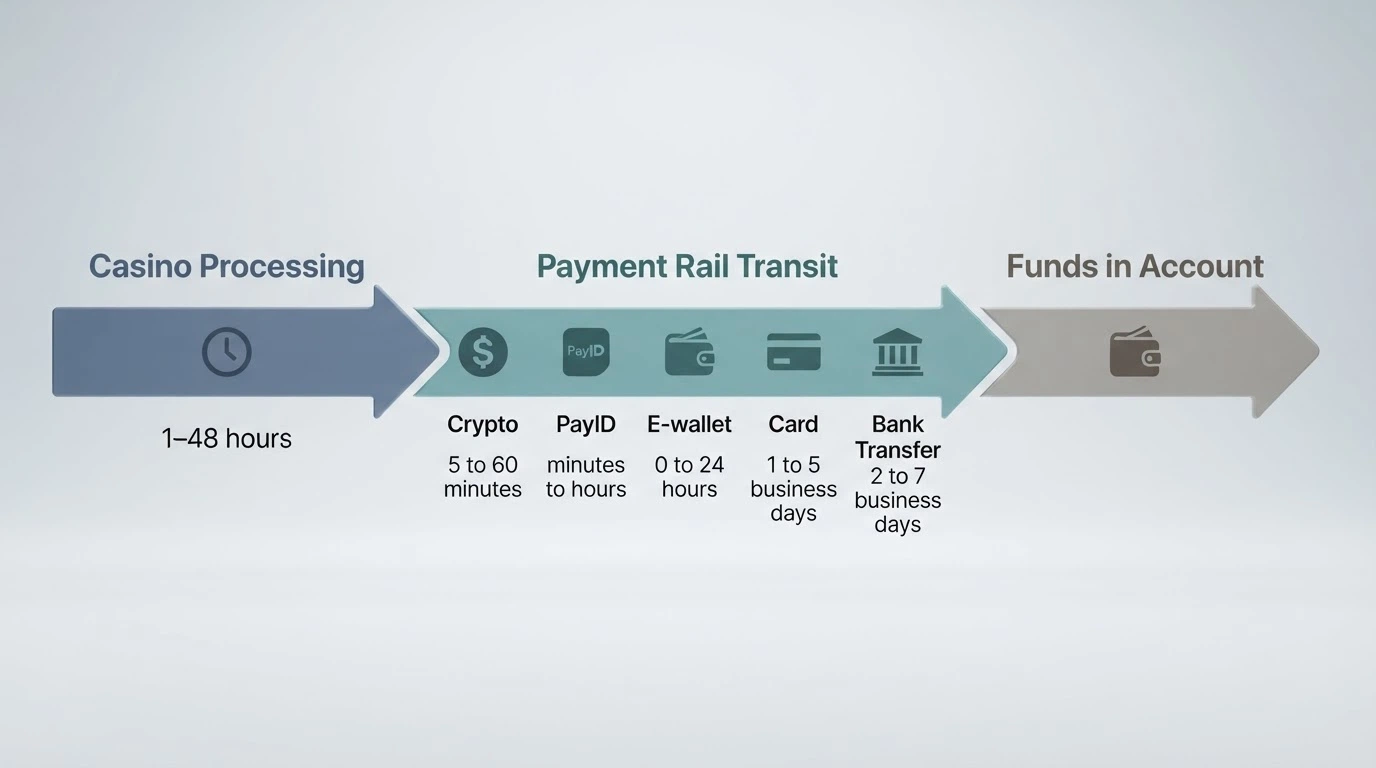
An advertised “24-hour withdrawal” is the casino’s processing time. The full pipeline is three stages: the casino reviews and approves the cashout, the payment rail moves the money, and the player’s bank credits the account. Each stage adds its own time.
Crypto is the fastest end-to-end rail because the casino’s processing window and the blockchain confirmation happen back to back, with the funds in the player’s wallet within the hour. PayID can match it — the 11-minute test at Wild Fortune is real — but only at operators that have wired their PayID withdrawal approval tightly. The 30-hour average across operators reflects the spread: some operators approve in minutes, others in a day.
Card withdrawals lose the race because of the card network and bank settlement. One to five business days is normal, and the casino’s 24-hour processing is the smallest part of the timeline. Bank transfer is slower still, at two to seven business days, because the banking system settles in batches.
The number one cause of withdrawal delays is incomplete KYC. A player who has not verified their account before requesting a cashout will wait while the casino requests documents, the player supplies them, and the casino’s compliance team reviews them. That is a delay measured in days, not hours. Verify the account before the first big bet, and the withdrawal goes through when the rail allows.
Mobile-Initiated Payouts: Same Rails, Different Screen
Requesting a withdrawal from a phone changes nothing about the timeline. The casino’s mobile app and the mobile browser cashier use the same payment rails as the desktop site, and the rail is device-agnostic. What changes is the experience: a push notification when the withdrawal is approved, biometric authentication on the cashier, and a saved-card flow that lets the player confirm a payout with a thumbprint.
Some e-wallets — MuchBetter and MiFinity in particular — are mobile-first products, designed for the app rather than the desktop browser. The player using them on a phone gets the full experience. The player using them on a desktop gets a serviceable web interface that does the same job.
Apple Pay and Google Pay availability at offshore casinos accepting Australians is operator-dependent and not systematically tracked. Where they appear, they are deposit-only in most cases, and they route to the underlying card. They do not accelerate the rail.
Paying From Your Phone: What Changes at a Mobile Casino — and What Doesn’t
The casino fits in a pocket now, but the payment rail does not know that. A player depositing from a phone is using the same PayID, the same Visa debit card, the same Skrill account as on desktop. The mobile interface is a different presentation of the same plumbing, and the difference is in convenience rather than in speed, cost or security.
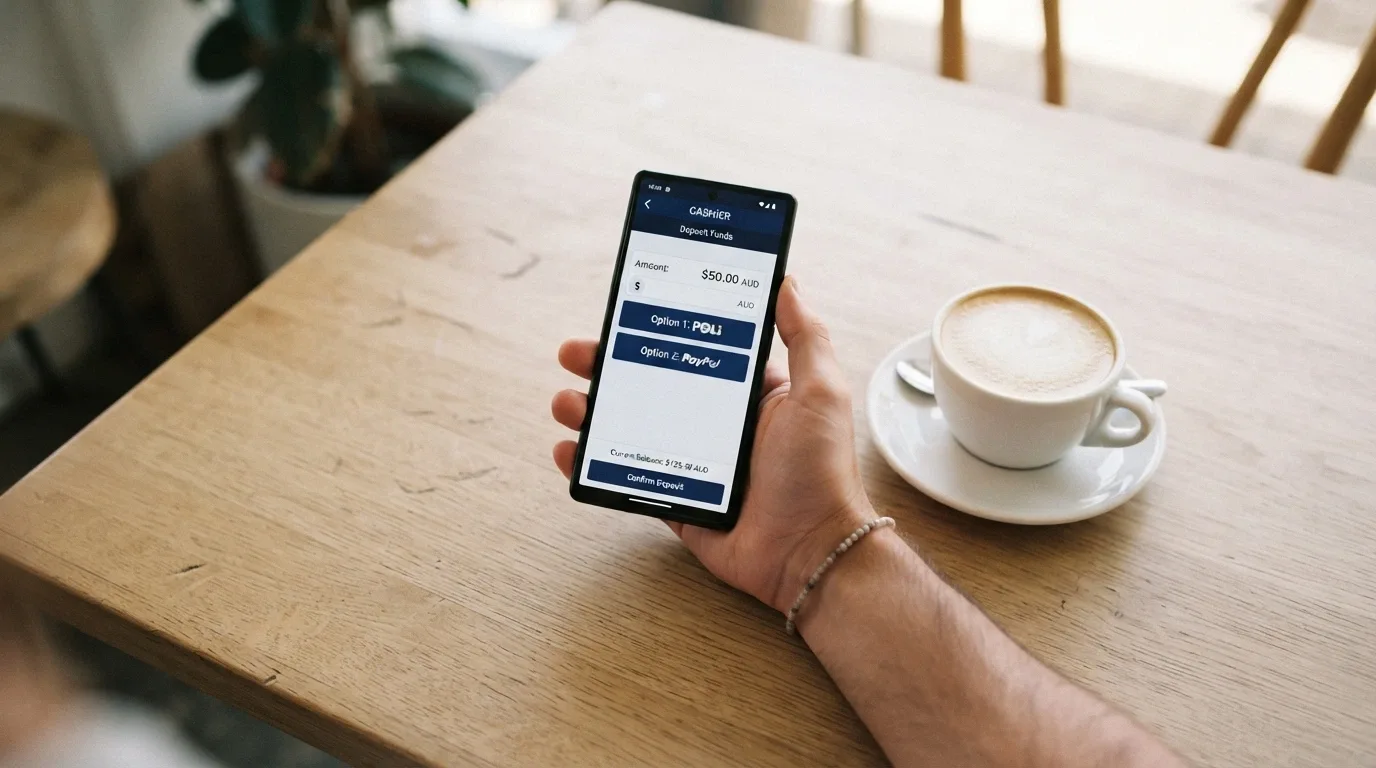
What does change is the saved-payment experience. The mobile casino cashier stores card details in a way that biometric authentication (fingerprint, face) confirms, and the player can move from balance to deposit in two taps. The payment rail is the same. The friction is lower.
Some methods suit mobile better than others. PayID works through the mobile banking app, so a deposit confirmation happens on the player’s phone before the player switches back to the casino. MuchBetter and MiFinity are mobile-first products, with apps designed for in-phone balance checks, push-notification alerts, and biometric login. Cards work everywhere, but the saved-card flow on a casino app is one of the smoother mobile experiences.
What does not change is the protection profile. A mobile deposit is a deposit, and the dispute rights on it are the dispute rights on the underlying method. The phone is a presentation layer. The rail is what governs the player.
Mobile-First Wallets and Apps: MuchBetter, MiFinity and PayID on the Go
MuchBetter and MiFinity are the mobile-native e-wallets on this list. Both are designed around an app-first experience: biometric login, in-app balance display, push-notification transaction alerts, and a flow that assumes the player is checking on a phone rather than a laptop. On desktop, they work, but they feel like a phone product shrunk to a bigger screen. The UX gap between MuchBetter or MiFinity and a desktop-era method is real, and it shows up in how often the player reaches for the app.
PayID works through the mobile banking app the player already has. The deposit confirmation happens there, in the bank’s own interface, before the player switches back to the casino. The casino cashier does not display a PayID screen at all — the player is told “deposit via PayID to this alias”, opens their banking app, sends the money, and the casino balance updates within seconds. The UX is split across two apps rather than living in one. For an Australian player used to mobile banking, it is natural. For a player whose bank does not have a strong mobile app, it is more friction than it looks.
Is Your Casino Payment Legal? The Australian Regulatory Reality in 2026
The legal picture for an Australian player using an offshore casino is uncomfortable but unambiguous. The Interactive Gambling Act 2001 prohibits the provider from offering online casino games, online pokies and in-play sports betting to anyone in Australia. There is no Australian online casino licence — not federally, not in any state or territory. The licensed product is pre-event sports and race wagering, lotteries, and keno. A casino accepting Australian players is, by definition, operating outside the Australian regulatory perimeter.

The IGA targets the provider, not the individual player. An Australian using an offshore casino is not prosecuted. But the player has no Australian consumer protection, no BetStop coverage, and no recourse if the operator refuses a withdrawal or closes the site. The ACMA has had 1,564 illegal gambling and affiliate websites blocked by Australian ISPs since November 2019, and more than 225 illegal services have withdrawn from the Australian market since 2017. The enforcement is real, and the site a player uses today can be on the blocked list tomorrow.
Licensed AU Wagering vs Offshore Casino: The Payment Rail Tells the Story
The payment menu at a licensed Australian wagering operator is fixed by the regulator. The payment menu at an offshore casino reflects what the operator can route. The difference is informative.
| Payment Rail | Licensed AU Wagering | Offshore Casino | Player Protections |
|---|---|---|---|
| PayID / Osko | Yes | Yes | Bank dispute process |
| Debit Visa / MC | Yes | Yes | Chargeback |
| Credit Card | Banned since June 2024 | Sometimes accepted | Chargeback (limited) |
| Bank Transfer | Yes | Yes | Bank dispute process |
| BPAY | Yes | Rare | Limited |
| Crypto | Banned since June 2024 | Yes | None — irreversible |
| PayPal | Rarely | Limited | Internal dispute process |
| Skrill / Neteller | Rarely | Yes | Limited wallet dispute |
| Neosurf | No | Yes | None (deposit-only) |
| POLi | N/A — decommissioned Sept 2023 | No | N/A |
A cashier offering credit cards or crypto is an offshore signal. Both are banned for licensed wagering since 11 June 2024, with penalties of up to A$247,500 for non-compliant operators. The ban does not apply offshore — the operator is not licensed in Australia — but the presence of either rail in the cashier is the clearest indicator that the casino is outside the Australian rules.
The honest answer to “is this casino licensed in Australia?” is, for online casino games and pokies, “no, because that licence does not exist”. The licensed options are sports and race wagering, lotteries and keno. Anything calling itself a casino and accepting Australians is operating from an offshore licence — most commonly Curaçao, Malta (MGA) or Kahnawake — none of which grants Australian consumer protection.
What the 2026 Reform Means for Your Casino Deposits From January 2027
The Interactive Gambling Amendment (Gambling Reform) Bill 2026 passed Parliament on 19 August 2026, and its measures commence on 1 January 2027. The provisions relevant to payments are the ones that give banks and payment providers express authority to block transactions to illegal gambling operators.
In practice, this means an Australian bank can refuse a transaction to an offshore casino without the player having any recourse. The current state — where banks decline MCC 7995 transactions inconsistently and without explanation — becomes an explicit, statutory authority rather than a discretionary block. A player whose bank decides the deposit should not go through will see the transaction fail, and the appeal process is thin.
The reform also tightens advertising and inducement restrictions. Direct marketing of welcome offers is prohibited for 14 days after sign-up, for three months after BetStop deregistration, and indefinitely for at-risk customers. The “free spins just for joining” emails and SMS messages that an offshore casino sends to an Australian are, from January 2027, an offence the operator commits at the player’s address.
The bettor’s practical exposure is the bank block. Players who have been using offshore casinos without issue will find, in 2026, that some transactions they used to make no longer go through. The cashier still shows the method. The bank refuses the credit. The player has to find a rail the bank will accept, and that rail may be the same one used to fail.
Safe Payment Methods: What “Safe” Actually Means When the Casino Is Offshore
Every payment method uses encryption. That is not the differentiator. What is different is what happens after something goes wrong.
A debit or credit card carries a chargeback right. The card network will arbitrate a dispute if the merchant fails to deliver the goods or service. For an offshore casino that refuses a withdrawal, a chargeback is the player’s most powerful external lever, and it is available regardless of whether the operator is licensed. The chargeback right exists on the network, not in the casino’s terms.
E-wallets carry a thinner internal dispute process. The wallet operator will investigate a complaint, but the process is the wallet’s own, and the wallet has a commercial relationship with the casino. The leverage is real but softer than a card network’s.
Crypto carries no dispute process at all. A confirmed transaction on the blockchain is irreversible, and there is no third party to escalate to. If the operator refuses the withdrawal, the player has lost the funds.
Bank transfers cannot be reversed once confirmed. The only dispute available is with the player’s own bank, and the bank has no obligation to escalate to the casino.
The practical step for an Australian player is to use a method that carries external dispute rights for any deposit the player is not willing to lose outright. A combination — PayID for fast deposits, a debit card for the dispute-protected play, crypto for the high-speed withdrawals — covers the bases better than any single method. The player who uses only crypto is the player with the fastest rail and the weakest recourse.
Responsible Gambling Tools That Still Work — Even From an Offshore Casino
The responsible-gambling infrastructure that licensed Australian wagering is built on does not reach offshore casinos. BetStop — the National Self-Exclusion Register, run by the ACMA — binds licensed Australian wagering services only. Offshore casinos are not connected to it. The 67,480 registrations since BetStop’s launch in August 2023 through 31 July 2026 — with 41,290 exclusions still active — represent real numbers of Australians who have chosen to lock themselves out, but the lock works only at the operators the register covers. An offshore casino will keep accepting a self-excluded player’s money without flag, because the operator has no connection to the register at all.
What does still work is the player’s own infrastructure. The National Gambling Helpline (1800 858 858) is free, confidential and staffed 24 hours a day. Gambling Help Online runs free 24/7 chat and email counselling. The helpline is the entry point a self-excluded person can actually use, regardless of which operators have or have not been told.
The data is worth keeping in view. About 2.1% of Australian adults — roughly 430,000 people — experience problem gambling. The Australian Institute of Health and Welfare put high-risk gambling at 1.8% in 2022. Of the 67,480 BetStop registrants through 31 July 2026, 78% were under 40, and 38% chose lifetime exclusion. The infrastructure is real, the demand for it is real, and the offshore casino gap is the part that the registered infrastructure does not cover.
How to Set Your Own Deposit Limits When the Casino Won’t
Licensed Australian wagering operators enforce customer-set deposit limits as part of their licence conditions. Offshore casinos do not. The player’s only limit-setting tools, at an offshore site, are the ones the player builds around the payment method itself.
Neosurf is the cleanest example. The voucher value is the deposit, and the deposit is the limit. A player who wants to cap a Saturday session at A$100 buys a A$100 Neosurf voucher, deposits it, and the rail does not allow a dollar more that day. No casino setting, no operator approval, no willpower required — the rail enforces it.
PayID works the same way at the bank level. The bank’s daily PayID transfer cap — usually A$1,000 to A$10,000 — sits on top of whatever the casino offers. A player who wants to enforce a hard A$200 daily cap can ask their bank to set the PayID daily limit at A$200, and the casino’s higher ceiling becomes irrelevant. The bank is the limit-setter, not the casino.
E-wallet self-imposed limits work in the same direction. Skrill, Neteller, MuchBetter and MiFinity all allow the account holder to set their own transaction or daily caps. The setting lives on the wallet, not the casino, so it applies to every site the wallet is used at, including offshore ones the wallet operator may not even know the player uses.
The card-side equivalent is the issuing bank’s daily card limit. Most Australian banks allow customers to set or lower the daily purchase limit on a debit card through the banking app. The setting lives on the card, so the cap travels with the card to every merchant, and the casino has no way around it.
The offshore casino will not enforce a limit on the player’s behalf. The payment method will. That is the trade-off the licensed vs offshore difference makes concrete.
How We Evaluated and Ranked These Payment Methods
The ranking on this page was built on six criteria, weighted by their practical importance to an Australian player using an offshore casino.
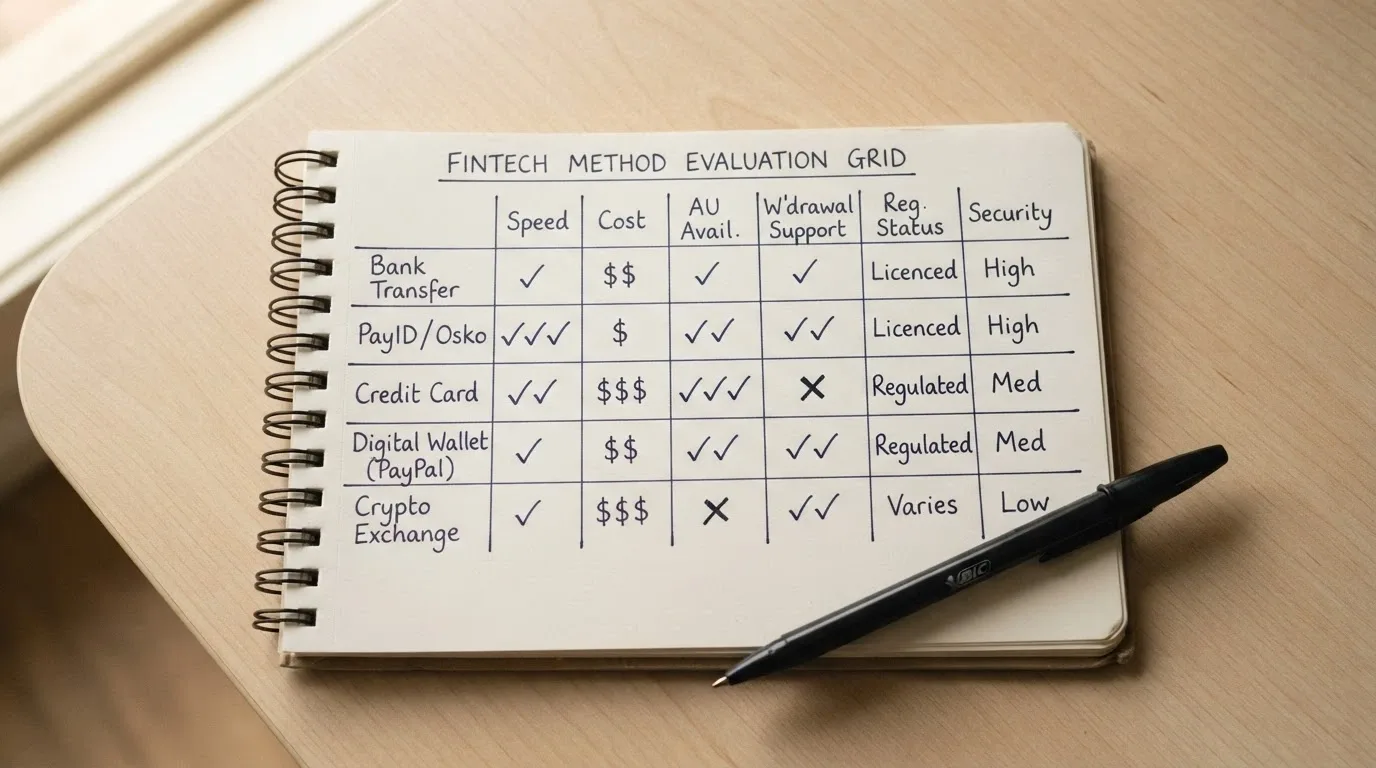
First, AU availability — whether the method works at all for an Australian player, accounting for bank support, currency support and the operator’s own acceptance list. Second, deposit speed — instant or near-instant beats multi-day on a method a player will use repeatedly. Third, withdrawal speed — and here the casino processing window is separated from the rail transit time, because a fast rail with a slow operator is still slow. Fourth, player cost — combining the casino-side fees, the wallet or card-side fees, and the network fees where they apply, so that two methods that look the same on the surface but cost different amounts across a full round trip are distinguished. Fifth, withdrawal support — a deposit-only method is a smaller tool than one that handles both directions. Sixth, AU licensed-wagering status — a method that works at the TAB and Sportsbet is more useful than one that does not, and the absence of that capability tells the player something about the rail.
Sources: per-method data was drawn from operator cashier tests published by Payoutverdict.com, Betsquare.org, Australiangamblers.com and newcasino.ai, cross-referenced against each wallet operator’s own published fee schedule (Skrill July 2026, Neteller August 2026, PayPal, MuchBetter, MiFinity). Regulatory figures came from the ACMA register and the AU regulation skill’s compilation of IGA text, the 2024 credit-and-crypto ban, the 2026 reform bill, and ACMA blocking data. The 2024 ban and the 2026 reform are public statute, and the ACMA figures were verified against the agency’s published data in mid-2026.
What the ranking does not do. It does not weight welcome bonuses, which vary by operator and turn over quickly. It does not weight country-specific loyalty programs, which require account-level data the player has to evaluate for themselves. And it does not claim that any single method is “best” — the right method for a player depositing A$20 a session is not the right method for one moving A$10,000 a month. The ranking orders by the data the page has, not by the player’s situation.
The ranking reflects the data available as of mid-2026. Operator cashier menus change. A method that is broadly accepted today may be removed by a major operator tomorrow; a method that is not in the cashier today may be added next month. The table is a snapshot, not a forecast.
Your Payment Method Is the Decision That Outlasts Every Bonus — Choose It First
Bonuses come and go. Welcome offers rotate, free-spin packages shift, deposit-match percentages rise and fall. An offshore casino that advertises a 200% first deposit bonus in 2026 may advertise something different in six months, and may not exist in twelve. The bonus is the marketing. The payment method is the plumbing, and the plumbing is what determines what a player pays, what they wait through, and what they keep when something goes wrong.
The argument this page has been building is that the right way to pick a casino, for an Australian player, is to pick a payment method first. The method the player can live with day after day — fast enough on deposits to be friction-free, fast enough on withdrawals to be useful, cheap enough that the fees do not eat the bankroll, and protected enough that a refusal or a disappearance does not cost the player everything — is a smaller set than the method any single cashier offers. PayID for the speed. A debit card for the chargeback. Crypto for the bigger withdrawals. Each of those rails carries a known cost and a known protection profile.
The licensed Australian wagering market offers AFCA, BetStop, state regulators and mandatory deposit limits. The offshore casino market offers the payment method’s dispute process and nothing else. That is the trade-off the IGA has created, and it is the trade-off every Australian player at an offshore casino is making by the act of depositing. The right payment method does not fix the trade-off. It gives the player a way to live with it.
If gambling is starting to feel less like entertainment and more like a problem, the National Gambling Helpline is 1800 858 858 — free, confidential and available 24 hours a day. Gambling Help Online (gamblinghelponline.org.au) runs free 24/7 chat and email counselling. Offshore casinos will not connect a player to either service. The player’s own phone will.
Frequently Asked Questions
What is the fastest payment method for online casino deposits and withdrawals in Australia?
Crypto is the fastest withdrawal method at every offshore operator tested in 2026 — Bitcoin confirmation in 10 to 30 minutes, Ethereum in 5 to 15, and funds in the player’s wallet within the hour after casino approval. PayID can match it, with one operator clearing an A$250 withdrawal in 11 minutes, though the average across operators is closer to 30 hours. E-wallets (PayPal, Skrill, Neteller, MuchBetter, MiFinity) clear same-day to within 24 hours. Crypto and PayID both deposit in under a minute.
Why was my credit card declined at an online casino in Australia?
Most often because the transaction was coded to gambling merchant category 7995, and the issuing bank declined it. Australian banks can refuse MCC 7995 transactions without warning and without explanation, at any point in the deposit or withdrawal flow. Credit cards are also banned for licensed Australian online wagering since 11 June 2024, so a credit card offer in a casino cashier is itself an offshore signal. A different card, an e-wallet, PayID, or crypto usually clears where a flagged debit card stalls.
What is KYC verification and why do online casinos require it before paying out?
KYC — Know Your Customer — is the identity check an operator runs before processing a first withdrawal: a government photo ID, proof of address, and sometimes proof of the payment method itself. It exists to meet anti-money-laundering and counter-terrorism-financing law, which applies to licensed operators and which offshore operators adopt because their own licences require it. Incomplete KYC is the number one cause of withdrawal delays. Verifying the account before a big bet, rather than at the cashout, is the fix.
Is POLi still available as a casino payment method in Australia?
No. ANZ decommissioned POLi on 30 September 2023, and it is no longer available at any casino. Reviews that still list POLi as a current payment method are out of date. PayID, which runs over the New Payments Platform, has filled the gap that POLi left for instant AU bank-to-account deposits, and it is the local rail to use at offshore casinos accepting Australians in 2026.
What happens to my money if an offshore casino blocks my account?
If the operator refuses a withdrawal after the account is blocked, the player has whatever dispute rights the payment method itself allows. A debit or credit card carries a chargeback right through the card network — the strongest lever available. E-wallets carry a thinner internal dispute process. Crypto and confirmed bank transfers carry none — once the transaction is on the blockchain or confirmed by the bank, the funds are gone. Offshore casinos are not covered by AFCA, the ACMA, or any Australian ombudsman. The payment method is the only escalation path.
Is PayID safe to use at online casinos in Australia?
PayID uses the player’s own bank’s authentication, which is the most secure payment flow available in Australia. Deposits arrive in under 60 seconds, and the rail itself does not weaken the player’s position. What it does not do is override the operator’s withdrawal behaviour — if the casino refuses to pay out, PayID cannot force the operator’s hand. The rail is safe. The operator may not be. Verify the account before depositing, pick an operator with a verifiable withdrawal track record, and treat PayID as the fast lane, not as insurance.
Prepared by the Microgaming Casinos AU editorial staff.