
Live Casinos Online in Australia — and Why Every Operator Sits Offshore
 Available in AU
Finding the best live casino online in Australia is straightforward in one sense — there are ten platforms that dominate what the market actually is — and uncomfortable in another. Every one of them sits outside the country. The Interactive Gambling Act 2001 makes it an offence to provide an online casino to a person in Australia, so the product does not exist inside the licensed system. What does exist is a market, fed by offshore operators, where Australian players fund accounts and play real-money tables with real dealers streamed from studios in Malta, Latvia, the Philippines and beyond. This page ranks those operators by market presence, explains what the live-dealer format actually delivers, and lays out the legal and financial machinery a player is stepping into. It does not pretend any of that machinery is settled.
Data current as of 18 October 2026 and cross-checked against the ACMA register of blocked services, BetStop registration statistics, and Australian Communications and Media Authority enforcement records.
Table of Contents
- What a Live Casino Actually Is — and Why Australian Players Use Offshore Sites
- The Top Live Casino Sites Accepting Australian Players in 2026
- Rocket Play
- Skycrown
- Royal Reels
- WinSpirit
- Stake
- Rainbet
- Scream Casino
- FairGO
- Bizzo Casino
- Rocket Casino
- Live Dealer Games That Actually Work for Australian Players
- Why Your Live Casino Bonus Is Smaller Than It Looks
- Playing Live Dealer Tables on Your Phone: What Australian Mobile Casinos Actually Deliver
- Free Live Casino Games: The Demo Mode Australian Sites Actually Offer
- Why Every Live Casino Australian Players Use Sits Offshore
- Staying in Control: Responsible-Gambling Tools Every Australian Live-Casino Player Should Know
- How We Picked and Ranked These Live Casinos
- What Australian Live-Casino Players Should Actually Do in 2026
- Frequently Asked Questions
What a Live Casino Actually Is — and Why Australian Players Use Offshore Sites
What a live casino is — and what it is not
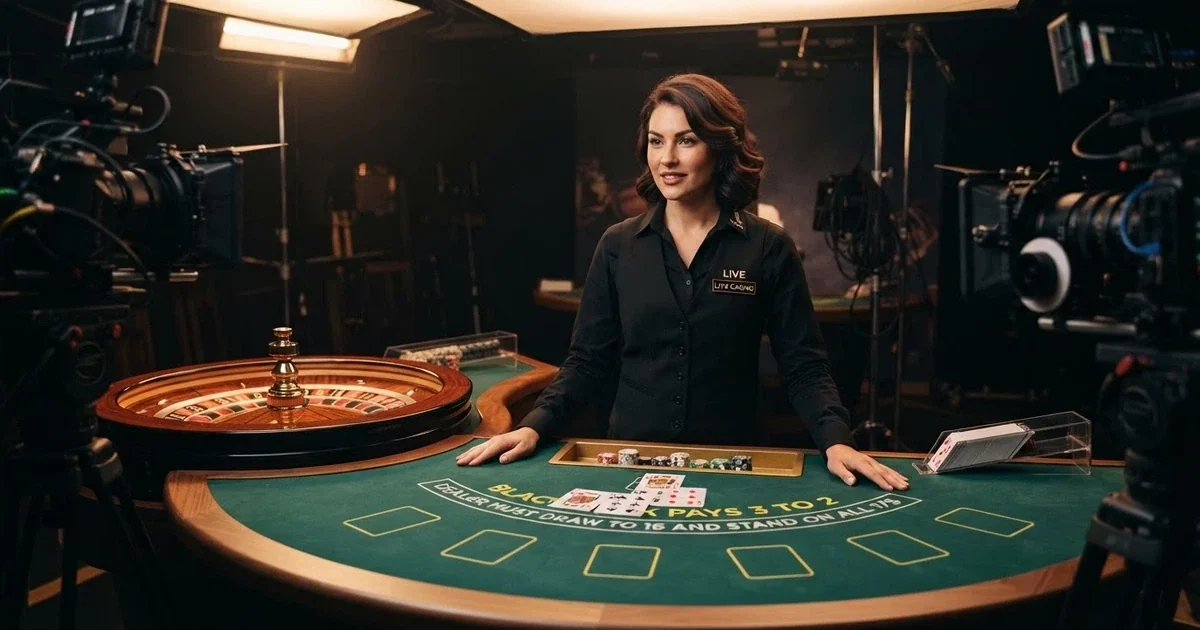
A live casino is a streaming product that turns a physical table game into an interface a player interacts with from home. There is a real dealer, in a real studio, dealing real cards or spinning a real wheel, and the result reaches the player through a video feed in real time. What it is not, despite what the marketing tends to imply, is a slot machine dressed up as a table. The pace, the social texture and the way a hand resolves are all physical events the technology is recording, not generating.
The standard online casino equivalent is a table game built on a random number generator, where the cards come out of code and the “dealer” is a graphical stand-in. The visual is similar; the engine is not. The player’s decision-making is the same, but the trust mechanism is different — one rests on the integrity of a certified RNG and the house edge built into it, the other on camera, on optical-recognition software reading physical cards, and on the studio behind the table.
How a live dealer hand actually runs, from bet to payout
The mechanics of a single round are worth knowing before picking a site, because they explain why some streams feel responsive and others feel laggy. The player clicks a chip on the digital layout to place a bet, the dealer acknowledges the round, the cards come out of a shoe or the wheel spins, and small cameras around the table capture the result. Optical character recognition software reads the cards or the winning number and pushes the outcome to every player’s screen within a second or two. Payouts land in the balance automatically — no dealer leans over and pushes chips, the way they would at a brick-and-mortar casino, because the screen is doing the math.
Latency between bet and result is the variable that separates studios. Low-latency feeds feel like a table the player is at. Higher-latency feeds feel like a stream the player is watching. Most modern studios run multiple camera angles, side-bet displays and chat windows where the player can talk to the dealer, and the better ones have done enough that the experience genuinely resembles a small casino floor rather than a television broadcast.
The live game menu: blackjack, roulette, baccarat and beyond
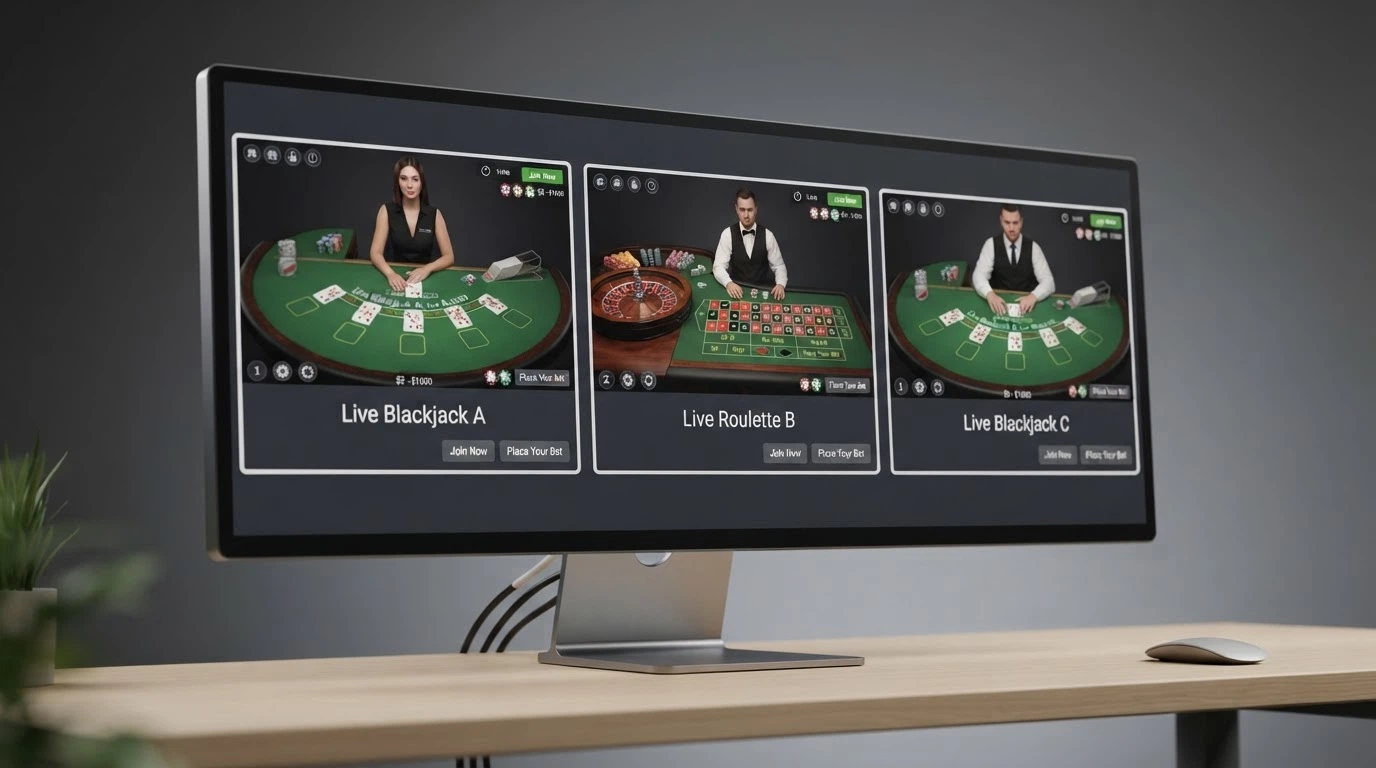
Every live casino lobby accepting Australian players is anchored by the same three games: blackjack, roulette and baccarat. Live blackjack is the highest-volume table in most lobbies, with standard seven-seat tables running alongside infinite-seat formats that let any number of players bet the same hand. Live roulette splits between European single-zero wheels and the higher-tempo auto-roulette variants that have no dealer downtime. Live baccarat is where the higher-stakes money tends to gather, with squeeze variants and speed baccarat sitting alongside the standard table.
One tier below the classics sit poker variants — Casino Hold’em, Three Card Poker, Caribbean Stud — plus Sic Bo and Dragon Tiger as the Asian-table mainstays. The newest tier is the game-show format, where a presenter runs a wheel-spin or a money-wheel game with bonus rounds, and the boundary with television entertainment starts to blur. Lobbies are usually organised by game family, then by stake level, then by variant, and the better ones let a player favourite a specific table so it appears at the top of the lobby next time.
Real-money play vs fun mode: what changes when you log in
The difference between browsing a live casino lobby and playing one is the same as it is at any online casino: a registered account, an authenticated login, and a funded balance. Some operators let a player observe a live table without an account, in a sort of spectator mode, but the moment a bet is placed the game shifts to real-money rules. Live tables are not the place to find demo modes — most studios restrict demos to RNG table games, because an empty seat is wasted revenue and a deck reshuffled for free play is not the same deck reshuffled for cash.
A small number of operators offer free-play credits to new sign-ups, and a few studios run a “fun mode” for selected tables where the bet is pretend and the result is pretend. Neither replaces the real-money experience, and both tend to be time-limited. The honest answer to “can I try before I deposit” at most live casinos is: not really. Your first hand is almost always a hand played with real money.
The Top Live Casino Sites Accepting Australian Players in 2026
How the ranking works: criteria at a glance
The list below is ordered by market presence among Australian players — by traffic and revenue share across the offshore operators that actively target the country. Market share is the cleanest single signal of which operators are actually delivering what Australian live-casino players want, week after week, in a market where none of them is licensed and all of them carry the same legal exposure. The ranking is ordinal — Rocket Play holds the largest slice, Skycrown the second — and the percentages are slices of one market, not absolute volume.
What the ranking deliberately does not measure is bonus value, game-provider count or payout speed. Live-data sourcing for per-operator bonuses, wagering requirements and provider lists was not available this review, and a rank inflated with invented specifications would have been worse than no rank at all. Where a per-operator figure is missing on this page, the section in question says so plainly, and the methodology section later in the article sets out the rules in full.
What separates a strong live-dealer casino from the rest
Market share tells a player where the existing player base has settled. It does not tell a player which site will suit them, because the player choosing a site cares about things that market share does not directly measure: how cleanly the stream runs on the network they actually use, how the dealer sounds in the language they prefer, whether AUD deposits clear without a conversion fee, and whether withdrawal requests go through on a Tuesday as reliably as they do on a Saturday. Stream quality and studio professionalism are the two characteristics that determine whether a player comes back after the first session. Table variety and seat availability matter when a player has a preferred game. The operator’s payment routes matter most when the player wants to move money in or out without friction. And the operator’s track record with Australian players matters when something goes wrong, because dispute resolution with an offshore operator is a slower and less certain process than it would be with a locally licensed one.
| Live Casino | Market Share | Status in Australia |
|---|---|---|
| Rocket Play | 9.4% | Offshore, unlicensed in AU |
| Skycrown | 8.55% | Offshore, unlicensed in AU |
| Royal Reels | 2.51% | Offshore, unlicensed in AU |
| WinSpirit | 1.55% | Offshore, unlicensed in AU |
| Stake | 1.28% | Offshore, unlicensed in AU |
| Rainbet | 1.28% | Offshore, unlicensed in AU |
| Scream Casino | 0.99% | Offshore, unlicensed in AU |
| FairGO | 0.8% | Offshore, unlicensed in AU |
| Bizzo Casino | 0.57% | Offshore, unlicensed in AU |
| Rocket Casino | 0.57% | Offshore, unlicensed in AU |
Rocket Play
Rocket Play sits at the top of the Australian live-casino market by a meaningful margin. Nine point four per cent of the country’s live-casino traffic runs through the platform — close to one in ten players and almost double the share of the next-largest operator. That is the headline figure, and the figure alone says something the marketing cannot: Australian players have voted with their deposits, and the votes have concentrated at this operator. The platform sits offshore and unlicensed in Australia, like every operator on this list, and it operates under whatever licence it holds in its home jurisdiction rather than under the Interactive Gambling Act, because the IGA does not permit the activity it runs.
What the public data does not reveal is the structure behind that 9.4%. The figure measures where players landed, not why they landed. Live-dealer product breadth, stream quality and the operator’s payout history with Australian players all sit behind the number, and no per-operator data on those points was available this review at the level of specification comparison pages usually print. The gap is a real one. What is not in doubt is that an operator holding that much of a market is doing something that compounds — a brand-recognition feedback loop where players who have already chosen Rocket Play tell new players about it, and new players land on a platform that already has a full lobby to play on.
If the player is starting from zero today, Rocket Play is the brand to test against first — the depth of liquidity in its live tables, the speed of its stream and the reliability of its AUD payout route are the benchmarks the rest of the list will be judged by. If those do not match what the player wants, the closer alternatives are obvious.
Skycrown
Skycrown is the operator that sits eight and a half per cent behind Rocket Play in the same market, and the gap matters more than it looks. Eight point five five per cent is not the share of a fringe operator — it is the share of a player base large enough to keep dozens of live tables running around the clock — but it is still almost a full percentage point clear of the third-placed operator, which suggests the top two are competing for the same player profile rather than serving two distinct customer groups.
Like every operator on this list, Skycrown sits offshore and unlicensed in Australia. The licensing it does hold sits in whatever jurisdiction the operator is registered in, and the regulatory framework that applies to a player dispute is not the ACMA. What a player gives up by playing here rather than at a domestically licensed sports or wagering bookmaker is the Australian recourse layer — and what a player gets in exchange is a live-casino product no domestically licensed bookmaker is allowed to provide.
Skycrown and Rocket Play sit close enough that the deciding factor between them usually comes down to a per-player preference the market-share figure does not speak to: a payment method that works at one and not the other, a stream that runs cleaner on a particular network, a welcome offer that looks more useful. The player gets the same category of product at both. The deciding factor lives outside the figures on this page.
Royal Reels
Royal Reels holds two point five one per cent of the Australian live-casino market — a meaningful share, but less than a third of what Skycrown holds, and the gap to the leader is wider than the gap between any two of the smaller operators below it. The market is not flat: it is sharply weighted at the top, with two operators holding roughly a fifth of it between them, and a long tail of platforms sharing the rest.
Royal Reels is offshore and unlicensed in Australia. The operator’s specific live-dealer product offering was not available at the per-title level this review, and the same gap applies to its welcome offer, wagering requirements and provider mix. What the share figure indicates is that an Australian live-casino player does not need to be at one of the two largest operators to find a populated lobby — Royal Reels sits in a tier where the casino has enough Australian revenue to staff its tables around the clock, and where the player experience is unlikely to feel emptier than the bigger brands.
If Rocket Play and Skycrown do not fit, this is the tier where the player should look next. Royal Reels is in this tier rather than at the bottom because the share it holds is roughly the difference between an operator with a full lobby and one with a half-empty one at off-peak Australian hours.
WinSpirit
WinSpirit is at one point five five per cent of the Australian market — a smaller share than Royal Reels but still well above the sub-1% operators further down the list. The trajectory implied by that share, more than the share itself, is what makes the operator worth watching: a brand at this slice of the market is one that has been adding Australian players faster than its peer group has, and the live-casino product is presumably part of why.
WinSpirit is offshore and unlicensed in Australia. Like every other operator on this list, its welcome offer, wagering structure and game-provider mix were not available at the per-operator level this review, and the operator is described here in qualitative terms for that reason. The player evaluating WinSpirit against the operators above it is essentially deciding whether the platform’s stream quality, payment routes and lobby composition fit them better than the bigger brands — a decision the market-share figure does not speak to directly.
One-and-a-half per cent is the share of a brand that has cleared the threshold where its tables run reliably at Australian evening hours, but that has not yet reached the brand-recognition tier where new players find it without an introduction. That positioning suits a player who has already heard about WinSpirit through word-of-mouth or through an affiliate review, and who is comparing it against the bigger operators rather than browsing for the first time.
Stake
Stake holds one point two eight per cent of the Australian live-casino segment, putting it in the same tier as Rainbet. What separates Stake from the smaller operators in the list is its international profile: the brand is one of the largest crypto-first casino and sportsbook operators in the world, and its Australian market share is a slice of a global player base rather than a slice of a primarily Australian customer base. That distinction shapes the experience in measurable ways.
Stake is offshore and unlicensed in Australia. Its broader international presence means its live-dealer product typically runs the Evolution and Pragmatic Play Live studios at full depth, because the platform’s global volume supports a fully populated lobby around the clock. The Australia-specific concern is whether a player’s AUD deposit route and AUD withdrawal route work as cleanly as they would at a smaller operator that has built its payment stack specifically for the Australian market — and no per-route reliability data was confirmed at the level of specification this page usually prints.
What a player gets at Stake that is harder to find at smaller operators is the depth of a fully populated Evolution and Pragmatic Play Live lobby. Stake is a strong choice for a player who values a globally recognised brand and a deep live-casino product, and it carries the same offshore-and-unlicensed profile as every other operator on this list.
Rainbet
Rainbet is tied with Stake at one point two eight per cent of the Australian market, and that parity is the most interesting thing about it. A smaller platform holding the same share as Stake means Rainbet is punching above what its global brand recognition would predict — the operator’s Australian player base is dense enough, relative to its overall size, that it ranks alongside a brand most Australians have heard of.
Rainbet is offshore and unlicensed in Australia. Its specific live-dealer product details, bonus structure and provider mix were not available this review, and the operator’s write-up is qualitative for that reason. What the market-share figure does say is that the platform has enough Australian volume to staff its live tables at peak hours, and that a player signing up is unlikely to find an empty lobby during Australian evening sessions.
Whether Rainbet holds its current share once the new payment-blocking rules take effect on 1 January 2027 is the open question for this tier of operators. A smaller operator with a less diversified payment stack is more exposed to a rule that lets banks refuse transactions to illegal operators, and the next twelve months will show whether Rainbet’s AUD routing holds up.
Scream Casino
Scream Casino sits just below one per cent of the Australian market, at zero point nine nine per cent — the first operator on the list that falls into the sub-1% tier. The drop from one point two eight per cent at Stake and Rainbet to zero point nine nine per cent is not dramatic in numerical terms, but it puts Scream Casino in a tier where the live-dealer lobby is populated by fewer Australian players, and where off-peak hours are more likely to see empty seats.
Scream Casino is offshore and unlicensed in Australia. The operator’s specific live-casino product offering was not available this review at the level of per-provider detail, and the write-up is qualitative on those points. The market-share figure places the brand in the bottom half of the top ten, which is still a meaningful slice of a market that runs to roughly thirty offshore operators actively targeting Australia, but it is also a tier where the player experience depends more on the studio feeds the operator has integrated than on the operator’s own branding.
Scream Casino’s sub-1% share puts it at the thinnest tier of the top ten — a functional live-dealer lobby, but emptier at off-peak Australian hours than the brands above. A player choosing it is choosing a specific preference over a deeper lobby at a higher-ranked operator.
FairGO
FairGO is positioned at zero point eight per cent of the Australian market, with a brand name that reads as a play on Australian colloquialisms. The brand positions itself as Australian-facing in a way the international operators do not — the name, the visual identity and the marketing copy are pitched at local sensibilities, and that positioning has clearly resonated with a slice of the Australian player base.
FairGO is offshore and unlicensed in Australia, and the Australian-facing positioning does not change the legal status of the platform. Like every operator on this list, FairGO does not hold an Australian online-casino licence, because none exists. What the Australian-facing branding does signal is a payment stack and a customer-service layer built around AUD and Australian banking hours — exactly what a player who does not want to deal with currency conversion or offshore time zones is looking for.
FairGO’s live-dealer product specifics were not available this review at the per-provider level, and the write-up cannot speak to the depth of the studio integration or the lobby composition. An Australian-tuned payment stack and customer-service layer is what FairGO is selling, and the brand name is part of the pitch.
Bizzo Casino
Bizzo Casino holds zero point five seven per cent of the Australian market — tied with Rocket Casino at the bottom of the top ten, and the lowest share on this list. The gap between Bizzo Casino and FairGO, immediately above it, is roughly thirty per cent of the share — meaningful, but not the gap between the top two and the rest of the field, which was much wider.
Bizzo Casino is offshore and unlicensed in Australia. Its specific live-dealer offering — providers, table variants, stake ranges — was not available at the per-operator level this review, and the write-up is qualitative for that reason. At a sub-1% market share, the live-dealer lobby is likely to be thinner than at the operators higher up the list, particularly during off-peak Australian hours when the platform’s player pool is smaller.
At the bottom of the top ten, Bizzo Casino offers the same offshore category as the rest of the list and the thinnest lobby of the ten. A player who has found a specific reason to prefer Bizzo over the bigger operators — a payment route, a particular game, a marketing-offer structure — has a coherent reason to choose it; a player browsing the bottom of the top ten against the operators above is choosing on dimensions the market-share figure does not measure.
Rocket Casino
Rocket Casino closes the top ten at zero point five seven per cent of the Australian market — the same share as Bizzo Casino, and the smallest slice on the list. The name similarity to Rocket Play, the market leader at nine point four per cent, is a coincidence an Australian player searching the web should be aware of, because the two platforms are not related and do not share a brand, a licence or a player pool.
Rocket Casino is offshore and unlicensed in Australia. Its specific live-dealer product details were not available at the per-operator level this review, and the write-up is qualitative for that reason. At zero point five seven per cent, the platform sits in the thinnest tier of the top ten — the live-dealer lobby is functional, but the player pool is small enough that off-peak hours may show empty seats, particularly for specialist variants rather than the core three.
Rocket Casino is not the same brand as Rocket Play, and the similarity stops at the name. A player choosing Rocket Casino is making a per-player decision the market-share figure does not speak to — a payment route, a particular variant, a marketing-offer structure — and accepting that the lobby will be thinner at off-peak Australian hours than at the top of the list.
Live Dealer Games That Actually Work for Australian Players
Live blackjack, roulette and baccarat: the table classics
Blackjack, roulette and baccarat anchor every live casino lobby accepting Australian players, and the depth of the offering in each of the three is what separates a populated lobby from a thin one. Live blackjack is the highest-volume table: standard seven-seat tables run alongside infinite-seat formats that let any number of players bet the same hand, and side-bets — perfect pairs, 21+3, bet behind — are standard. Live roulette splits between European single-zero wheels, which offer the lower house edge, and the higher-tempo auto-roulette variants where a real wheel spins but no dealer downtime slows the round. Live baccarat sits at the higher stake end of the lobby, with squeeze variants and speed baccarat giving a player who likes a fast game a reason to keep returning.

A player new to live casinos is best served by starting at the three classics, because the rules carry over from the RNG versions and the only new variable is the streaming layer. The decision that actually matters is whether the studio behind the table is the kind that streams cleanly on the player’s home network — and the way to test that is one or two hands, not a long session.
Poker, craps, Sic Bo and Dragon Tiger: the specialist tables
The second tier of live-dealer games is where a lobby either earns its place or shows it has not paid for the full studio integration. Casino Hold’em and Three Card Poker are the two live poker formats most Australian players will encounter, with Caribbean Stud as a less common third. Live craps is genuinely rare — the game requires more dealer training and a more elaborate studio setup than the table classics, and most operators do not bother. Sic Bo and Dragon Tiger are the Asian-table mainstays now available to most Australian-facing live casinos, and a player who enjoys the betting structure of Sic Bo in particular will find it at the more fully integrated operators.
The pattern across this tier is that the operators at the top of the market-share table are more likely to carry the wider selection, because their larger player pool justifies the studio costs of offering the rarer games. A player who specifically wants Sic Bo or live craps is better served by a top-of-list operator than by one near the bottom, where the rarer tables may sit empty or be unavailable entirely. The VIP and high-roller table segment sits in the same tier — present at the bigger operators, harder to find at the smaller ones.
Game shows and live slots: when the studio becomes the entertainment
The newest live-casino format is the game show, where a presenter runs a wheel-spin or money-wheel game with bonus rounds, and the boundary with television entertainment blurs. Evolution’s Crazy Time and Dream Catcher are the category definers — wheel-spin games with bonus rounds that can multiply a stake by hundreds — and they sit alongside a growing catalogue of similar products from Pragmatic Play Live and other studios. The pace is faster than the table classics, the payout structure is more volatile, and the social element (chat with the presenter, group bonus rounds) is closer to a live-stream broadcast than to a casino floor.
Live slots are a hybrid category: the visual is a slot machine, the engine is a remote server, and the player is essentially playing an online slot while watching a streamer react to it. The format is small but growing, and a player curious about it will find it at the more fully integrated operators. The honest read on both categories — game shows and live slots — is that they are entertainment formats with casino economics underneath, not the other way around.
The software studios behind Australian-facing live casinos
The studio behind the stream matters more than the casino brand on the front of the site. Evolution is the dominant live-casino platform provider globally, and most Australian-facing operators run at least some Evolution tables. Pragmatic Play Live is the second major studio, with a comparable catalogue of blackjack, roulette and baccarat tables plus its own game-show products. Playtech Live sits as the third of the major three, with a smaller catalogue but a presence at some operators that prefer its studio design. The studio behind a table determines the stream quality, the dealer presentation, the side-bet catalogue and the table-limit ranges, and a player who has found a studio they like can usually find that studio’s tables at multiple operators.
What this means in practice is that most AU-facing live casinos run a similar set of studio feeds, and the differences between operators are smaller than the marketing suggests. The studio licence is a B2B certification rather than a player-facing one, and what an API integration means for the player is that the operator has wired up the studio’s feed into its own lobby — sometimes well, sometimes poorly. A player judging an operator on stream quality is essentially judging it on the operator’s integration of the studio it has chosen, and that judgement is what the player should make in their first session.
Why Your Live Casino Bonus Is Smaller Than It Looks
Welcome and deposit-match offers that include live tables
A welcome offer at an Australian-facing live casino is almost always a deposit match — the operator matches a percentage of the player’s first deposit, up to a cap, and credits the matched amount as bonus funds. The headline figure is what the marketing leads with, and the terms attached to it are what determine whether the offer is worth claiming. The two terms that matter most are the wagering requirement (the multiple of the bonus the player must turn over before withdrawing) and the game weighting (the percentage of each bet that counts toward clearing that turnover). Live-dealer games are almost always weighted lower than slots — typically 10% or less — because the house edge on table games is lower than on slots, and the operator wants the bonus cleared on games where it makes more margin.

The result is that a “100% match up to $500” with a 40x wagering requirement on slots, weighted at 10% for live-dealer play, is effectively a $500 bonus that needs $20,000 of slot turnover to clear — or $200,000 of live-dealer turnover at 10% weighting. The headline sounds generous. The reality is that a live-casino player clearing the bonus on the games they actually want to play is committing to a turnover figure roughly ten times higher than the slot version. The marketing word “bonus” hides the math, and the math is what determines whether the offer is worth taking.
The per-operator welcome bonus was not available this review at the level of specification comparison pages usually print, and the player’s evaluation of an individual offer has to happen at the operator’s terms page. The structure — match percentage, wagering multiple, game weighting — is industry-standard, and a player who reads those three numbers on the offer page has enough information to decide.
No-deposit bonuses and free-spin promotions for live-casino players
No-deposit offers at Australian-facing live casinos are the rare exception rather than the rule, and free-spin bundles that apply to live-dealer games are rarer still. The mechanics of a no-deposit live-casino offer, when one exists, are usually a small credit (in the tens of dollars) credited to a new account on registration, with a high wagering multiple and a cashout cap that limits how much of the resulting balance can be withdrawn. Free-spin bundles, where they apply at all, usually apply to slots — the free spin is a slot-machine mechanic and most studios restrict it to slot games.
The honest read on no-deposit live-casino offers in the current Australian market is that no operator in the featured set had a confirmed offer of this kind at the time of writing. A player who finds an offer that seems to fit should read the wagering multiple and the cashout cap before claiming, because the gap between “free credit” and “withdrawable cash” is the gap those two terms define. Where the cashout cap is low and the wagering multiple is high, the offer is effectively a trial of the platform rather than a path to a payout.
The closest a player comes to free live-casino play is the demo or “fun mode” some studios offer, which is covered in the next section. None of those modes replace a real-money session, and none of them are tied to a bonus the player can withdraw.
Playing Live Dealer Tables on Your Phone: What Australian Mobile Casinos Actually Deliver
App features and live tables on the go
A dedicated live-casino app, where one exists, is an optional layer on top of what the mobile browser already does well. The standard live casino platform is built in HTML5 and runs in any modern mobile browser, and the experience of placing a bet on a hand of blackjack from a phone screen is functionally identical to placing it from a desktop. The dedicated app adds push notifications for new tables and promotions, marginally faster stream loading on a home Wi-Fi connection, and a touch interface tuned for one-handed play — but none of those gains change the underlying product.

The honest read on a live-casino app is that it is a convenience wrapper rather than a different product. A player who is already comfortable with the mobile browser version of the platform will not gain anything material by installing the app, and a player who prefers the browser version is not missing out. The exception is where the app offers a smoother deposit-and-launch flow than the mobile site, which tends to be the case at the more polished operators — but that is an integration quality judgement, not a feature gap.
None of the operators on this list had confirmed per-operator app availability data at the time of writing. A player who prefers an app over a mobile browser can check the App Store or Google Play listing for the specific operator, and most of the major offshore casinos have one.
Installing and logging in: the mobile player’s workflow
The practical steps from finding a site to playing a live hand on a phone are the same at every offshore operator. The player opens the operator’s URL in a mobile browser, taps to register, fills in the registration form with an email, a username and a password, and confirms the account via the email link. Account verification — the upload of an ID document and a proof of address — usually follows the first deposit rather than the registration, and most operators give a player a limited play window before requiring the verification to clear withdrawals.
The deposit-and-play flow on mobile runs through one of the standard Australian payment routes: debit card, bank transfer, PayID/Osko or BPAY. Credit cards and credit-related products have been banned as a payment method for online wagering since 11 June 2024, and crypto is also banned as a payment method for online wagering — so the deposit stack at an Australian-facing live casino is narrower than at a European-facing one. Once the deposit clears, the player opens the live casino tab in the lobby, picks a table, and is in a hand within a minute or two of registration.
A clean mobile deposit-and-launch flow is one of the practical signals of a well-integrated operator, and a player who values it should test it on the first session rather than assuming it works.
Free Live Casino Games: The Demo Mode Australian Sites Actually Offer
How free-play and demo modes work at live casinos
True free live-dealer play is rarer than the marketing implies. The reason is structural: a live-dealer table has a real dealer, a real studio and a per-hour cost to operate, and an empty seat at a free-play table is unrecovered revenue. Most studios therefore restrict demo modes to RNG table games — the random-number-generator versions of blackjack, roulette and baccarat — and offer them as a free-trial layer alongside the live lobby. A small number of operators run a limited “fun mode” on selected live tables, but the bet is pretend, the result is pretend, and the time limit is usually short.
What a player gets from a demo mode is the studio layout and the interface — the player can see the bet placement, the chat window, the side-bet display and the camera angles without committing cash. What a player does not get from a demo mode is the live-dealer pacing, the real-money psychology and the actual house edge in action. No operator in the featured set was confirmed to offer free live-dealer play at the time of writing. The free-play layer at Australian-facing live casinos is, in practice, an RNG demo mode dressed up next to a live lobby.
A player who wants to test an operator’s live product before committing cash is best served by a low-stakes first session rather than by waiting for a free-play mode that may not exist. The cost of a single small-stakes hand at a roulette table is low enough that the trial cost is trivial, and the insight gained — how the stream runs, how the dealer interacts, how the withdrawal flow works — is information a demo mode does not actually provide.
Demo play vs real-money: what you can and cannot test for free
The differences between demo and real-money live play are the differences that matter most. Stream quality and dealer interaction feel similar in both modes, and the visual interface is identical. What changes is payout speed and withdrawal friction — a real-money withdrawal request is the moment an offshore operator’s customer-service layer is actually tested, and a demo mode does not exercise it at all. Table limits and seat availability in the real lobby are the real-money signals of how busy the platform is at Australian peak hours; a demo mode sits in a separate queue and tells the player nothing about the real lobby’s depth.
The psychological difference between playing for pretend and playing for cash is the largest gap of all, and the one no demo mode can close. A hand played for free chips and a hand played with a fifty-dollar balance do not feel the same to the player on either side of the bet button, and the experience a player is actually buying from a live casino is the one with cash at stake. A demo mode is a useful orientation tool. It is not a substitute for the first session.
Why Every Live Casino Australian Players Use Sits Offshore
The Interactive Gambling Act: what it bans and what it does not
The Interactive Gambling Act 2001 makes it an offence to provide an online casino, online pokies or in-play sports betting to a person physically in Australia. The Act targets the provider, not the player — the individual player is not prosecuted under the IGA, and that is the legal footing every Australian live-casino player is standing on. The penalties the Act imposes fall on the operator and on the payment routes that fund the operator: penalties for accepting banned payment methods can reach $247,500, and the Act gives the regulator the power to pursue civil remedies that do not require a criminal conviction.
What the IGA does not ban is wagering on races and sport placed before the event begins, lotteries, and keno. Those products are licensable through state and territory wagering frameworks, and they are the products every Australian-licensed bookmaker actually offers. The distinction between providing and playing is the legal distinction that allows the offshore live-casino market to exist in its current form: the provider is exposed, the player is not. That asymmetry is the engine of the entire market, and it is the reason the offshore market continues to grow despite the regulatory pressure on the provider side.
A page that lists “the best licensed online casinos in Australia” is describing something that does not exist. The licensed Australian market offers wagering, not online casino. The product Australian players access at Rocket Play, Skycrown and the rest of this list sits entirely outside the licensed system.
State licensing, the ACMA and why no Australian casino licence exists for live tables
State and territory regulators handle Australian wagering licensing, and the de facto national licensor is the Northern Territory Racing and Wagering Commission, which licenses most of the major Australian-licensed bookmakers. The Australian Communications and Media Authority enforces the IGA’s online prohibition, and it has used that authority aggressively: 1,564 illegal gambling and affiliate websites have been blocked since November 2019, and more than 225 illegal services have withdrawn from the Australian market since 2017. The blocking programme has not eliminated the offshore market — it has not slowed its growth on the live-casino side, where Australian players continue to sign up in volume — but it has made it harder for new operators to find Australian players and easier for players to identify the brands that operate outside the ACMA’s reach.
No Australian licence exists for online casino. There is no path to one under the current Interactive Gambling Act, and the 2026 reform described below does not change that — the reform tightens enforcement and player-protection measures around the existing prohibition rather than legalising the product. The phrase “Australian licensed live casino” describes a category that does not exist, and a player who finds a site claiming to hold one is looking at a brand that is not licensed for what it is selling.
The 2026 reform and what changes for Australian players from 2027
The Interactive Gambling Amendment (Gambling Reform) Bill 2026 passed Parliament on 19 August 2026, and the substantive measures commence on 1 January 2027. The reform does not legalise online casino — it leaves the IGA’s prohibition intact — but it gives the existing enforcement architecture sharper teeth. From 1 January 2027, banks and payment providers gain express authority to block transactions to illegal gambling operators, which means a transaction from an Australian bank account to an offshore live casino can be refused at the payment-rail level rather than only at the website-blocking level. The reform also strengthens the operation of BetStop — the National Self-Exclusion Register — and bans direct marketing of inducements for three months after a BetStop deregistration, which closes a loophole where deregistered players were being targeted for re-engagement. A new hourly cap on wagering advertising — maximum three ads per hour between 6am and 8:30pm — and a live-sport blackout for ads are the consumer-facing advertising measures.
For an Australian live-casino player, the practical impact of the 2027 reform is on the payment stack rather than the catalogue. Credit cards and credit-related products have been banned as a payment method for online wagering since 11 June 2024, and crypto is also banned — the remaining routes are debit card, bank transfer, PayID/Osko and BPAY. From January 2027, those remaining routes become the choke point, and an operator with a thin or unreliable payment stack is more exposed than one with a deep, diversified one. A player choosing an operator today is choosing a payment stack that will be tested under the new rules, and the operators with the cleanest AUD deposit and withdrawal routes are the operators that will be most resilient to the change.
The full set of regulatory measures affecting live-casino play from Australia is summarised below.
| Restriction | What It Means for Live Casino Players | Effective From |
|---|---|---|
| IGA 2001 prohibition on online casino | Every live casino serving Australians sits offshore; no licensed option exists | 2001 |
| ACMA website blocking programme | 1,564 illegal sites blocked since 2019; offshore brands harder to reach | November 2019 |
| Credit card ban for online wagering | Deposits must use debit cards, bank transfer, PayID/Osko or BPAY | 11 June 2024 |
| Crypto ban for online wagering | Crypto deposits not permitted at Australian-facing live casinos | 11 June 2024 |
| Penalties for accepting banned payments | Operators face fines up to $247,500 for processing banned payment types | Active |
| 2026 reform — bank payment-blocking authority | Banks can refuse transactions to illegal operators at the payment-rail level | 1 January 2027 |
| 2026 reform — BetStop marketing ban | Operators banned from marketing inducements for 3 months after BetStop deregistration | 1 January 2027 |
| 2026 reform — wagering ad caps | Maximum 3 wagering ads per hour between 6am and 8:30pm, with a live-sport blackout | 1 January 2027 |
Staying in Control: Responsible-Gambling Tools Every Australian Live-Casino Player Should Know
BetStop, self-exclusion and the tools that actually work
BetStop is the National Self-Exclusion Register, and it is the single most powerful tool available to a player who has decided to stop. As of 31 July 2026, the register had 67,480 registrations, of which 41,290 exclusions were still active — meaning more than sixty per cent of registrants remained excluded at the cut-off. The age profile of registrants is striking: 78% of BetStop registrants were under 40. The exclusion-period distribution tells its own story: 38% of registrants chose lifetime exclusion rather than a fixed period, which is the share who decided the cleanest exit was the one with no end date. The 2026 reform adds a three-month marketing ban after BetStop deregistration, closing a gap where deregistered players were being targeted by inducements.
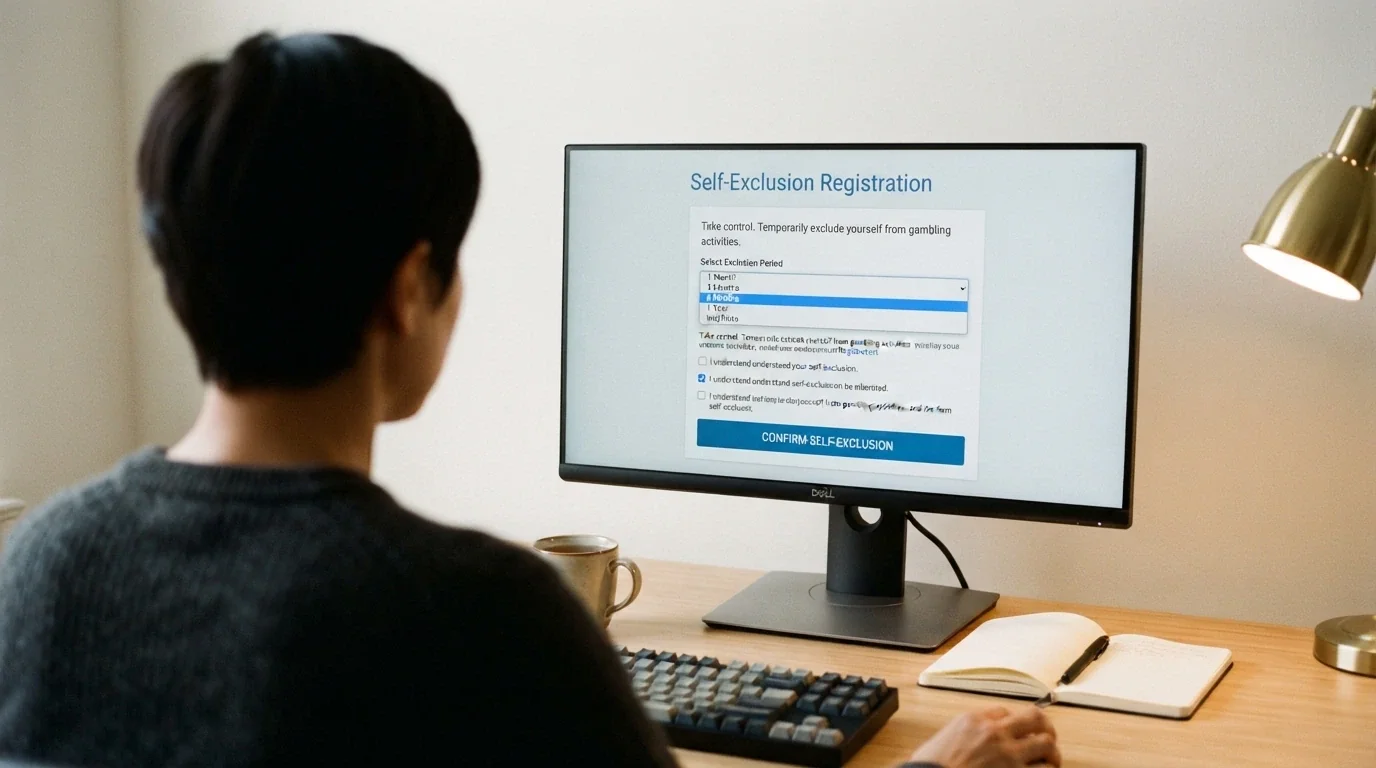
The mechanics of registering are simple: a player provides identity verification, selects an exclusion period (from three months up to lifetime), and the register passes the exclusion to every Australian-licensed wagering operator. The exclusion does not bind offshore live-casino operators directly, because those operators are not licensed in Australia and are not part of the register’s data-exchange layer. A player who has self-excluded through BetStop and is still playing at an offshore live casino is doing so outside the register’s enforcement scope, which is one of the harder truths about the offshore market.
The honest read on the registration numbers is that they reflect the scale of gambling harm in Australia, not the scale of voluntary self-management. About 2.1% of Australian adults — roughly 430,000 people — experience problem gambling, and the Australian Institute of Health and Welfare put high-risk gambling at 1.8% in 2022. BetStop registrations are a fraction of those figures, and the gap between the population that needs help and the population that has formally excluded is the gap the responsible-gambling infrastructure is trying to close.
Deposit limits, time-outs and where to get help
The first-line tools are the ones a player can set today, without registering anywhere. Most offshore live casinos offer deposit limits — daily, weekly or monthly — that the player can configure in the account settings. Session time-outs, which log the player out after a configured period, are a second-line tool. Reality checks, which pop up a notification every set interval to remind the player how long they have been playing, are a third. None of these tools is unique to the Australian market — they are industry-standard at most serious offshore operators — but their effectiveness depends on the player setting them before they need them, rather than after a session has gone badly.
The National Gambling Helpline — 1800 858 858 — is the single most useful number on this page. It is free, confidential and staffed 24 hours a day, seven days a week, and it routes callers to the gambling-counselling service in their state or territory. Gambling Help Online is the web-based equivalent: live chat, email counselling and self-help modules available without a referral. A player who is reading this page and recognising their own behaviour in the descriptions above has the option to call the helpline before the next session, and the call is free.
The prevalence figures — 2.1% of adults experiencing problem gambling, 1.8% high-risk — are the background context for every responsible-gambling tool on this page. Live casinos are designed to be immersive, the offshore setting removes the Australian recourse layer, and the player is the only person who can set the limits the regulator cannot.
How We Picked and Ranked These Live Casinos
The ranking on this page is ordered by market presence among Australian players — by traffic and revenue share data drawn from operator industry sources covering the period through 2026. Market presence is the cleanest single signal of where Australian live-casino players are actually playing, and a ranking ordered by it requires fewer assumptions about which operator is “best” than a ranking ordered by any other single metric. The percentages in the operator table are slices of one market, and the slices sum to the share held by the top ten operators among the broader set of offshore brands actively targeting Australia.
The featured set was checked against the official Australian online-casino licensing record before being ranked, and no operator on this list holds an Australian online-casino licence. The reasoning is mechanical: no such licence exists. The IGA 2001 prohibits the provision of online casino to a person in Australia, and no state or territory regulator issues a licence for that activity. The “Status in Australia” column reflects that fact, and a player evaluating an operator on this list is evaluating an offshore brand regardless of how the brand markets itself.
What this ranking deliberately does not measure is bonus value, game-provider count, payout speed or per-operator live-dealer product breadth. The reasons are data-driven: live-data sourcing for per-operator bonuses, wagering requirements and provider lists was not available this review at the level of specification comparison pages usually print, and a ranking that printed invented specifications would have been worse than one that printed honest gaps. Where a per-operator figure is missing on this page, the section in question says so plainly, and the operator write-up is qualitative on those points.
The reader this list is built for is the risk-tolerant Australian punter seeking the best live-dealer experience despite the legal grey area — the player who has decided to play offshore and is looking for a competent, well-staffed platform to do it on. The ranking is built for that player. The list is not a recommendation to play, and it is not an endorsement of any operator’s offer. It is a map of where Australian live-casino players have actually ended up.
What Australian Live-Casino Players Should Actually Do in 2026
The decision this page has been building toward is not which of the ten operators to pick. It is how to pick any of them well. Three checks matter before signing up at any of the operators on this list, and they are the same three checks whether the player is choosing Rocket Play, Skycrown, or any of the other eight.
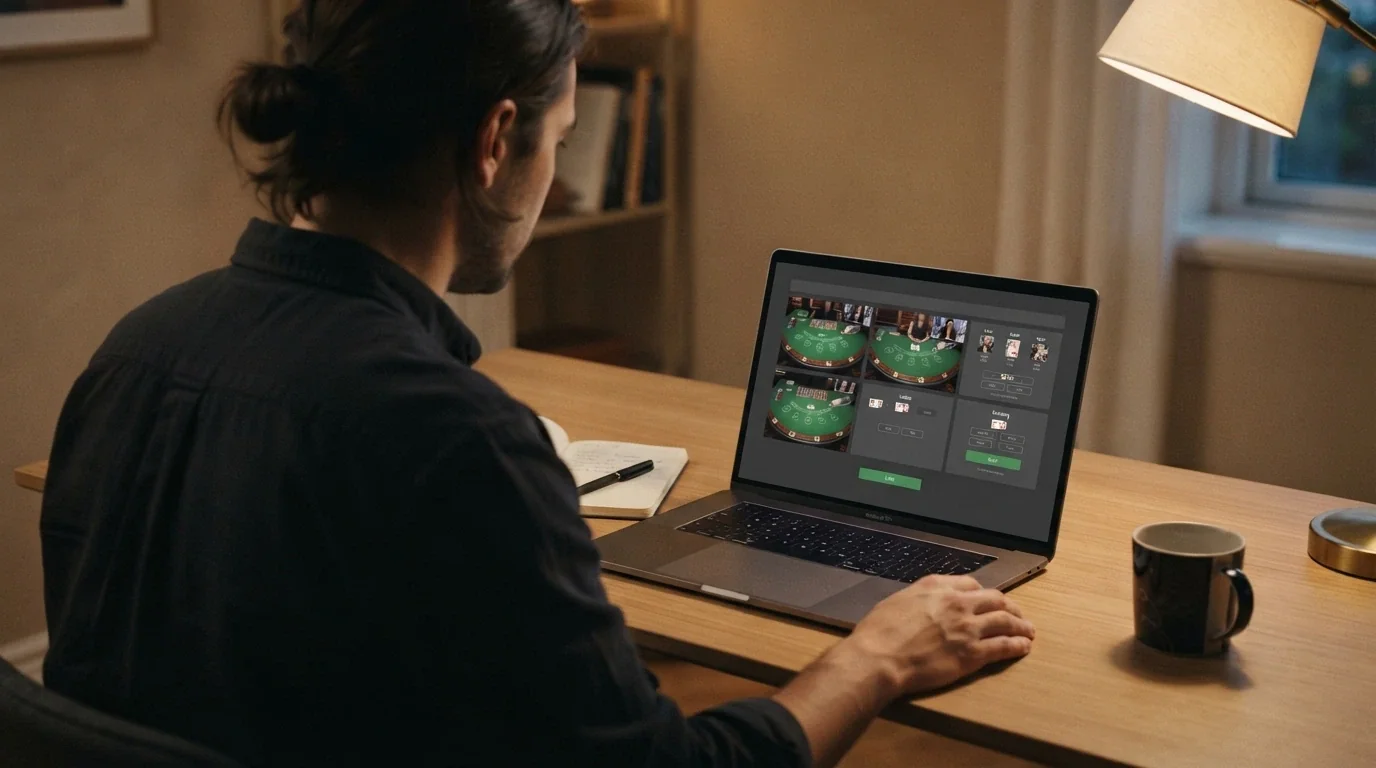
The first check is the payment route. Credit cards, credit-related products and crypto are banned for online wagering as of 11 June 2024, and the remaining routes — debit card, bank transfer, PayID/Osko, BPAY — are the routes an Australian live-casino player is working with. From 1 January 2027, banks gain express authority to block transactions to illegal gambling operators, which means the deposit-and-withdrawal stack at the operator is going to be tested under the new rules. An operator with a clean AUD deposit flow and a clean AUD withdrawal flow today is more likely to remain usable in 2027 than one with a thin one. The player should deposit the minimum, withdraw a small amount, and confirm the flow before committing a larger balance.
The second check is withdrawal history. An operator’s reputation among Australian players for paying withdrawals is the signal that matters most when something goes wrong, and the market-share ranking is a proxy for it rather than a direct measure. The share of the market an operator holds is the share it holds because Australian players have continued to use it, and continued use is downstream of getting paid. A player who hears of repeated complaints about a particular operator should weigh that against the market-share figure.
The third check is stream quality. The live-dealer product is a streaming product, and the studio behind the stream is the variable that determines whether the experience is responsive or laggy. The first session should be a low-stakes trial, and the operator that delivers a clean stream on the player’s home network is the one to keep using.
The highest bonus is a trap. The headline figure is the smallest part of the offer, and the wagering multiple and the game weighting are what the offer is actually worth. The math is the math: a bonus weighted at 10% for live-dealer play needs roughly ten times the slot turnover to clear, and a player clearing a bonus on the games they actually want to play is committing to a turnover figure the headline does not mention. Chasing the biggest headline is a fast way to commit to a long clearing schedule.
The 2027 reform is the structural change to act around. Acting sooner rather than later matters because the payment stack that works today is not guaranteed to work on 1 January 2027, and an operator that has a clean AUD flow today may have a thinner one after the banks start exercising their new blocking authority. A player who is going to play at all is better placed playing now than planning to play later, on the assumption that the payment stack will hold.
The one principle that beats any ranking: play only what you can afford to lose, and use the responsible-gambling tools this page has mapped out. BetStop, deposit limits, session time-outs, the National Gambling Helpline at 1800 858 858, Gambling Help Online — every one of these is a tool that exists before the player needs it, and the player who sets them before a session goes badly is the player who avoids the consequences. The offshore market does not provide Australian recourse. The player provides the limits.
Frequently Asked Questions
Is live casino legal in Australia?
Live casino is not legal for an operator to provide to a person in Australia — the Interactive Gambling Act 2001 prohibits the supply. The Act targets the provider rather than the player, which is why the offshore market continues to operate. Every site on this page is offshore and unlicensed.
Can I play live casino games on my mobile phone in Australia?
Yes. Live casino platforms run in any modern mobile browser, and a dedicated app is an optional layer rather than a requirement. The mobile experience of placing a bet on a live hand is identical to the desktop version. A clean mobile data connection and a recent browser are the only prerequisites.
How do I deposit and withdraw at live casinos from Australia?
The legal Australian payment routes are debit card, bank transfer, PayID/Osko and BPAY. Credit cards and crypto have been banned for online wagering since 11 June 2024. From 1 January 2027, banks can block transactions to illegal operators. Withdrawals use the same rails, and the operator’s withdrawal history with Australian players is worth checking.
Are live casino winnings taxed in Australia?
No — for the player. Betting and gambling winnings are not assessable income under section 6-5 of the ITAA 1997, unless the player runs a gambling business. Recreational players keep what they win. Operator-side tax is separate — 5% NT wagering tax plus 10–15% state point-of-consumption tax — but those fall on the operator, not the player.
What is the best live casino bonus for Australians?
No bonus is straightforwardly the best — every headline hides a wagering multiple and game-weighting table that determine its real worth. Live-dealer games are weighted at 10% or less, so a bonus cleared on live tables needs about ten times the slot turnover. Compare match percentage, wagering multiple and live-dealer weighting on the terms page.
Created by the ”Microgaming Casinos AU” editorial team.