
120 Free Spins No Deposit Australia: What the Bonus Is Really Worth
A “120 free spins no deposit” offer sounds like the simplest deal in iGaming. You register, the casino credits the spins, you play, and whatever you win is yours. The marketing lives at that altitude. The mechanics live somewhere else, and the gap between the two is the most important thing on this page.
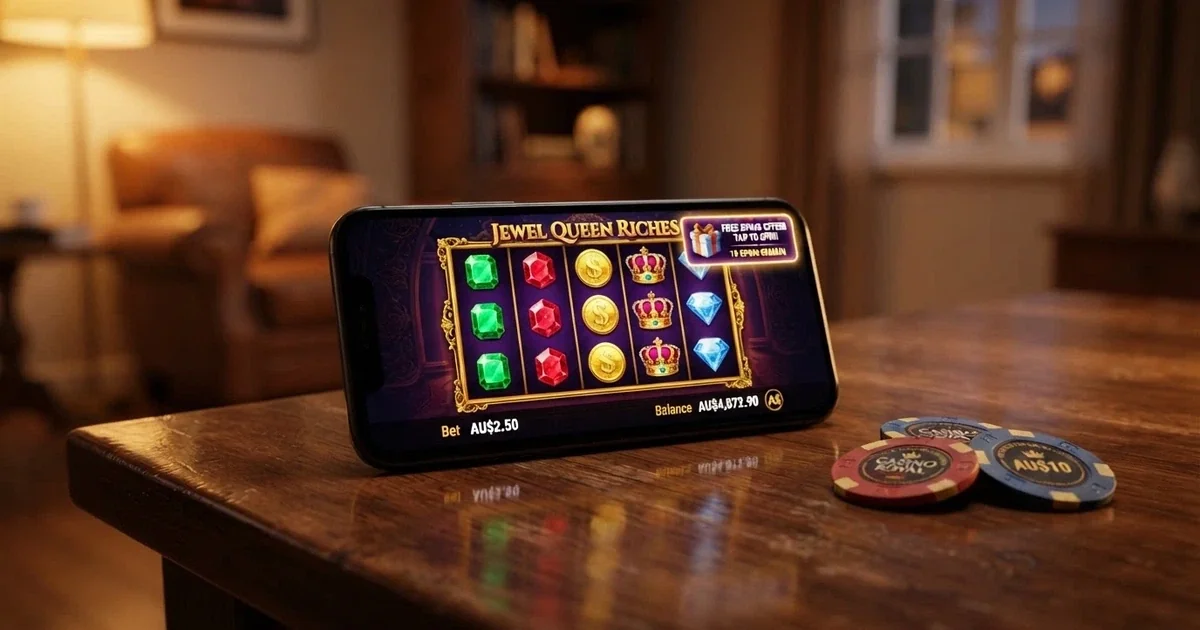
The short version: 120 spins at a typical $0.10 to $0.20 per spin is $12 to $24 of raw bonus value, but you do not actually keep any of it as cash until you have turned the winnings over — typically 30 to 60 times — at the casino’s house edge. Every operator offering this deal to Australian players is offshore, unlicensed under Australian law, and outside the reach of BetStop and Australian consumer protection. Whether the deal is worth claiming depends on the cashout cap, the wagering multiple, and what the reader is actually willing to lose in time and risk for a capped payout that may never clear.
This article walks through the offer in 2026: what it is, how it pays, what the fine print costs, which offshore operators carry it, and which ones are worth the phone-verification step at all.
Data current as of 18 October 2026. Operator offers and licence status verified against the ACMA public register and operator-published terms.
Table of Contents
- What 120 Free Spins No Deposit Actually Gets You in 2026
- Why Your No-Deposit Free Spins Come With Strings Attached
- The Real Cost of a ‘Free’ Casino Bonus in 2026
- Australian Gambling Law and Offshore Casino Free Spins in 2026
- Where Australians Find Free-Spins No-Deposit Offers in 2026
- The Pokies That Make 120 Free Spins Worth Playing in 2026
- Getting Your Winnings Out: Payments and the Withdrawal Reality
- Crypto Casinos and the Anonymity Trade-Off
- Playing on Your Phone: Mobile Casino Access for Australians
- New Casinos With Free Spins: Fresh Faces, Same Offshore Reality
- Free-Play Mode vs Real-Money Spins: What Your Bonus Is Worth
- Staying Safe: Responsible Gambling When Using Offshore Casinos
- How We Evaluated These Casinos
- Your Move: What to Do With This Information
- Frequently Asked Questions
What 120 Free Spins No Deposit Actually Gets You in 2026
The phrase does what it says on the tin, with three numbers that determine whether it is worth anything. Spin value is the dollar amount loaded onto each free spin — typically $0.10 to $0.20 in the current market, occasionally $0.25. The total raw value of 120 spins at those figures is $12 to $24, before any wagering requirement applies. A casino pushing “120 free spins!” is pushing 12 to 24 dollars’ worth of slot play. Not 120 dollars. Not a guaranteed win. Twelve to twenty-four dollars in spin credits, locked to one title.
The title lock matters. “120 free spins” almost never means 120 free spins on anything you want. The bonus is locked to a single game — Book of Dead, Sweet Bonanza, Big Bass Bonanza, a Big Bass variant, or Gates of Olympus are the most common choices in the current crop of offers targeting Australian players. That game lock is not generosity: it lets the casino pre-load a slot with a known return-to-player and run the bonus through a maths model they have already stress-tested.
Then the cap. The third number is the maximum convertible amount — the most you can withdraw from winnings generated by the bonus — and the current offshore market places it between $50 and $200 for the no-deposit offers reaching Australian players. Win $1,200 from your 120 spins on a high-volatility slot? You cannot withdraw $1,200. You can withdraw whatever the promotion allows, and the rest disappears. The cap is what makes the bonus a marketing instrument rather than a windfall.
The way this differs from a deposit-match bonus is structural. A deposit bonus credits extra cash against your own deposit, runs wagering against deposit plus bonus, and usually carries a higher cap or no cap at all. A no-deposit free spins offer costs the casino nothing up front, runs wagering against winnings only, and applies a tight cashout cap. The asymmetry is the point. Offshore operators target Australian players with no-deposit free spins because the offer looks bigger than it is — a single number, “120,” beats “100% up to $500” in the marketing even when the latter is the larger real-world payout.
A 2026 snapshot of typical packaging from industry tracking: spins locked to one title, spin value $0.10 to $0.25, wagering on winnings set between 35× and 60×, maximum convertible amount between $50 and $150, and validity window of 24 hours to seven days. The numbers cluster because the offers are sourced from the same offshore platform providers and tuned against the same maths.
How Free Spins Work: From Claim to Cashout
The lifecycle of a no-deposit free spins bonus has six steps, and the reader who skips one of them ends the bonus before the wagering is half-done.
Step one: registration. You create an account at an offshore casino — email, password, country, date of birth. The IGA prohibits the operator from providing the product, not the player from registering, so the player is not at legal risk here. What the player is doing is signing up with an unlicensed operator outside any Australian consumer protection regime.
Step two: verification. Phone verification is the standard gate for Australian-accessible no-deposit offers in 2026. The casino sends an SMS code, you enter it, and the bonus unlocks. Email verification alone is becoming rarer; phone verification gives the operator a marketing channel they can use later. Some casinos also require notification opt-in before the bonus appears.
Step three: credit. The 120 spins appear on your account balance, locked to the named pokie. You open the game and the free spins play at the pre-set value automatically.
Step four: wagering. Whatever you win lands in your bonus balance, not your real-money balance. To convert it, you have to wager it — turn it over at the casino — at the multiple stated in the terms. A $12 win at 50× wagering means $600 of total bets before any of that money is eligible for withdrawal. The wagering requirement is on the winnings, not on a pre-loaded deposit.
Step five: cashout cap. Once wagering clears, the bonus balance converts to real money up to the maximum stated in the promotion — typically $50 to $200. Anything above the cap is removed from the account. This is the step that surprises players most often.
Step six: withdrawal. The converted real money can be withdrawn, but only through a method the offshore casino accepts. PayID works at some operators; bank transfer works at most; crypto is the universal fallback. Verification of identity is required before the first withdrawal at any reputable operator — this is the KYC step, and it is the same step that the casino will refuse to skip for the player who wants to remain anonymous.
A worked example from current terms: a player wins AU$8 from 40 of their 120 spins on a Book of Dead-style title with wagering set at 35×. They must wager $8 × 35 = $280 before withdrawing that $8. At a $1 spin size that is 280 spins of additional play. At the average return-to-player of the slot, those 280 spins will return roughly $270 of the $280 turnover. The player keeps the $8. The casino keeps the expected $10 difference. The bonus cleared, and the player came out roughly even — with eight dollars, not a windfall.
Why Your No-Deposit Free Spins Come With Strings Attached
Every “free” casino bonus is a conditional offer, and the conditions are where the real cost lives. Four clauses matter more than any others.

Wagering requirements. The turnover multiple applied to winnings is the single biggest determinant of whether a bonus pays anything. Current Australian-accessible offers run 30× to 60× on winnings from no-deposit free spins. Below 35×, the bonus is realistically clearable with a moderate run of variance. Between 35× and 50×, the bonus is clearable but slow, with hours of play and a meaningful chance of the bonus balance dropping to zero before wagering completes. Above 50×, the bonus is effectively unclearable in practice — the expected loss over the required turnover exceeds the cashout cap, so the player pays for the privilege of attempting to clear a bonus they will statistically walk away from with nothing. The casino’s maths is not a guess; the house edge runs through every spin and compounds over hundreds of turns of turnover.
Max cashout caps. A 120-spin bonus with a $50 cashout cap is worth a maximum of $50 to the player, regardless of what the reels actually do. Most current offers sit in the $50 to $200 range. The cap is the marketing’s hidden ceiling — every “imagine winning big on the bonus!” image in the affiliate funnel runs into this wall. A $200 cap is the looser end of the market and is the difference between a bonus worth attempting and a bonus worth ignoring.
Game eligibility and contribution rates. Not every game contributes equally to wagering. Progressive jackpot pokies contribute 0% or 10% at most offshore casinos; live dealer games are almost always excluded outright; table games like blackjack and roulette typically contribute 5% to 20%. The bonus terms name the eligible games, and the eligible game for a free-spins bonus is the one title the spins are locked to — which means the player has no contribution-rate choice at all. The wagering completes inside one slot’s maths model.
Max bet during wagering. Exceeding the maximum bet size — typically A$5 per spin in current offers — voids the bonus entirely. This is the trap that catches players used to staking higher on pokies for the bonus round. A $6 spin during wagering wipes the bonus balance and any pending winnings. The rule is automatic and the casino does not warn before voiding.
The expiry window is the fifth clause most players miss. Validity runs 24 hours to seven days in the current market. A player who wins on day one and returns on day four to find the bonus expired loses the balance. The clock starts when the spins are credited, not when the player signs up.
No-Deposit Mechanics: Why Operators Offer Free Spins Without a Deposit
The commercial rationale is acquisition, not generosity. A no-deposit free spins bonus is the casino’s customer-acquisition cost in product form. The operator pays $12 to $24 of spin credits — and the expected loss on those credits is lower still, because the wagering requirement ensures the player turns the bonus over many times at the house edge — to put a real, verified phone number into their marketing database. The phone-verification step is not friction; it is the deliverable.
Once the player is in the database, the operator markets deposit bonuses, reload bonuses, and loyalty rewards to a contact who has already shown a willingness to register and play. The player who never deposits is still worth the SMS opt-in. The player who deposits once is worth several hundred dollars in lifetime value across the average retention curve. The free spins are a loss-leader with a known ceiling, and the casino’s accountants have already priced what proportion of free-spin recipients become depositing players.
The reason the offer is “120” rather than 50 or 200 is the same reason discount codes cluster around round numbers. 120 looks more generous than 100 without costing the operator meaningfully more — the difference between 100 and 120 spins is $2 to $5 in raw spin credits at typical values, which is noise against the customer-acquisition cost of the campaign. 200 spins would cost $20 to $40 per recipient and the operator’s expected return from the same conversion rate would not justify it. The maths converges on a number that is high enough to be attractive and low enough to be affordable.
The player gives the casino a phone-verified account with no money changing hands. The casino gives the player 120 spins locked to one title, with winnings capped and turned into a bonus balance. The exchange looks asymmetric on the surface and is asymmetric underneath, in the casino’s favour, but the difference is not dramatic: a reasonable wagering multiple and a reasonable cashout cap can leave both sides with something.
Wagering Requirements and Cashout Caps: The Two Numbers That Decide Whether You Keep Anything
Two numbers carry the whole decision. Wagering and the cap.
Wagering is what the player pays to access the cash. A 35× multiple on $8 of winnings is $280 of turnover, which is several hours of slot play at a moderate spin size. A 60× multiple on the same $8 is $480 of turnover, which is a longer session at the same spin size, and during which the expected loss to the house edge is roughly $12 to $15 — already more than the cap in some current offers.
The cap is what the player keeps. A $50 cap means the player can walk away with a maximum of $50 from the bonus. A $200 cap doubles that ceiling. The gap between $50 and $200 is the difference between a bonus that pays for an afternoon’s pokies and a bonus that pays for a meaningful payout.
The decision rule is simple. If the cashout cap divided by the wagering multiple leaves a positive expected value after the house edge runs through the required turnover, the bonus is mathematically worth claiming. If it does not, the bonus is a marketing trap with a known ceiling below the player’s expected loss.
The worked example from current terms: a $12 win at 50× wagering on a slot at 96.5% RTP means $600 of turnover. The expected loss on $600 at a 3.5% house edge is $21. The cap is $50. The bonus is mathematically worth the attempt because the ceiling ($50) exceeds the expected cost ($21) — with variance, some players will clear and some will not, but the average outcome leaves the player ahead. A $50 win at 60× wagering under the same slot maths is $3,000 of turnover with an expected loss of $105. If the cap is $50, the bonus is a clear negative — the player is paying $105 in expected loss for a maximum $50 payout. The arithmetic does not work.
The player who reads these two numbers before claiming will avoid most of the bad offers in the current market. The player who reads the headline will not.
The Real Cost of a ‘Free’ Casino Bonus in 2026
The arithmetic behind a no-deposit free spins bonus is a small, finite calculation, and it is the only honest way to evaluate the offer. Three inputs and one conclusion.
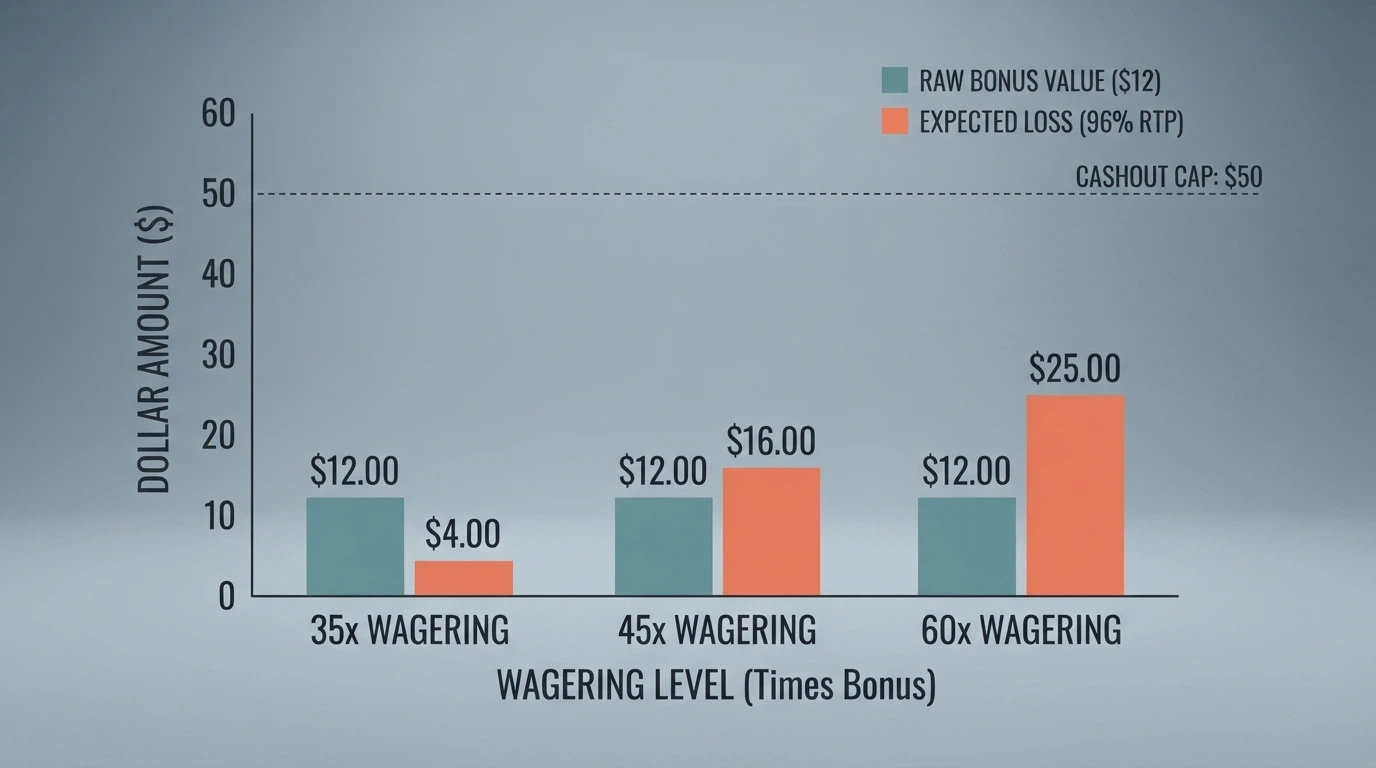
Inputs: the raw bonus value (120 spins at the stated per-spin value), the wagering multiple on winnings, and the slot’s return-to-player percentage. Conclusion: the expected loss across the required turnover, set against the cashout cap.
For a typical 120-spin offer at $0.10 per spin — $12 of raw bonus value, locked to a slot at 96.5% RTP, with 40× wagering on winnings — the expected loss over the required turnover is calculated as follows. Assuming the player wins a modest amount during the free spins (say, the same $12 back), the wagering requirement is $12 × 40 = $480 of total bets. At a 3.5% house edge (100% − 96.5% RTP), the expected loss across $480 of turnover is approximately $16.80. The cashout cap on a typical current offer is $50 to $100 — well above the $16.80 cost. The bonus is positive expected value for the player who lands near the average win and clears wagering.
For a tighter offer — the same 120 spins, but with 60× wagering and a $50 cashout cap — the calculation changes. A $12 win under 60× wagering is $720 of turnover. The expected loss at 3.5% house edge is $25.20. The cap is $50. The bonus is still positive expected value, but the margin is half what it was, and the variance required to clear the wagering is higher. Some players will lose the bonus balance before completing $720 of turnover; the house edge ensures most will.
For the tightest end of the market — 50× wagering on a 96% RTP slot (a 4% house edge), with a $50 cap — the expected loss on $600 turnover is $24. The cap matches the cost almost exactly. The bonus is a coin-flip in expected-value terms, with variance tilted slightly toward the house. Players who claim this bonus pay, on average, close to what they can win.
The pattern across the market: offers with 35× to 40× wagering and $100+ caps are the genuinely claimable bonuses. Offers with 50×+ wagering and $50 caps are the marketing instruments. The gap between raw bonus value and expected cost widens sharply as wagering rises above 40×. The cap is what stops a player from recovering the cost when variance runs against them. Both numbers must be read.
This is a statistical estimate across many spins under the stated assumptions, not a guaranteed outcome. Individual sessions will vary widely. The player who wins $200 on the first spin and clears $100 wagering keeps the cap minus the time spent; the player who wins $2 across 120 spins and loses the bonus balance before completing turnover walks away with nothing. The average is between the two, and the average favours the house by exactly the house edge.
Sign-Up Bonus vs No-Deposit Free Spins: Which Type Actually Pays
Two bonus formats target the Australian player, and they pay differently.
A deposit-match welcome bonus — RocketPlay’s 200% up to A$1,000, Fair Go’s 250% up to AU$2,000, WinSpirit’s 100% up to AU$500, Bizzo’s up to A$7,250 + 175 free spins across four deposits — runs wagering against the deposit plus the bonus. The player pays in real money and gets a larger bonus balance in return. The wagering multiple is typically 30× to 40×. The cashout cap is often absent on the deposit bonus, or set high.
A no-deposit free spins offer — Skycrown’s 100 free spins, RocketPlay’s 50 free spins, Fair Go’s $15 free chip — runs wagering against winnings only. The player pays nothing up front and gets a smaller bonus balance in return. The wagering multiple is typically 35× to 60×. The cashout cap is tight, $50 to $200.
The expected-loss comparison favours the deposit bonus for the player who is willing to stake real money. A $500 deposit at 100% match with 35× wagering on deposit plus bonus is $1,000 of bonus balance requiring $35,000 of turnover. The expected loss at a 3.5% house edge is $1,225. The payout is uncapped, so a hot session can recover the cost and more. The deposit bonus is a high-variance, high-ceiling product.
A 120-spin no-deposit offer at $0.10 per spin with 40× wagering and a $50 cap is a low-variance, low-ceiling product. The expected loss is a few dollars. The payout is capped. The bonus is worth attempting for a player who is willing to spend the time for a small, capped payout without risking real money.
The asymmetry is the point. The deposit bonus costs the player more in expected loss but pays out without a ceiling. The no-deposit bonus costs the player less but pays out only up to the cap. A player who is going to deposit anyway is better off taking the deposit welcome and ignoring the no-deposit free spins. A player who is not going to deposit but wants to test the casino can claim the no-deposit offer for the experience, with the understanding that the upside is capped and the time cost is real.
The cashout cap is the structural feature that distinguishes the two formats. Royal Reels’ A$2,500 + 50 free spins welcome across three deposits at 35× wagering on bonus only has no stated cashout cap on the deposit component. Fair Go’s 250% up to AU$2,000 deposit welcome at 30× wagering on deposit plus bonus has no max cashout on the deposit bonus. Both contrast with Fair Go’s $15 free chip at 60× wagering and $180 max cashout, which is a clearly capped product.
Promo Codes, Phone Verification and Claiming: What You Actually Hand Over
The price of a no-deposit free spins bonus is not just the wagering and the cap. It is also the information the player hands over.
Phone verification is the standard gate. Skycrown’s 100 free spins NDB is activated through phone verification. Royal Reels’ $10 NDB is delivered after phone verification. RocketPlay’s 50 free spins NDB is activated via email or SMS verification. The phone number becomes the casino’s marketing channel after the bonus is claimed, and the casino’s terms of service typically permit promotional SMS to that number unless the player opts out through a separate channel.
Email verification alone is rarer in the current market. The phone step is increasingly mandatory because it lets the casino verify the player is a real person with a reachable contact, and because the regulatory environment in licenced jurisdictions pushes casinos toward multi-factor verification that has been adopted by offshore operators as a default.
Bonus code fields exist at most offshore casinos, and the question of whether a code is needed for the no-deposit bonus varies by operator. Some offers are credited automatically after verification; others require a code entered at registration or at the cashier. The page does not list working codes — codes change, expire, and are tied to specific affiliate channels — and a player who reaches a no-deposit offer through a comparison site will see the current code in the operator’s promotion terms or the affiliate’s tracked link.
KYC identity verification — the upload of a government ID, a proof of address, and sometimes a payment-method screenshot — is the step before the first withdrawal. No reputable offshore casino releases a withdrawal without this step, regardless of how the player registered. The verification is the same step that the player who wanted to remain anonymous will now have to complete, which is why crypto’s anonymity promise collapses at the withdrawal stage. The casino’s payment processor requires verified identity before releasing funds to most banking rails.
Australian Gambling Law and Offshore Casino Free Spins in 2026
The legal position in Australia is not ambiguous, and it is worth stating plainly.

The Interactive Gambling Act 2001 makes it an offence to provide online casino games, online pokies or in-play sports betting to a person in Australia. There is no licence for online casino anywhere in the country — not federally, not in any state or territory. The law targets the operator, not the player, which means an Australian who registers and plays at an offshore casino is not committing an offence. The offshore casino is committing an offence by offering the product to an Australian customer, and the Australian Communications and Media Authority has been enforcing this since 2017.
The enforcement apparatus is real. The ACMA has had 1,564 illegal gambling and affiliate websites blocked by Australian ISPs since November 2019. More than 225 illegal services have withdrawn from the Australian market since enforcement was strengthened in 2017. The ACMA blocklist contains more than 800 domains as of early 2026, and the list grows continuously as new offshore operations appear and are added.
The 2026 reform did not change the casino prohibition. The Interactive Gambling Amendment (Gambling Reform) Bill 2026 passed Parliament on 19 August 2026, with measures commencing on 1 January 2027. The reform targets the licensed side: a national wagering advertising opt-out register (AdStop) administered by ACMA, no wagering advertising from 15 minutes before to five minutes after live sport, a cap of three wagering ads per hour between 6:00 am and 8:30 pm, prohibition on marketing inducements for 14 days after sign-up and 90 days after BetStop deregistration, and athletes, celebrities and influencers barred from promoting wagering. Banks and payment providers receive express authority to block transactions to illegal gambling operators.
The reform strengthens enforcement against licensed wagering operators’ advertising and against offshore operators’ access to Australian payment rails. It does not create an Australian online casino licence. The product remains prohibited, and the offshore operators remain the only supply for a 120 free spins no deposit offer.
A 2026 industry note: the situation in Australia is murkier than in the UK or Canada. The Interactive Gambling Act 2001 makes it illegal for any operator to provide real-money online casino games to Australian residents. No Australian-licensed online casino exists for pokies. Every offer described on this page comes from an unlicensed, offshore operator.
What Offshore Status Means for Your Money and Your Rights
The practical consequence of playing at an unlicensed offshore casino is the absence of every protection that exists in Australia’s licensed wagering market.
There is no Australian consumer protection. If an offshore casino refuses a withdrawal, voids a bonus for an alleged terms breach, or simply disappears with the player balance, the player has no Australian regulator to complain to, no Australian court with clear jurisdiction, and no Australian compensation scheme. The operator is typically licensed in Curaçao or another offshore jurisdiction, and the dispute resolution process is whatever the operator’s own terms say it is — which is usually nothing.
BetStop does not cover offshore casinos. The National Self-Exclusion Register binds Australian-licensed wagering services only. An offshore casino is not connected to the register and will continue accepting a self-excluded person’s money if that person registers. BetStop had 49,382 registrations as of 30 September 2025, with 31,838 having active exclusions. Every one of those exclusions is meaningless at the offshore operators offering no-deposit free spins to Australian players.
The site can be blocked at any time. The ACMA blocklist is updated continuously. A player who has a balance at an offshore casino on the day the domain is added to the blocklist may find the site inaccessible from Australian ISPs — and may find the operator’s terms allow them to forfeit the balance if the player does not withdraw within a stated window after the blocking event. The risk is not theoretical; it is the operational reality of an unlicensed market.
The payment method is a tell. Credit cards, credit-related products and digital currency have been banned as payment for licensed online wagering since 11 June 2024 under the Interactive Gambling Amendment (Credit and Other Measures) Act 2023. A site asking for credit card or crypto deposits is operating outside Australian rules. This is not a moral judgement — it is a factual indicator that the operator is not licensed in Australia and the consumer protections attached to a licence do not apply. An operator accepting credit cards or crypto to a customer in Australia is, by definition, not subject to the Australian regulatory regime.
State Taxes, the Player and What the Law Leaves Unregulated
Australian gambling winnings are not assessable income for ordinary punters. Section 6-5 of the ITAA 1997 excludes them, and losses are not deductible under section 8-1 unless the person is carrying on a business of betting or gambling. No Australian case has held the winnings of an ordinary punter assessable. The player who wins $200 from a free-spins bonus does not owe tax on the $200.
The market’s structural split is what creates the gap. Licensed wagering on races and sport, lotteries and keno, is a regulated market with real operators, consumer protection, and BetStop coverage. Online casino is prohibited entirely, leaving offshore operators as the only supply. The licensed side pays point-of-consumption tax — 10% to 15% of net wagering revenue, varying by state — and the Northern Territory Racing and Wagering Commission imposes a 5% wagering tax on wagers minus payouts plus a 0.05% racing levy. The offshore side pays nothing to Australia.
No federal deposit, loss or stake ceiling exists for any form of gambling. The reason is structural: the product those ceilings would govern is banned outright. What Australia caps is the payment method (credit and crypto banned), the advertising window (the 2026 reform’s broadcast restrictions), and the inducement window (the 14-day post-sign-up and 90-day post-BetStop prohibitions commencing January 2027). The licensed wagering operators offer customer-set deposit limits under state and territory conditions, but offshore casinos are not required to offer them and may not.
The minimum gambling age in Australia is 18 for all commercial gambling. The 78% of BetStop registrants under 40 is a reminder that the demographic reaching for help skews younger, and that offshore casino marketing reaches the same demographic through the same affiliate channels that the licensed market is now restricted from using.
Where Australians Find Free-Spins No-Deposit Offers in 2026
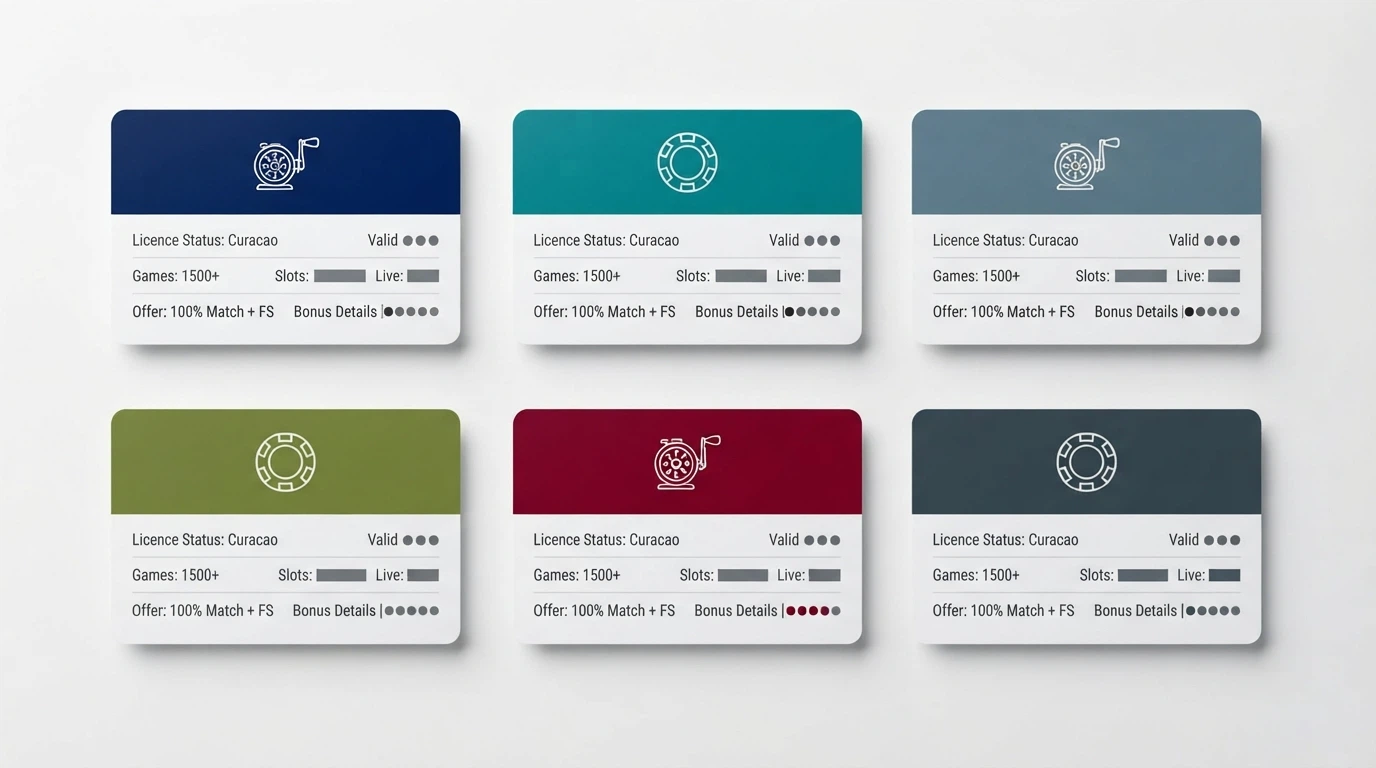
The 10 operators below are the offshore brands reaching Australian players with free-spins or cash-credit no-deposit offers in the current market. All are unlicensed under Australian law. All operate outside any Australian consumer protection regime. All carry the structural risk described in the previous sections. The ranking reflects the presence and clarity of the no-deposit offer, the scale of the game library, and the quality of the terms as published by the operator — not any judgement about whether the reader should play.
| Operator | Licence | No-Deposit Offer | Provider Count |
|---|---|---|---|
| Skycrown | Offshore (Curaçao), no Australian licence | 100 free spins via phone verification | 50+ |
| Royal Reels | Offshore, ACMA-blocked, no Australian licence | $10 cash credit via phone verification | 40+ |
| RocketPlay | Offshore (Curaçao), no Australian licence | 50 free spins at $0.10/spin, $50 max cashout | Multiple |
| Fair Go | Offshore, RTG-powered, no Australian licence | $15 free chip, $180 max cashout | RTG exclusive |
| Stake | Offshore (Curaçao), geoblocked in Australia | None confirmed | 23+ |
| Bizzo Casino | Offshore (Curaçao), no Australian licence | Notification-based (details not confirmed) | 70+ |
| WinSpirit | Offshore, no Australian licence | Not confirmed | Not confirmed |
| Scream Casino | Offshore, no Australian licence | Not confirmed | Not confirmed |
| Rainbet | Offshore, no Australian licence | Not confirmed | Not confirmed |
| Fox Slots | Offshore, no Australian licence | Not confirmed | Not confirmed |
The table tells one story above all others. Four operators carry a genuine, terms-published no-deposit free-spins or cash offer. Three operators carry a deposit-only welcome package with no confirmed no-deposit component. Three operators carry no confirmed details at all and appear in the set on the basis of tracked Australian-player traffic.
The reader who is comparing offers should focus on the first four: Skycrown, Royal Reels, RocketPlay, and Fair Go. The reader who is browsing the long tail — Scream Casino, Rainbet, Fox Slots — is looking at operators whose terms, providers, and bonus structures remain unverified, and the lack of data is itself a signal. New operators with no published terms are a separate risk category from established operators with terms that can be checked.
Skycrown: 100 Free Spins With the Largest Game Library
Skycrown is the largest library in the featured set. 10,400+ games from 50+ providers, including Pragmatic Play, NetEnt, Microgaming, Play’n GO, BGaming, Hacksaw Gaming, and Nolimit City. The no-deposit offer is 100 free spins, activated through phone verification — a smaller spin count than the headline 120, but with a larger underlying game catalogue and a clearer terms environment.
The deposit welcome package is the headline figure: 450% up to A$8,000 + 400 free spins across four deposits. The 400 spins are split across specific titles — 125 FS on Wolf Treasure, 75 FS on Coin Volcano, 50 FS on 15 Dragon Pearls, 150 FS on Mighty Wild: Panther. Wagering is 40× on deposit bonus and 40× on free spins winnings, with 14 days of validity.
A tested PayID withdrawal of AU$180 reached an Australian bank account in 2 hours 29 minutes. That figure is the closest thing to a verified withdrawal-speed benchmark in the featured set. It does not generalise to other operators or other amounts, but it is a real, tested data point for Skycrown’s PayID flow.
Skycrown is the right pick for a player who wants the largest game library, the clearest terms, and a no-deposit offer tied to a phone-verified account. The 100 free spins are a significant offer, and the library, the welcome package, and the tested PayID withdrawal make this the operator where the gap between marketing and reality is smallest in the featured set.
Royal Reels: $10 Cash Credit Instead of Spins
Royal Reels does not run a free-spins no-deposit bonus. The no-deposit offer is AU$10 in cash credit, delivered after phone verification. This is a different product from the offers many players seek, and a player who arrives expecting 120 free spins will find $10 of playable cash instead.
The game library is 5,400+ pokies from 40+ providers, the second-largest in the featured set. The deposit welcome package is A$2,500 + 50 free spins across three deposits, structured as 100% up to A$500, 75% up to A$750, and 100% up to A$1,250. Wagering is 35× on bonus only — lower than the deposit bonuses at Skycrown or Bizzo, and a meaningfully friendlier number for the player attempting to clear.
Royal Reels is ACMA-blocked. The operator’s domain has been added to the ACMA blocklist, and Australian ISPs are blocking access. A player in Australia who tries to reach the site directly will see the ACMA blocking notice; access is typically maintained through mirror domains, which change as quickly as the ACMA adds them to the list. The blocked status is not a marketing problem; it is an operational one, and the operator’s terms may treat balances differently for players who reach the site after a blocking event.
The cash credit is the right fit for a player who wants the largest spin-to-cash optionality at an offshore casino with a moderate library and a manageable wagering multiple on the deposit component. The $10 NDB is a small product, but the A$2,500 + 50 FS welcome across three deposits is the larger reason to look at Royal Reels — assuming the player is willing to deposit.
RocketPlay: 50 Free Spins With a Clear $50 Cashout Cap
RocketPlay runs the most transparent no-deposit offer in the featured set. 50 free spins at $0.10 per spin on a Gamzix slot, 60× wagering on winnings, $50 max cashout. Every number is published, and every number sits at the tight end of the current market — the wagering is high, the cap is low, the spin value is at the floor.
The deposit welcome is 200% up to A$1,000 — a clean, single-deposit match. The 50 no-deposit free spins are the headline no-deposit product, but the 200% welcome is the larger real-money offer for the player who is willing to deposit.
The one-day validity on the no-deposit offer is the strictest in the set. A player who wins on the 50 spins and does not return to wager within 24 hours loses the bonus balance. The 60× wagering is at the upper end of the clearable range — achievable in a long session, but only if the player has the time to put in.
RocketPlay is the right pick for a player who values terms transparency over library size. Every figure is published, and the bonus is exactly what it says it is. The cap and the wagering make this a smaller-payout bonus than Skycrown’s 100 free spins or Royal Reels’ $10 cash credit + A$2,500 welcome, but the published terms make the offer legible to a player who reads before claiming.
Fair Go: $15 Free Chip for RTG Pokies Fans
Fair Go runs an RTG-exclusive library, which is a distinctive position in the featured set. RealTime Gaming is an older studio without the modern mechanics of Pragmatic Play or Hacksaw, but the games are stable, the maths models are well-tested, and the experience is consistent across the catalogue.
The no-deposit offer is a $15 free chip — cash credit, not spins — with 60× wagering and a $180 max cashout. The cap is the highest in the featured set for a no-deposit offer, and the wagering is at the same high end as RocketPlay. The cap-to-wagering ratio is the most favourable of the four genuine NDBs, because $180 is enough headroom over the expected loss to make the bonus mathematically clearable with positive expected value.
The deposit welcome is 250% up to AU$2,000 with 30× wagering on deposit plus bonus and no max cashout. This is the largest match percentage in the featured set and the most favourable wagering multiple on the deposit side. The lack of a cashout cap is the structural advantage: a hot session on the deposit bonus is not artificially limited.
The catch is the consecutive-bonus rule. Consecutive free bonuses at Fair Go require a real-money deposit between claims. A player who claims the $15 free chip and then claims a second free bonus without depositing in between will not receive the second bonus. The rule prevents free-bonus abuse but limits the player’s ability to chain NDBs.
Fair Go is the right pick for a player who prefers the RTG catalogue, wants the highest NDB cashout cap in the set, and is willing to deposit to access the 250% welcome. The RTG-only library is the trade-off — fewer providers, fewer mechanics, but more consistent maths.
Stake: Crypto-Only Platform With No Free-Spins Offer
Stake is the outlier in the featured set. Founded in 2017 by Australian entrepreneurs Ed Craven and Bijan Tehrani, operated by Medium Rare N.V. under a Curaçao licence, with ~4,500+ games across 23+ studios plus the Stake Originals (Crash, Plinko, Dice, Mines). The welcome bonus is a 200% crypto match up to $3,000.
There is no no-deposit bonus confirmed at Stake in this evaluation. The platform is crypto-only — deposits and withdrawals in Bitcoin, Ethereum, Litecoin, and other cryptocurrencies — and the welcome offer is a deposit match, not a free-spins package. A player searching for “120 free spins no deposit” will not find one here.
Stake is geoblocked in Australia per the operator’s own terms, and the terms forbid VPN use. A player who is detected as accessing Stake from an Australian IP via VPN faces account closure and balance forfeiture. The geoblock is a stronger signal than the ACMA blocklist — it is the operator choosing not to serve Australian customers at all, while continuing to operate from Curaçao.
The relevance of Stake to a page about 120 free spins no deposit in Australia is the contrast it provides. Every other operator in the featured set offers an unlicensed product to Australian players in defiance of the IGA. Stake acknowledges the prohibition by geoblocking. The crypto-only model also illustrates the payment-method tell: a site asking for crypto is offshore by definition, since crypto has been banned for licensed wagering since June 2024.
Stake is a viable option for a player who is not in Australia and wants a crypto-native casino with a large library. For the Australian reader, the relevant facts are the geoblock and the absence of a no-deposit free spins offer. The operator is included here because it appears in affiliate tracking for Australian traffic and because the contrast with the other nine operators is itself informative.
Bizzo Casino: Deposit Welcome With a Notification-Based Freebie
Bizzo’s headline offer is the deposit welcome: up to A$7,250 + 175 free spins + 1 bonus game across four deposits, with 40× wagering. The library is 8,000+ games from 70+ providers — the largest provider count in the featured set, second-largest library after Skycrown. The welcome package is structured across four deposits, with the largest single payout at the fourth deposit.
The no-deposit offer at Bizzo is notification-based. The details regarding spin count, wagering multiple, and max cashout were not independently verified for this article. A player who reaches Bizzo through a comparison site may see an opt-in notification that unlocks a free-spins or cash-credit offer, but the terms are not published at the same level of detail as Skycrown’s, Royal Reels’, RocketPlay’s, or Fair Go’s.
Bizzo is the right pick for a player who wants the largest provider count and is willing to deposit across four stages to access the welcome package. The notification-based NDB is a softer product than the published offers at the other four operators, and a player who needs terms clarity before claiming will find less of it here.
WinSpirit: Deposit-Match Bonus Without a No-Deposit Option
WinSpirit’s offer is a deposit-match welcome: 100% up to AU$500 + 50 free spins on first deposit, with 30× wagering on the bonus amount. The wagering multiple is the lowest in the featured set, and the absence of a wagering requirement on the deposit itself is a structurally friendly arrangement for the player.
There is no confirmed no-deposit bonus at WinSpirit. A player searching for 120 free spins no deposit will not find one at WinSpirit. The welcome is deposit-gated, and the 50 free spins are part of the first deposit, not a separate NDB.
WinSpirit is an appropriate choice for a player who is depositing anyway and wants the lowest wagering multiple in the featured set on a deposit-match welcome. The 50 free spins are a bonus on top of the cash match, not a free-play opportunity. The operator is offshore and unlicensed under Australian law.
Scream Casino: New Entrant With an Unconfirmed Free-Spins Offer
Scream Casino appears in the operator tracking for Australian players in the current market. Specifics regarding the licence, provider count, welcome bonus, free-spin structure, wagering multiple, no-deposit bonus, and max cashout were unavailable during our review.
The honest description of Scream Casino is that it is an offshore operator reaching Australian players, that some details of its offer structure are tracked by affiliate sites, and that the specifics were not verifiable at the time of evaluation. A player who arrives at Scream Casino through a comparison link may find an offer, and may find terms that match the published no-deposit market — or may find terms that differ. The absence of confirmed data is itself the editorial point.
Scream Casino is included in the ranking because it reaches Australian players and because the affiliate tracking identifies it as a current no-deposit operator. The reader should treat the specifics as unconfirmed and verify the terms directly with the operator before claiming any bonus.
Rainbet: Another Fresh Face With Limited Confirmed Details
Rainbet is an emerging offshore operator in the same category as Scream Casino. Specifics regarding the licence, provider count, welcome bonus, free-spin structure, wagering multiple, no-deposit bonus, and max cashout were unavailable during our review.
Rainbet appears in affiliate tracking for Australian-player traffic, which is the basis for its inclusion in the ranking. The specifics of its offer — whether it runs a no-deposit free-spins bonus, what the wagering multiple is, what the max cashout cap is — were not verifiable at the time of evaluation. A player who arrives at Rainbet through a comparison link will need to read the current terms directly, because the published data behind this article does not extend to confirmed specifications.
Rainbet is the right pick for a player who is willing to read the operator’s current terms directly and is not relying on this article for the specifics. The inclusion in the ranking is on the basis of tracked Australian-player traffic, not on verified offer terms.
Fox Slots: Featured in No-Deposit Rankings, Details Pending
Fox Slots is featured in PokiesAustralia’s 2026 no-deposit ranking for Australian players. Specifics regarding the licence, provider count, welcome bonus, free-spin structure, wagering multiple, and no-deposit bonus details were unavailable during our review.
The affiliate ranking is the basis for Fox Slots’ inclusion in this article. A no-deposit offer exists per the affiliate’s tracking, but the specifics — the spin count, the wagering multiple, the max cashout, the eligible game — were not verifiable at the time of evaluation. The operator is offshore and unlicensed under Australian law, consistent with every other entry in the ranking.
Fox Slots is the right pick for a player who is browsing the long tail of the no-deposit market and is willing to verify terms directly with the operator. The affiliate’s ranking places Fox Slots in the current no-deposit conversation, and the absence of confirmed specifics in this article is the honest description of what the verification pass found.
The Pokies That Make 120 Free Spins Worth Playing in 2026
Five titles appear most often in no-deposit free-spins offers targeting Australian players. The return-to-player and volatility of these titles determine what the player can expect from the bonus, and the figures behind those expectations are below.

| Slot Title | Provider | RTP | Volatility | Max Win |
|---|---|---|---|---|
| Book of Dead | Play’n GO | 96.21% | High | 5,000× |
| Sweet Bonanza | Pragmatic Play | 96.49–96.51% | High | 21,175× |
| Big Bass Bonanza | Pragmatic Play / Reel Kingdom | 96.71% | High | 2,100× |
| Wolf Gold | Pragmatic Play | 96.01% | Medium | 2,500× |
| Gates of Olympus | Pragmatic Play | 96.50% | High | 5,000× |
The RTPs cluster tightly between 96.01% and 96.71%. The house edge is between 3.29% and 3.99% across these five titles — a narrow band that means the expected loss over a given turnover is similar regardless of which one the bonus is locked to. The difference between the titles is volatility, not return.
High volatility means the slot pays out less often, but in larger amounts when it does. A 120-spin session on a high-volatility title will most likely produce a small win or no win; occasionally it will produce a large win that runs into the cashout cap. The expected loss is the same as a low-volatility title over thousands of spins, but the distribution is wider. High-volatility bonuses are higher-variance products for the player attempting to clear wagering.
Medium volatility (Wolf Gold is the only medium-volatility title in the set) means more frequent, smaller wins. A 120-spin session on Wolf Gold will most likely produce a series of small wins adding up to a modest total. The variance is lower, and the path to clearing wagering is steadier.
The Big Bass Bonanza franchise is the dominant title family in the Australian-accessible no-deposit market. Big Bass Bonanza launched the largest slot franchise in iGaming history — 37 games by March 2026. The franchise has spawned sequels, regional variants, and mechanics extensions, and the base title (96.71% RTP, high volatility) appears in more no-deposit offers than any other single game in the current market.
Max win figures matter only as a ceiling on the cashout cap. The player who hits a 21,175× max win on Sweet Bonanza during a 120-spin no-deposit session keeps only what the cashout cap allows — typically $50 to $200. The max win is a marketing number; the cap is the real number.
Pragmatic Play, Play’n GO and the Studios Behind the Spins
Pragmatic Play supplies four of the five titles in the featured set: Sweet Bonanza, Big Bass Bonanza, Wolf Gold, and Gates of Olympus. The studio is the dominant provider in the Australian-accessible no-deposit market, and its games appear at every operator in the featured set with a published no-deposit offer.
Play’n GO supplies Book of Dead, the perennial NDB title. Book of Dead’s 96.21% RTP and high volatility make it a stable, well-understood bonus slot, and its inclusion in no-deposit offers is the result of years of consistent maths and recognisable branding.
RealTime Gaming supplies Fair Go’s entire library. RTG is an older studio without the modern mechanics of Pragmatic Play’s recent releases, but the games are stable and the maths models are well-tested. Fair Go’s RTG exclusivity is a deliberate positioning choice — the operator offers consistency over breadth.
Skycrown carries 50+ providers, including Hacksaw Gaming, Nolimit City, BGaming, and others outside the five-title cluster above. The provider diversity at Skycrown is the structural reason its library is the largest in the featured set, and the no-deposit offer sits within that broader catalogue.
The provider choice shapes the bonus experience in three ways: the RTP (which determines the house edge on every spin), the volatility (which determines the variance of the session), and the mechanics (which determine whether the player enjoys the 120 spins). Pragmatic Play’s modern slots run tumbling reels, free-spin rounds, and multiplier features; Play’n GO’s Book of Dead is a more traditional payline slot; RTG’s catalogue is the most classic of the three. A player who prefers one style over another will find it at a specific operator.
Getting Your Winnings Out: Payments and the Withdrawal Reality
The path from a free-spins win to a bank account is the part of the bonus experience most players underestimate. The wagering clears, the cap applies, and the remaining balance is supposed to be withdrawable — but the mechanics of moving money from an offshore casino to an Australian bank account involve friction that does not exist in the licensed wagering market.
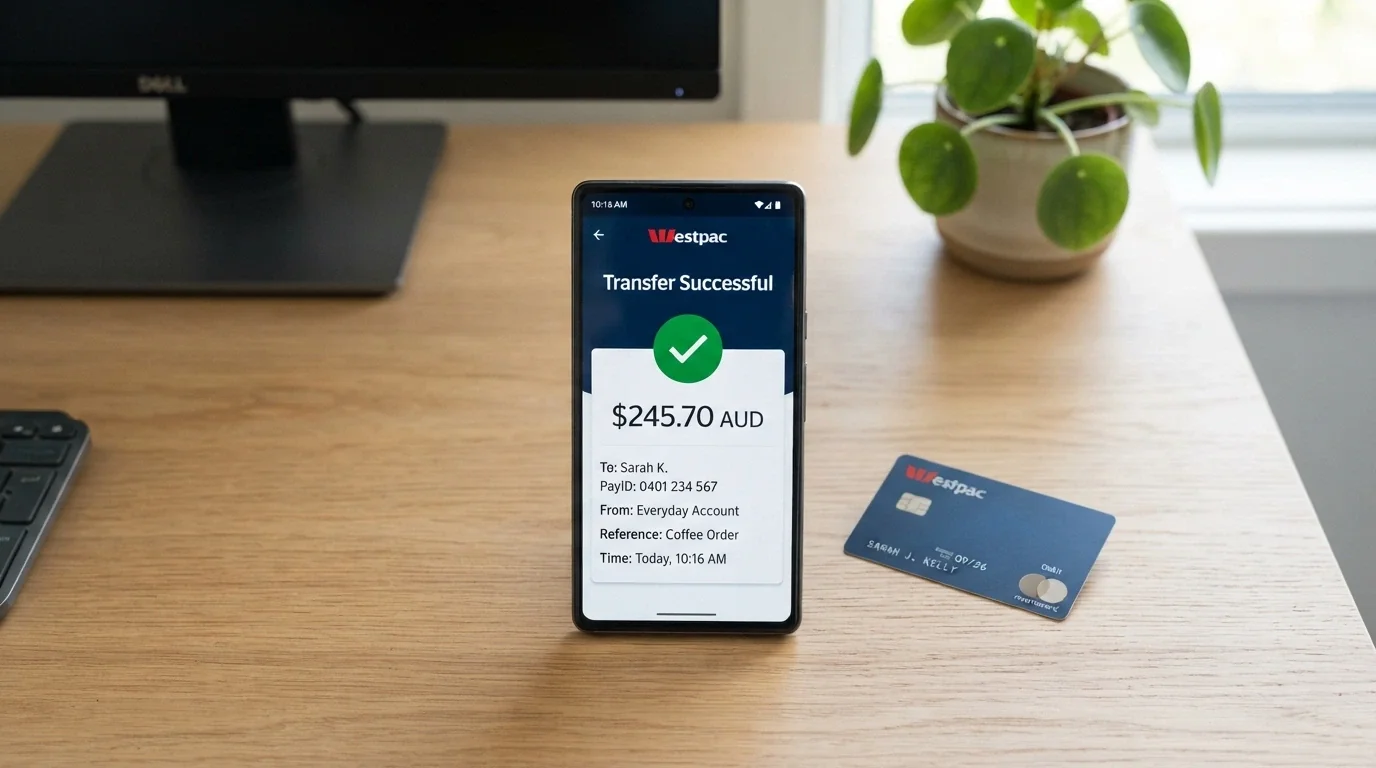
PayID is the fastest Australian-native method for offshore casino withdrawals. A tested PayID withdrawal from Skycrown reached an Australian bank account in 2 hours 29 minutes. PayID runs through the New Payments Platform (NPP) and Osko rails, which Australian banks support for instant transfers. The 2-hour figure is a benchmark, not a guarantee — speeds at other operators remain largely anecdotal — but it is the only concrete speed data point in the featured set.
Bank transfer is the universal fallback. Most offshore casinos support direct bank transfer for withdrawals, typically through SWIFT or through intermediary banks that handle the cross-border transfer. Bank transfer is slower than PayID — multiple business days is typical — but it works from any operator and any amount.
Crypto is the offshore casino’s universal payment method. Bitcoin, Ethereum, Litecoin, and stablecoins are accepted at most operators in the featured set, and crypto withdrawals are typically processed within hours. The catch is the conversion: the player withdraws in crypto, sells the crypto on an exchange, and deposits the Australian dollars into their bank account. Each step takes time and incurs fees, and the crypto exchange’s KYC requirements often exceed the casino’s.
The verification hurdle before the first withdrawal is real. No reputable offshore casino releases a withdrawal without verifying the player’s identity through a government ID, a proof of address, and sometimes a payment-method screenshot. The verification step is the same step that the player who wanted anonymity will now have to complete, which is why the crypto anonymity promise collapses at the withdrawal stage.
The cashout cap is the first ceiling on the withdrawal. A player who clears $200 of wagering from a no-deposit bonus with a $50 cap withdraws $50, not $200. The cap is applied before the withdrawal method is selected, and the player has no way to extract more than the cap allows.
Bitcoin, PayID and the Offshore Payment Patchwork
The payment methods that work for Australian players at offshore casinos are a patchwork, and the legal status of each method is part of the picture.
PayID is an Australian-native instant transfer system. It works through the New Payments Platform, which most Australian banks support. PayID deposits at offshore casinos are typically instant; PayID withdrawals are typically processed within hours. PayID is not banned for offshore gambling, because PayID is a domestic transfer rail and the offshore casino is not subject to the 2024 credit-and-crypto ban.
Osko is the branding on mid-day PayID transfers through participating banks. The player does not interact with Osko directly; it is the back-end of the PayID experience. Same speed, same coverage, same offshore compatibility.
BPAY is an older Australian bill-payment system that some offshore casinos accept for deposits. BPAY withdrawals are less common. BPAY is slower than PayID and is being phased out by some banks in favour of PayID, but it remains a functional deposit option at several offshore operators.
Credit cards are banned for licensed online wagering since 11 June 2024. The offshore casino is not licensed and is not subject to the ban, so credit card deposits may still work — but the player’s bank may block the transaction as part of its own gambling-related transaction policies. The credit card option at an offshore casino is a tell: the operator is not subject to Australian rules.
Crypto (Bitcoin, Ethereum, Litecoin, stablecoins) is banned for licensed online wagering since 11 June 2024. The same offshore-licensed logic applies: the offshore casino accepts crypto because it is not subject to the ban. Crypto is the universal payment method across the offshore market, and the volume of crypto transactions is one indicator of how much money is moving outside the licensed system.
The payment-method picture for the Australian player at an offshore casino is: PayID for the fastest and most native experience, bank transfer for the universal fallback, crypto for the most universal acceptance, credit card for the option that may be blocked by the player’s own bank. The licensed wagering market does not offer a no-deposit free spins bonus; the offshore market does, and the payment methods reflect the offshore status.
Crypto Casinos and the Anonymity Trade-Off
Crypto casinos market themselves on anonymity. The pitch is that the player can deposit and withdraw without sharing a bank account, without verification, and without a paper trail. For the player who values privacy, this is the structural appeal of the offshore crypto market.
The reality is more limited. The offshore casino that accepts crypto deposits still requires KYC verification before the first withdrawal. The verification step is the same as at a fiat casino — government ID, proof of address, sometimes a payment-method screenshot — and the player’s name, address, and identity are now in the operator’s database regardless of how the deposit was made. The crypto deposit buys the player anonymity at the deposit stage and forfeits it at the withdrawal stage.
Stake is the featured crypto-only operator in this article, and the case is instructive. Stake accepts deposits and withdrawals in Bitcoin, Ethereum, and other cryptocurrencies, runs no fiat rails, and offers a 200% up to $3,000 crypto welcome bonus. The operator’s own terms forbid VPN use and geoblock Australian customers. A player who is detected as accessing Stake from Australia via VPN faces account closure and balance forfeiture.
The 2024 ban on crypto as payment for licensed online wagering is the regulatory tell. A licensed Australian wagering operator cannot accept Bitcoin deposits. A site that does accept them is offshore by definition. The crypto option at an offshore casino is a confirmation of the operator’s unlicensed status, not a feature in isolation.
The anonymity trade-off for the Australian player is this: crypto deposits buy privacy from the player’s own bank (no gambling transactions on the bank statement) and from the licensed Australian market (no BetStop coverage to worry about). Crypto deposits do not buy privacy from the offshore casino itself, which still requires KYC at withdrawal. The marketing promise of “anonymous gambling” is half true at best.
Playing on Your Phone: Mobile Casino Access for Australians
The offshore no-deposit free spins market is mobile-first in practice, even when the operators are not mobile-only in design. Most offshore casinos run browser-based Progressive Web Apps — responsive sites that work in a mobile browser without requiring a download from an app store. The phone-verification step that gates the no-deposit bonus is itself a mobile-first onboarding flow, because the SMS code arrives on the player’s phone and is entered on the same device.
Dedicated casino apps are rare in the offshore set and do not appear in Australian app stores. Google Play and Apple’s App Store do not list real-money casino apps from operators without an Australian licence, which means the player who wants to play on a phone does so through the mobile browser. The experience is close to native — full-screen play, touch-optimised controls, portrait and landscape orientations — but it is not an installed app.
Push notifications are a bonus-delivery channel at some offshore casinos. The player opts in to notifications through the browser, and the casino sends bonus offers, free-spin alerts, and deposit-match promotions through the push channel. The notification-based NDB at Bizzo is an example of this delivery method: the player opts in, and the casino pushes the bonus through the notification channel. The opt-in is the gating step that replaces the phone-verification gate used at Skycrown and Royal Reels.
The practical reality for the Australian player is that the offshore casino experience on a phone is functionally equivalent to the desktop experience, with the bonus claim happening through the same verification flow. The mobile-specific advantage is convenience — the player can claim and play from anywhere — and the mobile-specific risk is the ease of impulse play, which is why the responsible gambling sections below are particularly relevant for mobile-first players.
New Casinos With Free Spins: Fresh Faces, Same Offshore Reality
The “new casino” category in the offshore market is not a structural departure from the established operators. It is the same product — unlicensed online casino, offshore-licensed, no Australian consumer protection — with newer branding and a thinner track record.
What counts as a new casino in the offshore market is loosely defined. Some operators launch with a fresh domain and build traffic over 12 to 24 months before appearing in affiliate tracking. Some operators rebrand from a blocked domain to a new domain after an ACMA blocking event. The ACMA blocklist contains more than 800 domains as of early 2026, and new domains appear continuously. The new-casino label is therefore as much a marketing label as an operational fact.
Whether new casinos offer better NDB terms is the question the affiliate funnel wants the reader to ask. The honest answer is that new casinos sometimes offer more generous NDB terms as a customer-acquisition lever, and sometimes offer worse terms because they have not yet calibrated the bonus against their actual player base. The variance is higher. The player who claims a bonus at a new casino is taking on a thinner track record — fewer data points on withdrawal speeds, fewer player reports on bonus-voiding disputes, fewer published terms that have been stress-tested by other players.
The risk of depositing at an unproven operator is structural. An established operator with two years of player traffic and a stable terms environment is a different product from a six-month-old operator with a single domain and no track record. The ACMA blocklist is a partial filter — operators that have been blocked have a public record — but the blocklist does not cover every operator, and the absence of a block is not a positive endorsement.
How to check how long a casino has been operating is the practical question. The WHOIS record on the domain gives a registration date. The terms of service sometimes include a launch date. The affiliate tracking sites sometimes list the operator’s first appearance in their index. None of these is conclusive, but together they build a picture. The player who wants to deposit at a new casino should do at least one of these checks before committing money.
The novelty does not change the offshore and unlicensed status. Every new casino in the current market is offshore. Every new casino is outside the Australian consumer protection regime. The only question is whether the new casino offers terms that justify the thinner track record, and that question is one the player has to answer on the basis of the published terms and the operator’s history.
Free-Play Mode vs Real-Money Spins: What Your Bonus Is Worth
Free-play mode and no-deposit real-money spins are two different products, and the distinction matters.
Demo mode is available on most offshore casino platforms and on most of the slot games in the featured set. Demo mode lets the player play a slot with virtual currency — no real money at stake, no wagering requirement, no cashout cap, no KYC verification, no withdrawal. The player loads the game, chooses the demo version, and plays with a play-money balance that the casino refills when it runs out. The experience is identical to real-money play in terms of game mechanics, RTP, and volatility. The only difference is the currency.
No-deposit free spins are real-money spins. The casino credits 120 spins at $0.10 per spin, the spins play on a real-money slot machine, the winnings land in a bonus balance subject to wagering, and the bonus balance converts to real money up to the cashout cap. The player is gambling with real money from the first spin, even though the casino fronted the spin credits.
The point at which demo play becomes real-money gambling is the moment the player switches from demo mode to real-money mode. In demo mode, the player cannot lose anything that matters. In real-money mode — including the no-deposit free-spins mode — the player can win real money and is gambling in the legal sense. The transition is a single button click at most offshore casinos, and the casino’s interface is designed to make the transition as frictionless as possible.
Why operators offer both is the marketing answer. Demo mode is a practice tool and an acquisition funnel — the player who plays 200 spins in demo mode is more likely to deposit real money than the player who arrives cold. No-deposit free spins are an acquisition lever — the player who claims 120 free spins has already verified their phone number and is in the casino’s marketing database. Both products serve the same commercial purpose: convert a visitor into a depositor. Demo mode is the earlier step in the funnel; free spins are the later step.
The player who wants to test a slot’s mechanics without risking money should use demo mode. The player who wants a real-money bonus with a cashout cap should claim the no-deposit free spins. The two products are not interchangeable, and treating them as interchangeable is a category error that distorts the value calculation.
Staying Safe: Responsible Gambling When Using Offshore Casinos
The harm-prevention context for offshore casino play in Australia is starker than for the licensed market, because the consumer protections are absent.
The National Gambling Helpline is 1800 858 858. Free, confidential, staffed 24 hours a day, with online chat through Gambling Help Online at gamblinghelponline.org.au. The helpline is the single most important number on this page for any reader who is concerned about their own or someone else’s gambling. It is free, it is confidential, and it is staffed by professional counsellors who understand the Australian gambling landscape.
- The National Gambling Helpline is 1800 858 858 — free, confidential, 24/7.
- Gambling Help Online at gamblinghelponline.org.au — online chat with professional counsellors, 24/7.
- BetStop — the National Self-Exclusion Register — covers Australian-licensed wagering services but does not cover offshore casinos. A player who self-excludes through BetStop will still be accepted at the offshore operators in the featured set.
- Self-assessment tools are available through Gambling Help Online, including a checklist of behavioural warning signs and a structured self-test.
The scale of gambling harm in Australia is the context every reader should know before claiming any bonus, offshore or otherwise. 15.1% of the Australian adult population — an estimated 3.32 million people — are experiencing some level of gambling harm from their own or others’ gambling behaviours as of March 2026. Risky gambling increased from 13.7% in 2024 to 19.4% in 2025, almost doubling since the COVID-19 lockdowns of 2020–2021. Problem gambling incidence increased from 1.9% in 2022–23 to 2.9% in 2024–25. 56.1% of individuals who gamble now mainly participate online. Australians lose approximately $25 billion on legal forms of gambling each year.
The offshore market is the additional risk layer. The licensed market has BetStop, deposit limits, and consumer protection. The offshore market has none of these. A player who is concerned about their gambling and is considering an offshore casino should treat the absence of these protections as a reason to seek help rather than a reason to find a workaround.
Recognising the Signs and Setting Your Own Limits
The behavioural warning signs that gambling is moving from entertainment into harm are well-documented. Gambling larger amounts to achieve the same excitement. Restless or irritable when trying to stop. Gambling despite problems at work, in relationships, or financially. Chasing losses. Lying about gambling activity. Using gambling as an escape. Borrowing money to gamble.
The self-assessment tools at Gambling Help Online take the player through a structured checklist and return a risk profile. The checklist is not a diagnosis; it is a starting point for a conversation with a counsellor at the National Gambling Helpline.
Setting your own limits is the practical harm-prevention step for the offshore casino player. Licensed wagering operators offer customer-set deposit limits under state and territory conditions, with weekly or monthly caps that the player can configure and that the operator enforces. Offshore casinos may offer these voluntarily but are not required to. The player who wants a deposit limit at an offshore casino needs to set it themselves — through a budgeting app, a separate bank account with a fixed balance, or a written commitment to stop at a defined loss threshold.
Take-a-break and self-exclusion options exist at some offshore casinos and are not universal. The player who wants to stop playing should contact the operator’s customer support and request a cooling-off period or account closure. The operator may comply; the operator may not. The reliable mechanism is the National Gambling Helpline and the self-exclusion commitment the player makes to themselves and to the people around them.
The 78% of BetStop registrants under 40 and the 38% who chose lifetime exclusion are a reminder that the help-seeking demographic skews younger. A reader in their twenties or thirties who is concerned about their own gambling patterns is in the demographic that BetStop was designed to serve, and the helpline is the right first contact regardless of whether they have ever used a licensed wagering operator.
How We Evaluated These Casinos
The evaluation behind this article draws on affiliate tracking sources (PokiesAustralia, CasinoAudit, BestBonusList, Slotozilla, AustralianGamblers), the ACMA public register for licence and blocklist status, and operator-published terms pages for bonus structure, wagering multiples, and max cashout caps. The 10 operators in the ranking are the offshore brands that affiliate tracking identifies as reaching Australian players with free-spins or cash-credit offers in the current market.
The criteria used to order the ranking are four: the presence and terms of a no-deposit offer, the game library size, the provider count, and the wagering transparency. Operators with a published no-deposit offer, a large library, and clear wagering terms rank higher. Operators with no confirmed no-deposit offer, no confirmed library size, and no confirmed wagering terms rank lower. The ranking is not a recommendation to play at any specific operator — it is a structured ordering of the operators by the completeness of the verified information about them.
The limits of the evaluation are real and worth stating. Operator terms change without notice. A wagering multiple of 40× this week may be 50× next week. A cashout cap of $100 this month may be $50 next month. A free-spin offer that is published today may be withdrawn tomorrow. The reader should verify the current terms directly with the operator before claiming any bonus. The figures on this page are the verified figures at the time of evaluation.
The verification pass behind this article confirmed: licence status and offshore positioning for all 10 operators; the no-deposit offer structure for Skycrown, Royal Reels, RocketPlay, and Fair Go; the deposit welcome structure for Bizzo, WinSpirit, and Stake; the absence of confirmed specifics for Scream Casino, Rainbet, and Fox Slots. The verification pass did not confirm: the no-deposit offer specifics for Bizzo, WinSpirit, Scream Casino, Rainbet, or Fox Slots; the withdrawal speed benchmarks for any operator other than Skycrown’s PayID test; the max cashout cap for any operator other than RocketPlay ($50) and Fair Go ($180 for the NDB).
The reader should treat unconfirmed specifics as unconfirmed. Where this article says “details not confirmed,” the absence of the detail is the editorial statement. A reader who arrives at one of these operators and finds published terms is welcome to use those terms; this article does not fill the gap with invented figures.
Your Move: What to Do With This Information
The honest verdict on 120 free spins no deposit at Australian-accessible offshore casinos is that the offer is mathematically worth claiming under specific conditions, structurally risky in its legal environment, and only useful for a player who reads the terms before playing.
A player who wants the bonus should pick from the four operators with published no-deposit terms: Skycrown’s 100 free spins, Royal Reels’ $10 cash credit, RocketPlay’s 50 free spins with a $50 cap, or Fair Go’s $15 free chip with a $180 cap. The player should read the wagering multiple and the cashout cap, calculate the expected loss against the cap, and claim the bonus that has the most favourable ratio of cap to expected loss. Skycrown’s offer has the largest underlying library; Royal Reels has a manageable wagering multiple on the deposit component; RocketPlay has the most transparent terms; Fair Go has the highest cashout cap and the largest deposit welcome.
A player who is going to deposit anyway is better off taking the deposit welcome and skipping the no-deposit offer. The deposit welcome at Royal Reels, Fair Go, WinSpirit, or Bizzo is a larger product with a higher ceiling than the no-deposit offer at the same operator. The deposit welcome costs real money; the no-deposit offer costs time.
A player who should not claim the bonus is a player who is uncomfortable with the offshore and unlicensed status of the operator, who cannot afford the time cost of clearing high wagering requirements, who is in any way concerned about their own gambling patterns, or who needs a withdrawal mechanism with Australian consumer protection. For these readers, the responsible gambling resources above are the right next step, not the bonus.
The legal reality every player must weigh is that no Australian-licensed online casino exists for pokies. Every offer on this page is offshore. Every offer is outside the reach of BetStop and Australian consumer protection. The player who claims the bonus is accepting this trade-off.
The harm-prevention steps every player should take before claiming any offshore bonus are concrete. Set a deposit limit before registering, and stick to it. Set a time limit, and stick to it. Read the bonus terms, and verify the wagering multiple and the cashout cap before claiming. Save the National Gambling Helpline number — 1800 858 858 — in the phone. If the gambling stops being entertainment, call the helpline.
120 free spins at $0.10 per spin is $12 of raw bonus value. After wagering, after the cashout cap, after the expected loss runs through the bonus balance, the player who clears the bonus keeps a small, capped payout and the casino keeps the house edge. That is the arithmetic. The reader’s job is to decide whether the arithmetic is worth the legal exposure and the time cost.
Frequently Asked Questions
What wagering requirements do no-deposit free spins offers usually carry in Australia?
No-deposit free-spin wagering requirements at Australian-accessible offshore casinos typically run from 30× to 60× on winnings, with anything above 50× considered practically unclearable. The wagering requirement applies to the bonus winnings, not to a pre-loaded deposit, and the player must turn the winnings over the stated multiple before they convert to withdrawable cash. RocketPlay’s 50 free spins carry 60× wagering; Fair Go’s $15 free chip carries 60×; the range across the featured set is 35× to 60×.
How much are 120 free spins worth when offered as a no deposit bonus?
A 120 free spin no-deposit bonus at the current typical spin value of $0.10 to $0.20 is worth $12 to $24 in raw bonus credits before any wagering requirement applies. The winnings from those spins are subject to the wagering multiple and the cashout cap, so the actual amount the player can withdraw is typically $50 to $200 at the cap. The raw bonus value is the headline; the cashout cap is the real ceiling.
Can I actually win real money from 120 free spins without depositing?
Yes, real money can be won from 120 free spins without a deposit, subject to the wagering requirement and the cashout cap. A small win from the free spins is converted to real money after the player completes the wagering requirement at the stated multiple, up to the maximum convertible amount in the promotion terms. The maximum is typically $50 to $200 in the current offshore market; any winnings above the cap are removed.
What is the maximum I can cash out from a no-deposit free spins bonus?
The maximum cashout from a no-deposit free-spins bonus at Australian-accessible offshore casinos in 2026 is typically AU$50 to AU$200, set by the promotion terms. RocketPlay’s 50 free spins have a $50 max cashout; Fair Go’s $15 free chip has a $180 max cashout; the range across the featured set is $50 to $200. Winnings above the cap are removed from the bonus balance after wagering is complete.
What happens if I register with BetStop — does it cover offshore casinos?
No, BetStop does not cover offshore casinos. BetStop is the National Self-Exclusion Register and binds Australian-licensed wagering services only. An offshore casino is not connected to the register and will continue accepting a self-excluded person’s money if that person registers. A player who has self-excluded through BetStop and then registers at an offshore casino is not protected by the exclusion. The 49,382 BetStop registrations as of September 2025 cover licensed wagering services exclusively.
Do I need to verify my identity to claim no-deposit free spins in Australia?
Phone verification is the standard gate for claiming no-deposit free spins at Australian-accessible offshore casinos. Skycrown’s 100 free spins are activated through phone verification; Royal Reels’ $10 NDB is delivered after phone verification; RocketPlay’s 50 free spins use email or SMS verification. Identity verification through a government ID is required before the first withdrawal at any reputable offshore operator, regardless of how the player registered. The KYC step at withdrawal is the same step that defeats the anonymity promise of crypto deposits.