
Best 7-Reel Pokies in Australia: Mechanics, Rankings and the Offshore Reality
 Available in AU
A seven-reel pokie is a different animal from the three-reel fruit machine your dad played at the local pub, and the difference runs deeper than the symbol count. Most 7-reel games replace fixed paylines with cluster pays on a 7×7 grid, run 49 symbols per spin, and use cascading mechanics that can chain multiple wins from a single paid spin. The format suits a particular kind of punter — someone willing to trade the predictability of fixed lines for the higher variance of cluster pays.

Data current as of 18 October 2026, cross-checked against the ACMA enforcement register and the Roy Morgan Gambling Harm Index.
Table of Contents
- 7-Reel Pokies Explained — More Reels, No Paylines
- Top 7-Reel Pokies for 2026 — Side-by-Side on Return, Risk and Payout Potential
- Are 7-Reel Pokies Legal in Australia? The Offshore Reality
- Staying Safe While Playing 7-Reel Pokies — Tools, Limits and the Real Risk
- How We Chose and Ranked These 7-Reel Pokies — Sources and Criteria
- Your 2026 7-Reel Pokie Playbook — What to Actually Do Next
- Frequently Asked Questions
7-Reel Pokies Explained — More Reels, No Paylines
The seven-reel format is a design shift, not a tweak. The third reel you learned on a pub fruit machine was a strip of symbols spun independently of the others; a 7-reel pokie is usually a 7×7 grid where every position is evaluated together for cluster combinations. The result is a game that pays in clusters of five or more matching symbols that touch each other horizontally or vertically, rather than in fixed-line matches across three or five reels. “7 reel slots are online slot games that use 7 columns instead of the standard 3 or 5,” notes Vegas Slots Online, and unlike traditional slots, “most 7 reel slots use cluster pays or grid-based mechanics rather than fixed paylines.”
That structural change cascades into everything else. Cascading wins replace the single payout per spin. Charge meters and grid-specific bonus triggers replace the simple free-spin round. Even the maths shifts: with 49 symbols on screen at any time, the number of possible cluster combinations dwarfs the number of possible line combinations on a 5-reel game, and the volatility climbs to match.
What separates a 7-reel pokie from your standard 3-reel and 5-reel slot
A three-reel pokie is the simplest version of the format: one payline, sometimes three, and a single payout per spin. Wins are small and frequent, and the player who enjoys a slow grind picks these deliberately. A five-reel video slot is the mass-market middle: multiple paylines (usually 10 to 50), bonus rounds, free spins, and a payout rhythm that runs somewhere between the two extremes.
A seven-reel pokie sits well outside that middle. Most seven-reel games have no fixed paylines at all. They use cluster pays, where five or more matching symbols need to touch each other horizontally or vertically to count as a win. The 7×7 grid holds 49 symbol positions per spin, which is far more than a 5×3 layout manages, and the cluster-pays design treats the whole grid as one big board rather than five independent reels. That is why modern seven-reel games feel different from the older 7×3 layouts that still ran fixed paylines — the grid is the engine, and the reel count is just the number that gave the genre its name.
The 7×7 grid explained — why seven reels ditch traditional paylines
A 7×7 grid is, mechanically, a 49-cell board that resets on every paid spin. Each cell holds one symbol drawn from the game’s symbol set, and wins form when five or more matching symbols form a connected group — touching horizontally or vertically, with diagonals generally not counting. The same symbols in the same grid that fail to touch do not pay.
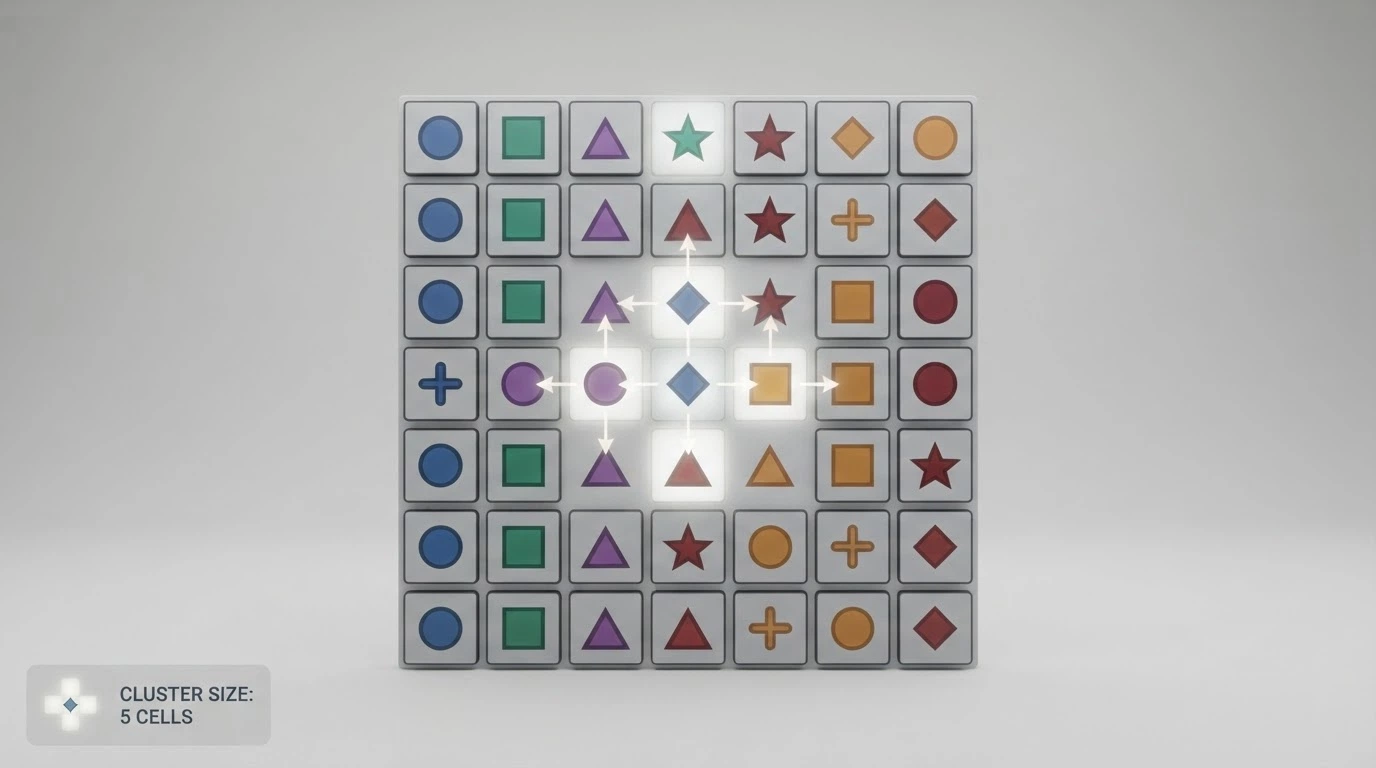
Fixed paylines cannot scale to this. A payline is a predefined path across a small number of symbol positions, and the more positions you add, the more paylines you need to cover the meaningful combinations. A 7×7 grid would require thousands of paylines to cover its cluster combinations, and that is before the cascading feature starts changing the board mid-spin. Cluster pays sidestep the whole problem: the game evaluates the grid for connected groups on every spin and pays on whichever groups form. New symbols drop into the gaps left by winning groups, the grid is re-evaluated, and the cycle continues until no new cluster forms.
That is where the modern 7-reel format earns its volatility reputation. A single spin can chain two, three or more payouts as cascades resolve, and the multiplier mechanics layered on top — multiplier spots, charge meters, quantum features — turn a modest cluster into a string of wins that grows with each cascade.
Cascading reels, charge meters and the bonus engines driving modern 7-reel pokies
Cascading wins — also called tumbling or avalanche reels — are the engine that makes the grid format feel different. After a cluster pays, the winning symbols vanish, the symbols above fall into the empty spaces, and new symbols drop in from the top. The grid is re-evaluated, and if new clusters form, those pay too. A single paid spin can therefore yield a chain of payouts, and the chain’s length depends on how often new clusters form as the board refills.
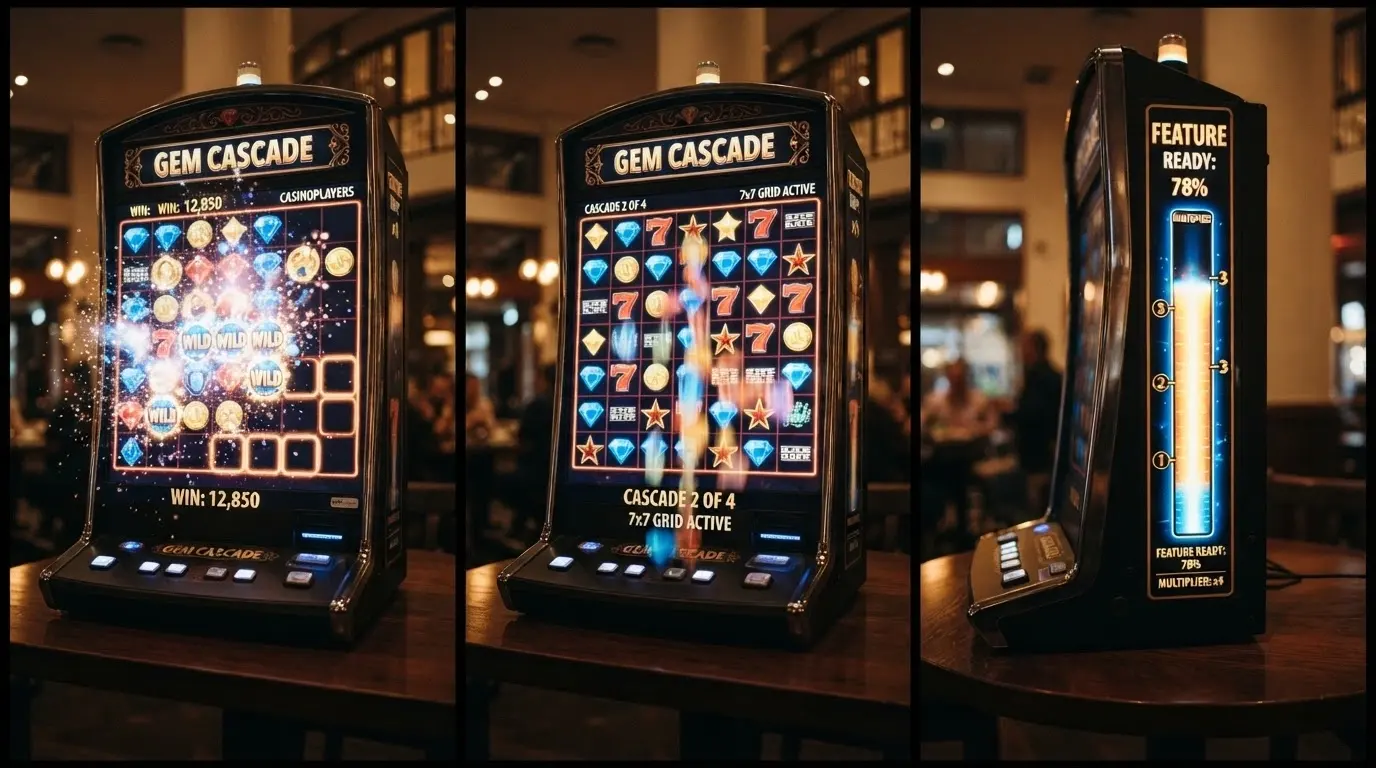
Charge meters fill across cascades. Most 7-reel games track how many winning symbols a cascade has removed, and once a meter fills, a feature triggers — usually free spins, sometimes a grid-specific bonus mode. Sugar Rush 1000 from Pragmatic Play runs a Multiplier Spots system where every winning position becomes a 2× multiplier that doubles to a maximum of 128× if the same position wins again; multiple multipliers on the same cluster add together, and in the free-spins round the multipliers never reset. The result is a game where one well-placed cluster early in the bonus round can carry through every cascade that follows.
Free spins in Sugar Rush 1000 trigger when three to seven Gumball Machine Scatters land, awarding between 10 and 30 free spins depending on the number of scatters. The free-spin round is where the Multiplier Spots system stops resetting — and where the headline 25,000× max win becomes a real possibility rather than a theoretical one. Sugar Rush 1000 is also a game with multiple return-rate configurations — 97.50% at the premium tier, 96.53% as the default, 95.50% and 94.50% at the operator’s discretion — and the casino chooses which version it deploys, which is why the published RTP and the RTP an Australian punter actually plays can sit a full percentage point apart.
Free-play 7-reel pokies — demo mode, no registration, no download
Most offshore casinos serving Australian players carry demo-mode versions of their 7-reel titles, though coverage is not universal. Demo mode runs the same game engine as the real-money version — same symbols, same cluster mechanics, same RTP — and uses a play-money balance that resets when the page reloads. No registration is required to launch a demo on most platforms, and no download is needed for the browser-based versions.

What demo mode replicates faithfully is the mechanics: the cascade chain, the charge meter, the multiplier grid, the scatter trigger. What it does not replicate is the psychological weight of a real-money session. The RTP is the same in theory, but the player who watches A$200 vanish in 200 spins of demo mode feels nothing close to the player who watches A$200 vanish in 200 spins of cash. Demo mode is the right place to learn cluster-pays logic before risking anything — and the wrong place to learn what real-money variance actually costs.
Real-money 7-reel pokies — what changes when you play for cash
The jump from demo to real money is mostly mechanical, and partly legal. Mechanically, the stakes change: most 7-reel pokies run a per-spin bet from A$0.20 at the low end to A$100 at the ceiling, with the cluster payouts scaling linearly with the stake. A cluster that pays 5× at A$0.20 pays 5,000× at A$2 — same hit, different number on the screen.
Legally, the jump crosses a line that does not exist in most other gambling markets. Australia does not license online pokies at all — the Interactive Gambling Act 2001 prohibits the provision of online casino games to a person in Australia — and every Australian punter playing a real-money 7-reel pokie online is doing so through an offshore operator the ACMA cannot reach. That prohibition covers the credit card and crypto payment routes too: since 11 June 2024, Australian-licensed wagering services cannot accept credit cards or crypto, though offshore casinos freely accept both. PayID, bank transfer, and a small range of e-wallets remain the practical deposit routes for an Australian punter — Royal Reels clears a PayID deposit in under 90 seconds.
Classic 7-reel titles vs bonus-heavy 7-reel slots — two different animals
The seven-reel format has split into two distinct camps. The first leans on the reel count as the headline and runs traditional slot logic on a 7-column layout. Seven 7’s uses a CONTINUWIN mechanic where landing a seven or a 2× symbol on the first reel causes a second reel to appear and respin, and the chain can extend up to seven reels before either a BAR symbol lands or a reel stops between symbols, which resets the chain. The classic format still pays big — Seven 7’s carries a 25,000× max win on a 96.6% RTP — but the bonus structure is closer to a five-reel video slot than to a modern grid game.
The second camp builds an entire bonus ecosystem around the grid. Sugar Rush 1000, Reactoonz, Gemix, Honey Rush and Wild Frames all come from this tradition — the 7×7 grid is the bonus engine, the cascading wins feed the meter, and the free-spin round multiplies whatever the base game built. 7’s Luck sits at the bridge between the two camps with its Wild x2 Reel mechanic: a full stack of Wild sevens on a reel doubles any win it contributes to, and if two or three reels transform at once the multipliers combine for 4× or 8× respectively. Collecting 15 Scatters delivers a 10,000× headline prize — and that prize pays on a 7-reel layout that still respects the genre’s classic roots.
The studios building 7-reel pokies — Pragmatic Play, Play’n GO and the Australian connection
Pragmatic Play and Play’n GO between them account for most of the 7-reel catalogue an Australian punter will encounter. Pragmatic Play ships Sugar Rush 1000 at 97.5% RTP and Chicken Drop at 96.5%, both high volatility and both running the cluster-pays grid format. Play’n GO owns the Reactoonz line — Reactoonz itself runs 96.51% RTP on a maximum 10/10 volatility rating, with a 4,570× max win — and backs it with Gemix (96.83%), Honey Rush (96.5%) and Wild Frames (96.5%), all grid-based cluster games. Reactoonz also carries five selectable return-rate configurations — 96.51%, 94.51%, 91.49%, 87.50% and 84.51% — and the operator picks which version it runs, which is why an Australian punter’s actual session RTP can land anywhere on that ladder.
BGaming’s Fiesta Clusters carries a 97.0% RTP and a 5,000× max win — the second-highest RTP in the seven-reel format and a serious alternative to Pragmatic Play’s Sugar Rush 1000. ReelPlay and Nolimit City round out the supporting studios, and Big Time Gaming sits behind much of the wider grid innovation: BTG is the Australian-founded studio behind Megaways, where the number of ways to win can stretch to 117,649 on a single spin. BTG’s work is technically a different mechanic — Megaways is a ways-to-win system, not strictly a cluster-pays system — but the grid-first design philosophy that runs through the seven-reel format has Megaways roots.
Top 7-Reel Pokies for 2026 — Side-by-Side on Return, Risk and Payout Potential
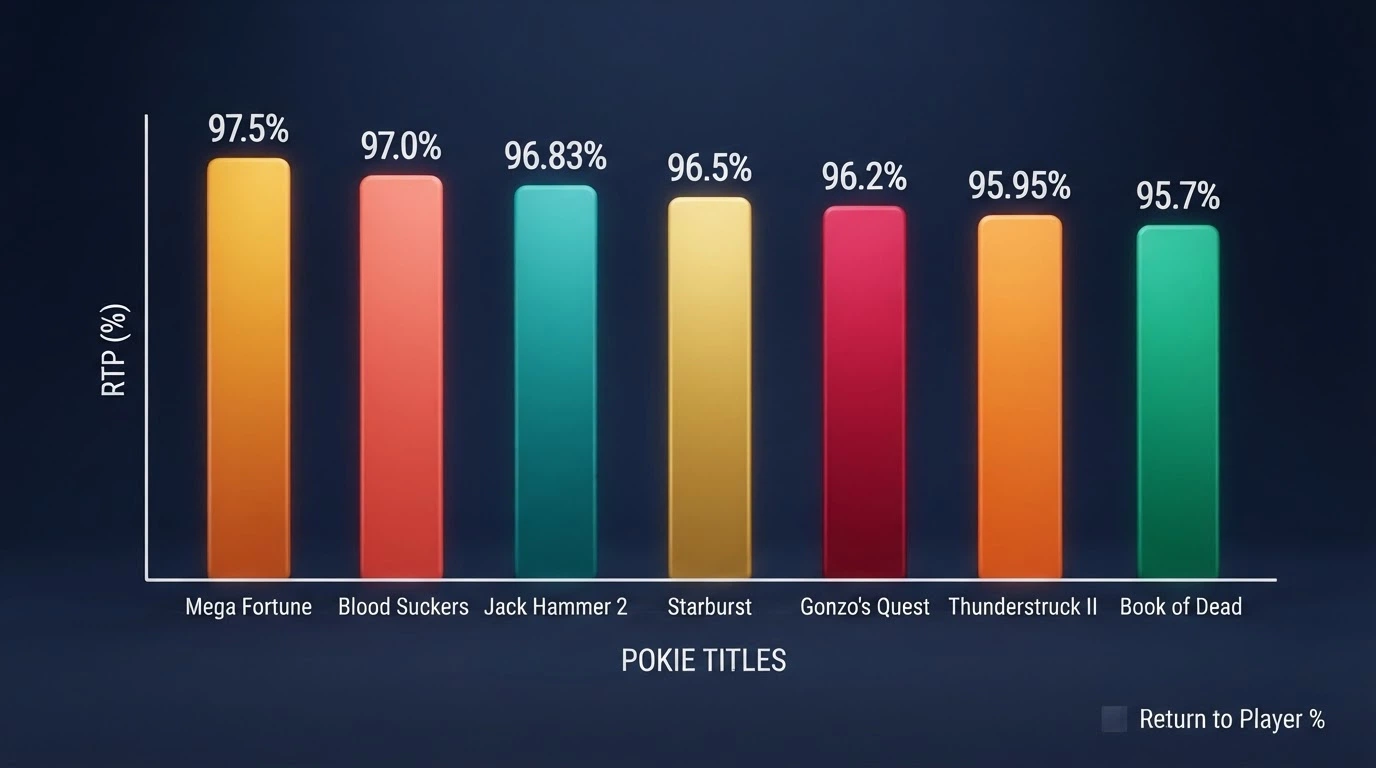
The ranking that follows leans on three numbers: the published return-to-player (RTP), the volatility rating, and the maximum win multiplier. None of the three is a complete picture on its own, but read together they describe what a game costs in the long run and what it can pay when the maths line up. The table below ranks every 7-reel title research backs from highest RTP down, with the volatility class and the headline max win for each.
| Operator | AU market rank | Offshore licence jurisdiction |
|---|---|---|
| SkyCrown Casino | #4 | Offshore |
| Rocket Play | #3 | Offshore |
| Royal Reels | #9 | Offshore |
| WinSpirit | #11 | Offshore |
| Stake | #12 | Curaçao |
| Rainbet | #13 | Offshore |
| Scream Casino | #14 | Offshore |
| FairGO | #16 | Offshore |
| Bizzo Casino | #19 | Offshore |
| Rocket Casino | #20 | Offshore |
Every operator above is offshore, and every offshore operator in this market runs without an Australian licence — there is no licence available, since online pokies are prohibited under the Interactive Gambling Act 2001. None of these brands connect to BetStop, none fall under ACMA complaint handling, and all accept payment methods Australian-licensed wagering services are banned from taking.
What makes a 7-reel pokie worth your time — the three numbers that matter
RTP is the long-run return percentage. A 97.5% RTP — Sugar Rush 1000’s headline figure — means the game returns A$97.50 for every A$100 wagered, averaged across millions of spins. The other A$2.50 is the house edge, and that is what the player pays for the privilege of playing. A 96.5% RTP — the level most Play’n GO grid games land on — costs the player A$3.50 per A$100 wagered. Over a session of 200 spins at A$2 per spin, that 1% gap between Sugar Rush 1000 and a 96.5% game works out to A$4 in additional expected loss. It is a small number per spin, and a meaningful number per month for anyone playing regularly.
Volatility is the rhythm of wins and losses. Low volatility pays frequently in small amounts. High volatility pays rarely in large amounts. Reactoonz sits at the developer-rated maximum — 10/10 on Play’n GO’s scale — which means long dry spells broken by occasional large payouts, and a session curve that looks more like a series of cliffs than a series of steps. Max win is the ceiling: Sugar Rush 1000 caps at 25,000× and Seven 7’s matches it, while Atomic Kittens stretches to 17,040× and most grid games land between 4,500× and 9,000×. The cap matters more on a high-volatility game, because high volatility is what makes a 25,000× ceiling reachable rather than purely theoretical.
How these 7-reel titles stack up side by side
| Title | Provider | RTP | Volatility | Max win |
|---|---|---|---|---|
| Sugar Rush 1000 | Pragmatic Play | 97.5% | High | 25,000× |
| Fiesta Clusters | BGaming | 97.0% | High | 5,000× |
| Gemix | Play’n GO | 96.83% | Medium | 4,500× |
| Daruma Impact | — | 96.77% | High | 10,000× |
| Atomic Kittens | — | 96.75% | Low | 17,040× |
| Rave Party Fever | — | 96.73% | Medium | 5,000× |
| Wild Clusters | — | 96.71% | High | 5,000× |
| Seven 7’s | — | 96.6% | High | 25,000× |
| Reactoonz | Play’n GO | 96.51% | High (10/10) | 4,570× |
| Honey Rush | Play’n GO | 96.5% | High | 9,000× |
| Wild Frames | Play’n GO | 96.5% | High | 7,000× |
| Chicken Drop | Pragmatic Play | 96.5% | High | 5,000× |
The spread at the top of the table is tight. Sugar Rush 1000’s 97.5% RTP is the high-water mark among the titles research verified, with Fiesta Clusters at 97.0% a clear second. The mid-table games all sit between 96.5% and 96.83%, and most of them carry max wins below 10,000×. The interesting outliers are Seven 7’s and Atomic Kittens — both push max wins well into five figures despite middling RTPs, because they combine high (or unusually low) volatility with payout ceilings most grid games never approach. Reactoonz is the careful player’s note: 10/10 volatility and a 4,570× ceiling means the dry spells last, and the wins, when they come, do not stretch to the levels the headline numbers imply on Sugar Rush 1000.
SkyCrown Casino — AU market rank #4
SkyCrown’s welcome package is built for the player who plans to deposit across all four tiers: up to A$8,000 and 400 free spins spread over four deposits, with 40× wagering applied to bonus and free-spin winnings across the board. The minimum deposit starts at A$30 on the first deposit and climbs to A$50 by the fourth. Free-spin winnings are capped at A$300 per bonus part — the cap that matters most for anyone treating the free spins as the headline rather than the deposit match.
Bank transfer withdrawals start from A$100 and clear within three days. The game catalogue is extensive — research does not confirm an exact count, but the implied range covers the providers any 7-reel player would look for. SkyCrown is offshore, which means no BetStop, no ACMA recourse, no AU consumer protection, and the blocking risk that comes with every offshore site. The package is one of the largest on the AU market by headline figure; the 40× wagering and the A$300 free-spin cap are the small print that determines what any of it actually returns.
Rocket Play — AU market rank #3
Rocket Play splits its welcome offer across two deposits rather than four: a first-deposit 100% match up to A$500 plus 100 free spins, and a second-deposit 200% match up to A$500. The minimum deposit on the second deposit is A$50, and the wagering requirement is 40× on the bonus amount — standard for this market, but worth counting in. The line that matters most is the A$7.50 maximum bet during wagering: a player who spins above that figure risks having the bonus voided and the winnings confiscated, and A$7.50 is high enough to feel generous until the player sees how a single oversized spin can wipe out a day’s worth of cleared turnover.
The game lobby lists 3,000+ titles, which gives a 7-reel player a strong chance of finding Sugar Rush 1000, Reactoonz, Fiesta Clusters and most of the supporting catalogue. Rocket Play is offshore, with the same gap to BetStop and ACMA that defines every other operator on this list. The two-deposit structure suits a player who wants the welcome offer without committing to four tiers of matched deposits.
Royal Reels — AU market rank #9
Royal Reels carries the lightest wagering requirement of the four operators with confirmed terms: 35× on bonus only, against the 40× most competitors run. The welcome package totals A$2,500 plus 50 spins across three deposits (100% to A$500, 75% to A$750, 100% to A$1,250), with an A$30 minimum deposit and an A$5 per-spin cap during clear-down. The 35× figure is the headline that matters: on a A$500 deposit match, the player has to turn A$17,500 before withdrawing, and at 40× the same bonus costs A$20,000 in cleared turnover — a 14% gap that compounds across every tier of the package.
Roughly 1,400 of Royal Reels’ 1,800 titles are pokies, and the catalogue draws from 30+ providers including Pragmatic Play, Evolution Gaming, Yggdrasil and Hacksaw Gaming. The average RTP across the top 50 most-played pokies sits at 96.4%, which is competitive for the offshore market. PayID deposits clear in under 90 seconds, which makes Royal Reels one of the faster deposit routes among the operators research covers. Royal Reels is offshore, which means the same gap to Australian consumer protection that applies to every other operator on this list.
WinSpirit — AU market rank #11
WinSpirit’s welcome offer is the highest-percentage match on this list at 200% — a smaller headline figure than SkyCrown or Royal Reels in absolute dollars, but a larger percentage of whatever the player actually deposits. The package adds 25 free spins on top, with 40× wagering on promotions and a regular calendar of tournaments, cashback offers and loyalty rewards that runs beyond the welcome period. The loyalty program is the differentiator WinSpirit leans on: rising perks for ongoing play rather than a single large one-off bonus.
The game catalogue and provider list are not confirmed in the research that fed this page, so any claim about which 7-reel titles WinSpirit carries is an unsupported guess. What research does confirm is the bonus structure and the promotional calendar. The right fit for WinSpirit is a player who plans to play across weeks or months and values the ongoing rewards over the headline size of a single welcome bonus — for a player who only intends a single deposit, the 200% match is competitive but smaller in absolute terms than Royal Reels or SkyCrown.
Stake — AU market rank #12
Stake runs a Curaçao-licensed, crypto-native platform that sits in a different corner of the offshore market from the AUD-friendly operators above. Research did not confirm Stake’s welcome bonus, wagering terms, or game catalogue specifics for this page, which means the only verified claim is its market rank and its crypto-first positioning. A player who already holds crypto and prefers to deposit in Bitcoin or Ethereum will find Stake fits their setup; a player who prefers PayID or AUD bank transfer will not.
The standard advice applies here as it does to every offshore operator: check the current bonus terms directly on Stake before depositing, and treat any specific number this page could quote as unverified until the operator publishes it. Crypto deposits and withdrawals carry their own volatility risk on top of the casino’s own, and the ACMA cannot intervene if a dispute arises.
Rainbet — AU market rank #13
Rainbet sits at #13 in AU market share with a confirmed offshore presence and no confirmed specifics on its welcome bonus, wagering requirements, game catalogue or licensed providers. What that means in practice: a player can find Rainbet among the operators Australian punters access, and a player cannot rely on this page to tell them what Rainbet offers. The bonus terms, the 7-reel title availability, and the deposit and withdrawal routes all need direct verification by the player before depositing.
Scream Casino — AU market rank #14
Scream Casino’s AU market rank (#14) is the only verified fact on this page. Its bonus terms, game catalogue, and provider list are not confirmed by research, which means the operator is documented as a market presence rather than as a fully verified option for 7-reel play. Any specific claim about which 7-reel titles Scream Casino carries, what its welcome bonus looks like, or what its wagering requirements run would be unsupported.
FairGO — AU market rank #16
FairGO’s name signals an AU-targeted operator, but the name is the only AU connection research confirms. The operator is offshore — there is no AU licence for the product it offers — and its bonus terms, game catalogue and provider list are not verified. A player drawn to FairGO by the branding should know that AU-targeted branding on an offshore site is a marketing choice, not a regulatory connection. No BetStop, no ACMA recourse, no AU consumer protection.
Bizzo Casino — AU market rank #19
Bizzo Casino rounds out the AU market share list at #19 with no verified bonus or game-catalogue data. Research documents its presence on the AU offshore market and stops there. A player choosing between Bizzo and the more thoroughly covered operators above is choosing on marketing visibility rather than on verified specifications.
Rocket Casino — AU market rank #20
Rocket Casino is not to be confused with Rocket Play — they are separate operators with separate AU market ranks (#20 vs #3) and separate catalogues. Rocket Casino has no confirmed bonus terms, no confirmed game catalogue, and no confirmed provider list. The only verified fact is the market rank itself, which is enough to place the brand among the operators Australian punters access but not enough to evaluate it for 7-reel pokie play.
Are 7-Reel Pokies Legal in Australia? The Offshore Reality
Every 7-reel pokie an Australian plays online sits on a server the ACMA can block and a domain the ACMA has likely already considered. The Interactive Gambling Act 2001 prohibits the provision of online casino games and online pokies to a person in Australia — it does not prohibit the player from accessing them, but it makes the operator the target and leaves the player unprotected. That is the line every Australian punter crosses when they deposit on an offshore site, and it is the line that shapes every other risk on this page.
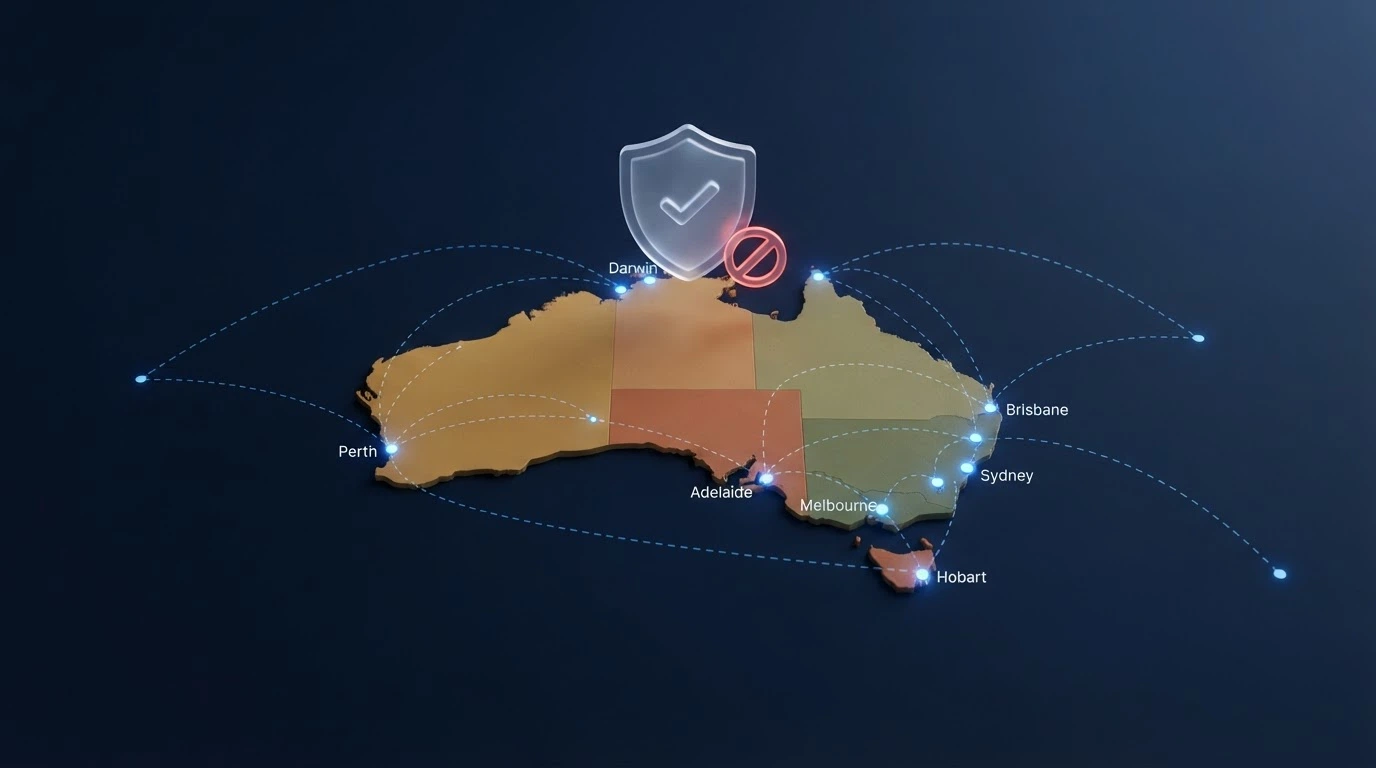
The enforcement record runs deep. The ACMA has had 1,788 illegal gambling and affiliate websites blocked by Australian ISPs since its first blocking request in November 2019 (1,564 as of March 2026, climbing through to August 2026), and more than 230 illegal services have withdrawn from the Australian market since 2017. The civil penalties sit at A$2,475,000 per day for an individual provider and A$12,375,000 per day for a corporation. The 2026 reform — the Interactive Gambling Amendment (Gambling Reform) Bill 2026, passed on 19 August 2026 — strengthens the prohibition further: from 1 January 2027, banks and payment providers gain express authority to block transactions to illegal gambling operators, alongside advertising restrictions and bans on celebrity and influencer promotion.
The Interactive Gambling Act — what it bans and what it doesn’t
The IGA’s scope is sharp. Prohibited services for Australians: online casino games, online pokies, and in-play betting on a sporting event once it has started. Permitted and licensable: pre-event wagering on racing and sport, lotteries and keno, through operators licensed by a state or territory. The minimum age for all commercial gambling is 18. The Australian Communications and Media Authority is the federal enforcer, and licensing for online wagering is state and territory business — concentrated at the Northern Territory Racing and Wagering Commission and administered through Licensing NT.
What the IGA does not do is prosecute the individual player. The provider is the target — civil penalties, site blocking, formal warnings, referral for enforcement — and an Australian punter playing a 7-reel pokie on an offshore site is not committing an offence under the Act. That is the only comfort the IGA offers the player, and it is a thin one. The player has no Australian consumer protection, no complaints body, and no recourse if the offshore site refuses a withdrawal, voids a win, or disappears with the balance still on it.
Offshore casinos vs Australian-licensed wagering — two different worlds
| Feature | Offshore casino | AU-licensed wagering |
|---|---|---|
| BetStop coverage | No | Yes |
| ACMA complaint handling | None | Yes |
| Payment methods | Credit, crypto, debit, e-wallet, bank | Debit, PayID, BPAY (credit/crypto banned since June 2024) |
| Withdrawal dispute recourse | None | State regulator + ACMA |
| Site blocking risk | Yes — ACMA can block at any time | None |
| Banking block (from 1 January 2027) | Yes | No |
| Default deposit ceiling | Set by the operator | Customer-set under state conditions |
| Tax on winnings | None (ordinary punter) | None (ordinary punter) |
The columns do different work. The offshore column carries the access — flexible payments, large bonus headlines, the catalogue an Australian punter actually plays — alongside the gaps that the licensed column closes. Credit card and crypto deposits are banned for AU-licensed wagering since 11 June 2024, with operator penalties up to A$247,500 for non-compliance; offshore sites accept both, and the e61 Institute has measured that the credit card ban cut affected punters’ sports gambling spend by A$50 per fortnight purely through reduced participation, not reduced stake size. The licensed column carries BetStop, ACMA complaint handling, withdrawal dispute recourse, and the absence of site blocking risk. None of those protections extend to an offshore casino.
From 1 January 2027, the banking block adds a new layer: banks and payment providers gain express authority to refuse or freeze transactions to illegal gambling operators. That is a material change for offshore access, and it is the closest the IGA has come to cutting the offshore route at the deposit stage rather than at the domain stage.
Where free-play and no-download 7-reel pokies sit in the legal framework
The IGA targets real-money gambling services. Free-play demo modes — the browser-based, no-registration instant-play versions most offshore casinos carry — are generally not captured by the Act, because no money changes hands. The ACMA has not issued specific guidance on demo-mode access, and the platforms hosting the demos are still offshore and still outside Australian regulatory reach.
That distinction is more useful to the operator’s lawyers than to the player. Demo mode runs through the same offshore casino infrastructure that real-money play does, and the player’s exposure does not change just because no money is at stake. The practical value is what the player does with it: learning the cluster-pays mechanics of Sugar Rush 1000 before risking A$2 a spin is the right order, and the ACMA’s silence on demo-mode access does not change the fact that the same site will be ready to take real money the moment the player decides to switch.
Staying Safe While Playing 7-Reel Pokies — Tools, Limits and the Real Risk
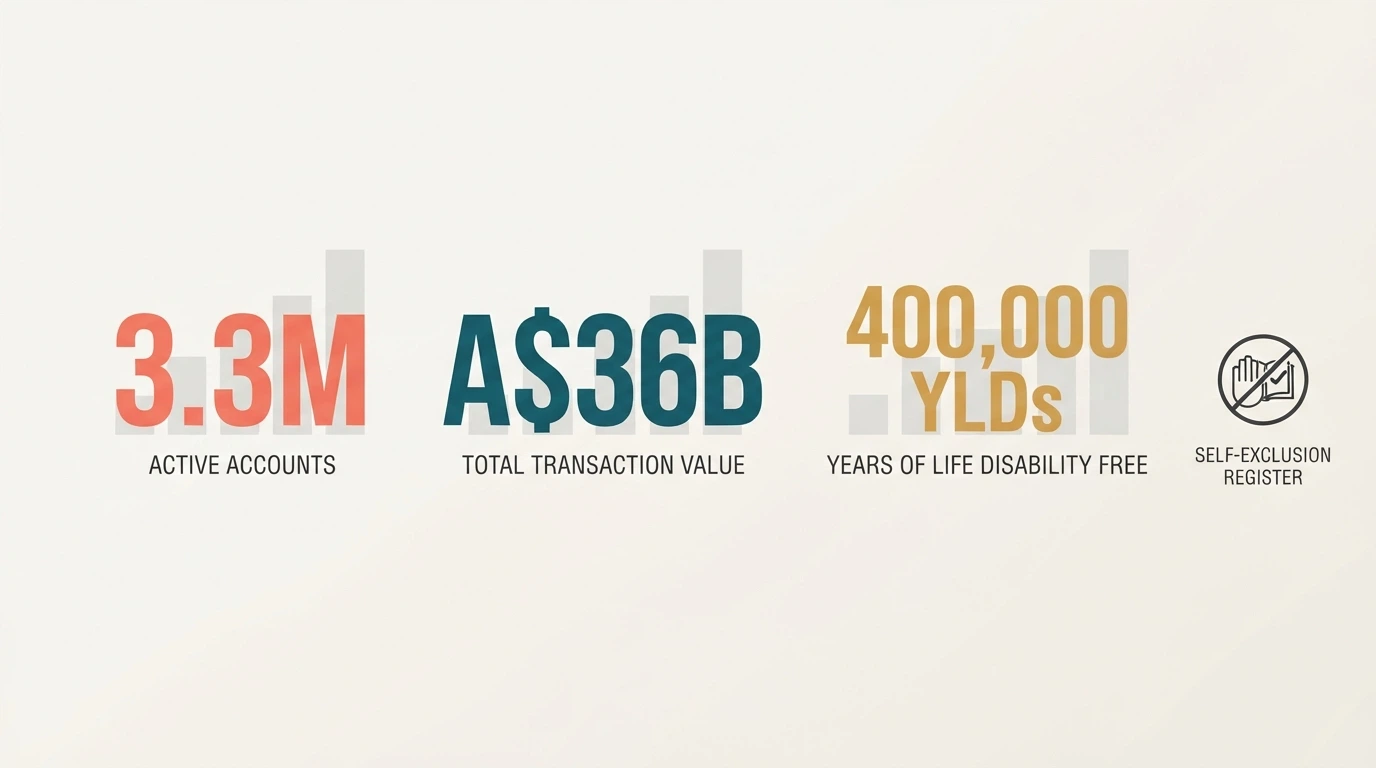
Australia runs some of the strongest harm-minimisation infrastructure in the world for licensed gambling — and none of it reaches an offshore pokie site. The National Gambling Helpline (1800 858 858) is free, confidential, and staffed 24 hours a day. Gambling Help Online runs 24/7 online chat with professional counsellors. BetStop — the National Self-Exclusion Register — has 67,480 registrations since its August 2023 launch, of which 41,290 exclusions are still active. Every one of those services works. None of them cover offshore casino play.
The single most important responsible-gambling fact on this page is the offshore gap. A player who self-excludes through BetStop is barred from every Australian-licensed wagering service in a single step — but an offshore casino is not licensed in Australia, is not connected to the register, and will keep accepting the same player’s deposits the same afternoon. The 2026 reform strengthens BetStop for licensed operators; it does not extend it offshore.
BetStop, deposit limits and the tools Australian players actually have
- BetStop — the National Self-Exclusion Register. Self-exclude from every AU-licensed online and phone wagering service in one registration, for a minimum of 3 months up to a lifetime. 67,480 registrations since August 2023; 41,290 still active. 78% of registrants were under 40, and 38% chose lifetime exclusion. Does not cover offshore casinos.
- National Gambling Helpline — 1800 858 858. Free, confidential, 24/7. Online chat and counselling through Gambling Help Online.
- Customer-set deposit limits and activity statements. Available on AU-licensed wagering platforms under state or territory conditions.
- State services. Gambler’s Help (Victoria), Problem Gambling Helpline (WA), QLD gambling harm counselling. Each state runs its own support line and online resources.
The list works for licensed wagering. For offshore casino play, the list shrinks to the helpline, Gambling Help Online, and the state services — and those are reactive, not preventative. Self-exclusion from an offshore site is a manual, site-by-site process, and there is no Australian regulator that enforces it.
Gambling harm by the numbers — what Australian punters need to see before they spin
The Roy Morgan Gambling Harm Index, published in mid-2026 and built on the Gambling Harm Scales framework from Central Queensland University, puts 3.3 million Australians — 15.1% of the adult population — in the category of experiencing some form of gambling harm. That figure breaks down into 13.0% (2,857,000 people) harmed by their own gambling and 5.4% (1,177,000 people) harmed by someone else’s gambling. The Problem Gambling Severity Index shows problem gambling climbing from 1.9% in 2022–23 to 2.4% in 2023–24 to 2.9% (622,000 people) in 2024–25.
The financial picture is harder to absorb. Australians lost A$36.0 billion to gambling between March 2025 and March 2026, according to The Australia Institute. The health burden runs to over 400,000 Years Lived with Disability annually, on a model that estimates approximately 3.29 million Australians aged five and over are affected each year by their own or another person’s gambling, including about 1.38 million adult affected others. Online gambling is now the majority channel: more than half (56.1%) of Australians who gamble did so mainly online in 2025, and risky gambling nearly doubled from 13.7% in 2024 to 19.4% in 2025, on the back of the COVID-era lockdowns. The most severe end of problem gambling still affects between 0.7% and 1.0% of the population, per ANU’s 2025 data.
These are the numbers behind the helpline. They are also the numbers an offshore pokie site does not surface on its homepage.
Setting limits before free-play tips into real money — a practical checklist
- Set a deposit cap before opening the casino lobby. Pick a figure you can afford to lose, and stop at that figure.
- Set a loss limit in dollar terms. Once the session has lost the cap, close the game.
- Use a timer. A 30-minute alarm is enough to break the cascade-chasing habit that 7-reel pokies encourage.
- Do not chase losses with another deposit. The second deposit does not undo the first loss; it adds to it.
- Check whether the offshore operator offers voluntary limit tools. Some do, but they are not legally required to and the coverage is inconsistent.
- Know that BetStop cannot reach an offshore site. Self-exclusion offshore is manual and site-by-site, with no automatic enforcement from any Australian body.
The checklist runs from the practical to the structural. The first four points are decisions the player makes and the player enforces. The fifth is a question to ask before depositing. The sixth is the hard truth every offshore punter eventually meets: the Australian safety net stops at the licensed border, and the offshore casino is not on the Australian side of it.
Why BetStop can’t reach your offshore pokie session — and what that costs you
A self-exclusion through BetStop is binding on every Australian-licensed online and phone wagering service, and on every land-based venue that has signed onto the register. 78% of registrants were under 40, and 38% chose lifetime exclusion — a step that says, in unambiguous terms, that the person making it has decided they cannot trust themselves to stop without an external barrier.
None of those barriers reach an offshore pokie site. The offshore casino is not licensed in Australia, is not connected to BetStop, and operates under its own house rules. The 2026 reform strengthens BetStop for licensed operators — tightening marketing restrictions, banning inducements for at-risk customers, and requiring a three-month cooling-off period on direct marketing after deregistration — but the reform does not extend the register’s coverage offshore. The reform is a strengthening of the licensed side, not an expansion of it.
What that means in practice: no safety net, no automatic block, no cooling-off period enforced by anyone but the player. A punter who has registered with BetStop and deposited on an offshore casino in the same week is breaking no law — but the registration did nothing to stop the deposit, and the offshore casino has no record of the exclusion. The harm-minimisation infrastructure that works for licensed wagering does not work for 7-reel pokies. The player is the only system that runs.
How We Chose and Ranked These 7-Reel Pokies — Sources and Criteria
The numbers on this page come from three sources. Best Slots Journal supplied the per-title RTP, volatility and max win figures for every game in the ranked table. Vegas Slots Online supplied the mechanics explainer for the 7×7 grid, cluster pays and the structural differences between 3-reel, 5-reel and 7-reel formats. The ACMA supplied the enforcement figures (1,788 sites blocked, 230+ services withdrawn, civil penalty amounts), and Roy Morgan Research and ANU supplied the harm-prevalence data behind the responsible-gambling section.
The ranking methodology is straightforward. Slot titles are ordered by RTP from highest to lowest, with max win and volatility as the secondary filters where two titles share an RTP. Only titles with verified RTPs are included in the table; titles with no verified RTP are excluded rather than estimated. The operator ranking is AU market share, drawn from market-data partners and cross-referenced where research permits. The 10 operators listed are the operators that Australian punters actually access for 7-reel pokies — not a ranking of licensed casinos, because there are no licensed online pokies anywhere in Australia.
What this page cannot do: it cannot test every operator live, it cannot guarantee current bonus terms or game availability, and it cannot speak to the experience of any individual player. Bonus terms change, game catalogues rotate, and a casino that carries Reactoonz today may not carry it next quarter. The page is a snapshot of what research verified at the time of writing — and a player depositing real money should always confirm the current offer directly on the operator’s site before committing.
Your 2026 7-Reel Pokie Playbook — What to Actually Do Next
The best 7-reel pokie by long-run cost is Sugar Rush 1000 at 97.5% RTP, with Fiesta Clusters at 97.0% the clear second. The best 7-reel pokie by max win is a tie between Sugar Rush 1000 and Seven 7’s at 25,000× — and the choice between them runs through volatility, since Sugar Rush 1000 is a grid-based cluster game and Seven 7’s is a classic-tinged reel game. The best 7-reel pokie by volatility profile is the question the RTP ranking does not answer: Atomic Kittens pays frequently in small amounts at 17,040× max win, and the rest of the catalogue sits somewhere between that and Reactoonz’s 10/10 maximum volatility.
The cost of a session is the number that matters most. At A$2 per spin across a 200-spin session — roughly 17 minutes at the 5-second pace a 7×7 cluster game runs — the expected loss under Sugar Rush 1000’s 97.5% RTP works out to A$10. The same session on a 96.5% game costs A$14. The same session on a 96.83% game costs A$12.83. Those figures assume every spin is paid at the same stake and no bonus round alters the maths — which is rarely true in practice, but useful as a benchmark. The A$36 billion Australians lost to gambling in the year to March 2026 is the aggregate version of the same calculation, run across millions of sessions at stakes most punters would not blink at individually and add up to something the country cannot afford collectively.
The offshore reality sits underneath every other recommendation on this page. None of the operators above is licensed in Australia — the product is prohibited — and none of them is connected to BetStop, falls under ACMA complaint handling, or guarantees the player any recourse if a withdrawal stalls. From 1 January 2027, banks gain the express authority to block transactions to illegal gambling operators, which is the closest the IGA has come to cutting the offshore route at the deposit stage. The defensive moves a player can make are the practical ones: demo first, deposit small, set a timer, and know that the safety net Australia has built for licensed wagering does not reach an offshore pokie site.
The verdict is not a casino recommendation. It is an argument from the numbers. Sugar Rush 1000’s 97.5% RTP gives the player the lowest long-run cost; the offshore route that delivers Sugar Rush 1000 to an Australian punter carries risks no Australian regulator can insure against; the responsible-gambling tools that work for licensed wagering do not work here. A player who has read this far knows all three of those statements. The rest is what they decide to do with them.
Frequently Asked Questions
Can I play 7-reel pokies for free before wagering real money in Australia?
Yes — most offshore casinos serving Australian players carry demo-mode versions of their 7-reel titles. The demo runs the same game engine, RTP and cluster-pays mechanics as the real-money version, with no registration or download required on most platforms. The ACMA has not issued specific guidance on demo access, and the IGA’s prohibition targets real-money gambling services, so free-play demos fall outside that scope.
What are the bonus features typically found in 7-reel slot machines?
Cascading wins (winning symbols vanish and new ones drop in), charge meters that fill across cascades and trigger bonuses, multiplier grids where winning positions accumulate 2× up to 128× multipliers, and free-spin rounds that integrate with the cluster mechanics. Sugar Rush 1000’s Multiplier Spots system — doubling to 128× and never resetting during free spins — is the worked example the rest of the genre follows.
Is it safe to play 7-reel pokies on offshore casino sites from Australia?
Offshore sites carry the games an Australian punter wants to play, but they do not carry Australian consumer protection: no BetStop, no ACMA complaint handling, no recourse if a withdrawal stalls. The IGA targets the provider rather than the player, so the player is not prosecuted — but the player is unprotected, and the ACMA can block an offshore site at any time with the player’s balance still on it.
What is the best-paying 7-reel slot in terms of RTP and max win?
Sugar Rush 1000 by Pragmatic Play leads at 97.5% RTP with a 25,000× max win. Fiesta Clusters by BGaming is second at 97.0% RTP and 5,000× max win. Seven 7’s matches the 25,000× ceiling on a 96.6% RTP, and Atomic Kittens stretches to 17,040× at 96.75% RTP with low volatility. The right answer depends on whether long-run cost, payout ceiling or win frequency matters most to the player.
How do cluster pays work in 7-reel pokies compared to traditional paylines?
Cluster pays replace fixed paylines entirely. Instead of matching symbols on a predefined path, the player needs five or more matching symbols connected horizontally or vertically anywhere on the 7×7 grid. Every connected cluster pays, and winning symbols vanish to allow new symbols to cascade in for another evaluation. The result is a game that can chain multiple payouts from a single paid spin, running at higher volatility than the equivalent fixed-line slot.
Created by the ”Microgaming Casinos AU” editorial team.