An honest guide to online keno casinos for Australian players in 2026
 Available in AU
Every keno casino an Australian can actually reach from inside the country is an offshore casino. The Interactive Gambling Act 2001 makes it an offence to provide an online casino product to a person in Australia, and no Australian licence exists for online keno anywhere — not federally, not in any state or territory. From 1 January 2027 the picture hardens further: the Interactive Gambling Amendment (Gambling Reform) Bill 2026 explicitly bans online keno outright under Schedule 4. This page ranks the offshore operators Australian keno players actually use, lays out the real RTP and bonus arithmetic, and shows where the consumer-protection gap sits before any punter opens an account. The ranking does not pretend the legal picture is greyer than it is.
Data current as of 18 October 2026 and verified against the ACMA’s public register of licensed Australian wagering services.
Table of Contents
- What Makes a Keno Online Casino Worth Your Time in 2026
- How Online Keno Actually Works — Rules, Variants and the RNG Behind Every Draw
- Keno Slots vs Pokies — Why the Label Changes What You Are Playing
- Free Keno Slots — Practice the Game Before You Put Real Money Down
- Bitcoin Keno Casinos — Crypto Deposits, Faster Payouts and What the Ban Means
- The Best Offshore Keno Casinos Accepting Australian Players in 2026
- Neospin — 14 Keno Formats and a 96.9% Site-Wide RTP
- Stake — 99% House-Keno RTP and a Crypto-First Platform
- SkyCrown — 450% Welcome Bonus and 30x Wagering on Keno
- Rocket Play
- Royal Reels
- FairGO
- Bizzo Casino
- WinSpirit
- Scream Casino
- Rainbet
- Is Online Keno Legal in Australia? What the Interactive Gambling Act Actually Says
- Playing Keno Safely — Limits, Self-Exclusion and Where to Get Help
- How We Evaluated and Ranked These Keno Casinos
- Should You Play Keno at an Offshore Casino? What the 2026 Landscape Means for Your Choice
- Frequently asked questions
What Makes a Keno Online Casino Worth Your Time in 2026
There is no licensed Australian online keno casino to recommend. What an Australian player can access from inside the country is a set of offshore brands that accept Australian sign-ups, run keno among their games, and operate under their own house rules — licensed elsewhere, governed by their own terms, and outside the reach of BetStop and Australian consumer law. That does not mean the choice is meaningless. It means the criteria for “best” have to be picked deliberately rather than assumed.
A keno-focused online casino, in the sense most Australian searchers mean it, is an offshore casino whose keno catalogue, keno RTP, mobile access and AU-friendly cashier make keno the realistic centre of gravity — not just one tab among thousands of pokies. The best of the bunch pair a wide keno format count with published paytables, decent bonus terms on keno (rare, but it exists), and a payment route that has not been blocked by the credit-card and crypto ban that took effect on 11 June 2024. None of this changes the legal picture. It changes the practical one.
What Is an Online Keno Casino — and What Makes One Worth Playing At
A keno casino is a casino that carries keno titles and treats them as a discoverable category, not a curiosity hidden behind a search bar. The wider offshore brands stack 5,000 to 10,000 games and put one or two keno entries deep in the lobby; a keno-focused operator puts keno near the top, alongside live casino and pokies, with enough variants to make the choice between them a real one. Format count matters because the difference between two keno games is not cosmetic — it is whether you can play one card at a time, four cards simultaneously, turbo draws every few seconds, or live-dealer keno with a human presenter running the draw.
RTP transparency is the second leg. Licensed Australian keno returns about 75% across spot types — a 25% house edge baked into every draw. Online keno at offshore casinos runs anywhere from about 75% on the thinnest paytables up to roughly 99% on the best, with most mainstream titles sitting in the 94%–98% band. That gap — 20 percentage points of house edge — is the difference between a slow bleed and a fast one, and a paytable that publishes the figure is worth more than one that does not. Deposits and withdrawals matter because the AU credit-card and crypto ban reshaped the cashier at every operator an Australian punter reaches. Mobile access matters because most offshore keno play happens on a phone.
How We Shortlisted and Ranked the Best Keno Sites for Australian Players
Every operator in this ranking is offshore. The shortlist came from the AU operators skill (offshore casino brands with real AU traffic) and the search archive of prior AU keno searches, then ordered by keno-specific fit. The criteria that ranked them were keno format count, keno RTP where the operator publishes one, welcome offer value weighted against wagering, AU-facing cashier and payment routes, and the availability of mobile and demo play. The ACMA’s enforcement record — 1,564 illegal gambling sites blocked since November 2019 and more than 225 services withdrawn from the Australian market since 2017 — was the background, not a screening filter. The product is prohibited. Every operator in this list sits on the wrong side of that line, and naming them honestly is the only responsible way to write this page.
A few things did not make the cut and should be named. No AU-licensed wagering operator offers online keno at all. Keno at TAB outlets and The Lott runs in retail venues and over the counter, not as an online casino product. Casino-style keno products from state-licensed venues are similarly land-based. The result is a ranking whose every entry is offshore, whose every entry sits outside Australian consumer protection, and whose RTP spread runs from ordinary to excellent.
How Online Keno Actually Works — Rules, Variants and the RNG Behind Every Draw
Online keno looks like a lottery ticket, plays like a slot machine, and pays like neither. A punter picks numbers from a pool, the game draws numbers at random, and the paytable settles the bet by how many of the punter’s picks match the drawn numbers. What changes between variants — and what makes one keno game worth more than another — sits underneath that simplicity: how many numbers you can pick, how many the draw produces, what the paytable pays for a given hit count, and how fast the rounds run.
The mechanics are uniform across offshore casinos because the providers writing keno titles are a small set. Spribe, Galaxsys, Lightning Box and a handful of in-house developers account for most of what an AU player will see in a keno lobby. Each one writes the paytable, sets the RTP, and chooses the volatility band; the casino merely hosts the game.
How to Play Keno Online — Spot Selection, Draws and Paytables
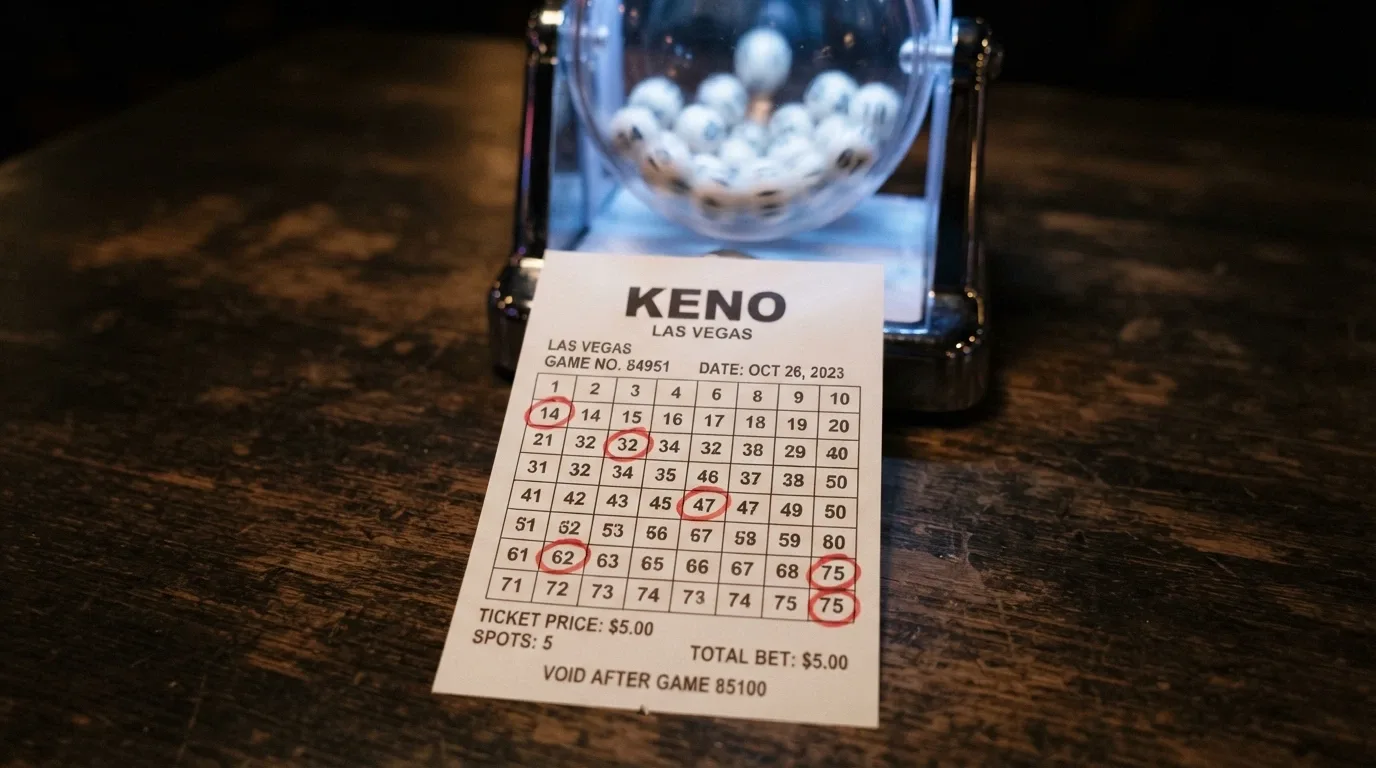
Pick your spots. Standard online keno tickets allow between 1 and 10 spots from a pool of 80 — your selection is the set of numbers you want to hit. Some products extend the range to 15, 20 or even 40 spots; those are rarer offshore and worth picking deliberately because the hit-rate math shifts as the grid widens. Once your spots are marked, the draw runs: 20 numbers pulled from the 80, drawn live on screen or generated by a random number generator, with the whole round taking a few seconds at the offshore end.
The paytable is where the game actually lives. Each paytable cell shows what a stake returns for a given combination of spots hit — usually the highest multiplier reserved for catching every spot, lower multipliers for partial hits, and a zero or near-zero return for missing almost everything. The more spots you pick, the larger the top-end multiplier (a 10-spot catch on a max-pick ticket can pay tens of thousands of times the stake), but the lower the probability of any specific hit count. Minimum stakes at offshore keno commonly start at A$1 per game. Maximum stakes vary by title and casino, and the bigger the maximum, the more important it is to read the paytable before staking. A QuickPick button picks a random selection for you; auto-play lets the same spots run across a configured number of rounds.
Multi-Card and 4-Card Keno — Playing Several Cards in One Round
Multi-card keno is the variant for players who want more action per round without manually rebuilding a ticket every draw. The mechanic is simple: pick one set of numbers, then play that same selection across two, four, ten or even twenty cards simultaneously, with each card paying independently. 4-card keno is the most common version — four grids, one draw, four sets of results. The upside is volume. The downside is bankroll burn — every card costs a stake, so a four-card round costs four times a single-card round, and the variance multiplies with the card count.
The trade-off is the honest framing. A single-card round at A$1 costs A$1 per draw and gives one set of results; a 20-card round at A$1 costs A$20 per draw and gives twenty. The expected loss per draw scales linearly with the card count, because each card pays independently through the same paytable. The thrill comes from the multi-card grid — four flashes of partial hits across four tickets at once — but the math does not improve with the card count. Keno is pure chance on each card, and no quantity of cards beats the house edge.
Live Keno vs RNG Keno — What Changes When a Dealer Runs the Draw
The split between RNG keno and live keno is the split between software and studio. RNG keno is software-driven: a random number generator picks the 20 numbers, the draw animation plays out over a few seconds, and the round resolves before the player has finished their next sip of coffee. Live keno runs the same game with a human presenter drawing the numbers on a stream — same 20-from-80 mechanics, same paytable, slower pace and a different atmosphere.
The honest comparison is on three axes. Pace: RNG draws complete in a handful of seconds, often with a turbo option that runs in under five; live draws follow the studio schedule, often with pauses between rounds. Transparency: RNG keno at reputable providers (Spribe, Galaxsys) runs on a published RNG that has been audited, with provably fair protocols on some titles; live keno has the visible draw as its own proof. RTP: the paytable does not change between RNG and live versions of the same title — the house edge is the same. The decision between them is a feel question, not a math question.
Keno Strategy — What Actually Moves the Needle and What Does Not
There is no keno system that beats the house edge. Every spot-count strategy, every number-pattern theory, every “due number” notion is selection bias dressed in mathematics — keno is a pure-chance game where each draw is independent of the last, and the only constant is the paytable. What does move the needle is the paytable itself. A 99% RTP keno game returns A$99 of every A$100 staked across millions of draws; a 75% RTP game returns A$75. That is a 24 percentage point difference in expected return, larger than anything a spot-count choice can produce.
Bankroll management is the second lever, and the one that matters most for a high-variance game. Keno’s draw frequency means a session can absorb hundreds of rounds in an hour, and a bankroll that survives a thousand draws at A$1 each (A$1,000) is not the same bankroll that survives a hundred 4-card rounds at A$5 (A$2,000). Setting a session cap before the first draw — a hard ceiling on losses and a time limit on the session — is the practical edge a player controls. Choosing fewer spots improves hit frequency at the cost of payout size; choosing more spots does the reverse. Neither changes the long-run expected loss.
Real-Money Keno — Stakes, Paytables and What a Win Actually Pays
The headline gap is between licensed Australian keno and offshore online keno. Licensed AU keno, available at retail venues and licensed clubs, returns about 75% across spot types 1 through 10, 15, 20 and 40 — a house edge near 25% baked into the paytable. Offshore online keno runs higher: Spribe’s Keno at 97%, Galaxsys Keno at 93.55% on the base title but up to 99.6% on variants, Stake’s house keno at 99%, BC.Game’s Keno at 98%, Lightning Box’s Keno at 94%. The RTP spread across published titles is roughly 75% to 99%, and that spread is the most consequential number on the page.
The maximum win line tells the same story at a different scale. Spribe’s Keno 80 tops out at a ×63,500 maximum win — a theoretical ceiling that requires the maximum number of spots matched on the maximum stake. Galaxsys Keno 10 caps at ×10,000. BC.Game’s Keno stops at ×1,000 on a 1–40 grid. Keno Express by Galaxsys sits at a modest ×97 maximum. The relationship between max win and RTP is not linear — a low max win can sit on a high RTP title — but a player who chases the largest headline multiplier is gambling against a paytable that pays it rarely. A A$1 minimum stake per game is the floor; the ceiling is whatever the operator allows, and offshore keno sites typically run higher maximums than retail. The table below sets the verified figures side by side.
| Keno Title | Provider | RTP | Volatility | Max Win |
|---|---|---|---|---|
| Keno | Spribe | 97% | Medium | — |
| Keno 80 | Spribe | 94.48% | — | ×63,500 |
| Keno | Galaxsys | 93.55% (range 87.5%–99.6%) | High | ×10,000 |
| Keno Express | Galaxsys | 97% | Variable | ×97 |
| Keno | BC.Game | 98% | — | ×1,000 |
| Keno | Stake | 99% | — | — |
| Keno | Lightning Box | 94% | Medium | — |
| Across the Universe Keno | — | 95.15% | High | — |
| Keno Fast | — | 95.5% | — | — |
| Bonus Keno 2 | — | 96.51% | — | — |
| Keno Betting | — | 97.44% | — | — |
| Keno | Duel | 99.95% | — | — |
| Keno | Roobet | ~96% | — | — |
The pattern to read is the spread. The best figures cluster around Spribe, Galaxsys variants, BC.Game and Stake; the thin end of the paytable sits with base Galaxsys Keno at 93.55% and Lightning Box Keno at 94%. The keno racing, heads-or-tails and progressive MegaMillions-style pool products run closer to 80% RTP at the licensed end and around 76.5% on the progressives. A player choosing a title from this list should weight the RTP first and the max-win headline second, because the RTP is the number that compounds across a session.
Keno Slots vs Pokies — Why the Label Changes What You Are Playing
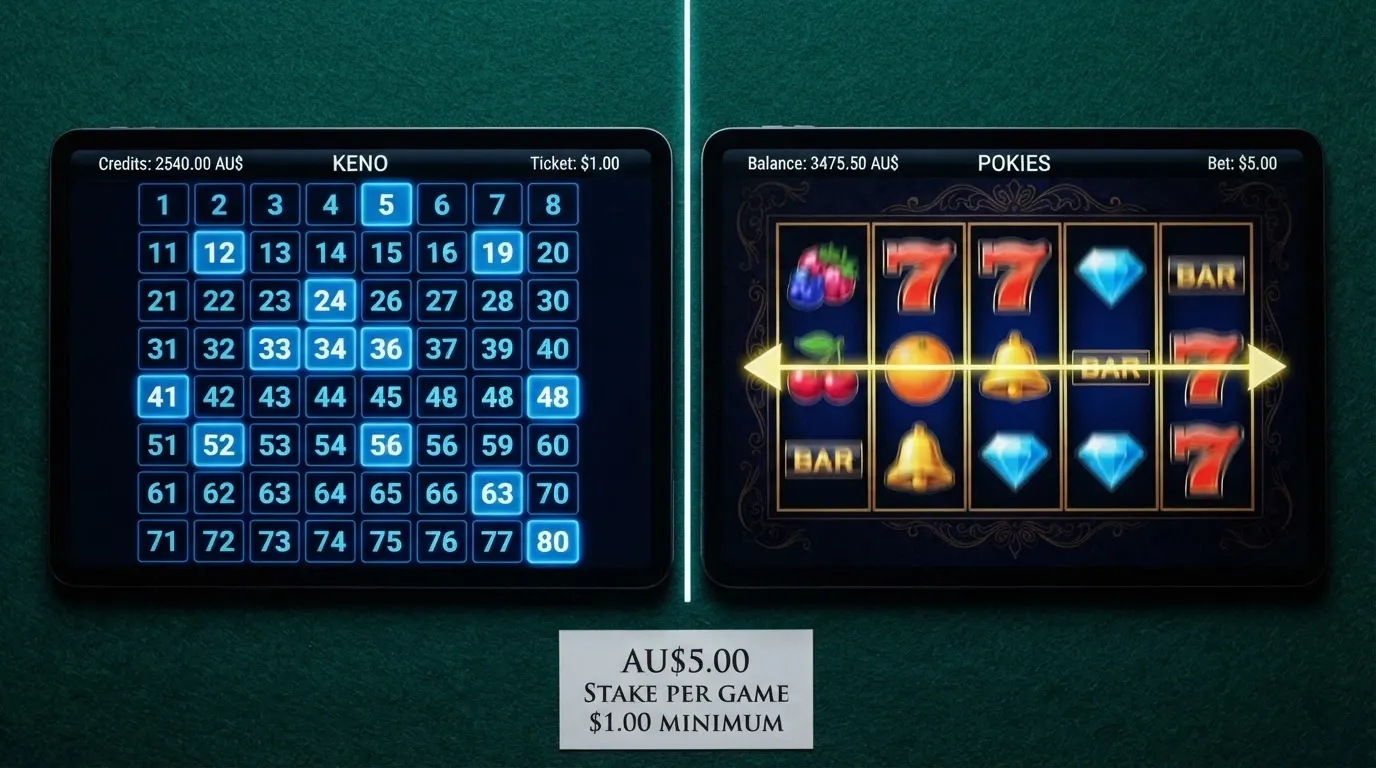
Australian searchers use two words for what the rest of the world calls slots: “pokies” and “slots”, and they slip between them without noticing. The slip matters when the game inside the cabinet is not a slot at all. Keno slots, also searched as keno pokies, are keno games dressed in pokie-style clothing — the number-draw mechanics of keno running inside an interface that looks like a pokie. They are not pokies, and the RTP behaves differently because the game underneath is different.
Keno Slots and Keno Pokies — What the Australian Label Means
“Keno pokies” is a distinctly Australian search — a label that pairs the local word for slots with the number-draw game. The reasoning is mechanical: many keno titles at offshore casinos sit inside the same lobby as the pokies, use the same casino-style cabinet graphics, and the casual player looking for “pokies online” finds them alongside actual reel-spinning games. The label is local; the game is universal. Underneath every keno pokie is a 20-from-80 number draw and a paytable, not five spinning reels and a payline structure.
The practical implication for an Australian player is that searching “keno pokies” surfaces a wider set of titles than searching “keno” alone, because the algorithm reads “pokies” as a slot category and indexes the keno entries under it. The game mechanics are not changed by the label. The paytable still pays on spots hit, the draw still produces 20 numbers from 80, and the RTP is whatever the developer published.
Slot-Machine Keno and Your Odds — What the Reels Hide
A keno draw inside a pokie-style cabinet hides two things. The first is the format: a player who loads what looks like a pokie and sees a number grid instead of spinning reels is playing keno with a pokie’s visual frame, not a pokie. The second is the RTP — and here the gap can be wider than between two keno titles. A Lightning Box Keno, for example, runs at 94% RTP with medium volatility. A mainstream pokie from the same provider typically sits in the 95%–96.5% band. The keno slot is not necessarily worse, but it is a different game with a different expected return, and a player who assumes the pokie’s RTP carries over will be off by several percentage points of house edge.
The widest spread sits at the bottom. Keno titles licensed for retail in Australia are configured at about 75% RTP — a 25% house edge that would be unacceptable on a digital pokie. Online keno at offshore casinos sits much higher. The reels hide this spread because the visual language is identical: both look like casino games, both use the same bonus-round vocabulary, both show a “spin” button. The numbers underneath are not the same.
How to Access Keno-Slot Play Online From Australia
Keno-slot titles live inside the broader game lobby at the offshore casinos. Neospin runs 14 distinct keno formats inside a 5,800-plus game library, which is the widest confirmed range in the ranking; Wild Tokyo, named in the search archive but not in the top-10 ranking, has logged 23. Demo mode is available on most of these titles at the casinos that carry them, which means a player can run a thousand draws at zero cost to learn the paytable before staking real money. The mobile experience mirrors the desktop one — the grid fits a phone screen and the cashier behaves identically.
The honest summary is that the “keno slots” search is a useful way to find keno games dressed in slot-cabinet graphics, but the category is not a separate game family. It is keno, hosted inside a casino that also hosts pokies, and the RTP that governs it is the keno title’s RTP — not the casino’s overall RTP and not the pokie section’s RTP. A punter who wants the best keno-slot odds should look at the per-title RTP table earlier in this page, not the casino’s site-wide figure.
Free Keno Slots — Practice the Game Before You Put Real Money Down
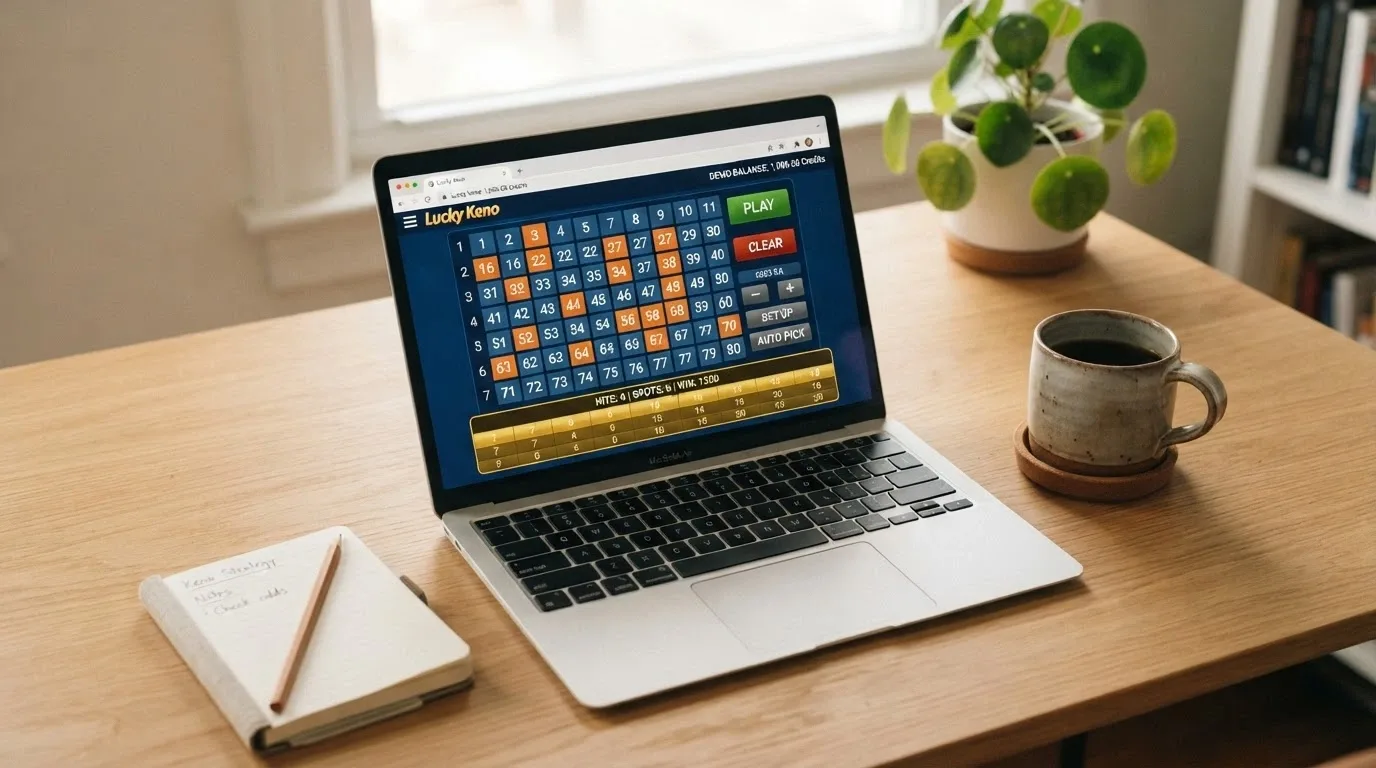
Free-play keno is the most useful tool an offshore casino offers a new player, and it costs the casino nothing to provide it. Most keno titles run in demo mode by default — load the game in the browser, the casino loads a fake balance (often 1,000 credits), and every mechanic behaves exactly as it would with real money. The draw is the same RNG, the paytable is the same, the volatility is the same. What changes is the absence of a stake, which removes the part of the experience a new player most needs to learn: their own behaviour under pressure.
Free Keno Slots — Play Without Spending a Cent
Free keno is widely available at the offshore casinos in this ranking. No deposit is required; no account is needed at some casinos; the games load as HTML5 in a browser and run with virtual credits. The range of free keno titles runs from classic 10-spot single-card keno through turbo draws, multi-card variants, video keno with bonus features, and live-dealer keno — the same catalogue as the real-money version, gated by the demo toggle rather than by payment.
Two things deserve attention. First, the paytable in demo mode is the same as in real-money mode for the same title at the same casino, with rare exceptions where providers run a slightly tighter demo version. Second, demo mode does not teach the cashier — deposits, withdrawals, KYC, bonus terms — and those are the parts of offshore casino play most likely to surprise a new player. Free keno is a tutorial on the game. It is not a tutorial on the casino.
Demo and Practice Keno — What You Learn Before You Stake
A practice session reveals what reading about keno cannot. The draw rhythm — how fast a round resolves, how the animation reads, how long a 100-round session actually takes — is a felt quantity, not a written one. The bet slider’s behaviour at minimum and maximum stakes, the auto-play confirmation prompts, the way a near-miss reads on screen, the volume of stake buttons on a mobile interface — all of these are visible in demo mode and invisible on a paytable.
What demo mode does not reveal is the psychological pressure of real money. A punter who runs 100 demo rounds at A$1 nominal stake and a punter who runs 100 real-money rounds at A$1 are playing different games, because the second punter feels the loss in a way the first does not. The session cap, the loss limit, the time check — none of these exist as instincts until they have been set and tested under real-money pressure. Demo mode is the right place to learn the rules. The right place to learn the discipline is the first real-money session, with the limits already set.
Bitcoin Keno Casinos — Crypto Deposits, Faster Payouts and What the Ban Means
Crypto deposits at offshore casinos are marketed on three promises: speed, anonymity and lower fees. The promises are partly true, and partly irrelevant to an Australian player — because Australian-licensed operators cannot take crypto, and offshore operators that do take it sit outside the AU consumer protection framework that the credit-card and crypto ban was meant to enforce.

Bitcoin Keno Deposits and Payouts — How They Work at Offshore Casinos
Funding a keno session with Bitcoin or another cryptocurrency at an offshore casino works as it does at any merchant that accepts crypto. The punter sends Bitcoin (or Ethereum, USDT, Litecoin and a long tail of alternatives) to a casino-controlled wallet address, the casino credits the account once the transaction confirms on the blockchain, and keno play begins. Withdrawals reverse the process: the casino sends crypto to a punter-controlled wallet, typically within hours for the established operators and longer for the slower ones.
The speed advantage is real at the deposit end and variable at the withdrawal end. A crypto deposit confirms in minutes; a bank transfer takes longer. The withdrawal half is where offshore casinos diverge — a fast operator pays within an hour, a slow one takes 24 to 48 hours, and a problematic one does not pay at all. The anonymity claim is more limited. The blockchain is public; the casino knows the wallet address it paid, and a punitive regime (or a tax authority) can trace the flow. What crypto does offer is the absence of a card-network intermediary, which is the mechanism the AU payment ban uses to block credit transactions.
Anonymous and Crypto-Friendly Keno — What the AU Payment Ban Actually Changes
The Interactive Gambling Amendment (Credit and Other Measures) Act 2023 took effect on 11 June 2024. Credit cards, credit-related products and digital currency are now banned as payment for online wagering in Australia. The target of the ban is the payment route, not the player — an operator that processes a credit-card deposit or accepts crypto from an Australian customer faces penalties of up to A$247,500. The individual player is not prosecuted; the IGA targets the provider, and the payment ban targets the payment.
What this means for an offshore casino is that the ban bites through the Australian payment infrastructure, not through the offshore casino’s terms. A bank can refuse to send a credit-card transaction to an offshore gambling merchant; an Australian-licensed payment processor is barred from handling the transaction. The offshore casino itself sits outside Australian jurisdiction, and the only mechanism that reaches it is the bank’s refusal. From 1 January 2027, banks and payment providers gain express statutory authority to block transactions to illegal gambling operators — a tightening of the existing arrangement that makes the practical effect of the ban more uniform. The anonymity trade-off for a crypto-using punter is sharp: no KYC at some offshore casinos means no recourse if the operator refuses a withdrawal, freezes the account, or disappears.
The Best Offshore Keno Casinos Accepting Australian Players in 2026
Every operator in the table below is offshore. None holds an Australian online casino licence because none can — online casino games, including keno, are prohibited in Australia under the Interactive Gambling Act 2001, and the Interactive Gambling Amendment (Gambling Reform) Bill 2026 will prohibit online keno outright from 1 January 2027. The ACMA has blocked 1,564 illegal gambling sites since November 2019, and more than 225 services have withdrawn from the Australian market since 2017. What follows is a ranking of the offshore operators with the strongest keno-specific fit and AU-facing access; the legal picture above it does not change.
| Operator | Legal Status in Australia |
|---|---|
| Neospin | Offshore — no Australian licence |
| Stake | Offshore — no Australian licence |
| SkyCrown | Offshore — no Australian licence |
| Rocket Play | Offshore — no Australian licence |
| Royal Reels | Offshore — no Australian licence |
| FairGO | Offshore — no Australian licence (AU-branded) |
| Bizzo Casino | Offshore — no Australian licence |
| WinSpirit | Offshore — no Australian licence |
| Scream Casino | Offshore — no Australian licence |
| Rainbet | Offshore — no Australian licence |
The detailed write-ups that follow the table cover each operator’s keno-specific offering, welcome bonus and wagering terms where research confirms them, and the practical case for or against that brand for an Australian keno player. Where the operator’s bonus terms, keno format count or game-by-game RTP have not been independently confirmed, the write-up says so rather than guessing.
Neospin — 14 Keno Formats and a 96.9% Site-Wide RTP
Neospin carries the widest confirmed keno catalogue in the ranking: 14 distinct keno formats inside a 5,800-plus game library. The overall site-wide RTP runs at 96.9%, which is competitive against the major offshore casinos and well above the licensed Australian keno figure of around 75%. The welcome offer is a 300% deposit match up to A$11,000 with 300 free spins attached — among the larger match percentages in the ranking, sized for a punter who plans to make a substantial first deposit and work through it across the bonus period.
The 14-format catalogue is the headline for a keno-specific player. A wider keno format count means more variants to compare paytables against, more chances to find a high-RTP title, and more flexibility on spot count and draw speed. Some of the 14 will be duplicates or reskins under different names; the working figure is that the keno section is a real section, not a one-title curiosity. The 96.9% site-wide RTP is the cross-game figure across pokies, table games and live casino, weighted by play volume; the keno-specific RTP on individual titles will sit either side of that average depending on the developer.
The honest case for Neospin is the keno depth plus the welcome-offer size: a punter who values format choice and is willing to make a sizeable deposit gets both. The honest caveat is that the wagering multiplier on the bonus, the maximum cashout from the offer, and the game-specific contribution of keno to wagering have not been independently confirmed in this round — and keno’s contribution to wagering requirements is typically lower than pokies’ at most offshore casinos, which extends the time and stake volume needed to clear a bonus. Neospin carries the widest confirmed keno catalogue in the ranking, and the welcome offer is among the largest match percentages available; the wagering terms need a careful read before staking.
Stake — 99% House-Keno RTP and a Crypto-First Platform
Stake’s house keno carries a 99% RTP — the highest confirmed figure for any keno title in the ranking. The platform is crypto-native: deposits and withdrawals run through Bitcoin, Ethereum, Litecoin and a wide range of altcoins, the cashier is built around on-chain settlement, and the game catalogue includes Stake’s proprietary titles alongside the third-party catalogue. The platform’s provably fair architecture is the technical claim behind every draw — a cryptographic verification mechanism that lets a punter confirm each outcome was generated by the stated algorithm and not retroactively altered.
The 99% RTP is the number that matters for a keno-specific player. A 1% house edge sits below every other figure on this page, including the 97% on Spribe’s mainstream keno, the 98% on BC.Game’s keno, and the 94% on Lightning Box’s keno. The practical implication is that a punter staking A$1 per draw at Stake’s house keno over a long session loses roughly A$1 per A$100 staked, against A$6 per A$100 at a 94% RTP title. The 5 percentage point difference between a 99% and a 94% title is the difference between a session that bleeds slowly and one that bleeds quickly.
The case for Stake is the 99% keno RTP plus the crypto cashier. The case against is the one that applies to every offshore crypto casino for an Australian player: no Australian licence, no BetStop coverage, and from 1 January 2027 an Australian bank with the new statutory authority to block the transaction outright. Welcome-offer terms at Stake are typically structured around rakeback, reload bonuses and sportsbook promos rather than the deposit-match-and-free-spins model used by pokies-focused casinos — a structure that suits a keno player who wants to fund a session directly rather than work through a bonus. For a punter comfortable with crypto and looking for the lowest house edge in the keno market, Stake is the strongest fit.
SkyCrown — 450% Welcome Bonus and 30x Wagering on Keno
SkyCrown’s welcome offer is the largest in the ranking by match percentage: 450% deposit match up to A$8,000 with 400 free spins, against 30x wagering on the bonus. The maths is straightforward and the conclusion is unflattering. A bonus at the A$8,000 cap times 30x wagering means A$240,000 of required turnover before any withdrawal clears. At a 95% RTP — the working figure for mainstream online keno — the expected loss across that turnover is A$240,000 multiplied by 5%, or A$12,000. Pull the RTP down to 75% on a thin paytable and the same turnover costs A$240,000 multiplied by 25%, or A$60,000. Sit a keno title at the 99% end of the spread and the expected loss falls to A$2,400; sit it at 80% — the band that covers keno racing and heads-or-tails — and the loss rises to A$48,000. The honest reading: the bonus is not free money, it is a spend commitment whose cost is paid in house-edge losses, and the size of the cost is governed by the paytable the punter actually plays.
To hit the A$8,000 bonus cap, a punter deposits roughly A$1,778 — the deposit at which the 4.5× multiplier reaches the maximum. The 30x wagering requirement is mid-range for offshore casinos, and the 400 free spins add a slot dimension whose value depends on the slot’s RTP and any winnings cap. Data on SkyCrown’s specific keno metrics is unavailable in this search, which limits the comparison. SkyCrown is the right pick for a punter who wants the biggest welcome multiplier and has read the cost above, not a punter who treats 450% as a gift.
Rocket Play
Rocket Play sits in the ranking as an offshore brand with archive-confirmed Australian keno traffic. The site does not publish keno-specific bonus, format or RTP metrics, so the archive relies on AU player visit data rather than verified operator specs. A punter signing up to Rocket Play for keno will find an offshore casino that accepts Australian sign-ups, offers keno in its game lobby, and runs under its own licensing and terms. The lack of published data means the page cannot detail the welcome offer, wagering, or format counts; the punter has to read the terms page themselves.
For an Australian keno player, Rocket Play is a reasonable fallback when the data-confirmed operators — Neospin, Stake, SkyCrown — are unavailable or undesirable, with the same offshore legal picture and the same gap between Australian consumer protection and the casino’s player base. The honest case for the brand is its presence in the AU keno search archive; the honest caveat is the absence of independently confirmed keno-specific data. Compared with Neospin, Stake and SkyCrown, Rocket Play is the fallback — chosen when a punter wants a third option beyond the data-confirmed operators and accepts the verification exercise on a less-documented brand.
Royal Reels
Royal Reels’ name is positioned squarely at the Australian punter, and the offshore reality sits behind it. The brand accepts Australian sign-ups, runs keno in its lobby, and operates under an offshore licence that does not extend to Australian consumer protection. Specifics on the welcome offer, keno format count and bonus wagering have not been confirmed in this round.
What a player can reasonably expect is an offshore casino with a familiar AU-facing brand wrapper, a keno section inside a broader pokies-and-table-games lobby, and the same payment routes available across the ranking. The brand-name resonance is real marketing but no substitute for verified terms — the punter still needs to read the bonus conditions, the keno wagering contribution, and the withdrawal terms before staking. Royal Reels is the right fit for a punter who has already verified those terms on a more confirmed brand and wants to test an AU-named alternative; it is not the right fit for a punter relying on the brand’s name as a proxy for an Australian licence.
FairGO
FairGO carries an Australian brand name and an offshore reality. Like every operator in the ranking, FairGO holds no Australian licence — the name is a marketing position, not a regulatory one. The brand’s AU-facing presentation is its distinguishing feature: the site reads as Australian, the brand reads as Australian, and the offshore licence behind it does not change either fact.
The honest case for FairGO is brand familiarity — an Australian punter who has seen the name elsewhere may trust the presentation more than an unfamiliar offshore brand. The honest caveat is the same as for every operator in this list: no BetStop coverage, no Australian consumer protection, no recourse on a blocked withdrawal. Keno format count and bonus specifics have not been confirmed in this round. FairGO gets a punter a brand that reads Australian on an offshore licence — and the offer still needs to be read on the casino’s own terms page.
Bizzo Casino
Bizzo Casino appears in the ranking on the strength of archive-confirmed Australian keno traffic — search-archive results show AU keno players reaching the brand. The operator does not provide independently verifiable keno-specific data on bonuses or formats in this round.
The honest framing is the same as for the other data-light operators: Bizzo is an offshore casino accepting Australian sign-ups, with keno in its lobby, operating under its own licence and its own terms. A punter choosing Bizzo for keno should treat the first deposit as a verification exercise — confirm the welcome offer, the wagering terms, the keno contribution to wagering, and the withdrawal route before staking a meaningful bankroll. Among the data-light operators, Bizzo is the brand with the strongest AU keno search presence; like its peers, it asks the punter to verify the terms on the casino’s own site before staking.
WinSpirit
WinSpirit shows archive-confirmed Australian player access, which is the criterion that placed it in this ranking. This brand does not supply verified bonus terms, keno format lists or RTP figures for this review.
The honest case for WinSpirit is its presence in the AU keno search space — the brand is reaching Australian players and Australian players are reaching it. The honest caveat is the absence of independently confirmed keno-specific data on the welcome offer, the wagering or the keno catalogue size. A punter who has already worked through the verification exercise on a more confirmed operator may find WinSpirit’s terms easier to evaluate by comparison — that is the practical case for the brand.
Scream Casino
Scream Casino rounds out the ranking with archive-confirmed Australian keno-player presence — the search archive records AU players reaching the brand through keno-related queries. Independent keno-specific data on bonuses and formats for this brand is unavailable.
The honest case for Scream Casino is its AU keno presence; the honest caveat is the absence of verified specifics. The brand’s profile for an Australian keno player is the same as for every other data-light operator in this ranking: offshore, no Australian licence, keno in the lobby, terms and conditions on the casino’s own page. Scream Casino earns its place in the ranking on AU keno traffic — and the bonus terms are the punter’s own discovery.
Rainbet
Rainbet closes the ranking on the strength of archive-confirmed Australian presence. Verification of the operator’s keno-specific bonus and format terms was not possible for this review.
The honest framing for Rainbet is identical to the other data-light operators in the ranking: offshore, no Australian licence, keno available, terms and conditions on the casino’s own page. The brand’s place in the ranking reflects its AU keno search presence, not verified operator data. Rainbet is the tenth option in a ranking of ten, and its place reflects AU keno search presence rather than verified operator data.
Is Online Keno Legal in Australia? What the Interactive Gambling Act Actually Says
Online casino keno is not legal in Australia. There is no federal or state licence for online keno as a casino product; the Interactive Gambling Act 2001 prohibits providing online casino games, online pokies and in-play sports betting to a person in Australia, and keno is treated as an excluded lottery service under section 8D of the IGA. The Interactive Gambling Amendment (Gambling Reform) Bill 2026, passed by Parliament on 19 August 2026, makes the prohibition explicit: Schedule 4 prohibits online keno and foreign-matched lotteries outright, with measures commencing on 1 January 2027. By the time this page is read in the second half of 2026, online keno is roughly six months from being unambiguously illegal rather than implicitly so.

The prohibition targets the provider. The IGA makes it an offence to provide a prohibited interactive gambling service to a person in Australia — section 15 of the Act sets out the offence structure, and section 313 of the Telecommunications Act 1997 gives the regulator the power to direct ISPs to block illegal services. The Australian Communications and Media Authority (ACMA) is the regulator that investigates complaints, issues formal warnings, runs civil penalty proceedings, refers operators for enforcement and maintains the blocking regime. As at March 2026, ACMA had directed Australian ISPs to block 1,564 illegal gambling and affiliate websites since November 2019. More than 225 services have withdrawn from the Australian market since ACMA’s 2017 enforcement powers were strengthened.
Keno Licensing and the ACMA — Who Regulates What in Australian Gambling
The regulatory architecture splits across state and federal lines. ACMA is the federal online-gambling enforcer — it investigates complaints, issues formal warnings, runs civil penalty proceedings, and directs ISPs to block illegal services under the Telecommunications Act 1997. State and territory regulators handle retail and land-based gambling: state-based keno at clubs and TABs runs under the wagering and gaming licence regime of each jurisdiction. The de facto national wagering licensor is the Northern Territory Racing and Wagering Commission (NTRWC), administered through Licensing NT — most online wagering operators (Sportsbet, bet365, Ladbrokes and the rest of the major bookmakers) hold NT licences, and the NT regime has become the practical hub for online wagering licensing because of its long licence terms (up to 20 years) and mature regulatory framework.
The keno gap is the absence. Keno is licensable through state and territory regimes for retail and land-based play, but online keno as a casino product falls through every licensing framework that exists. It is not licensed federally, it is not licensed by any state, and the IGA prohibits it. What is licensable is wagering on races and sport placed before an event begins, lotteries, and keno at licensed retail venues — but none of those are online casino products. Online keno sits in the prohibited middle, and from 1 January 2027 the prohibition is explicit rather than interpretive.
Legal vs Offshore Keno Play — Player Protections You Have and the Ones You Do Not
Playing keno at a licensed Australian wagering operator is a different experience from playing at an offshore keno casino, and the difference sits in the protection layer. A licensed wagering operator is bound by Australian consumer law, by state-based wagering conditions, by the National Self-Exclusion Register (BetStop), and by the dispute-resolution arrangements each state regime requires. An offshore keno casino is bound by none of these — it is licensed by its own regulator (typically Curaçao, Malta, the Isle of Man or Kahnawake), operates under its own terms and conditions, and offers no recourse through Australian channels if a withdrawal is blocked or a balance is contested.
The payment-method ban sharpens the contrast. From 11 June 2024, credit cards, credit-related products and digital currency are banned as payment for online wagering in Australia, with penalties of up to A$247,500 for non-compliant operators. The ban targets the payment route, not the player: an Australian bank refuses to process the transaction, and an Australian-licensed payment processor is barred from handling it. Offshore casinos that accept crypto or credit from Australian customers sit outside Australian jurisdiction, and the only mechanism that reaches them is the Australian bank’s refusal. From 1 January 2027, banks and payment providers gain express statutory authority to block transactions to illegal gambling operators — a tightening of the existing arrangement that makes the practical effect more uniform. A punter who funds an offshore keno account through a debit card, PayID or POLi is using a payment route that has not been banned; a punter who funds it through credit or crypto is using a route that has been banned for Australian-licensed operators and that an Australian bank may refuse to process on its own initiative.
Playing Keno Safely — Limits, Self-Exclusion and Where to Get Help
Keno’s draw frequency is its distinctive risk. A retail keno draw at a TAB or licensed club runs every three to four minutes; an online keno draw at an offshore casino resolves in seconds, with turbo variants running under five. The cadence lets a session absorb hundreds of draws in an hour, and a statutory review has identified the regulatory gap: Australians have been recorded spending up to A$1,000 every three minutes on online keno despite being self-excluded from other gambling platforms. The tools that exist to manage keno play work for licensed wagering operators; for offshore keno casinos, the same tools are mostly absent.
Setting Limits and Self-Excluding — The Tools That Actually Work for Keno Players
The tools available to an Australian keno player split across licensed and offshore channels. At a licensed Australian wagering operator, deposit limits, loss limits and session-time caps are customer-set under state-based conditions that differ by jurisdiction. BetStop — the National Self-Exclusion Register, launched 21 August 2023 — excludes a registered punter from every Australian-licensed online and phone wagering provider in a single step, with exclusion periods from three months to lifetime. As at 31 July 2026, 67,480 registrations were recorded on BetStop, with 41,290 exclusions still active — more than 60% of everyone who ever registered. 78% of registrants were under 40, and 38% chose lifetime exclusion. The register works for its scope; its scope is the licensed wagering market, and the offshore keno market sits outside it.
The critical gap is what BetStop does not cover. BetStop binds Australian-licensed wagering services only — an offshore casino is not connected to the register, and self-exclusion through BetStop does not stop a punter from opening an account at an offshore keno casino. Most Australian keno play is offshore, and most offshore keno play is outside BetStop’s reach. The protective mechanisms for an offshore keno player are the punter’s own: deposit limits set before the first stake, loss limits written into a session plan, and the discipline to walk away when the plan says stop. The licensed-AU tools work; the offshore-AU tools are the punter’s own.
- Set deposit limits at the casino before staking — not after a session has run hot
- Use session-time caps or external timers to break the draw frequency
- Read the bonus terms carefully — wagering requirements multiply the bankroll exposure
- Self-exclude via BetStop for the licensed wagering market; recognise that offshore casinos are outside the register’s scope
Account Tools, Help Resources and the Rapid-Draw Risk Specific to Keno
The help infrastructure for an Australian keno player is well-developed and free. The national Gambling Helpline is 1800 858 858, staffed 24 hours a day, seven days a week, with online chat and counselling through Gambling Help Online at gamblinghelponline.org.au. Both services are confidential and free. Activity statements and reality checks are available at licensed operators; the offshore operators that offer them vary, and the punter needs to check the casino’s responsible-gambling page for the available tools. The problem with keno is the draw cycle — the same rapid-draw mechanic that makes online keno appealing also makes it the format most likely to outrun a punter’s own session limits.
The reforms taking effect on 1 January 2027 reshape the marketing environment around keno. Wagering advertising will be capped at three ads per hour between 6:00 am and 8:30 pm, with a live-sport blackout from 15 minutes before until five minutes after a live sporting event. Direct marketing of inducements is prohibited for 14 days after signup, for three months after a punter deregisters from BetStop, and indefinitely for customers identified as at-risk. Athletes, celebrities and influencers are barred from promoting wagering products. Broadcasting sporting odds is banned outright. None of these restrictions reach the offshore keno casino in the punter’s browser — they govern licensed Australian operators. What they do is reduce the volume of inducement marketing the licensed market produces, which is the source of the cultural pressure on Australian punters.
- Call the national Gambling Helpline on 1800 858 858 — free, confidential, 24/7
- Use Gambling Help Online at gamblinghelponline.org.au for chat and counselling
- Recognise the rapid-draw risk: keno’s three-minute retail cycle and seconds-long online cycle outrun ordinary session limits
- The reforms taking effect on 1 January 2027 reduce inducement marketing from licensed operators but do not reach offshore casinos
How We Evaluated and Ranked These Keno Casinos
The ranking in this page is built on four sources. The AU operators skill surfaced offshore casino brands with real Australian traffic. The search archive of prior AU keno searches logged which brands Australian keno players actually reach. The ACMA public register and the ACMA’s published enforcement data (1,564 sites blocked since November 2019, 225-plus services withdrawn since 2017) provided the regulatory context. The keno-title data came from the providers’ own published RTPs and the third-party catalogues that aggregate them. No source is a substitute for the punter reading the casino’s own terms page, and the ranking makes that explicit.

The criteria that ordered the ranking were keno-specific. Keno format count was the first filter — a casino with one keno title is not a keno casino, no matter how strong its pokies section. Keno RTP, where the operator or provider publishes one, was the second. Welcome offer value was the third, with wagering terms weighted as heavily as the headline percentage because the headline is the easy part and the wagering is where the cost lives. AU-facing payment routes were the fourth — a casino that does not accept PayID, POLi or BPAY is friction for an Australian punter in 2026’s payment landscape. Mobile and demo availability rounded out the criteria. Every operator in the ranking was checked against the ACMA framework, and none holds an Australian online casino licence — because none can.
The honest summary of the methodology is that the ranking is keno-specific rather than casino-generic, weighted toward format count and RTP rather than welcome-offer headline size, and grounded in published data where the data exists. Where the data does not exist — for seven of the ten operators — the write-up names the gap rather than filling it, because a punter choosing between operators needs the gap to be visible.
Should You Play Keno at an Offshore Casino? What the 2026 Landscape Means for Your Choice
The legal picture is the first fact. Online keno is prohibited in Australia today and will be explicitly prohibited from 1 January 2027, with banks gaining statutory authority to block transactions to illegal operators on the same date. The player is not the target of enforcement under the IGA — section 15 targets the provider, and the payment ban targets the payment route. But the player is the one who loses every consumer protection that the Australian licensing regime would have provided. BetStop does not cover offshore keno casinos. Australian consumer law does not cover offshore keno casinos. Dispute resolution through state-based wagering regulators does not cover offshore keno casinos. A withdrawal blocked at an offshore casino stays blocked.
The RTP gap is the second fact. Licensed Australian keno returns about 75% across spot types — a 25% house edge that is one of the widest in any Australian gambling product. Offshore online keno returns anywhere from about 75% on the thinnest paytables to 99% on Stake’s house keno, with the bulk of mainstream titles in the 94%–98% band. That spread is real money: a punter staking A$1 per draw across 10,000 draws at 75% RTP loses A$2,500; the same 10,000 draws at 95% RTP loses A$500; the same at 99% RTP loses A$100. The offshore route offers better paytables than the licensed route, and the licensed route is the one Australia actually permits.
The bonus arithmetic is the third fact. SkyCrown’s 450% welcome bonus up to A$8,000 with 30x wagering means A$240,000 of required turnover before withdrawal. Against mainstream keno RTP figures, the expected loss across that turnover runs from A$12,000 at a generous paytable to A$60,000 at a thin one. The bonus is not a gift; it is a structured spend commitment whose cost is paid in house-edge losses. A punter who treats the bonus as a route to a payout should run the arithmetic first; a punter who treats it as a route to extended play should accept that extended play has a price.
The protection gap is the fourth fact, and it is the single biggest risk of the offshore route. No BetStop. No Australian consumer law. No recourse on a blocked withdrawal. The site can be blocked by the ACMA tomorrow with a balance still on it. The offshore casino can change its terms with notice shorter than the punter’s session plan. A punter who chooses to proceed should check three things before signing up: the keno RTP is published and the paytable is readable, the payment route is one that an Australian bank will not refuse under the new statutory authority, and the withdrawal terms — minimum amount, processing time, identity checks — are written in language the punter can understand. The offshore keno market offers real RTP advantages and real bonus size. It does not offer the protections an Australian punter would otherwise have.
Frequently asked questions
What is the RTP (return to player) for online keno games?
Online keno RTP runs anywhere from about 75% on the thinnest paytables to around 99% on the best titles — the widest spread of any major online casino game. Stake’s house keno sits at 99%, BC.Game’s keno at 98%, Spribe’s mainstream keno at 97%, Galaxsys Keno at 93.55% on the base title but up to 99.6% on variants, and Lightning Box’s Keno at 94%. Licensed Australian retail keno is configured at about 75% RTP, giving a 25% house edge that is much wider than what most offshore online keno offers.
How do keno odds compare to other casino games like pokies?
Keno’s odds are wider than pokies at the bottom end but comparable at the top. A standard online pokie runs at 94% to 96.5% RTP; a mainstream offshore keno runs at 94% to 98% RTP. The spread is what differs — a thin keno paytable at 75% RTP is worse than almost any pokie, while a high-end keno at 99% RTP is better than almost any pokie. The house edge is the constant: both games carry a built-in margin that compounds across a session, and keno’s rapid-draw format means a session absorbs more rounds per hour than a pokie session.
What happens if an offshore keno site blocks my withdrawal?
Nothing automatic. The player has no BetStop protection and no Australian consumer-law recourse at an offshore casino. The casino’s own dispute-resolution process is the only mechanism, and its quality varies. A punter who faces a blocked withdrawal should first read the casino’s terms and dispute process, then file a complaint through the casino’s listed regulator (Curaçao, Malta, the Isle of Man and Kahnawake all operate complaint channels). The ACMA can investigate the operator’s Australian-facing conduct but cannot force a payout. Offshore withdrawals carry real risk and limited recourse.
Do Australian players risk any penalty for playing at offshore keno casinos?
No. The Interactive Gambling Act 2001 targets the provider of a prohibited interactive gambling service, not the individual player — section 15 of the Act sets out the offence structure, and the player is not the target of enforcement. The payment-method ban that took effect on 11 June 2024 targets the payment route, with penalties of up to A$247,500 for non-compliant operators, not the player. The risk an Australian player runs is not legal penalty; it is the loss of every Australian consumer protection the licensed wagering regime would have offered, plus the practical risk that the offshore casino blocks a withdrawal with no recourse.
Can I try keno without spending money first?
Yes. Demo mode is widely available at the offshore casinos in this ranking, with no deposit and usually no account required. The demo runs the real game with a virtual balance (commonly 1,000 credits), the same RNG, the same paytable and the same volatility as the real-money version. What demo mode does not teach is the cashier — deposits, withdrawals, KYC and bonus terms — and those are the parts of offshore casino play most likely to surprise a new player. Demo is the right place to learn the rules; the real-money session is where discipline matters most.
Keno Casino Apps and Mobile Play — Do You Need a Dedicated App?
Browser-based keno on a phone is the default at every offshore casino in the ranking. The site renders in mobile Safari or Chrome, the keno lobby loads under a casino or other-games tab, and the cashier accepts the same payment routes as the desktop version. No operator in this set publishes a dedicated keno app in an Australian app store — Apple’s restrictions on real-money gambling apps and Google’s similar policies keep offshore casino apps out of the mainstream stores. What exists is a web-app shortcut: open the casino in a mobile browser, add it to the home screen, and the icon behaves like an app without the app-store gate.
The mobile experience itself is competent. Keno draws well on a phone — a 6×4 or 8×5 spot grid fits a portrait screen, the number highlights read clearly, and the bet slider is built for a thumb. The friction lives in the cashier: entering card details on a phone is fine, but the AU credit-card ban means most players move money through PayID, BPAY or POLi, all of which work on mobile but route outside the casino’s app. Demo mode is mobile-native at the casinos that support it, which is most of them. The conclusion is that you do not need a dedicated app to play keno on an AU phone — you need a decent browser, a payment route that works, and a casino that publishes its keno paytable before you stake.
Published by the Microgaming Casinos AU team.