
Casino VIP Programs in Australia: What the Ladder Actually Pays and What It Costs You
Every VIP program an Australian player can join for online casino is run by an operator sitting outside Australian law. The Interactive Gambling Act 2001 prohibits online casino games, online pokies and in-play sports betting to anyone in Australia. There is no licence for online casino anywhere in the country — not federally, not in any state or territory. The tier ladder, the cashback, the personal host, the Porsche 911 at Level 30 — all of it arrives from operators the Australian regulator is actively blocking.

That is not a footnote. It is the frame this page opens with, because the marketing never puts it first.
Data current as of 18 October 2026 and verified against the Australian Communications and Media Authority (ACMA) register of enforcement actions and the Interactive Gambling Act 2001 as published on the Federal Register of Legislation.
Table of Contents
- What a Casino VIP Program Actually Delivers (And What It Costs You)
- Australia’s Best VIP Casino Programs, Compared Side by Side
- Comparison of VIP Reward Structures
- VIP Bonuses That Look Generous — Until You Read the Terms
- The Games That Drive VIP Status — Slots, Pokies and Live Tables
- Crypto, Anonymity and the Payment Methods Offshore Casinos Depend On
- Why Every VIP Casino an Australian Plays at Is Operating Outside the Law
- How VIP Programs Exploit the Same Psychology That Drives Problem Gambling
- How We Selected and Evaluated These VIP Programs
- Before You Chase That Next Tier, Read This
- Frequently Asked Questions
What a Casino VIP Program Actually Delivers (And What It Costs You)
A casino VIP program is a loyalty scheme dressed in private-room language. The basic mechanic is the same one a frequent flyer runs on: spend more, earn points, climb tiers, unlock better rewards. The casino adds personalised attention, higher withdrawal limits, exclusive tables, and a percentage of losses returned as cashback — the visible layer that distinguishes a “VIP club” from a generic comp-points system.
The labels vary. “XP” at Rocket Play, “Tier Points” at The Star Club, “Status Credits” at Crown Rewards. Underneath, every program rewards the same behaviour: more deposits, longer sessions, larger bets. That alignment is by design. A study published in the International Gambling Studies journal found loyalty program participation is linked to more frequent gambling, longer sessions, and higher spending. The International Association of Gaming Regulators stated in 2026 that “loyalty and VIP programs reward and encourage people to gamble more often and/or spend more on gambling.” That is the design, not a side effect.
For an Australian player the central tension is sharper than for a player in a regulated market. Every program on offer here is run offshore, by an operator not bound by the Interactive Gambling Act, not connected to BetStop, not subject to Australian consumer law. The rewards are real. The protections the rewards assume — a complaint body, a self-exclusion register, a regulator who can compel a payout — are not.
How VIP Tiers and Loyalty Levels Work
The ladder looks different across the operators that publish their terms. Rocket Play runs six tiers from Iron to Diamond, with the first rung at 15,000 XP. U88 spreads seven tiers from Bronze to Legendary and gates each one on cumulative deposits, ranging from A$500 at Bronze to A$9,999,999 at Legendary. Cloud9AUS uses automatic tier progression on a rolling assessment, requiring no manual opt-in. Bizzo Casino stretches the structure to 30 levels, with free spins at the base, AUD cash in the middle, and a Porsche 911 at Level 30.
The progression mechanism matters more than the tier name. Three structures dominate the offshore market.
XP-based programs award points for wagers and convert them into tier milestones. The dollar-to-XP ratio is set by the operator and rarely published; what is published is the entry threshold — 15,000 XP at Rocket Play to reach Iron is one of the few figures in the market a reader can check against their own play.
Cumulative-deposit programs gate tiers on the total amount deposited over a period, regardless of wins or losses. U88’s spread from A$500 to A$9,999,999 is the widest published benchmark. The incentive is structural: a player who has deposited A$100,000 to reach Platinum is being asked to keep depositing to defend it.
Automatic-assessment programs like Cloud9AUS move a player up or down based on activity within a rolling window, with no opt-in step required. The psychological effect is different — there is no achievement to claim, only a status quietly maintained or quietly lost.
The land-based contrast is worth noting. Crown Rewards reviews status every twelve months on 1 October. The Star Club runs a 365-day entitlement cycle. Both are annual cycles with defined review dates. Offshore programs use rolling windows precisely because rolling windows never reset the chase.
The Real Value of Cashback, Deposit Insurance and VIP Rewards
Cashback and deposit insurance are the most-quoted numbers on a VIP page. They are also the most misleading.
Weekly cashback rates at Rocket Play run from 7% at Iron to 10% at Diamond. Bizzo offers 20% weekend cashback up to A$200. Casiny’s published range runs from 5% to 25% across its ten levels. Lucky Hills starts at 5%. The numbers look meaningful until you read what they are calculated against.
Cashback on a VIP program is almost always calculated on net losses, not on turnover. A 10% weekly cashback rate on A$1,000 in losses returns A$100. The same 10% on A$10,000 in turnover returns A$100 too, but the player who lost A$1,000 has already paid A$1,000 for the privilege of getting A$100 back. The headline percentage is not the return — the return is the percentage applied to losses the player would prefer not to have had.
Deposit insurance works the same way. Rocket Play’s program covers up to 25% of daily losses, with Bronze covering A$1,000 of daily deposit, Silver A$1,500, and Gold through Diamond A$2,000. Charmius’s comparable program covers up to 15% on three deposits per day. The insurance is real, the percentage is real, and the underlying loss is real. The product on offer is a partial rebate on money the player has already lost.
Birthday bonuses — Casiny’s published range runs from A$50 at Level 1 to A$2,000 at Level 10 — are retention tools, not value transfers. They arrive once a year, they apply to players who have already demonstrated they will deposit, and the wagering requirements attached to them usually eat most of the headline figure.
Personal Hosts, VIP Rooms and the High-Roller Experience
The soft benefits matter more than the cashback percentage for players moving serious volume. A personal account manager — Cloud9AUS’s Diamond tier is one published benchmark — is the program’s real retention engine. The host knows the player’s history, can adjust comps in real time, and provides the social texture that a slot machine cannot.
Enhanced withdrawal limits are the practical payoff. Rocket Play’s standard limit is A$9,000 per week and A$35,000 per month; VIP members at higher tiers run on enhanced payout plans. A high-volume player who would otherwise wait through multiple weekly cycles for a single large withdrawal finds the friction removed.
VIP-only tables and lounges are the visible markers. In the live dealer environment these are higher-limit tables with a dedicated dealer, sometimes streamed from a studio the standard player cannot access. The atmosphere is the product — a room that looks like a private floor is a room designed to make leaving feel like a downgrade.
The psychological function is documented. Behaviour-tracking data on loyalty members records betting frequency, bet size, volatility in bet size, chasing patterns and limit exceedances. The same data that lets a host recognise a player also lets the operator recognise a player at risk. The same host who offers a birthday bonus is the one who knows when to apply pressure. The asymmetry is the design.
Australia’s Best VIP Casino Programs, Compared Side by Side
The table below lists every operator covered in this review. Two operators — Rocket Play and Bizzo Casino — surfaced detailed VIP programme data in the research this page is built on. The remainder are present in the Australian-facing market but their VIP specifics could not be confirmed this run; their individual entries state what is known honestly rather than filling gaps with guesswork.
Every operator listed is offshore. No Australian online casino licence exists, and none can be issued, meaning every player forfeits Australian protections by using these services.
The detail lives in the individual entries below.
| Operator | Legal Status | Enforcement Record |
|---|---|---|
| Rocket Play | Offshore | Unlicensed |
| Bizzo Casino | Offshore | Unlicensed |
| Skycrown | Offshore | Unlicensed |
| Royal Reels | Offshore | Unlicensed |
| WinSpirit | Offshore | Unlicensed |
| Stake | Offshore | Unlicensed |
| FairGO | Offshore | Unlicensed |
| Scream Casino | Offshore | Unlicensed |
| Rainbet | Offshore | Unlicensed |
| Rocket Casino | Offshore | Unlicensed |
Comparison of VIP Reward Structures
| Operator | Tier Structure | Key Reward |
|---|---|---|
| Rocket Play | 6 Tiers | Cashback / Insurance |
| Bizzo Casino | 30 Levels | Porsche 911 |
| U88 | 7 Tiers | Cumulative Deposits |
| Cloud9AUS | Automatic | Personal Host |
Rocket Play runs the most transparent programme in the featured set. The six-tier ladder — Iron, Bronze, Silver, Gold, Platinum, Diamond — has a defined entry point at 15,000 XP and published cashback rates at every tier.
Weekly cashback runs from 7% at Iron to 10% at Diamond. The programme promises loss-rebate percentages, with the daily deposit cap rising from A$1,000 at Bronze through A$1,500 at Silver to A$2,000 across Gold, Platinum and Diamond. The standard withdrawal limit of A$9,000 per week and A$35,000 per month lifts to an enhanced payout plan for VIP members at higher tiers. Live casino players get a separate track — up to 5% cashback on live casino losses, with a minimum A$150 net loss over seven days required to qualify, and crypto wallets excluded from the live cashback calculation.
The transparency is what distinguishes Rocket Play from operators whose tier pages are marketing copy. A reader who wants to know what Diamond pays can read it; a reader who wants to know what daily deposit cap applies to their insurance tier can read that too. The percentage figures are published in a market where most operators publish nothing.
What the programme does not change is the legal status. Rocket Play is offshore. No Australian licence exists. The terms are written in AUD because the operator targets Australian players, not because the operator is bound by Australian consumer law. A player who reaches Diamond is still playing on a site the ACMA can direct ISPs to block.
Bizzo Casino — 30 VIP Levels and a Porsche Waiting at the Top
Bizzo runs the deepest tier structure in the featured set — 30 levels, active from the player’s first AUD deposit, with rewards that escalate across the entire climb. Levels 1 to 5 award free spin packages. Levels 6 to 10 add AUD bonus cash on top. Levels 11 to 20 escalate the AUD cash. Levels 21 to 29 add premium cash and personalised perks. Level 30 is a Porsche 911.
The promotions layered over the tier structure are the more frequent reward channel for most players. Monday free spins offer up to 100 spins on a deposit of A$20 or more. Thursday’s reload bonus matches 50% up to A$500 on a similar deposit. Weekend cashback returns 20% on net AUD losses, capped at A$200. A player who hits the weekly cadence across all three promotions can recover up to A$200 of a losing weekend and pick up spins and a reload bonus on the other days.
The depth is also the problem. 30 levels is 30 milestones, each with its own reward tier, each designed to keep a player climbing. The cost of reaching Level 30 — in deposits, in turnover, in time — is not published. The Porsche at the top is real; the path to it is opaque.
Skycrown
Skycrown is an offshore operator reaching Australian players through its own marketing and affiliate channels. Its VIP programme details — tier count, cashback rates, bonus terms — were not confirmed in the research this page is built on, and this entry does not fill the gap with assumptions. What is confirmed is that Skycrown operates outside Australia, accepts Australian players, and offers no Australian consumer protection because no Australian licence exists for the product it sells.
For a player comparing options, the absence of confirmed VIP data is itself information. A programme whose structure is not published in the operator’s own terms is a programme whose terms the player cannot check before depositing. That is a different decision than choosing between two operators who both publish their tiers.
Royal Reels
Royal Reels is an offshore operator in the same position as Skycrown — present in the Australian-facing market, no Australian licence, VIP programme details not confirmed this run. The brand reaches Australian players; what it offers them in exchange for deposits and play time could not be verified.
A reader weighing Royal Reels against an operator with published terms is choosing between two kinds of risk. The published programme can be checked against experience. The unpublished programme can only be learned by depositing.
WinSpirit
WinSpirit is an offshore operator accessible to Australian players. No VIP programme details were verified here. As with other offshore sites, it offers no BetStop coverage or complaint recourse, as these protections do not exist for prohibited offshore services under Australian law.
Stake
Stake is a globally recognised brand. Its Australian-facing presence is real; its VIP programme structure for casino players was not confirmed this run. Stake’s reputation in crypto wagering markets does not change its legal status for Australian players using its casino product. Online casino is prohibited under the IGA. No operator’s brand recognition moves that line.
FairGO
FairGO brands itself with Australian imagery — the name, the visual identity, the colloquial register of its copy. The branding does not confer Australian regulatory status. FairGO is an offshore operator, holds no Australian licence because no Australian online casino licence exists, and its VIP programme details were not confirmed this run.
The branding angle is worth naming because it can mislead. A brand that looks Australian is not regulated as Australian. The protections an Australian player might assume from the visual register are not present.
Scream Casino
Scream Casino is an offshore operator present in the Australian-facing market. VIP programme details were not confirmed this run. This site shares the same offshore legal status as the others in this list: unlicensed, disconnected from BetStop, and entirely outside the scope of Australian consumer protections.
Rainbet
Rainbet is an offshore operator. VIP programme details were not confirmed this run. The entry is brief because the entry is brief — there is no published programme to describe, and this page does not invent one.
Rocket Casino
Rocket Casino is not the same operator as Rocket Play. The shared name element is coincidence. Rocket Casino is an offshore operator in its own right, with its own terms, its own VIP programme (not confirmed this run), and its own legal position — which is identical to every other operator on this table: no Australian licence exists, none can be issued, and the protections that follow from one do not apply.
The distinction matters because a reader searching for “Rocket Play VIP” and landing on Rocket Casino’s terms page is reading a different programme with a different structure. The shared name element increases the chance of that mistake.
VIP Bonuses That Look Generous — Until You Read the Terms
A VIP welcome bonus quoted in thousands of dollars is not a thousand dollars. It is a number that becomes a different number once you multiply it by the wagering requirement.
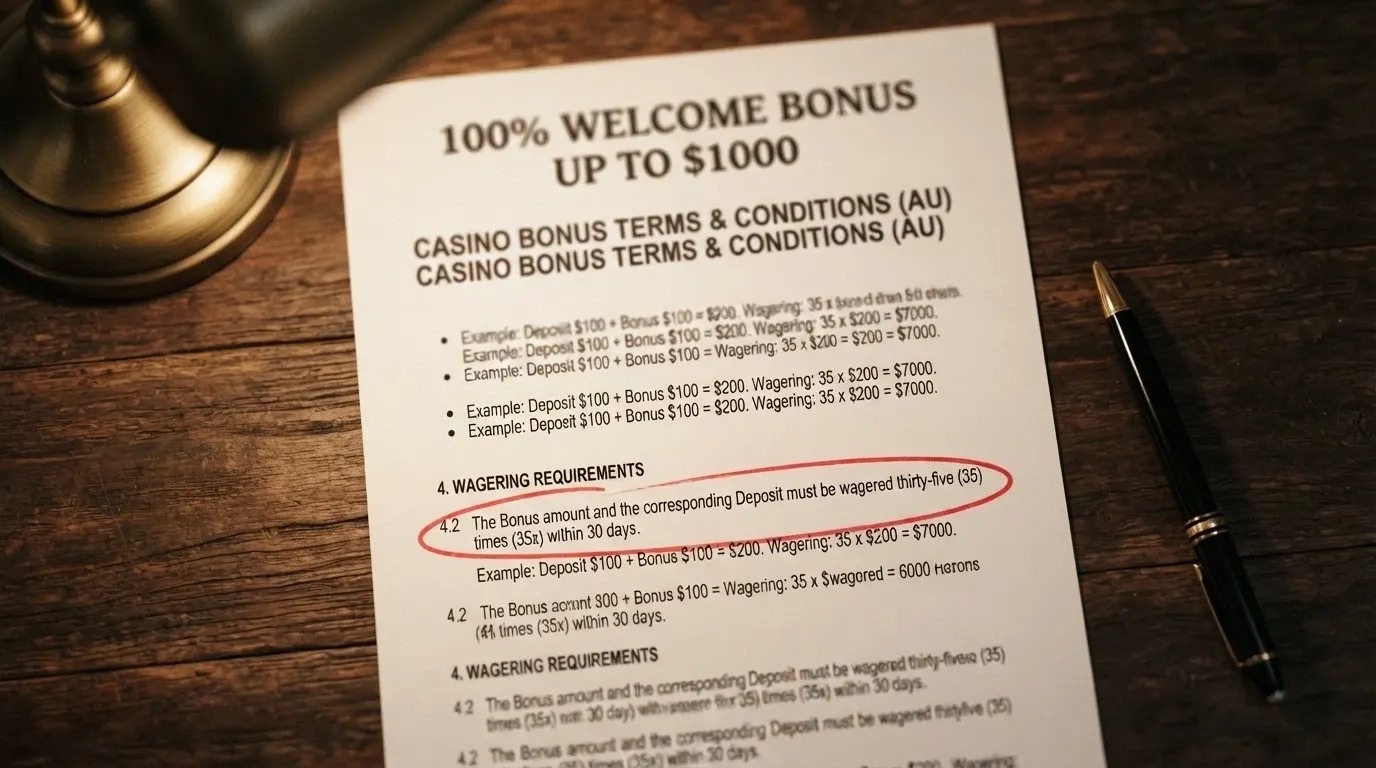
Charmius’s published wagering scale runs from x20 at Bronze down to x3 at Diamond. A player at Bronze clearing a A$1,000 bonus at x20 has to put A$20,000 through the games before any of the bonus is withdrawable. The same A$1,000 bonus at x3 — what a Diamond-tier player might clear — is A$3,000 in turnover. The headline bonus is identical. The cost of clearing it differs by a factor of nearly seven.
That gap is the point. Lower wagering at higher tiers is what the climb is for. The marketing says “exclusive rewards for our VIP members.” The arithmetic says the rewards exist because the operator has reduced the cost of converting bonus money to withdrawable money at exactly the tiers a high-volume player reaches. The Diamond-tier requirement is the exception that confirms the rule.
Welcome Bonuses and the Turnover Trap
A match bonus works like this: the casino matches a percentage of the player’s deposit with bonus money, and the player wagers the bonus (and often the deposit too) a set number of times before the bonus becomes withdrawable. A A$1,000 match bonus with a 20x wagering requirement means A$20,000 in turnover before a cent is withdrawable.
The wagering multiple is the number that matters, not the bonus figure. A A$500 bonus at 40x is A$20,000 in turnover. A A$1,000 bonus at 20x is the same. A reader scanning bonus headlines and seeing “A$1,000 welcome bonus” is not seeing the same offer as a reader seeing “A$500 welcome bonus” — they may be seeing the same cost.
The Charmius scale shows why high-tier players get lower wagering. The operator’s incentive is to keep high-volume players depositing, and lower wagering at the top tiers reduces the friction that would otherwise push those players toward a competitor. A Diamond-tier Charmius player clearing the same nominal bonus at x3 instead of x20 is the operator’s way of saying: stay here, the cost of playing through us has come down.
Cashback, Reload Offers and the Promotions That Actually Return Value
Cashback on losses and reload bonuses with manageable wagering are the offers that put money back in a player’s account in a form the player can use.
Bizzo’s Thursday reload bonus — 50% match up to A$500 on a A$20 deposit — is a moderate-wagering offer at most VIP-tier levels. Bizzo’s weekend cashback — 20% on net AUD losses up to A$200 — returns a percentage of what the player has already lost, with the cap at A$200 setting a ceiling on the recovery. Rocket Play’s weekly cashback of 7% to 10% is the same mechanic at a lower rate, paid weekly rather than per weekend.
The contrast with a 200% match bonus buried under 40x wagering is structural. A player clearing a 200% match bonus at 40x has to put eight times the bonus amount through the games before withdrawing. A player receiving 20% weekend cashback on losses receives the cashback on a defined loss base, with no further wagering in most cases. The latter offer puts money back faster. The former offer promises a larger number and charges the player more to convert it.
Birthday bonuses — Casiny’s published range of A$50 to A$2,000 — sit in the middle. They are real money, they arrive once a year, and the wagering attached to them varies. A player who treats a birthday bonus as a once-a-year event and clears it in a single session is getting the offer at face value. This is a deliberate retention mechanic.
No-Deposit Bonuses and the Fine Print That Caps Your Withdrawal
A no-deposit bonus gives the casino the player’s contact details and a reason to deposit. The bonus itself is usually small — well below A$100 in most published programs — and the conditions attached to it are where the offer’s real character sits.
The standard structure is a no-deposit bonus with a high wagering multiple and a maximum cashout cap. A A$20 no-deposit bonus with a 50x wagering requirement and a A$50 maximum withdrawal is a marketing offer whose maximum realisable value is A$50, conditional on the player putting A$1,000 through the games and then winning enough to actually hit the cap. The function is acquisition, not value. The casino is buying the player’s email address and a foothold on their account.
No featured operator in this review published a confirmed no-deposit VIP bonus this run. The mechanics above describe the typical offer in the offshore market, not a specific offer any operator below is making. A reader who encounters a no-deposit bonus at any of the operators listed should read the wagering multiple and the maximum cashout before treating the headline figure as money in hand.
The Games That Drive VIP Status — Slots, Pokies and Live Tables
Not every game contributes equally to a VIP ladder. Pokies and online slots typically contribute 100% to wagering requirements and tier points. Live dealer tables — blackjack, roulette, baccarat — usually contribute far less, sometimes 10% or nothing.

The weighting is structural. Pokies run at a higher house edge, a faster play rate, and a higher turnover-per-minute than table games. An operator that wants a player to climb the tier ladder wants the player playing pokies. The 100% contribution rate is the operator’s incentive; it is also the player’s fastest route up the ladder, and the player’s fastest route through their bankroll.
Pokies and Slots — The Fastest Route Up the VIP Ladder
Pokies is the Australian term for what the global market calls slots. Offshore casinos targeting Australian players use the local word in their game libraries — it appears in category labels, in promotional copy, in the names of featured games. The terminology is local; the mathematics underneath is the same as any other slot game.
RTP (return to player) and volatility are the two numbers that describe a slot’s character. RTP is the percentage of wagered money a game returns to players over a very large number of spins — a 96% RTP returns A$96 of every A$100 wagered across the long run. Volatility describes how the returns are distributed — a high-volatility game pays out rarely and in larger amounts, a low-volatility game pays out frequently and in smaller amounts. Neither number changes the house edge; both shape the texture of a session.
This review does not publish a per-title RTP table. The reason is straightforward: research on the featured operators did not confirm per-title RTP values for individual games this run, and inventing them would be worse than omitting them. A reader who wants per-title RTP should check the game’s information panel inside the casino lobby or the developer’s published specification.
Live Dealer Tables and High-Stakes Play for VIP Members
Live dealer games are the natural habitat of a VIP player. The format — a real dealer, real cards, real-time streaming from a studio — is what the marketing pictures look like. Blackjack, roulette and baccarat at higher stake levels are where a high-volume player’s bankroll actually sits.
The trade-off is contribution rate. Most offshore casinos apply a much lower wagering-contribution weight to live dealer games than to pokies — often 10% or 0% on certain game types. A player betting A$500 a hand on live blackjack might receive the same tier credit as a player betting A$50 on pokies. The games the VIP player prefers are the games that earn the slowest climb.
Rocket Play’s live cashback track is the workaround: up to 5% on live casino losses, with a minimum A$150 net loss over seven days required and crypto wallets excluded. The track rewards live play directly, but it rewards losses, and it requires a threshold of losses before it pays out. A player whose live play is winning does not qualify.
Crypto, Anonymity and the Payment Methods Offshore Casinos Depend On
Crypto is banned for licensed Australian wagering and widely accepted at offshore casinos. The ban took effect on 11 June 2024, covering credit cards, credit-related products and digital currency. An operator that fails to enforce the ban faces penalties of up to A$247,500. The ban applies to Australian-licensed wagering operators — the ones the IGA permits, which means licensed sports and race bookmakers, not online casinos. Online casinos are already prohibited. The payment-method ban is a second layer of restriction on the licensed side.

For an Australian player, the payment method a casino asks for is itself a signal. A licensed Australian wagering operator offers debit card, bank transfer, PayID, Osko and BPAY. An offshore casino asks for credit cards, crypto, e-wallets, and various combinations that licensed Australian operators cannot accept. From 1 January 2027, banks and payment providers gain express authority to block transactions to illegal gambling operators. The signal will get harder to ignore.
Bitcoin and Crypto Deposits for Australian VIP Players
Offshore casinos market crypto as a privacy feature. The marketing picture is a player moving funds without a bank in the middle, holding their bankroll in Bitcoin or Ethereum, withdrawing without a wait. The reality at VIP tier is different.
A VIP programme is built on identity. The personal host knows the player’s history. The enhanced withdrawal limits apply to a verified account. The higher cashback percentages are paid to a player the operator can identify. At the tiers where the rewards are real, anonymity has already been surrendered — the operator has run KYC on the account holder, verified the source of funds at higher volumes, and built a customer profile that links every deposit to a real person.
The contradiction is the design. The marketing sells anonymity at entry; the programme requires identification at the top. A player who reaches Diamond has stopped being anonymous to the operator, regardless of what payment method they used to get there. Data privacy is not part of the deal.
What Your Payment Method Reveals About an Operator’s Legitimacy
An Australian player asked for a credit card or crypto deposit by a gambling site is being served by an operator outside Australian rules. The payment method is the first legitimacy test, and it is a test the player can run before depositing.
The licensed side of Australian wagering uses PayID, Osko and BPAY for instant bank transfer, debit cards for direct payment, and bank transfer for everything else. Crypto is not on the menu because the law prohibits it. Credit cards are not on the menu because the law prohibits them. The list of accepted payment methods is itself the compliance posture.
An offshore casino asking for Bitcoin is not asking because it is innovative. It is asking because it cannot connect to the Australian payments system and remain an Australian-licensed operator, because no Australian online casino licence exists. The crypto deposit is the marker of an unlicensed operator.
Why Every VIP Casino an Australian Plays at Is Operating Outside the Law
There is no licensed online casino in Australia. The Interactive Gambling Act 2001 prohibits online casino games, online pokies and in-play betting. No licence exists federally or in any state or territory. Every VIP program available to an Australian player is operated by an offshore entity in violation of Australian law.
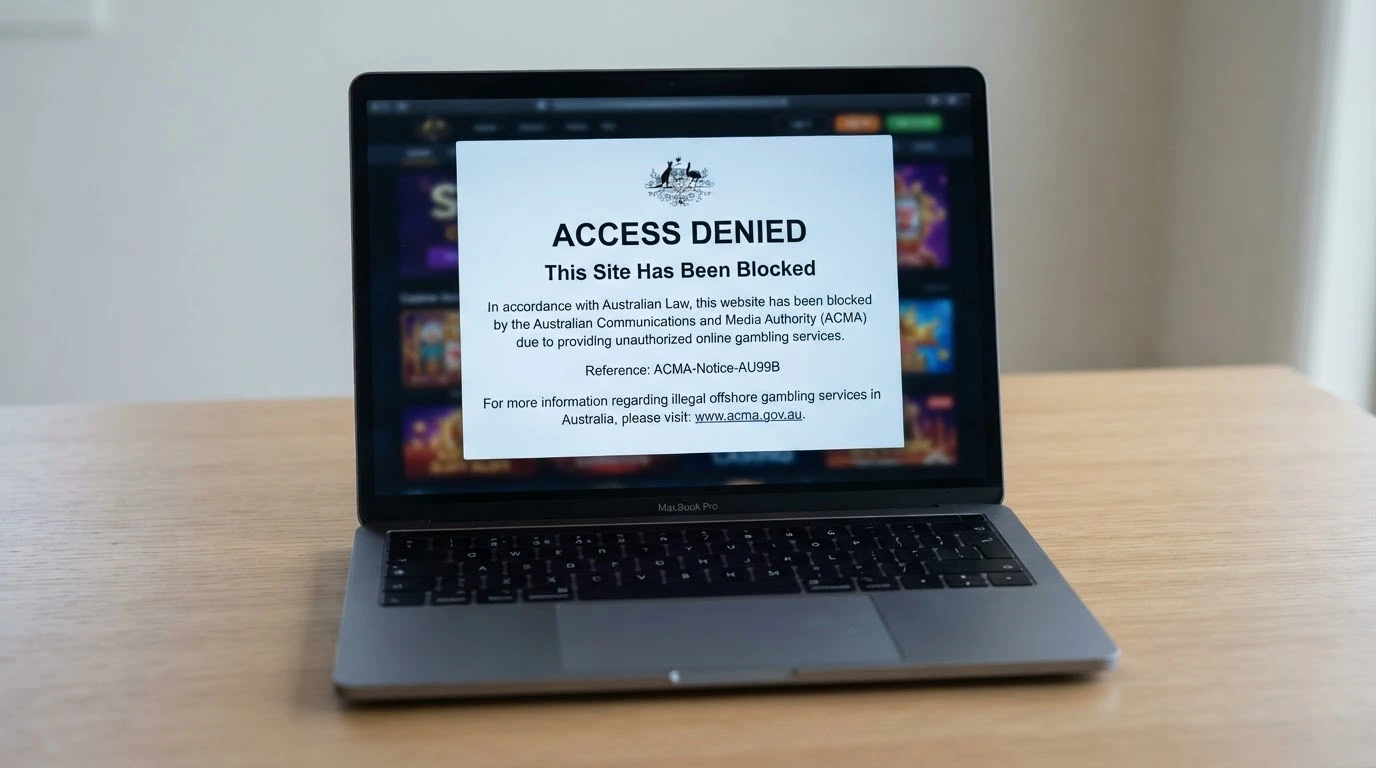
The ACMA — the Australian Communications and Media Authority — is the federal regulator that enforces the prohibition. Since the Interactive Gambling Amendment Act 2017 closed the loopholes offshore operators had used, the ACMA has had formal enforcement and site-blocking powers. As of March 2026, 1,564 illegal gambling and affiliate websites have been blocked at the ACMA’s direction. More than 225 illegal services have withdrawn from the Australian market since 2017.
The individual Australian player is not prosecuted under the IGA. The Act targets the provider, not the person using the service. That is the legal position for the player. It is not the legal position for the protections a player might assume — those do not exist for offshore operators under Australian law.
The Interactive Gambling Act — What It Prohibits and What It Doesn’t
The IGA prohibits online casino games, online pokies and in-play betting on sporting events once they have started. It does not prohibit wagering on races and sport placed before the event begins, lotteries or keno — those remain licensed products. The minimum age for any commercial gambling in Australia is 18.
Licensing for online wagering is state and territory business. In practice it concentrates with the Northern Territory Racing and Wagering Commission (NTRWC), administered through Licensing NT. The NT is the de facto national licensor for online bookmakers, but its licences cover wagering on sport and racing — not online casino. No state or territory licensing body issues online casino licences because the IGA forbids it.
The provider is the target of the Act, not the player. Criminal penalties attach to providing a prohibited interactive gambling service to a person in Australia. The player faces no prosecution for using one. That distinction is the legal floor under the offshore VIP market — and it is also the ceiling of what the IGA does for a player who has a dispute with an offshore operator, because the Act provides no complaint mechanism for players at all.
The 2026 Reform and What Changes on 1 January 2027
The Interactive Gambling Amendment (Gambling Reform) Bill 2026 passed Parliament on 19 August 2026. The measures are law but not yet in force; commencement is 1 January 2027. The new rules do not legalise online casino — the prohibition remains. They restrict how licensed wagering operators can advertise and market, and they give banks new tools.
From 1 January 2027, wagering advertising is capped at three ads per hour between 6:00 am and 8:30 pm. A live-sport blackout runs from 15 minutes before an event until five minutes after it ends. Radio ads during school times are barred. Broadcasting sporting odds is banned outright. Online wagering ads can only be shown to logged-in, age-confirmed users who have not opted out. No ads inside sports venues or on player or official uniforms. Athletes, celebrities and influencers are barred from promoting wagering products.
Direct marketing of inducements is prohibited for 14 days after a customer signs up, for three months after a person deregisters from BetStop, and indefinitely for customers identified as at risk of gambling-related harm.
Banks and payment providers gain express authority to block transactions to illegal gambling operators. The signal that credit card and crypto deposits have been sending since June 2024 becomes an enforced block rather than a tell.
The offshore VIP market sits outside all of this. An offshore casino advertising a welcome bonus to Australians is breaking the prohibition itself, not merely an advertising rule.
What Australian Players Forfeit When They Use an Offshore Casino
The cost of using an offshore casino is not the house edge. It is the complete absence of Australian consumer protection.
No BetStop coverage. BetStop binds Australian-licensed wagering services only. An offshore casino is not connected to the register and will keep accepting a self-excluded person’s money.
No Australian consumer protection. The Australian Consumer Law does not apply to an offshore operator selling a prohibited product. A player who has a dispute has no Australian complaint body to take it to.
No guarantee a withdrawal will be honoured. There is no Australian regulator who can compel an offshore operator to release funds. The operator’s own terms govern, and the operator’s own discretion enforces them.
No guarantee the site will still exist. ACMA site-blocking is DNS-level — the site becomes inaccessible through Australian ISPs. More than 1,564 sites have been blocked since November 2019. A blocked site is a site a player cannot reach to withdraw funds, and there is no Australian authority that can compel the operator to release those funds through an alternative channel.
The land-based contrast is sharp. In Victoria, the Gambling Regulation (Pre-commitment and Loyalty Scheme) Regulations 2014 require land-based loyalty programs to award points for both gambling and non-gambling activities, with points from gambling activities not exceeding points from non-gambling activities, and points not redeemable for gambling machine credits or tokens. Crown Rewards and The Star Club operate under those rules. Offshore VIP programs do not — the rewards are designed to drive further gambling, not to balance against it.
How VIP Programs Exploit the Same Psychology That Drives Problem Gambling
Research published in the International Gambling Studies journal links loyalty program participation to more frequent gambling, longer sessions and higher spending. Several studies connect VIP status to gambling-related harms. Behaviour tracking data on loyalty members records betting frequency, bet size, volatility in bet size, chasing patterns and limit exceedances — the same data that can identify a player at risk is also the data that targets high spenders with personalised offers.

The International Association of Gaming Regulators stated in 2026 that “loyalty and VIP programs reward and encourage people to gamble more often and/or spend more on gambling. Research shows that participation in these programs is often linked to more frequent gambling, longer gambling sessions, and higher spending on gambling.” The statement is not a warning shot — it is a regulatory consensus.
The land-based contrast in Victoria exists because the regulator identified the same mechanism and acted on it. Victoria’s loyalty scheme regulations force the points balance toward non-gambling activities and prevent redemption for further gambling credits. Offshore programs face no equivalent requirement. The structure is the design.
Deposit Limits, Self-Exclusion and Why BetStop Cannot Reach Offshore Casinos
BetStop, the National Self-Exclusion Register, went live in August 2023. One registration excludes a person from every Australian-licensed online and phone wagering service in a single step. As at 31 July 2026, the register held 67,480 registrations, with 41,290 exclusions still active — more than 60% of everyone who ever registered. 78% of registrants were under 40; 38% chose lifetime exclusion.
The register is one of the strongest self-exclusion systems in the world. It binds every Australian-licensed wagering service with a single registration.
It does not bind offshore casinos. An offshore operator is not connected to the register, is not bound by Australian licensing conditions, and will keep accepting a self-excluded person’s money because no mechanism forces it to check. A player who has registered with BetStop and then opens an account with an offshore casino is not protected by the registration at that casino.
From 1 January 2027, the 2026 reform prohibits direct marketing of inducements to a person who has deregistered from BetStop for three months afterward. That is a marketing restriction on licensed operators, not a binding rule on offshore sites.
The licensed operators also offer deposit limits and activity statements as a condition of their licence. An offshore casino offers what it chooses to offer. Most offer deposit limits through the player’s account settings. None is required to honour them by an Australian regulator, because no Australian regulator’s authority reaches them.
Where to Get Help — Services That Actually Work for Australian Players
If gambling has stopped being fun, these are the services that pick up the phone in Australia.
- National Gambling Helpline: 1800 858 858 — free, confidential, staffed 24 hours a day, 7 days a week
- Gambling Help Online — gamblinghelponline.org.au — online chat and free counselling
- BetStop — the National Self-Exclusion Register, one registration excludes from every Australian-licensed online and phone wagering service
About 2.1% of Australian adults — roughly 430,000 people — experience problem gambling. The Australian Institute of Health and Welfare put high-risk gambling at 1.8% in 2022. The number is not a margin of error; it is a population.
How We Selected and Evaluated These VIP Programs
This review checked every operator against the ACMA’s public enforcement record and the Interactive Gambling Act 2001. No operator listed holds an Australian online casino licence because no such licence exists. The ranking is by the depth and transparency of the VIP programme as surfaced this run — Rocket Play and Bizzo Casino surface detailed published terms; the remainder are present in the market but their VIP specifics could not be confirmed.
The evaluation is qualitative. There is no score, no weighted ranking, no recommendation of one operator over another. The legal position is identical for every operator covered. The product is prohibited. The rewards are real; the protections are not.
The sources used for this review are the operator VIP programme pages where available, the ACMA public enforcement data, the Interactive Gambling Act 2001 as published on the Federal Register of Legislation, AIHW harm prevalence research, IAGR regulatory reporting, and the International Gambling Studies journal for the loyalty program harm evidence.
Before You Chase That Next Tier, Read This
The page has laid out what VIP programs offer — tier ladders, cashback, loss-rebate promises, personal hosts, withdrawal enhancements — and what they cost in turnover. The page has also laid out the legal reality: online casino is prohibited in Australia, every VIP program available to an Australian player is operated by an offshore entity, no Australian consumer protection applies, BetStop does not reach the operator, and the site can be blocked with funds still on account.

The wagering multiple is the number that matters, not the headline bonus. A A$1,000 match bonus at x20 is A$20,000 in turnover. A A$1,000 match bonus at x3 is A$3,000. Both arrive as “A$1,000 welcome bonus” on a marketing page. The cashback is on losses, not on turnover. The deposit insurance is on losses, not on deposits. The personal host is the operator’s retention engine, not the player’s advocate.
If the value of an Australian consumer protection matters to the reader, the only online gambling product that carries it is licensed wagering on races and sport, placed before the event begins. Online casino is prohibited in Australia. The VIP programs reviewed on this page are the offshore alternative. They are real, they pay out where their terms say they will, and they operate outside the protections the reader would otherwise have.
The tier ladder is designed to keep a player on it. Knowing that is the only real player advantage.
Frequently Asked Questions
Is it legal for an Australian to join an online casino VIP program?
Joining is not prosecuted under the Interactive Gambling Act 2001 — the Act targets the provider of a prohibited service, not the individual using it. The program itself operates in violation of Australian law, and no Australian consumer protection applies to a player who uses it. The legality for the player and the legality of the service are different questions with different answers.
Do offshore casinos actually pay cashback and insurance to Australian VIP members?
The operators that publish their terms in AUD — Rocket Play and Bizzo Casino — have documented programmes. Cashback rates, deposit insurance percentages and weekly schedules are stated in writing on their VIP pages. Payment is at the operator’s discretion, and there is no Australian regulator that can compel an offshore operator to honour a published term. A player should verify the terms directly with the operator before relying on them.
What happens to my money and rewards if the ACMA blocks the casino I use?
ACMA blocking is DNS-level. The site becomes inaccessible through Australian ISPs. Funds already on the site are not automatically returned — the player must contact the operator through alternative channels, and there is no Australian authority that can compel the operator to release the funds. More than 1,564 sites have been blocked since November 2019. Keeping a large balance on an offshore site is a real risk.
Can I still deposit with cryptocurrency at a VIP casino after the 2024 payment ban?
The 11 June 2024 ban on credit cards and crypto applies to Australian-licensed wagering operators. Offshore casinos are not bound by it and many still accept crypto. The ban is a signal: an operator asking for crypto from an Australian player is operating outside Australian rules. The 2026 reform, commencing 1 January 2027, gives banks express authority to block transactions to illegal operators, which makes the signal harder to ignore.
How is a land-based loyalty program like Crown Rewards different from an online VIP program?
Crown Rewards and The Star Club are state-licensed, regulated loyalty programmes operating under consumer protection rules. Crown runs five tiers with Status Credit thresholds reviewed annually on 1 October; The Star Club runs four tiers on a 365-day cycle. In Victoria, the regulations require points to be earnable through non-gambling activity, prevent gambling points from exceeding non-gambling points, and bar redemption of loyalty points for gambling credits. Offshore VIP programs face no equivalent requirements and no regulatory oversight.