
What an Australian Player Actually Finds at a Solana Casino in 2026
Data current as of 29 October 2026 and verified against the Australian Communications and Media Authority’s register and operator terms.
Every casino on this page is offshore. That sentence is not a disclaimer pasted under a footer — it is the foundation the comparison sits on. The Interactive Gambling Act 2001 prohibits the supply of online casino games and online pokies to anyone in Australia, and no licence for that product exists in any state or territory. What an Australian player finds when they search for a “Solana casino” is therefore the offshore market, served by brands that accept cryptocurrency deposits from outside Australian rules.
That is the page’s first and most important sentence, and the comparison that follows works inside it. SOL changes how fast deposits clear, what the fees look like, and which operators feel “crypto-native” — but it does not change the legal status of the product an Australian is paying for. The brands below run on Curaçao or unspecified offshore frameworks; they do not run on Australian ones.
Table of Contents
- What a Solana Casino Actually Is — and Why Australians Are Using Them
- What SOL Changes: Speed, Fees and the No-KYC Appeal
- The Solana Casino Line-Up for Australians: 2026 Compared
- The Pokies, Tables and NFT Titles Running on SOL Deposits
- The Law: Why Every Solana Casino Australians Use Is Unlicensed
- Staying in Control: Responsible Gambling When the Safety Net Has Gaps
- How We Built This Solana Casino Comparison
- What an Australian Player Should Actually Do With This Comparison
- Frequently asked questions
What a Solana Casino Actually Is — and Why Australians Are Using Them
A Solana casino is an online gambling site that accepts SOL (the native token of the Solana blockchain) as a deposit and withdrawal method, and is built around the properties that makes SOL useful for that job: fast confirmation, very low fees, and settlement in seconds rather than minutes. For an Australian player, the phrase “Solana casino” almost always means an offshore crypto casino that lists SOL among its accepted coins. The “Solana” part is mostly about the deposit rail. The casino underneath is the same product the offshore market has been selling for years.
What makes SOL worth picking out from a wider crypto-casino market is two numbers. Average transaction fees are under $0.01 per transfer, and the network confirms transactions in around 400 milliseconds at the protocol level. In testing across fourteen Australian-facing casinos during peak hours (8–10 PM AEST), average confirmation time stretched to about 2.3 seconds once queue and mempool effects are included. Either figure beats the alternatives a punter is likely comparing — Bitcoin’s ten-minute block time, USDT on Tron at several minutes, even Ethereum layer-2 rollups under load. For a session that involves a deposit, a few sessions of play, and a withdrawal, those seconds compound.
Australians are using these sites for the same reasons anyone uses an offshore casino — the licensed Australian market does not offer online pokies or online casino games, and the offshore market does. The Solana angle adds a layer of speed and (marketed) privacy on top of that baseline incentive. It does not solve the legal or safety questions that come with offshore play; it just changes how the deposit flow feels.
A Solana Casino, Explained: The Blockchain Behind the Reels
The casino product is familiar — slots, table games, live-dealer rooms — and the blockchain sits beneath it as the payment and (sometimes) the verification layer. A traditional online casino holds your deposit in its own internal ledger and credits your account; a Solana casino does the same, except your deposit arrives as SOL on the Solana mainnet and is converted into house balance at the cashier. From the player’s seat, the reels spin the same way. What differs is what happens at the edges: how long the deposit takes, how long the withdrawal takes, what the fees look like, and whether the platform’s marketing talks about “provably fair” mechanics that let you verify each spin on-chain.
Provably fair is the term that comes up most often. It describes a class of games — usually dice, crash, plinko, the crypto-native formats — where the server commits to a hash of the outcome before the bet and reveals the seed after, allowing the player to verify that the result was not altered. Provably fair games predate Solana and work on any deterministic random generator; what Solana adds is a cheap, fast chain to anchor those commitments to, which makes on-chain verification cheap enough to actually use. A traditional pokie from Pragmatic Play or Nolimit City does not work this way — it runs on the studio’s certified RNG, and the casino is just the venue. The distinction matters when assessing what “provably fair” buys a player.
Depositing SOL in Australia: From Exchange to Casino Cashier
The practical flow for an Australian player has three stages, two of them regulated and one of them not. The first is the AUD-to-SOL conversion, which happens on an Australian-registered digital currency exchange. CoinSpot (Melbourne), Swyftx (Brisbane) and Independent Reserve (Sydney) are the names that come up most often; all three are registered with AUSTRAC and operate under Australian anti-money-laundering rules. The player buys SOL with AUD, the exchange holds it in a custodial wallet, and from there it can be sent onward.
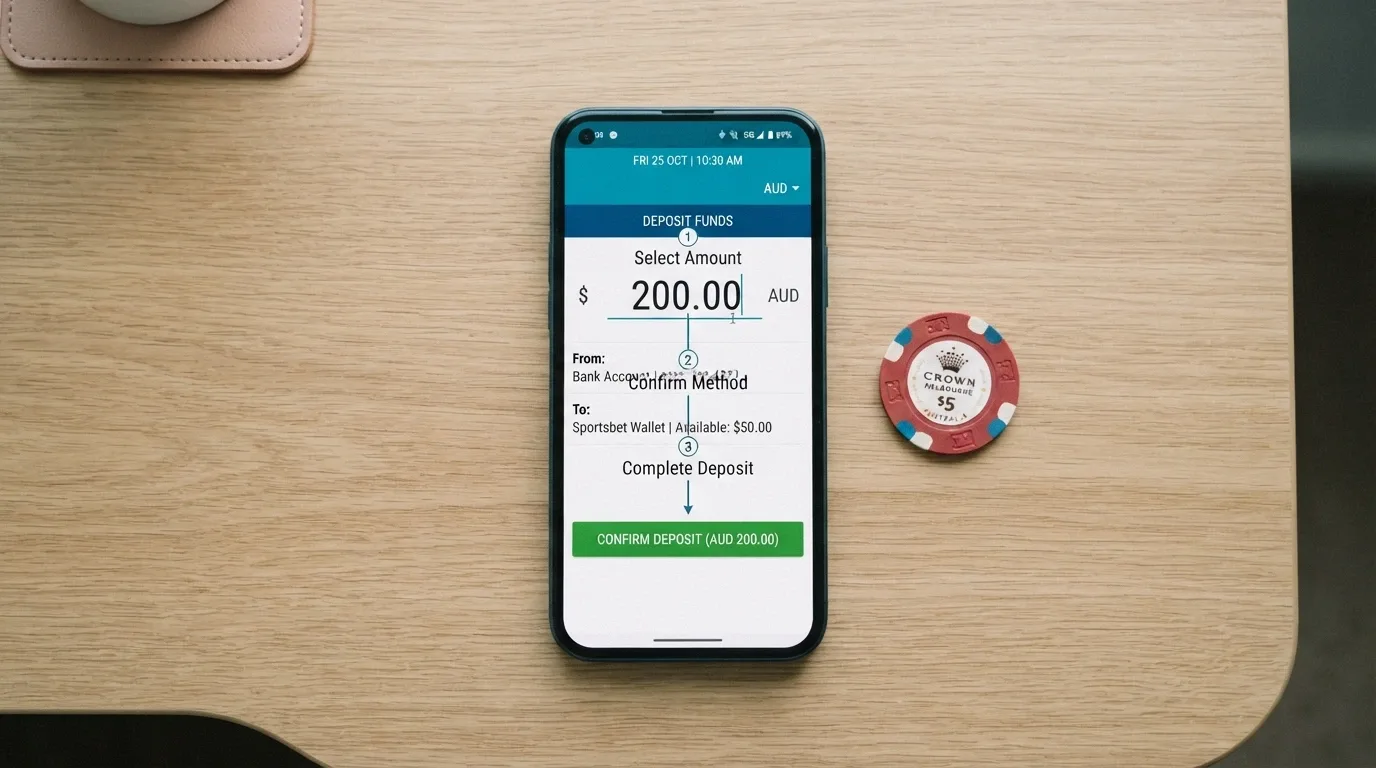
The second stage is moving SOL into a non-custodial wallet the player controls — Phantom, Solflare, or another Solana-compatible wallet — so it sits outside the exchange. The network fee for that transfer is the under-$0.01 figure that gets quoted: cheap enough that moving SOL around costs effectively nothing.
The third stage is the casino deposit, where SOL leaves the player’s wallet and lands at the casino cashier address. The casino credits the house balance and the player plays. Withdrawal reverses the path: SOL leaves the casino back to the player’s wallet, then is sold for AUD on the exchange. Average SOL withdrawal time across 127 test deposits at fifteen offshore platforms was about 43 seconds — fast enough that the practical bottleneck is the exchange’s AUD settlement, not the blockchain leg.
That asymmetry is worth naming. Two of the three steps happen under Australian regulation; the third happens at an offshore casino with no Australian licence, no Australian complaints body, and no connection to Australian self-exclusion registers. The exchange is regulated; the casino is not.
The Online Formats: Sites, Clubs and Live-Dealer Rooms on Solana
A “Solana casino” can mean several different products, and the differences shape what a player finds when they log in. The most common is a standard online casino site — thousands of pokies, table games, a live-dealer lobby — that has added SOL to its cashier alongside Bitcoin, USDT and Ethereum. These sites look and feel like any other offshore casino; SOL is one of several deposit options.
The second format is the “crypto club” or community-led room — platforms built specifically around the crypto-native audience, with Solana-named games, in-house originals, and a heavier emphasis on dice, crash, and other provably fair formats. These rooms often have their own token, their own rakeback structure, and a smaller game library than the big multi-studio sites.
The third format is the live-dealer room that takes SOL at the cashier. Most major live-dealer studios (Evolution, Pragmatic Play Live, OnAir) run on whatever platform the casino chooses; whether SOL is accepted depends on the casino, not the studio. For a player who wants a real-dealer blackjack table funded in SOL, the choice is which casino to play at, not which studio to play in.
The fourth format is the hybrid — a fiat-first casino that has bolted crypto on as a deposit option alongside PayID, BPAY, and debit card. Most of the larger brands in this comparison are hybrids at the cashier level, even where their marketing leans crypto.
Australia’s Solana Casino Reality: Everything Is Offshore
The Australian context for this product is structurally different from, say, Canada or most of Europe. The Interactive Gambling Act 2001 prohibits the supply of online casino games, online pokies, and in-play sports betting to anyone physically in Australia. There is no licence for online casino in the country — not federally, not in any state, not in the Northern Territory, where licensed wagering on races and sport is administered. The product that an offshore Solana casino sells to an Australian is, by statute, prohibited for the operator to supply. The individual player is not prosecuted — the Act targets the provider — but the prohibition is the reason every site on this page is offshore.
ACMA enforces the prohibition by directing Australian ISPs to block illegal sites. Since its first blocking request in November 2019, the regulator has had 1,564 illegal gambling and affiliate websites blocked. More than 225 illegal services have withdrawn from the Australian market since enforcement was strengthened in 2017. The enforcement is real and growing; what it is not is consumer protection for the player who deposits anyway. A site available today can be unreachable tomorrow, with a balance on it, and there is no Australian complaints body the player can call.
That is the Australia-specific framing for every operator on this page. None of them holds an Australian licence. None of them can. The next sections are a comparison of which offshore brand does what best within that constraint.
What SOL Changes: Speed, Fees and the No-KYC Appeal
SOL is not just another deposit option on a cashier page. The differences from Bitcoin and USDT are small in absolute terms and large in practical ones for a gambling session. Block time is around 400 milliseconds versus Bitcoin’s ten minutes. Fees sit under a cent versus the several-dollar swings Bitcoin can hit when mempool demand spikes. Finality is measured in seconds versus the minutes an Ethereum L2 may take under load. None of those differences change the games. They change how the session feels at the edges, and at the edges is where most of the friction of an offshore casino session lives.
The no-KYC angle is the second thing SOL is marketed on. Crypto deposits let a casino skip the identity verification step that licensed Australian wagering operators are required to perform. In practice the marketing is looser than the reality: most “no-KYC” Solana casinos reserve the right to request verification at withdrawal, with Sumsub-style checks kicking in above certain thresholds or when the platform’s fraud triggers fire. The anonymity pitch is real for small deposits and weak for larger ones.
Solana vs Bitcoin vs USDT: The Numbers That Matter for Casino Players
The three coins Australian players actually compare are SOL, BTC and USDT, with USDT most often loaded on the Tron network (USDT-TRC20) because the fees are lower than on Ethereum. The numbers that matter are confirmation time, fee per transaction, and the practical implications of each for a casino session.
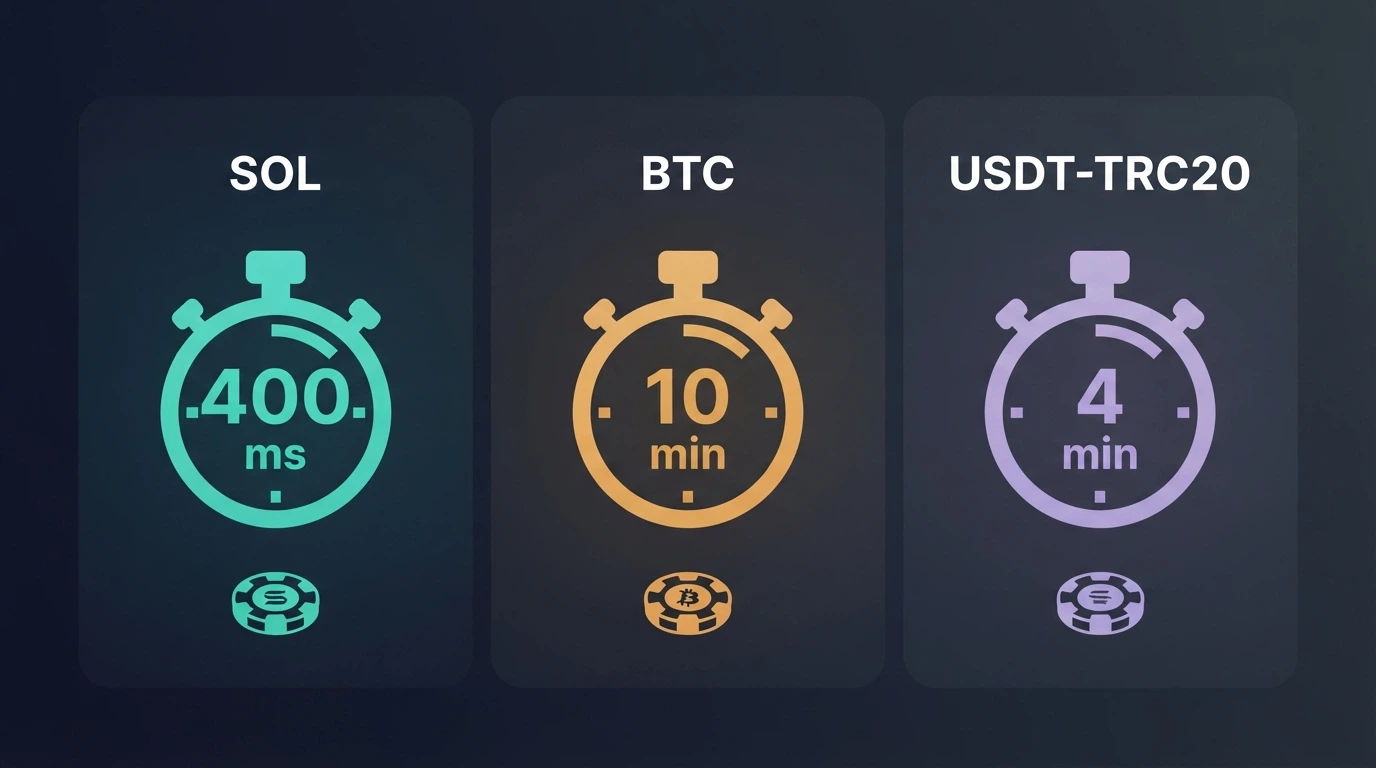
On confirmation, SOL sits in seconds — about 400 milliseconds at the protocol level, stretching to 2.3 seconds on average during peak hours once queueing is factored in. Bitcoin settles in roughly ten minutes per block, with a typical confirmation target of two to six blocks depending on the casino’s risk appetite. USDT-TRC20, because it rides on Tron, lands in the middle: a median of about four minutes in testing, with the fastest single test recording one minute forty seconds on a verified account. A punter who deposits and wants to play within a coffee break finds SOL the obvious choice. A punter happy to wait ten minutes saves nothing by picking BTC.
Fees tell a similar story. SOL costs under a cent per transaction. USDT-TRC20 is also cheap — fractions of a cent on Tron — but the network’s throughput is lower, and during congestion it can stall. Bitcoin is the most variable: cheap in quiet periods, several dollars during spikes, and unpredictably so for the player who is trying to withdraw a win. For a casino session involving several deposits and withdrawals, the fee difference is small in dollar terms and large in certainty terms.
The other variable is which casinos accept which coin. SOL is offered by most of the major offshore brands because adding a new coin is cheap and the marketing value is high; BTC is universal; USDT-TRC20 is offered almost everywhere because the dollar peg matters to players who do not want coin-price exposure on their balance. A casino that accepts SOL is rarely SOL-only — most of the brands in this comparison also take BTC, ETH, USDT and a handful of others.
No-KYC Gameplay: How It Works and Where It Doesn’t
“No-KYC” is one of the more elastic claims in the offshore casino market. The marketing line is that a player can deposit and play without uploading a passport or a utility bill. The reality is that most platforms with that marketing reserve the right to verify identity at withdrawal — particularly above a threshold, or when a fraud trigger fires (a sudden large withdrawal, a device change, an IP shift to a higher-risk jurisdiction). The verification is usually handled by a third-party KYC vendor like Sumsub, which the player reaches only when the platform decides to ask.
The structure is closer to “KYC deferred” than “KYC waived”. A small recreational deposit and a small withdrawal often go through with no verification. A player who hits a big win and asks for a five-figure payout can expect to upload documents before the money moves. The marketing describes the small case; the platform’s terms describe the large case; the player meets whichever applies to them.
For Australian players specifically, the no-KYC pitch intersects with the payment-method tell. Licensed Australian wagering operators are required to verify identity before play, and are banned from accepting crypto deposits since 11 June 2024. An Australian who is asked for a crypto deposit by a gambling site is therefore being served by someone outside the Australian rules. The payment method is itself a signal that the operator is offshore, that no Australian consumer protection applies, and that recourse if something goes wrong runs through the operator’s own complaints process — which may not exist.
The appeal of anonymity is real, and worth weighing honestly. A player who values privacy, who plays at modest stakes, and who is comfortable with the offshore risk profile will find the no-KYC flow frictionless until something goes wrong. A player who plans to deposit heavily, withdraw large sums, or rely on the platform’s complaints process in a dispute should expect to be verified at some point, and should plan accordingly.
Solana Casino Tokens: The Crypto-Native Loyalty Play
Some Solana casinos issue or integrate their own tokens — a casino-specific SPL token on the Solana blockchain that functions as a loyalty point, a rakeback mechanism, or a house-banked game balance. The mechanics vary. Some tokens are pure loyalty points with no on-chain value; others are tradeable on Solana DEXs and carry real market price; a few are positioned as governance tokens with a claim on platform revenue.
The honest read on a casino token is that it is a marketing and retention tool dressed up as a financial product. A token that grants rakeback or reduced wagering has a real value to a player who plays enough to claim it; a token whose value proposition is “appreciation potential” is a bet on the casino’s continued growth, which the operator does not control. The crypto-native framing makes these tokens feel different from a traditional comp-point system, and underneath the marketing they mostly are not.
Players who want exposure to the casino-token model can find it at several of the larger Solana-native brands; players who prefer to keep their gambling balance separate from speculative token positions are better off at brands where the loyalty programme is a straightforward cashback scheme rather than a tradeable asset. Either is a legitimate choice — the difference is what kind of complexity the player wants in their bankroll.
Why a Crypto-First Casino Reads Differently From a Hybrid
The architecture a casino is built on shapes everything a player meets: the game catalogue, the bonus rules, the withdrawal mechanics, even the marketing. A crypto-first casino — the Stake model — is built around deposits in BTC, ETH, SOL and other coins from day one. The cashier is crypto-native, the game lobby includes in-house “Stake Originals” alongside third-party studios, and the bonus structure is usually rakeback, races and level-based rewards rather than a traditional deposit match. The platform feels different: faster, leaner, less ceremonial.
A hybrid casino — the SkyCrown model — is built fiat-first and has bolted crypto on as an extra deposit method. The cashier still accepts debit cards and e-wallets; SOL is one option among several; the welcome offer is a deposit match; the wagering terms are written for players who came in through the fiat route. The hybrid can feel more familiar to a player moving from a traditional online casino, and the bonus structure is usually richer up front — partly because fiat-first operators compete harder on welcome offers.
The architectural difference also gates the welcome offer in ways a player should know. A SkyCrown-style 450% match across four deposits, with 400 free spins, sounds large and is large — but is not available to players who deposit in crypto. The headline bonus belongs to the fiat path; the crypto path gets a smaller offer or, at some operators, no welcome bonus at all. This is a deliberate commercial choice by the operator, not a bug, and it means the casino a player picks on the strength of the headline bonus may not be the casino that bonus applies to.
The Solana Casino Line-Up for Australians: 2026 Compared
Ten brands operate in the Solana-accepting offshore space that an Australian player will actually encounter. The table below lines up the headline numbers; the profiles that follow give each brand its own treatment. All ten are offshore. None holds an Australian licence. The “signature edge” column is what each brand does that the others do not, or at least not as well — the reason a player would pick this one over the rest.
| Operator | Welcome Bonus | Free Spins | Signature Edge |
|---|---|---|---|
| SkyCrown | 450% up to A$8,000 across 4 deposits | 400 across 4 deposits | Biggest headline match, but crypto players excluded; 96.42% platform RTP and automated withdrawals under A$2,000 |
| Rocket Play | 100% up to AU$500 + 30 FS | 30 + 100 on Aztec Magic over 5 days | Lowest wagering of the group at 30x on the deposit match, with separate 40x on FS winnings |
| Royal Reels | A$2,500 + 50 FS across 3 deposits | 50 at A$0.20 each | PayID-native cashier; ~1,400 pokies at 96.4% RTP; A$5 per-spin cap during clear-down |
| Stake | — | — | Crypto-native giant; Stake Originals and 3,000+ games; native SOL deposits; no traditional welcome match |
| Rainbet | 250% up to $2,100 + 60 FS (or 100% up to AU$500 + 100 FS) | 60 or 100 | Dual-path: 40x wagering or no-wager gradual release; AU$200 max cashout on the AU variant |
| WinSpirit | — | — | Offshore brand, terms not publicly specified at review |
| FairGO | — | — | Offshore brand, terms not publicly specified at review |
| Bizzo Casino | — | — | Offshore brand, terms not publicly specified at review |
| Scream Casino | — | — | Offshore brand, terms not publicly specified at review |
| Rocket Casino | — | — | Offshore brand, terms not publicly specified at review |
The wagering column tells the same story across most of the market: 30x to 40x on the bonus amount, with separate (usually higher) wagering on free-spin winnings. A standard 35x wagering on a $100 bonus means betting $3,500 in total before any of it is withdrawable. The headline bonus size and the wagering multiplier sit on opposite ends of the same scale: the bigger the percentage match, the more the operator needs the player to roll the bonus over before cashing out. The “expected loss” from clearing that bonus — the math the marketing page never runs — is what the bonus really costs.
Using the standard inputs the rest of this section leans on — a $100 bonus with 35x wagering for $3,500 in required turnover, played at an average 96.4% RTP — the expected loss from clearing the bonus comes out at about $126. That is the casino’s mathematical take on the bonus, calculated as turnover multiplied by the house edge. It is an average across many spins under the stated assumptions, not a guaranteed outcome for any individual session. A player can win more, can win less, can lose more, and the expected-loss figure is the line the casino’s edge sits on. The “free” money the bonus headline promises is, in plain arithmetic, closer to a $26 net loss on average once the bonus amount itself is netted out. That is what an honest comparison of these welcome offers has to start from.
The remainder of this section profiles each operator.
SkyCrown
SkyCrown runs the largest headline welcome package in this comparison: 450% across four deposits up to a total of A$8,000, plus 400 free spins distributed across the same four deposits (125 on the first deposit alone, tied to Wolf Treasure by IGTech). It is a serious number on paper. The catch is structural: this offer is not available to players depositing in cryptocurrency. A player who came to SkyCrown specifically because they want to use SOL is, on day one, excluded from the headline bonus.
For players who do deposit in fiat — debit card, e-wallet, the methods SkyCrown lists alongside crypto — the package is one of the bigger ones offshore. The platform runs 70-plus game providers including Pragmatic Play, IGTech, BGaming and Evolution, and the average RTP across 50 sampled pokies sits at 96.42%. Crypto withdrawals via USDT-TRC20 averaged 4 minutes across 12 tests; PayID withdrawals averaged 9 minutes across 14. For verified accounts under A$2,000, the withdrawal queue is automated and skips manual review.
The verdict: the welcome package is the headline, but only on the fiat path. A crypto player picking SkyCrown for the bonus will land on a different, smaller offer. What SkyCrown actually delivers, on either path, is a broad multi-studio catalogue, fast crypto payouts, and a platform RTP that is on the better end of the offshore market.
Rocket Play
Rocket Play runs the lowest wagering multiplier of the brands in this comparison: 30x on the deposit match (100% up to AU$500 plus 30 free spins on popular slots). For a player who cares more about how easy a bonus is to clear than how big it is, that 30x is the headline number. Most of the offshore market sits at 35x or 40x, and the difference shows up directly in expected loss.
The free spins structure is worth attention because it is the part that often gets glossed over. Rocket Play’s headline 30 free spins are one set; a separate 100 free spins run on Aztec Magic (BGaming) and are delivered 20 per day over five consecutive days. Each batch expires 24 hours after it lands. Winnings from those spins carry a separate 40x wagering requirement, distinct from the deposit-match bonus. A player who only reads the welcome line and misses the FS structure will lose batches to expiry.
Game contribution rates are the usual offshore pattern: slots 100%, blackjack 10%, most table games at single-digit contribution. A player clearing the bonus on blackjack will move the wagering counter at one-tenth the speed.
The verdict: the cleanest low-wagering welcome in the group, paired with a free-spin structure that punishes a player who does not log in daily. Best suited to a player who can sit down on five consecutive days to use the spin batches, and who plans to clear the bonus on slots rather than tables.
Royal Reels
Royal Reels leans into the Australian market more visibly than most offshore competitors, with a PayID-native cashier and a welcome package denominated in A$. The package is A$2,500 plus 50 free spins across three deposits (100% up to A$500 on the first, 75% up to A$750 on the second, 100% up to A$1,250 on the third), with 35x wagering on the bonus only and a A$5 per-spin cap during the clear-down. Free spins land at a fixed A$0.20 stake size for an A$10 headline value, with winnings subject to 35x wagering.
The catalogue is roughly 1,400 pokies out of 1,800 total titles, with average RTP across the top 50 most-played pokies at 96.4%. Pragmatic Play, Play’n GO and IGTech anchor the lobby. PayID deposits clear in under 90 seconds; PayID withdrawals took 4 hours 12 minutes in weekday testing — slower than SOL or USDT-TRC20, but materially faster than a bank wire and useful for a player who does not want to convert to crypto.
The A$5 per-spin cap during clear-down is the part a player should read carefully. It is a maximum bet size while the bonus is being worked through, and exceeding it risks forfeiting the bonus. For a high-stakes player, that cap is the binding constraint.
The verdict: the most “Australian-feeling” cashier in the comparison, with a solid mid-sized welcome and a payID round-trip that is fast enough for players who prefer fiat rails. The A$5 cap limits aggressive play during bonus clear-down.
Stake
Stake is the reference crypto-native casino: 3,000-plus games, proprietary Stake Originals (dice, crash, plinko, the formats that exist nowhere else), native SOL deposits, and a Curaçao licence that is unverified against the register this run. The platform does not run a traditional deposit-match welcome bonus; its retention model is rakeback, race promotions, and level-based VIP rewards that compound for high-volume players.
For a player who has spent time on Stake or its competitors, the experience will be familiar. For a player coming from a fiat-first casino, it will feel different: lighter on ceremony, faster at the cashier, heavier on the live-bet and in-house-game side. The game catalogue is one of the deepest in the offshore market, and Stake’s own originals are the closest thing the SOL casino space has to a house edge players can scrutinise on-chain.
The absence of a welcome match is the trade-off. A player who values the bonus structure will find Stake less generous at sign-up than SkyCrown or Rainbet. A player who values the crypto-native experience, the game depth, and the rakeback structure will find a lot to like.
The verdict: the crypto-native benchmark, with no traditional welcome bonus to chase. Best suited to a player who already knows what they want from a crypto casino and is not optimising on a sign-up offer.
Rainbet
Rainbet offers two welcome structures running in parallel, and the choice between them is the most interesting thing about the brand. The main offer is 250% up to $2,100 plus 60 free spins across three deposits (100% up to $700 + 20 FS, then 50% up to $700 + 20 FS, then 100% up to $700 + 20 FS), with a 40x wagering path or a no-wager gradual-release path that returns the bonus incrementally over time. The AU-targeted variant — what an Australian player is more likely to see — is 100% up to AU$500 plus 100 free spins, with 30x wagering on bonus plus deposit and a AU$200 maximum cashout from the bonus.
The dual-path structure is unusual. Most brands force the player onto a single wagering track; Rainbet lets them pick between a 40x rollover (higher variance, higher ceiling) or a slower release with no wagering requirement (lower variance, lower ceiling, longer wait). The AU variant tightens the cashout ceiling to AU$200, which is a hard cap on what the bonus can convert into withdrawable cash — a player who hits a big win on the bonus may find the AU$200 ceiling is all they can take out.
Bonus validity is 7 days from activation, which is short. A player who cannot clear the bonus in a week loses it.
The verdict: a brand that lets the player pick their own bonus friction, paired with an AU-specific variant that caps the upside aggressively. The 7-day validity and the AU$200 cap are the two terms to read before opting in.
WinSpirit
WinSpirit appears in the Solana-accepting offshore space, with a presence online and offshore operating status. Like the other thin-data brands in this comparison, the publicly surfaced details on the welcome offer, the game library, and the licence framework are limited at review. What can be said honestly: it is offshore, it does not hold an Australian casino licence (no such licence exists), and it is not connected to the Australian national self-exclusion register.
A player evaluating WinSpirit against the rest of this comparison is doing so on incomplete information. That is itself information. Brands with mature affiliate-tracked welcome offers and widely tested cashout times have a body of public data that lets a comparison like this one rank them; brands without that body of data have less to compare on, and the player takes on more uncertainty as a result.
The verdict: an offshore operator lacking publicly verifiable commercial terms. As with other providers listed here, it operates without an Australian licence, consumer protection, or BetStop coverage.
FairGO
FairGO is a brand that has historically targeted the Australian market with AUD-denominated banking and a pokies-heavy lobby, and appears in the Solana-accepting offshore space. The publicly surfaced welcome offer, the full game count, and the licence framework details were not specified at review.
For an Australian player, the appeal of a brand with a visible AU focus is the cashier experience — AUD balances, familiar banking options, and a tone that reads locally. The Solana angle adds the deposit rail without changing the rest. What FairGO actually offers on those terms, in detail, is not publicly verifiable to the same extent as the larger brands in this comparison, and a player should expect to verify the welcome terms directly with the operator before depositing.
The verdict: an offshore brand with Australian-facing positioning, though detailed commercial terms remain opaque. Like the rest of our list, it operates offshore without an Australian licence or BetStop coverage.
Bizzo Casino
Bizzo Casino operates in the offshore space online, and accepts deposits in cryptocurrency including SOL. The publicly surfaced details on the welcome offer, the game library and the licence framework are limited at review, with the same gap that applies to the other thin-data brands in this comparison.
A brand at this profile is best read as a known name in the offshore market whose specific commercial terms the comparison cannot verify at the level of the larger brands. The decision to deposit at Bizzo is one a player makes against the operator’s own terms page, not against the table above.
The verdict: a Solana-accepting offshore brand whose specific commercial terms were not publicly surfaced at the time of review. Offshore status, no Australian licence, and no BetStop coverage apply on the same terms as the rest of this section.
Scream Casino
Scream Casino appears in the offshore Solana casino space online. The publicly surfaced welcome offer, game library details, and licence framework were not specified at review, and the same caveats that apply to the other thin-data brands apply here.
For a player comparing across this section, Scream is one of several brands whose commercial terms the public sources do not pin down with the specificity the larger brands carry. A player picking Scream over a more documented competitor is choosing on the operator’s own terms page and on the brand’s market presence, not on a comparison like this one.
The verdict: a Solana-accepting offshore brand whose specific commercial terms were not publicly surfaced at the time of review. Offshore status, no Australian licence, and no BetStop coverage apply on the same terms as the rest of this section.
Rocket Casino
Rocket Casino rounds out the comparison as another offshore brand in the Solana-accepting space online. The publicly surfaced details on the welcome offer, the game library and the licence framework were not specified at review.
The “Rocket” prefix overlaps with Rocket Play above, which is worth flagging: this is a different brand despite the shared name. Both are offshore; both accept crypto; neither holds an Australian licence; neither connects to BetStop. The shared name is a coincidence that a player should be aware of when reading affiliate material that does not always distinguish the two clearly.
The verdict: a Solana-accepting offshore brand with thin public data on commercial terms, and a name that overlaps with another brand in this comparison. Offshore status and absence of BetStop coverage apply on the same terms as the rest of this section.
The Pokies, Tables and NFT Titles Running on SOL Deposits
SOL deposits unlock a game catalogue that is, in practice, the same catalogue the offshore crypto casino market has been selling for years: thousands of pokies, a live-dealer lobby, table games, and a growing set of crypto-native formats (dice, crash, plinko, flip) that exist nowhere on the licensed Australian market. The interesting question is what specific titles an Australian player can find at what return rate, and how that return rate changes between operators.
The headline figure across most of the offshore market is that the better-curated platforms run an average RTP in the mid-96% range. Thrill sits at 96.3% across 3,100-plus games, BC.Game at 96.7% across 9,000-plus, FortuneJack at 96.5% across 3,000-plus. Those are platform-level averages — the specific pokies a player spins will be higher or lower, sometimes by a lot.
Solana Slots: RTPs, Volatility and the Titles You Will Actually Find
The titles below are the ones a comparison can ground in specific numbers. The volatility column carries only what research specifies; for the rest, the no-data marker is the honest answer.
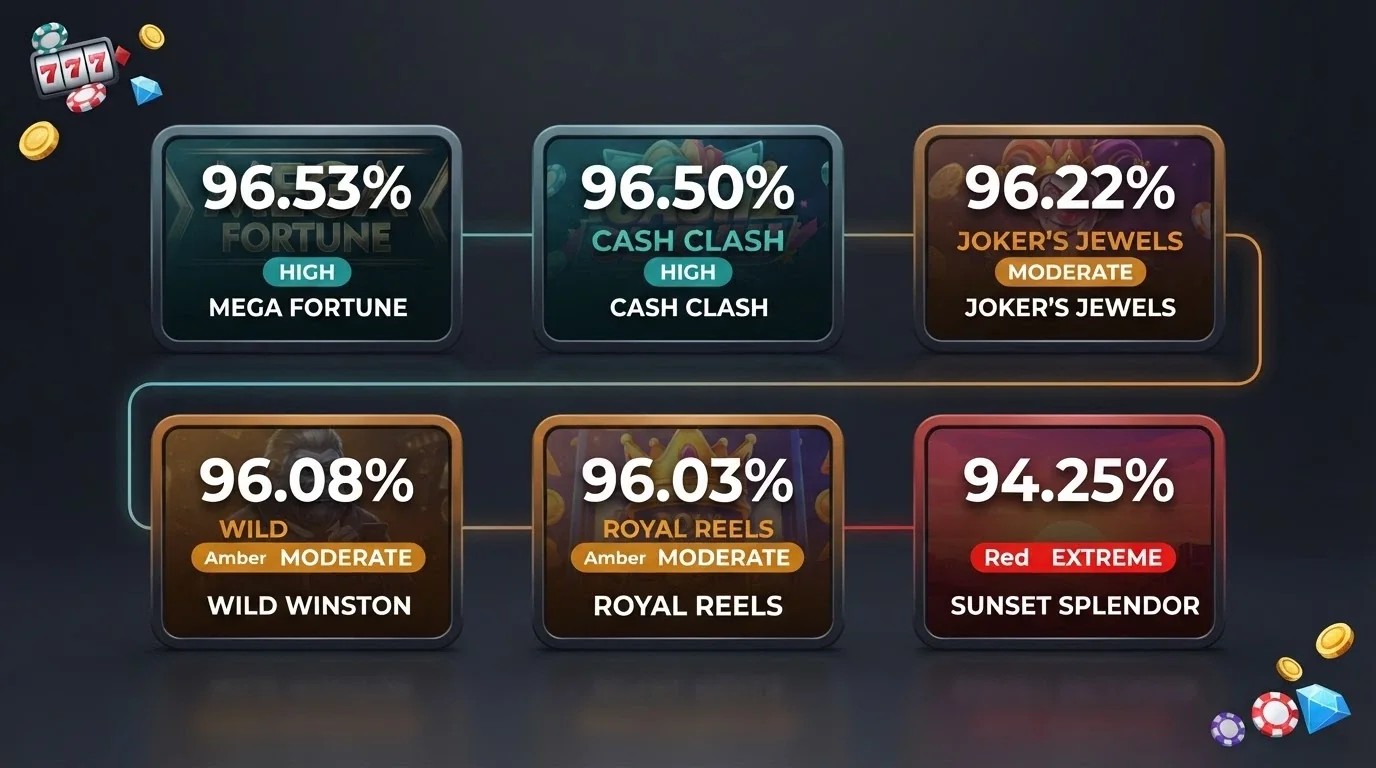
| Slot Title | Provider | RTP | Volatility |
|---|---|---|---|
| Gates of Olympus | Pragmatic Play | 96.50% | — |
| San Quentin xWays | Nolimit City | 96.03% | Insane |
| Tombstone R.I.P. | Nolimit City | 96.08% | — |
| Rip City | Hacksaw Gaming | 96.22% | 3/5 |
| Sunnydaze Asylum | Pragmatic Play | 96.53% | High |
| Book of Dead | Play’n GO | 94.25% | — |
Two things are worth naming in this table. First, RTP varies by game and by operator configuration. Nolimit City titles can run at 94.20% or 96.08% depending on which setting the casino has chosen, and a player on a lower-configured Nolimit game is playing a meaningfully different machine from a player on the higher setting. Hacksaw Gaming sits at around 96.27% on average, with a range of 96.00% to 96.41%; the variation is real but smaller. The in-game paytable is the only place a player can confirm which setting they have.
Second, volatility is the lever a comparison usually ignores. A slot with Insane volatility (San Quentin xWays, with a 150,000x max win) is a different product from a slot with 3/5 volatility (Rip City, with a 12,500x max) — the first eats bankroll in long dry stretches punctuated by occasional large hits, the second pays out more steadily at a lower ceiling. The house edge is similar; the experience is not.
Dice, Flip and Crash: The Crypto-Native Game Formats
Dice, crash, plinko, flip — these are the formats that exist because crypto casinos exist. They are simple, fast, and built around a mechanic that licensed online casinos in Australia do not offer.
Dice is the oldest. The player picks a number, the server rolls below or above it, and the payout scales with the probability. Provably fair dice lets the player verify the roll after the fact by checking the server’s pre-committed hash against the revealed seed. On Solana, the verification is cheap enough to actually run.
Crash is the recent signature format. A multiplier rises from 1.00x upward; the player cashes out before it crashes. The longer they wait, the higher the multiplier — and the higher the chance the multiplier has already crashed. The cashout decision is the entire game. The house edge lives in the small probability that the multiplier will crash at 1.00x and not pay out at all.
Flip is a coin-flip variant — the player picks heads or tails, the server commits to an outcome, the player verifies after. The mechanic is provably fair in the same way as dice.
For a player used to pokies and roulette, these formats take a recalibration. The house edge is transparent, the variance is high, and the session length is in the player’s hands. The crypto-native framing is not marketing fluff: these games are built for the deposit rail and the verification model that SOL makes cheap.
The General Game Library: Providers, Ranges and What Is Missing
The provider mix at the larger offshore brands is what an experienced Australian online casino player would expect: Pragmatic Play, Nolimit City, Hacksaw Gaming, BGaming, Play’n GO, Evolution, Pragmatic Play Live. Several of the brands in this comparison run 70-plus providers. Royal Reels lists approximately 1,400 pokies out of 1,800 total titles; the larger crypto-first brands run into four-digit territory.
What is missing is the licensed Australian wagering product. The licensed AU market offers race and sports wagering through operators like the major TABs and online bookmakers; it does not offer online casino, online pokies, or in-play betting. A player coming to an offshore Solana casino from the Australian licensed market will find games they cannot legally access at home, played at an operator that does not have an Australian licence, on a cashier that accepts coins the licensed market is banned from taking.
Live-dealer availability with SOL depends on the casino, not the studio. Evolution’s live-dealer tables run wherever the casino integrates them; the cashier at the front of the lobby decides whether SOL is one of the accepted coins. The big studios are well-represented across the offshore market, and the live-dealer experience at the larger brands is essentially indistinguishable from the licensed European market the studios primarily serve.
The Law: Why Every Solana Casino Australians Use Is Unlicensed
The Interactive Gambling Act 2001 prohibits the supply of online casino games and online pokies to anyone in Australia. That is the entire framework in one sentence. There is no online casino licence to apply for because the activity is banned at the supply level; the prohibition is structural, not regulatory. The amendments that have strengthened it since 2017 have not opened a path; they have closed the loopholes offshore operators used to reach Australian players. The 2026 reform, which passed Parliament on 19 August 2026 and commences on 1 January 2027, extends enforcement but does not legalise the product.
This is the legal reality the comparison above sits inside, and the section below unpacks it in three parts: what the statute actually prohibits, what ACMA does about it, and what changes in 2026 once the new reform is in force.
The Interactive Gambling Act: What It Prohibits and What It Does Not
The IGA’s prohibited list is short and specific. Online casino games, online pokies (slots), and in-play sports betting (betting on a sporting event once it has started) cannot be supplied to a person physically in Australia. The supply is the offence; the player is not the target of the Act.
What is permitted and licensable is wagering on races and sport placed before the event begins, lotteries, and keno. Licensing is state and territory business, and the Northern Territory Racing and Wagering Commission (administered through Licensing NT) is the de facto national wagering licensor — the major online bookmakers hold NT licences. The minimum age for any commercial gambling activity is 18.
The Interactive Gambling Amendment Act 2017 strengthened the original statute, closing the loopholes offshore operators had used and giving ACMA the enforcement and blocking powers the regulator now exercises. The Interactive Gambling Amendment (Credit and Other Measures) Act 2023, which took effect on 11 June 2024, went further on the payment side: credit cards, credit-related products, and digital currency (crypto) are banned as payment for online wagering, with penalties of up to $247,500 for operators that fail to enforce it.
For an Australian playing at an offshore Solana casino, the crypto payment ban is the most directly relevant piece of the framework. It applies to licensed operators; offshore operators do not enforce it because they are not licensed. A player using SOL to deposit is therefore using a payment method the licensed Australian market is banned from taking — which is itself an indicator of the offshore status of the casino.
KYC, ACMA Blocking and the Offshore Safety Net That Is Not There
ACMA’s enforcement runs through a complaints-and-blocking process that has racked up real numbers. Since its first blocking request in November 2019, the regulator has had 1,564 illegal gambling and affiliate websites blocked by Australian ISPs. More than 225 illegal services have withdrawn from the Australian market since enforcement strengthened in 2017. The list of blocked services is public, and ACMA updates it as new sites are added.
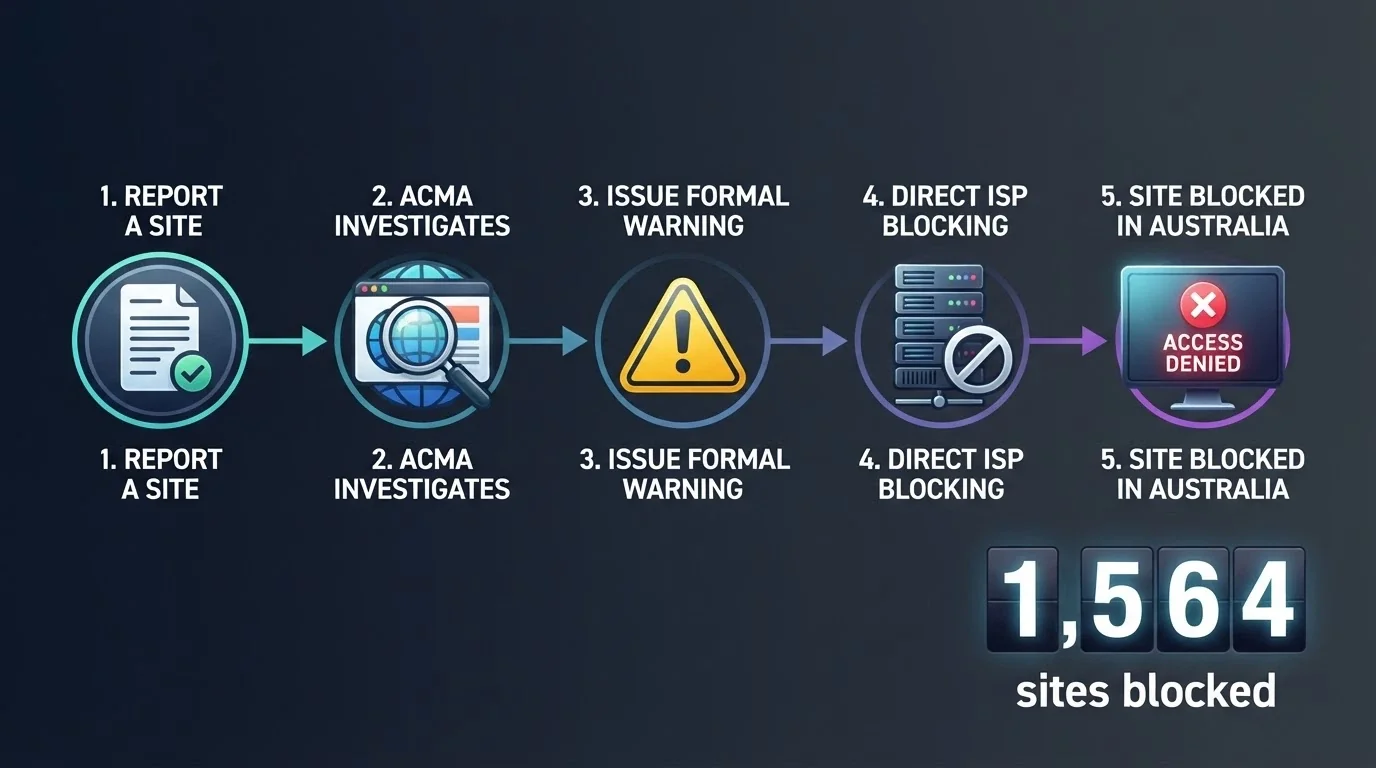
The blocking is effective. A site available today can be on the block list next month. The sites usually continue operating in other jurisdictions; what the block does is make them unreachable from an Australian IP address without a VPN. For a player who has a balance on a blocked site, the practical effect is that withdrawals still go through (the blockchain does not care about DNS), but access to the platform’s website and cashier — including support — may be cut off. The site can be blocked with the player’s balance still on it, and the recourse is whatever the casino’s own complaints process provides.
What Australia does not provide for the offshore player is consumer protection. There is no Australian complaints body for an offshore casino dispute, no BetStop coverage, and no equivalent of the UKGC or MGA framework that would give a player an ombudsman to escalate to. A player whose withdrawal is refused, whose bonus is confiscated, or whose account is closed has only the operator’s own terms and whatever goodwill the operator extends.
This is the offshore safety net that is not there. The legal status is clear (the product is prohibited, the operator is offshore, the player is not prosecuted), and the practical status is just as clear (no Australian recourse, no BetStop coverage, no consumer protection).
The 2026 Reform Bill: What Changes on 1 January 2027
The Interactive Gambling Amendment (Gambling Reform) Bill 2026 passed Parliament on 19 August 2026 and commences on 1 January 2027. Its provisions are aimed at the licensed wagering market and at the operators that supply it, but several of them touch the offshore-Solana picture a player should be aware of.
On advertising, the reform caps wagering advertising to no more than three ads per hour between 6:00 am and 8:30 pm, bars radio ads during school hours, bans broadcasting of odds, and restricts online ads to logged-in confirmed 18+ users. There will be no wagering ads in sports venues or on uniforms, and athletes, celebrities and influencers will be barred from wagering advertising. A live-sport blackout runs from 15 minutes before a live event until 5 minutes after.
On inducements, direct marketing of bonus offers is prohibited for 14 days after sign-up, for three months after a BetStop deregistration, and indefinitely for customers the operator has classified as at-risk. The “free bet” churn the Australian licensed market has been running on will tighten considerably.
On payments, banks and payment providers gain express authority to block transactions to illegal gambling operators. The mechanism is the bank-blocking power; the effect, in practice, is that a transaction from an Australian bank account to a known illegal gambling operator can be refused at the payment-processor level rather than caught at the ISP-blocking level.
What stays the same is the underlying prohibition. The 2026 reform does not legalise online casino. It does not open a licensing path. It strengthens enforcement around the existing ban and adds pressure on the operators that supply the prohibited product.
Staying in Control: Responsible Gambling When the Safety Net Has Gaps
Australia has built substantial responsible-gambling infrastructure for the gambling it does license. BetStop, the National Self-Exclusion Register, has had 67,480 registrations since it went live in August 2023, with 41,290 exclusions still active as at 31 July 2026. 78% of registrants are under 40, and 38% have chosen lifetime exclusion. The National Gambling Helpline (1800 858 858) is free, confidential, staffed 24/7, and backed by Gambling Help Online for chat and counselling. The tools exist, they are used, and they work for the operators Australia licenses.
The offshore Solana casino market sits outside all of it. BetStop binds Australian-licensed wagering services only; an offshore casino is not connected to the register. A player who has self-excluded through BetStop can still deposit at every site in this comparison. That is not a glitch — it is the structural consequence of the offshore status described in the previous section.
BetStop, Deposit Limits and Why They Do Not Cover Offshore Casinos
BetStop works by having every Australian-licensed wagering operator check the register before accepting a new customer account. If the customer is on the register, the operator must refuse the account and must not accept deposits. The mechanism is sound and the coverage is broad — every licensed bookmaker, every licensed totalisator, every state-licensed wagering product.
Licensed wagering operators also offer customer-set deposit limits and activity statements under their state or territory conditions. A player can set a daily, weekly or monthly deposit ceiling at most Australian-licensed operators, and can request an activity statement that shows deposits, withdrawals, and net position over a period. The conditions differ between jurisdictions, but the basic toolkit is universal across the licensed market.
The boundary is hard. None of this applies to an offshore casino. An offshore Solana casino is not connected to BetStop, does not check the register, does not have to honour an Australian self-exclusion, and is not subject to the deposit-limit conditions of any Australian licence. The player who self-excludes and then deposits at an offshore casino has done the Australian system the right way and the offshore system does not care.
For a player trying to control their own play, the practical implication is that the Australian safety tools work only on the operators they cover. Offshore play has to be controlled at the source — the player’s own decision, the player’s own limit, the player’s own decision to walk away.
Gambling Harm in Australia: The Numbers and Where to Get Help
The prevalence data is sobering. Roy Morgan research from March 2026 puts 15.1% of the Australian adult population — an estimated 3.32 million people — as experiencing some level of gambling harm, whether from their own gambling or someone else’s. 13.0% of the population (around 2,857,000 people) are experiencing harm from their own gambling behaviours. POLIS at ANU, tracking 2025 data, found that risky gambling had risen from 13.7% in 2024 to 19.4% in 2025 — almost doubling, and concentrated among those who gamble mainly online (56.1% of recent participants).
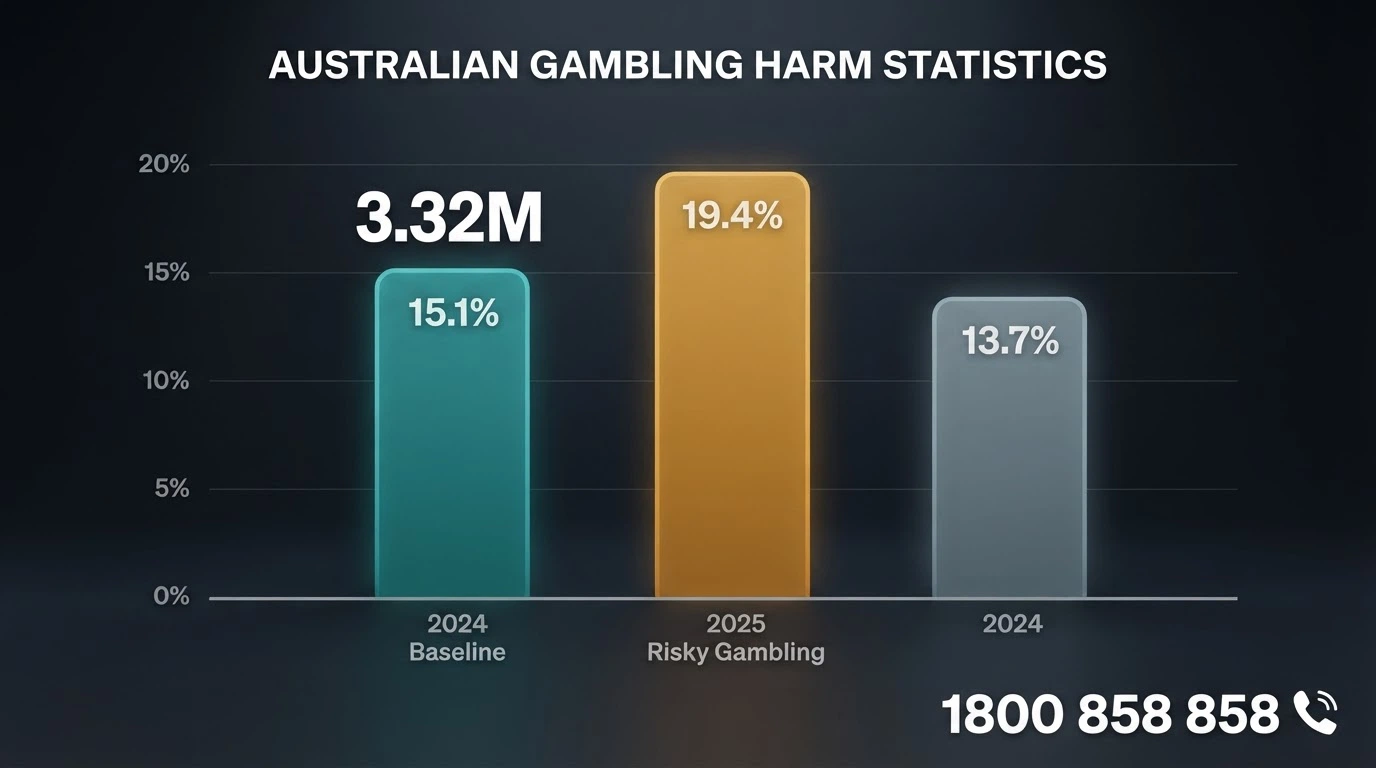
These are not numbers specific to offshore crypto play; they are numbers for Australian gambling harm in general. The offshore Solana casino space is a slice of a larger picture, and the harm picture is the one that justifies the prohibition and the player-protection infrastructure above.
Help is free, confidential, and one call away. The National Gambling Helpline — 1800 858 858 — runs 24/7 with online chat and counselling through Gambling Help Online at gamblinghelponline.org.au. State-level services include Gambler’s Help Victoria and the Youthline at 1800 262 376. A player who is worried about their own gambling, or about someone else’s, can reach any of these services without giving a name and without committing to anything other than a conversation.
The hardest step is the first one. The infrastructure after that is built to carry the player from there.
How We Built This Solana Casino Comparison
This comparison draws on four sources. Operator-level data — welcome bonuses, wagering terms, free-spin structures, platform RTPs, withdrawal speeds — comes from affiliate reviewers who have tested the brands in detail (Tech Insider, SlotsPeak, PlayCasino, Hostripples, AssistoTV, VIP-Grinders, CoinCodex, among others). The legal and enforcement framework is anchored to ACMA and to the Interactive Gambling Act as published by the Australian Government. The Australian gambling-harm and self-exclusion figures are drawn from Roy Morgan, ANU POLIS, and the Department of Social Services. The Solana network and SOL casino-specific data points come from blockchain-focused outlets (Casinozoid, Casipto, BTCDices) and from operator-side testing where available.
The ranking is qualitative. The brands at the top of the comparison carry the most publicly surfaced data; the brands lower in the comparison carry less. Where a welcome offer, a game count, or a licence detail was not publicly surfaced at review, the table and the profile say so, with an em dash for the cell rather than a fabricated figure. A reader who wants to verify a specific term should check the operator’s own terms page; the comparison is a snapshot, not a contract.
What this comparison does not cover: the user-experience quality of each operator’s mobile app or live chat; the player-complaints history of each brand; the bonus terms for non-welcome promotions (rakeback, reloads, races) that change frequently and are not part of the sign-up offer. The offshore-vs-licensed distinction is structural, not a judgement on operator trustworthiness — there are well-run offshore brands and poorly run licensed brands, and the legal status of the operator is one input among several, not the only one.
What an Australian Player Should Actually Do With This Comparison
The honest first move is to accept the offshore reality. Every brand in this comparison is offshore; every brand operates without an Australian licence; every brand sits outside BetStop and outside Australian consumer protection. That does not mean the comparison is pointless — it means the comparison is for a player who has decided to use the offshore market and wants to do so with eyes open about which brand does what best inside that frame.
The next move is to weigh the bonus against the wagering. SkyCrown’s 450% headline is the largest match in the group, and is also gated against crypto players. Rocket Play’s 30x is the cleanest wagering, and pairs with a free-spin structure that punishes a player who does not log in daily. Royal Reels’ A-denominated welcome, and comes with a A denomination, or no welcome at all.
The third move is to weigh the SOL-specific advantages that hold across operators: deposits that confirm in seconds, fees under a cent, withdrawals measured in minutes for the brands that have automated queues. The Solana experience at the cashier is a real improvement on the Bitcoin or wire-transfer experience, and it is the part of the comparison the offshore status does not undermine.
The fourth move is to price in the risk factors every offshore player carries. Sites can be blocked with balances on them. Operators can refuse withdrawals under their own terms. Self-exclusion through BetStop does not extend offshore. Recourse runs through the operator’s own complaints process. None of this is unique to Solana casinos — it is the cost of the offshore market the player has chosen to use.
The final move is the one that matters most. If the offshore market is starting to feel less like a choice and more like a need — if the wagering is getting larger, the sessions longer, the losses harder to absorb — the right next step is not a different offshore brand. It is a call to 1800 858 858, a chat at gamblinghelponline.org.au, or a conversation with someone the player trusts. The infrastructure is built for that call, and it is free.
Frequently asked questions
What is the fastest Solana casino for withdrawals in Australia?
The fastest verified figure in this comparison is the 43-second average SOL withdrawal across 127 test deposits at fifteen offshore platforms, with SkyCrown’s USDT-TRC20 median sitting at 4 minutes across 12 tests and the fastest single recorded test at 1 minute 40 seconds. None of these are Australian-licensed operators, and ACMA can block any of them at any time — fast on the way in is no guarantee of fast on the way out when a balance is on the line.
What welcome bonuses do Solana casinos offer to Australian players?
The headline figures run from SkyCrown’s 450% across four deposits up to A$8,000 plus 400 free spins (with the catch that crypto players are excluded) down to Stake’s absence of a traditional welcome match. Rocket Play, Royal Reels and Rainbet sit in the middle with offers ranging from A$500 to A$2,500 plus varying free-spin structures. Wagering on the bonus amount runs 30x to 40x across the group, with separate (usually higher) wagering on free-spin winnings. Every brand offering a bonus is offshore and unlicensed in Australia.
What are the risks of using an offshore Solana casino in Australia?
The product is prohibited under the Interactive Gambling Act 2001, and the operator has no Australian licence. ACMA has blocked 1,564 illegal gambling and affiliate websites since November 2019, and a balance can be on a blocked site. There is no Australian consumer protection, no Australian complaints body, and BetStop does not cover offshore casinos — a self-excluded Australian can still deposit and play. The individual player is not prosecuted, but “not illegal for the player” is not the same as “safe”.
How does Solana compare to Bitcoin for online casino deposits?
Solana confirms in about 2.3 seconds during peak hours, with fees under a cent per transaction. Bitcoin confirms in roughly ten minutes per block, with fees that can range from a few dollars to significantly more during mempool spikes. For a casino session that involves several deposits and withdrawals, SOL is materially faster and more predictable on fees. USDT on the Tron network sits in the middle, at around 4 minutes per confirmation and a median of 4 minutes on the fastest-tested withdrawals.
What should I do if I have a gambling problem in Australia?
Call the National Gambling Helpline on 1800 858 858, free and confidential, 24/7. Online chat and counselling are available through Gambling Help Online at gamblinghelponline.org.au. State services include Gambler’s Help Victoria and the Youthline on 1800 262 376. BetStop, the National Self-Exclusion Register, has had 67,480 registrations since August 2023 — it covers Australian-licensed wagering services but not offshore Solana casinos, so registration should be paired with the player’s own commitment to avoid offshore brands.
Will the 2026 gambling reform bill affect Solana casinos in Australia?
The Interactive Gambling Amendment (Gambling Reform) Bill 2026 passed Parliament on 19 August 2026 and commences on 1 January 2027. Its advertising caps and inducement bans apply to licensed wagering operators, and the bank-blocking power gives Australian banks and payment providers express authority to block transactions to illegal gambling operators. The underlying prohibition on online casino is unchanged: the reform strengthens enforcement around the existing ban rather than legalising the product. Offshore Solana casinos remain illegal to supply to Australian players, and the new bank-blocking powers may make deposits from Australian bank accounts harder to land at offshore brands.
NFT-Based Casino Games: Novelty or the Next Standard?
A handful of Solana casinos integrate NFT mechanics — provably scarce in-game items, NFT-based slot reels, or tokenised loyalty assets. The Solana NFT ecosystem is real and active, and it provides an obvious on-ramp for NFT-based casino products: a player who already holds a Solana NFT can use it inside a casino that recognises the contract.
The honest read on whether this is novelty or the next standard is that, at the time of writing, it is closer to novelty. The casino games that integrate NFTs tend to be slot reskins with the NFT as a cosmetic layer rather than a change to the underlying game math. The house edge and the RTP work the same way; what the NFT adds is a tradable asset on the player’s balance, with all the upside (resale value, cross-game utility) and downside (illiquidity, price exposure) that implies.
For a player who is already active in the Solana NFT space, the integration is a real feature. For a player whose interest in casino play is the casino play, NFT mechanics add complexity without changing the math, and that complexity is a cost.