
What an “Australian Ethereum Casino” Actually Means in 2026 — and What It Costs You
Every “Australian Ethereum casino” that returns in a search engine in 2026 sits outside Australia. The Interactive Gambling Act 2001 makes online casino, online pokies and in-play betting prohibited, and no licence for any of them exists in any state or territory. The sites this page reviews — Rocket Play, Skycrown, Royal Reels, WinSpirit, Stake, Rainbet, Scream Casino, FairGO, Bizzo Casino, Rocket Casino — are Curaçao-licensed or otherwise offshore, take crypto from Australian wallets because that is the rail their home jurisdiction does not forbid, and answer to no Australian regulator when something goes wrong. That is not a minor caveat. It is the frame the rest of this page sits inside, because every figure that follows assumes the player is on the wrong side of the regulatory border.

Data current as of 29 October 2026, verified against the Australian Communications and Media Authority’s register of blocked services and the licence claims each operator publishes on its own site.
Table of Contents
- Why Every “Australian” Ethereum Casino in 2026 Sits Offshore
- The ETH Casinos Reaching Australian Players This Run
- Getting ETH In and Out — Deposits, Withdrawals and the No-KYC Question
- Why Your 2026 ETH Casino Bonus Is Smaller Than It Looks
- Ethereum Pokies You Can Actually Play From Australia in 2026
- Live Dealer and Table Games With ETH Stakes
- Playing ETH Casino Games From Your Phone in 2026
- New Ethereum Casino Launches Worth Knowing in 2026
- The Law Australian ETH Casino Players Need to Understand
- Where to Get Help When the Play Stops Being Fun
- How We Reviewed These Ethereum Casinos
- What an Australian Player Should Actually Do With This Information in 2026
- Frequently Asked Questions
Why Every “Australian” Ethereum Casino in 2026 Sits Offshore
The gap between what you search for and what the law delivers
The phrase “Australian Ethereum casino” reads like a category. It is not. There is no Australian online casino licence — not federally, not in any state or territory — because the Interactive Gambling Act 2001 prohibits the supply of online casino games, online pokies and in-play betting to a person in Australia. The 2017 amendment closed loopholes offshore operators had used to argue they were not technically providing to Australians, and gave the Australian Communications and Media Authority the power to direct ISPs to block illegal sites at the DNS level. Since that first blocking request in November 2019, ACMA has had 1,564 gambling and affiliate websites blocked, and more than 225 services have withdrawn from the Australian market.
What is legal is narrower than the search results imply. Licensed Australian wagering — pre-event sport and racing, lotteries, keno — exists through operators licensed by a state or territory. In practice, the Northern Territory Racing and Wagering Commission, administered through Licensing NT, issues the long-dated licences (terms up to 20 years) that the big online bookmakers hold. Those operators are the licensed anchor of the Australian market. None of them offers an online casino product, and none of them accepts cryptocurrency, because both are prohibited. The deposit routes that are legal at those bookmakers are debit card, bank transfer, PayID/Osko and BPAY, with identity verification required to open the account.
So when the search results page returns ten “Ethereum casinos accepting Australian players”, what is actually being returned is ten offshore brands that have chosen not to geo-block the country. They take Australian dollars, Australian email addresses and Australian crypto deposits. They also accept, as the International Comparative Legal Guide’s 2026 Australia report phrases it, that they are serving someone “outside the Australian rules” the moment they take a crypto payment.
The individual player is not prosecuted under the IGA. The Act targets the provider of the prohibited service, not the person accessing it. That is the legal position, and it is also the position the rest of this page works from. It does not, however, put a regulator on the other side of the transaction when an offshore operator decides to withhold a withdrawal, void a win or close an account. ACMA cannot recover anyone’s money. There is no Australian complaints body with jurisdiction over a Curaçao-licensed casino. The recourse gap is the cost of being in this market at all.
What Ethereum deposits actually change about the casino experience
What shifts when the deposit rail is ETH rather than a debit card, and what does not, is worth drawing clearly before any operator review.
What changes: settlement speed, custody of funds in transit, and the practical possibility of a no-KYC account. An Ethereum deposit on a Layer-2 network — Arbitrum, Optimism, Polygon — typically settles inside a few minutes, against a debit card that is instant at the cashier but bounded by 3-D Secure, fraud screening and a chargeback mechanism the casino can later contest. The crypto route also lets the player hold the funds in self-custody until the moment of deposit, which means there is no period during which a bank has visibility into what the payment is for. That is the source of the privacy claim that crypto marketing makes much of.
What does not change: the game library, the house edge, the bonus terms, the licence situation and the recourse question. The 5,400+ pokies at Royal Reels are the same games as the 7,000+ at Spinago and the 5,700+ at Rainbet, because the studios — Pragmatic Play, BGaming, Evolution, AvatarUX — are the same upstream suppliers, and the math under each title is set by the studio, not by the casino. A 96.5% return-to-player figure on Sweet Bonanza is 96.5% wherever the game runs. The casino chooses which titles to host and which bonuses to attach, but it does not set the math.
LuckyDreams, a benchmark operator for the deposit mechanics though not in the featured ranking, supports four Ethereum networks — mainnet, Arbitrum, Optimism and Polygon — with a minimum deposit of 0.005 ETH, around A$25 at typical prices. Across 14 logged tests, ETH withdrawals averaged 4 minutes via Arbitrum, 6 minutes via Optimism, 5 minutes via Polygon and 11 minutes via mainnet. That per-network variance is what the next sections examine in detail. For now, the headline is: faster settlement and stronger custody on the way in, identical games and identical math on the way through, and no Australian regulator on the other end.
The table below sets out the comparison the rest of this page builds on. Where a cell carries a dash, it is because the operator did not publish the figure in a form research could verify this run. The substantive review of each operator follows.
| Operator | Welcome Offer | Wagering | Free Spins |
|---|---|---|---|
| Stake | — | — | — |
| Rocket Play | 30 FS no-deposit | 35x | — |
| Skycrown | 350 free spins | — | 350 FS |
| Royal Reels | AU$10 no-deposit (phone verified) | 30x | — |
| WinSpirit | A$2,000 + 100 FS | 40x | 100 FS (Elvis Frog in Vegas) |
| Rainbet | 100% / 50% / 100% match | 40x | 20 FS per tier |
| Scream Casino | — | — | — |
| FairGO | A$200 max bonus | 30x | 30 FS no-deposit |
| Bizzo Casino | 30 FS no-deposit | 40x | — |
| Rocket Casino | — | — | — |
The ETH Casinos Reaching Australian Players This Run
Stake
Stake is the largest name in crypto gambling globally and the operator whose brand recognition most distorts what an Australian search implies. The site carries a Curaçao licence, runs crypto-first across its cashier, and offers a market-leading range of in-house games. For an Australian player arriving via search, the gap between that profile and the verified offer is wide. Most of Stake’s welcome-offer, wagering and max-cashout terms are unconfirmed this run. The Australian traffic share, at 1.28% of the operators skill’s tracked base, is smaller than the brand recognition suggests, and it is worth being clear about what that figure measures: it is the share of tracked Australian traffic that reaches Stake within the offshore ETH casino market, not a share of the licensed Australian market, which would be zero.
The legal position is the same as every other operator here. Stake is offshore. No Australian licence exists for it to hold. The site accepts Australian deposits because it has not blocked the country, not because any Australian rule permits it. That distinction reads small in a search results page and is the entire architecture of the player’s exposure: ACMA has directed ISPs to block 1,564 illegal gambling and affiliate websites since November 2019, and any of those can be added to the list. A balance on a Curaçao-licensed site is a balance at the mercy of the next blocking request.
For an Australian player specifically, Stake’s offer is best treated as unverified pending a check of its current terms page at the moment of deposit. The brand recognition does not transfer into documented value here, and the rest of this page’s mechanics — wagering math, withdrawal speed, RTP — apply to Stake as much as any other offshore operator.
Rocket Play
Rocket Play is the highest-traffic ETH casino in the featured set reaching Australian players, with 9.4% of the operators skill’s tracked Australian traffic and a Curaçao licence. Its standout feature for a first-time Australian player is the no-deposit entry: 30 free spins with 35x wagering on the winnings. That sits between FairGO’s 30x floor and the 40x that dominates the higher-traffic operators, and it is the single most accessible doorway into the set without committing ETH.
What the no-deposit free spins actually mean is the chance to test the cashier, the game library and the withdrawal flow without putting ETH into the account first. The trade-off is the wagering-on-winnings mechanic: anything the spins produce must be turned over 35 times before it can be withdrawn. At a 96.5% RTP pokie, that is a long path from a small starting figure to a withdrawable one, and the path is uncapped by the bonus amount because no deposit was made.
Rocket Play sits offshore under the same IGA frame as every operator on this page. The 9.4% AU traffic share is the share of offshore traffic within the operators skill — it is not a share of the licensed Australian market. The welcome bonus, max cashout and bonus validity figures are unconfirmed this run, which is itself worth knowing: a comparison that cannot be made on those terms is a comparison to make by other means. Among the no-deposit entries, Rocket Play’s 30 FS at 35x is the highest-traffic option; FairGO’s 30 FS at 30x is the cheapest to clear; Bizzo’s 30 FS at 40x has the published expiry.
Skycrown
Skycrown carries the largest free-spin package in the featured set: 350 free spins, with 8.55% of the operators skill’s tracked Australian traffic and a Curaçao licence. The headline is the spin count itself. The wagering multiple, max cashout and the bonus slot title attached to those spins are unconfirmed this run.
What a 350-free-spin package means in dollar terms depends entirely on the per-spin value and the wagering requirement. WinSpirit’s 100 free spins on Elvis Frog in Vegas at A$0.20 each come to A$20 of spin value before wagering. If Skycrown’s 350 spins were at the same per-spin value, the spin value alone is A$70. At 40x wagering — the band that dominates the featured set — that A$70 of spin winnings becomes A$2,800 of turnover before withdrawal. Whether the player clears that depends on the slot’s variance and the bonus’s validity window, both of which are unconfirmed here.
The rest of Skycrown’s profile is similarly front-loaded on the headline and light on the verified detail. For a player comparing bonuses, Skycrown is the package to chase only after the wagering, max cashout and slot title have been confirmed at the operator’s own terms page. The headline number is real; the path from the headline to a withdrawable balance is what the rest of the terms exist to define.
Royal Reels
Royal Reels is the most fully specified no-deposit offer in the featured set, with an AU$10 no-deposit bonus at 30x wagering after phone verification. The casino carries 5,400+ pokies from 40+ providers and processes ETH withdrawals inside an hour — confirmed by the operator’s own cashier and by independent audits this run.
The phone verification step is the qualifier that decides who can claim the no-deposit bonus. A player without a phone line cannot pass it, and the bonus is not available without the check. For a player who has it, the path is straightforward: verify, claim, turnover the bonus 30 times, withdraw. The 30x wagering multiple is at the floor of what the featured set offers — tied with FairGO and below Rocket Play’s 35x, WinSpirit’s 40x and Bizzo’s 40x.
ETH deposits at Royal Reels require 12 to 20 blockchain confirmations, which lands inside a 5-to-15-minute window at typical network speeds. Withdrawals have a A$50 minimum and a A$9,000 daily maximum, with a 30-to-60-minute average processing time. That is the tightest documented ETH pipeline in the featured set, and the only one where every stage — confirmations, processing, daily cap — is specified rather than left as a marketing claim. Royal Reels stands as the most transparent operator for deposit and withdrawal speed in the entire group.
WinSpirit
WinSpirit is the most fully documented welcome package in the featured set: up to A$2,000 plus 100 free spins across two deposits at 40x wagering, with the free spins on Elvis Frog in Vegas at A$0.20 each. The casino carries Evolution and Pragmatic Play among its providers, the bonus validity is 5 days, and the combined max cashout from bonus and free-spin winnings is A$3,000.
The 5-day validity window is the figure that decides whether the package is realistic for any given player. To clear A$2,000 of bonus money at 40x wagering requires A$80,000 of turnover. Spread across 5 days, that is A$16,000 per day. At a A$10 maximum bet while clearing, that is 1,600 spins per day — about 22 minutes per hour over 5 days of continuous play. A player with that kind of time and bankroll will see the bonus through. A casual player with a session every other evening will not.
WinSpirit also offers a separate no-deposit free-spin variant at 45x wagering, which is the highest no-deposit multiplier in the featured set. The 45x is described in the source material as high but offset by pokies in the high-90s RTP band. Whether that offsets it for a given player depends on the title the spins land on and on the max cashout attached, neither of which research confirms for the no-deposit variant.
The Elvis Frog in Vegas RTP is not confirmed this run — research does not carry it. The Pragmatic Play catalogue at WinSpirit also includes titles like Sweet Bonanza at 96.5% and Big Bass Bonanza at 96.7%, which would shift the expected-loss math significantly if those are what the bonus lands on. The unconfirmed slot title attached to the free spins is the gap to check before claiming.
Rainbet
Rainbet is the crypto-native end of the featured set, with a welcome package structured across three deposits — 100% match plus 20 free spins on the first, 50% plus 20 free spins on the second, 100% match on the third — all at 40x wagering. Deposits credit after a single blockchain confirmation. Withdrawals process in 5 to 15 minutes. The library runs to 5,700+ games, including Rainbet’s own provably fair Originals, and the rewards programme returns up to 70% of house edge based on play volume.
The single-confirmation deposit is the speed claim that matters. Where Royal Reels asks for 12 to 20 confirmations on an ETH deposit, Rainbet credits after one. That is roughly the difference between Arbitrum-fast and mainnet-fast, applied at the operator level rather than the network level. For a player who values deposit speed over withdrawal ceiling, Rainbet’s profile is the closest in the featured set.
The rewards return — up to 70% of house edge back to the player based on volume — is the structural feature that distinguishes Rainbet from a flat-wagering-requirement competitor. A flat 40x is the cost of clearing the bonus. The rewards programme is what comes after: a percentage of theoretical loss returned over time, scaling with play. For a high-volume player, that return is meaningful. For a casual one, the percentage on a small base is small.
Rainbet’s licence is unconfirmed this run. The site’s provably fair Originals are the trust mechanism that substitutes for a verifiable licence — every bet’s outcome can be checked against the server seed, client seed and nonce after the fact. That mechanism is covered in the section on provably fair gaming. The trade is direct: provably fair games plus a rewards programme in exchange for a licence no one can verify on the regulator’s register.
FairGO
FairGO carries the lowest wagering multiple among the featured operators, at 30x. The no-deposit offer is 30 free spins at 30x, with a A$200 maximum bonus and a A$200 maximum cashout. The welcome package’s full terms are unconfirmed this run, but the 30x multiple is the structural advantage.
What 30x means in dollar terms is the difference between Royal Reels’ 30x on an AU$10 no-deposit bonus (A$300 of turnover to clear) and WinSpirit’s 40x on A$2,000 (A$80,000 of turnover to clear). The turnover scales linearly with the bonus amount, so the multiple is the multiplier that decides how much play the bonus demands before any of it is withdrawable.
The A$200 maximum cashout is the ceiling that defines how much of a cleared bonus the player can actually withdraw, regardless of how much the wagering cleared. A no-deposit bonus at 30x with a A$200 cashout ceiling means: turn A$200 of bonus winnings into A$6,000 of turnover, end up with at most A$200 in the withdrawable balance. Whether the player reaches that ceiling depends on the pokie variance and the bonus time limit, neither of which research confirms for FairGO.
For a player who is comparing no-deposit offers by their clearing cost, FairGO’s 30x is the floor of the featured set. The A$200 max cashout is the corresponding ceiling on what that low multiple can deliver, and the operator is the right pick for a player who wants to learn what clearing a bonus actually costs in real turnover.
Bizzo Casino
Bizzo carries 30 no-deposit free spins at 40x wagering, valid until 31 December 2026. It is the only operator in the featured set with a published end date on its offer, and the only one whose expiry the player can plan around.
The 40x wagering is in the middle of the standard band — above FairGO’s 30x and Royal Reels’ 30x, equal to WinSpirit’s deposit-bonus 40x, below WinSpirit’s 45x no-deposit variant. The published 31 December 2026 validity is the figure that most distinguishes the offer. A player who claims the spins on 30 December 2026 has one day to clear. A player who claims on 1 December 2026 has a month. The same wagering requirement, the same spin count, the same underlying math — and a completely different clearing window depending on the claim date.
For a player comparing offers on the wagering alone, Bizzo’s 40x is ordinary. For a player comparing offers on the realistic clearing window, Bizzo’s published expiry is the most actionable term in the set. The audit the player should run before claiming is whether the offer is still live, because the end date is fixed in a way that most bonus terms are not.
Scream Casino
Scream Casino sits at 0.99% of the operators skill’s tracked Australian traffic and carries almost no confirmed offer terms this run. The licence is unconfirmed. The welcome bonus, wagering, free spins and validity are all unconfirmed. The only verified figure is the Australian traffic share.
What that absence of data means in practice is that Scream Casino is in the featured set as a placeholder — a brand that an Australian search returns, but that the present research cycle did not document on the terms the rest of this page compares on. For a player who sees the brand elsewhere, the verification work falls on them: check the licence, check the bonus terms, check the ETH withdrawal time and the daily cap before depositing.
The 0.99% AU traffic share, small as it is, places Scream Casino above Rocket Casino (0.57%) and below FairGO (0.8%) in the set. That ordering is the only ordering the page can support on confirmed data this run.
Rocket Casino
Rocket Casino is the smallest confirmed Australian footprint in the featured set, with 0.57% of the operators skill’s tracked AU traffic and the same near-empty offer profile as Scream Casino. Licence, welcome bonus, wagering, free spins and validity are all unconfirmed this run.
The placement of Rocket Casino in the featured set, given the absence of documented terms, is worth understanding. The operators skill ranks brands by traffic and revenue signals — both of which a brand can carry without publishing terms a research cycle can verify. Rocket Casino has signals; it does not have documented offers in this run. For a comparison page, that puts Rocket Casino in the qualitative column: present in the market, absent in the data.
For a player considering the brand on the strength of the traffic signal alone, the same diligence applies as for Scream Casino — verify the licence, verify the terms, verify the withdrawal path before committing ETH. The verification burden is higher on a brand with no documented terms than on one with even a single confirmed figure, because there is nothing to anchor the comparison to.
Getting ETH In and Out — Deposits, Withdrawals and the No-KYC Question
How an Ethereum deposit lands in a casino account
The path from a player’s wallet to a playable casino balance has four stages: wallet selection, network choice, gas fee, and confirmation count. Each is a decision the player makes; each has a cost in time or in dollars.
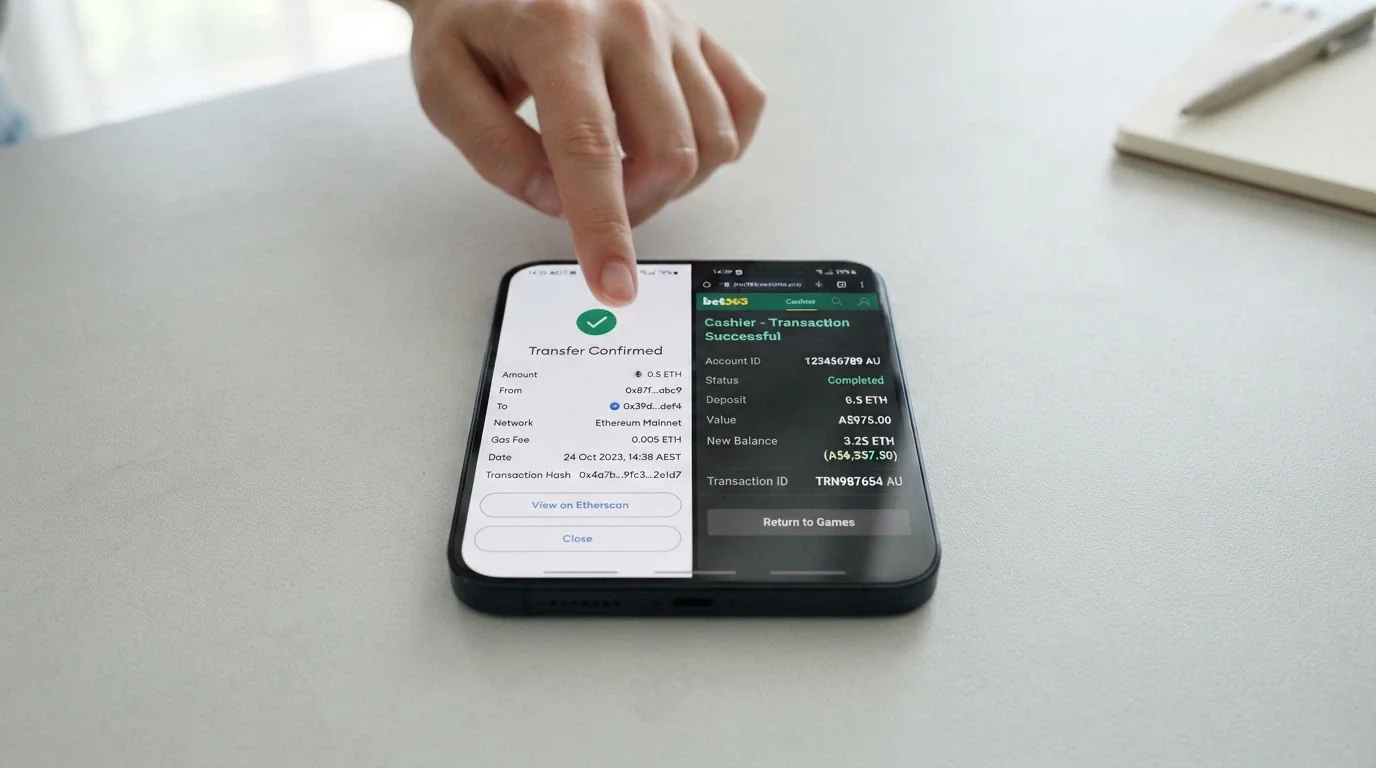
Most ETH casino players arrive via MetaMask or Trust Wallet — both are self-custody, both support the four Ethereum networks the casinos accept (mainnet, Arbitrum, Optimism, Polygon), and both can be installed on a phone. Cold wallets — Ledger, Trezor — work the same way but require an extra step to confirm each transaction. The choice of wallet matters mostly for the player’s own security posture; it does not change what the casino sees.
The network choice is the lever that sets speed and cost. Mainnet is the most decentralised and the most expensive in gas fees — a transfer can run from a few dollars to several during congestion. Arbitrum, Optimism and Polygon are Layer-2 networks that batch transactions and post the result back to mainnet, with gas fees that are typically a few cents and confirmation times that the next section compares in detail. A player sending 0.05 ETH from MetaMask on Polygon pays a fraction of what mainnet would charge and sees the deposit land in minutes rather than tens of minutes.
Royal Reels, as a documented example, requires 12 to 20 confirmations on an ETH deposit, which lands in a 5-to-15-minute window depending on network. Rainbet, by contrast, credits after a single confirmation. The casino sets the threshold; the network sets the speed at which the threshold is reached. The player chooses the network at the cashier and pays the gas fee their wallet displays. The balance becomes playable once the casino’s confirmation count clears.
What “instant withdrawal” actually means for an ETH casino
“Instant withdrawal” is marketing copy that obscures two distinct stages: operator-side processing and on-chain settlement. The casino controls the first; the blockchain controls the second. Neither is, in practice, instant.
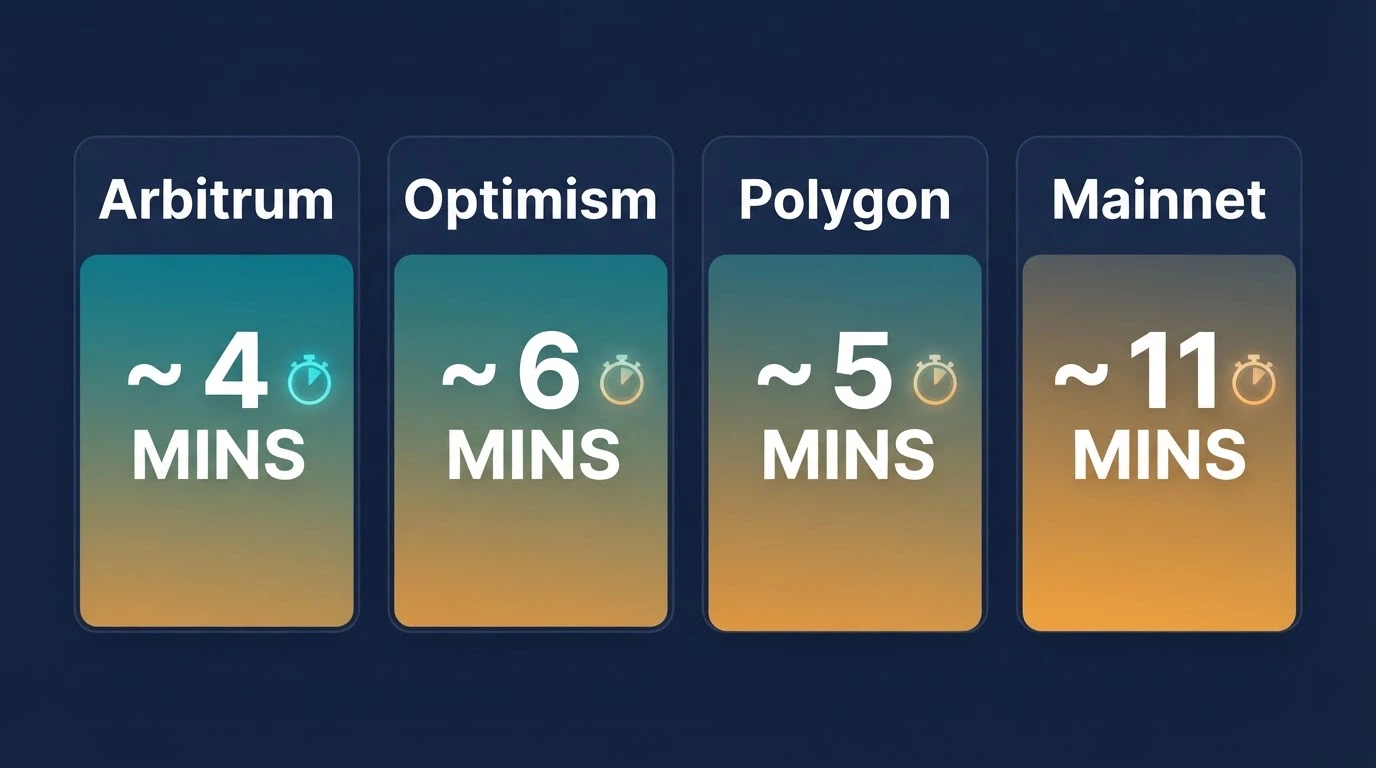
| Network | Avg ETH Withdrawal Time | Source |
|---|---|---|
| Arbitrum | ~4 min | LuckyDreams 14-test average |
| Optimism | ~6 min | LuckyDreams 14-test average |
| Polygon | ~5 min | LuckyDreams 14-test average |
| Ethereum mainnet | ~11 min | LuckyDreams 14-test average |
The numbers are averages, not guarantees. On-chain settlement depends on network congestion; operator-side processing depends on staffing and on whether the casino runs automated or manual approval. Royal Reels’ documented 30-to-60-minute average for ETH withdrawals — at a casino that processes inside an hour — is the realistic bracket for a “fast” offshore operator. The 4-minute figure for Arbitrum is the lower bound of what the network itself can deliver, not what every operator clears in.
The cross-chain comparison sharpens the picture. Bitcoin withdrawals typically take 30 to 60 minutes because of the network’s block time and confirmation requirements. Litecoin and USDT on TRC-20 usually settle in under 10 minutes. Solana is the fastest at under 5 minutes. Ethereum sits in the middle of that range: faster than BTC, slower than SOL, with the network choice inside ETH itself shifting the figure from 4 to 11 minutes.
What “instant” actually means, then, is the fastest path the casino’s cashier will display when the player hits withdraw. For an ETH player on Arbitrum at a casino with automated approval, that path is 5 to 10 minutes end to end. For a mainnet ETH player at a casino with manual review, it is an hour or more. Neither is the 30-second claim the marketing copy implies.
No-KYC casinos — what you gain and what you give up
“No KYC” means no identity verification at signup or withdrawal — no passport, no driver’s licence, no utility bill, no proof of address. The casino takes a crypto deposit from a wallet address, credits the balance, and lets the player play. At withdrawal, the same: the casino sends ETH to the wallet address the player controls.
The trade is direct. The gain is frictionless onboarding and a payment trail that does not pass through a bank, an identity check or a credit file. The loss is recourse. If the operator withholds a withdrawal, voids a win, or closes the account, the player has no identity to claim under, no regulator to file a complaint with, and no Australian complaints body with jurisdiction over a Curaçao-licensed casino. ACMA cannot recover the player’s money. There is no industry ombudsman, no chargeback route, and no Australian court order that the operator is obliged to recognise.
The crypto withdrawal benchmarks for no-KYC operators sit in the same 10-to-30-minute window as their KYC counterparts, because the operator’s processing time is independent of whether the player has verified an identity. What KYC changes is the dispute resolution path, not the withdrawal speed. A player who never submitted documents has fewer documents to defend a claim with.
For an Australian player specifically, the no-KYC angle intersects with the crypto payment ban in a way that matters. As the section on Australian law details, the crypto ban applies to licensed Australian wagering operators. An offshore casino accepting ETH from an Australian is outside the Australian rules already. The no-KYC posture of the operator is a further extension of that distance: not only is the site outside Australian jurisdiction, but it has also not recorded who its customer is.
Provably fair — the crypto trust mechanism that fiat casinos cannot offer
Provably fair is a mechanism, not a marketing word. It is a way for a casino to prove, after a bet has settled, that the outcome was determined before the player placed it — without giving the casino the ability to manipulate the result.
The mechanism works on three components. The server seed is a random string generated by the casino before the player’s bet. The client seed is set by the player (or by their browser, by default). The nonce increments with each bet. After the bet settles, the casino reveals the unhashed server seed; the player can then verify that the combination of server seed, client seed and nonce produces exactly the outcome the casino displayed. If the math matches, the bet was fair. If it does not, the casino has changed the seed after the fact.
Rainbet’s in-house Originals — Dice, Plinko, Crash, Mines, Keno, Limbo — run on this system. The player can verify each bet in a dedicated verifier page, with the result computed from the seeds and the nonce. For a fiat casino, the equivalent would be a casino publishing its random number generator’s seed history and inviting players to audit it — which no fiat casino does, because the seed history is the house’s intellectual property.
For a player at an offshore casino, where the licence is not enforceable, provably fair is the trust mechanism that does not require trusting the operator. It moves the verification of each bet from the regulator to the player, and it does so with cryptographic primitives that the player can check themselves. It is not a guarantee that the casino will pay — that is a separate question, and one the licence and the operator’s track record answer. But it is a guarantee that the games themselves were not manipulated, which is the question a Curaçao licence does not actually answer.
Why Your 2026 ETH Casino Bonus Is Smaller Than It Looks
The arithmetic of a bonus is what determines whether it is worth claiming. A 100% match up to A$10,000 reads like A$10,000 of free money. It is not.

A welcome match bonus works like this: deposit A$100, receive a A$100 bonus, play with A$200. The bonus is then locked behind a wagering requirement — typically 35x to 40x at the operators in the featured set. On the A$200 starting balance (deposit + bonus), 40x wagering means A$8,000 of turnover before the bonus converts to withdrawable cash. The player must place A$8,000 in bets across qualifying games before the bonus funds, and any winnings derived from them, become withdrawable.
The expected loss over that A$8,000 turnover depends on the RTP of the games played. Expected loss is turnover multiplied by the house edge: at a 96.5% return-to-player figure, A$8,000 in turnover costs an average of A$280 in expected loss (turnover × (1 − RTP)). At 94%, the figure is A$480. At 97%, it is A$240. The bonus that read as A$10,000 of free money costs the player, on average, somewhere between A$240 and A$480 of that A$10,000 just to clear it — before the max-bet cap, the game weighting and the validity window apply further restrictions.
For a player taking the largest offers in the market — a A$30,000 bonus at 40x wagering, the upper band of what research confirms — required turnover is A$1,200,000. At a 96% RTP, expected loss is A$48,000; at 94%, A$72,000. For a smaller offer — a A$1,000 bonus at 35x — turnover is A$35,000 and expected loss sits between A$1,050 and A$2,100 across the RTP band. The bonus amount is the headline; the expected loss is the real cost, and the cost scales with both the bonus size and the wagering multiple.
Welcome match bonuses — the headline number vs the real cost of unlocking it
The featured operators cover the upper band of the offshore welcome market. Spinago, a benchmark operator this section references for the size of the package, runs a 100% match up to A$10,000 plus 500 free spins at 40x wagering, with a A$7.50 maximum bet while the requirement is active. SlotsGem, another benchmark, offers up to AU$10,000 plus 750 free spins across three deposits at 35x. The typical match range across the market is 100 to 200% on the first deposit, with caps between A$1,000 and A$30,000 and free-spin packages of 50 to 500 on a featured pokie. Crypto deposits at some operators pick up an additional 10 to 25% boost.
What that means for the player at a representative offer — A$2,000 matched at 100%, wagering 40x — is A$4,000 of starting balance (deposit + bonus) requiring A$160,000 of turnover to clear. At 96.5% RTP, that is A$5,600 of expected loss. The A$2,000 bonus costs the player, on average, more than the bonus is worth in raw dollar terms, because the house edge runs across the entire required turnover, not just the bonus amount. The expected loss is the real cost of the bonus. The bonus itself is the headline that obscures it.
The max-bet cap sharpens the picture. While the wagering requirement is active, most operators cap bets at A$5 to A$10 equivalent — Spinago at A$7.50, the standard market at A$5 to A$10. That cap limits how fast a player can clear the requirement, which means the validity window has more teeth. WinSpirit’s 5-day validity on A$2,000 plus 100 free spins at 40x requires A$16,000 of turnover per day at A$10 bets — 1,600 spins daily. That is the clearing pace for a player who intends to convert the bonus.
No-deposit bonuses and free spins that accept Ethereum
The no-deposit offers in the featured set are the cleanest comparison on cost-per-claim, because the player has not put any of their own ETH into the account. Rocket Play offers 30 free spins at 35x wagering. Royal Reels offers AU$10 at 30x after phone verification. FairGO offers 30 free spins at 30x, with a A$200 max bonus and A$200 max cashout. Bizzo offers 30 free spins at 40x, valid until 31 December 2026. WinSpirit offers a separate no-deposit free-spin variant at 45x, the highest in the set.
The wagering-on-winnings mechanic is what defines the cost of clearing. Any win from the no-deposit offer must be turned over the stated multiple before it can be withdrawn. The 30 free spins at FairGO’s 30x, on a pokie at 96% RTP, mean A$0 of starting bonus producing some winnings that must be turned over 30 times. If the wins come to A$50, the clearing turnover is A$1,500, with expected loss of A$60 at the 96% RTP. The max cashout ceiling of A$200 then caps what survives the clearing.
FairGO’s 30x is the lowest multiple in the featured set. Royal Reels’ AU$10 at 30x is the lowest multiple on a cash no-deposit offer. WinSpirit’s 45x is the highest. The gap between 30x and 45x is the gap between A$300 and A$450 of clearing turnover on a A$10 win — small in absolute dollars, but a 50% increase in the work required to reach a withdrawable balance. These offers are differentiated primarily by their clearing costs and cashout ceilings.
Wagering, caps and the fine print that shrinks every offer
The four numbers that determine what an offer actually costs the player are wagering multiple, max bet, game weighting, and validity window. The bonus amount is the fifth number, and the least informative of the five.
| Offer Type | Typical Match % | Typical Free Spins | Wagering × | Max Bet While Clearing |
|---|---|---|---|---|
| Welcome match (1st deposit) | 100–200% | 50–500 | 35–40x | A$5–10 |
| Multi-deposit welcome | 100% per tier | 20–100 per tier | 35–40x | A$5–10 |
| No-deposit free spins | n/a | 30 | 30–45x | A$5–10 |
| No-deposit cash bonus | n/a | n/a | 30–40x | A$5–10 |
| Crypto boost (extra %) | +10–25% on top of welcome | varies | inherits base | inherits base |
Wagering in the 35-to-40x band is the standard across the featured set. The lowest in the set is 30x at FairGO and Royal Reels. The highest is 45x at WinSpirit’s no-deposit variant. Below 30x is rare in this market. Above 40x is rarer still — the offers tend to either sit at the standard or compensate with a higher spin count.
Max bet while clearing is A$5 to A$10 across the standard market, with Spinago at A$7.50 as a specific example. The cap matters because exceeding it is one of the standard reasons a casino voids a bonus and the winnings derived from it. A player who pushes A$15 through a A$10 cap during clearing forfeits the bonus and any balance accrued under it.
Game weighting is the line that decides which games count toward the wagering requirement and at what percentage. Slots count 100% across the market. Live casino and table games count at 10% or not at all. That is the structural reason a 40x wagering requirement is meaningful — it can only be cleared at slot pace, because a blackjack hand at 10% weighting would need ten times the turnover to clear the same bonus.
Validity windows are the clock that turns the math from theoretical to practical. WinSpirit’s 5-day window is the tightest in the featured set. Bizzo’s 31 December 2026 published expiry is the most explicit — it gives a player a fixed date to plan around, rather than an opaque “X days from claim” that requires checking the terms. A short window at a low max bet makes clearing a large bonus mathematically impossible for a casual player, because the daily turnover required exceeds what the bet cap allows in the time available.
Ethereum Pokies You Can Actually Play From Australia in 2026
The pokies that dominate ETH casino lobbies — and their RTPs
| Title | Provider | RTP | Volatility | Max Win |
|---|---|---|---|---|
| Sweet Bonanza | Pragmatic Play | 96.5% | medium-high | — |
| Big Bass Bonanza | Pragmatic Play | 96.7% | high | — |
| Gates of Olympus | Pragmatic Play | 96.21% | high | 15,000x |
| Crypto Bro | AvatarUX | 95.96% | high | 20,000x |
| Crypto Genesys | Pragmatic Play | 96.50% | very high | 15,000x |
| Dog House Megaways / 5 Lions Megaways | Pragmatic Play | — | — | — |
The table covers the six titles research confirms with an RTP, plus the two Megaways titles where the engine is named but the per-title figures are not. Across the confirmed set, the RTP spread is 95.96% (Crypto Bro) to 96.7% (Big Bass Bonanza) — a 0.74 percentage-point gap. Over A$10,000 of turnover, that gap is worth A$74 in expected return. Over A$100,000, it is A$740. The spread is small in relative terms and meaningful in absolute terms at scale.
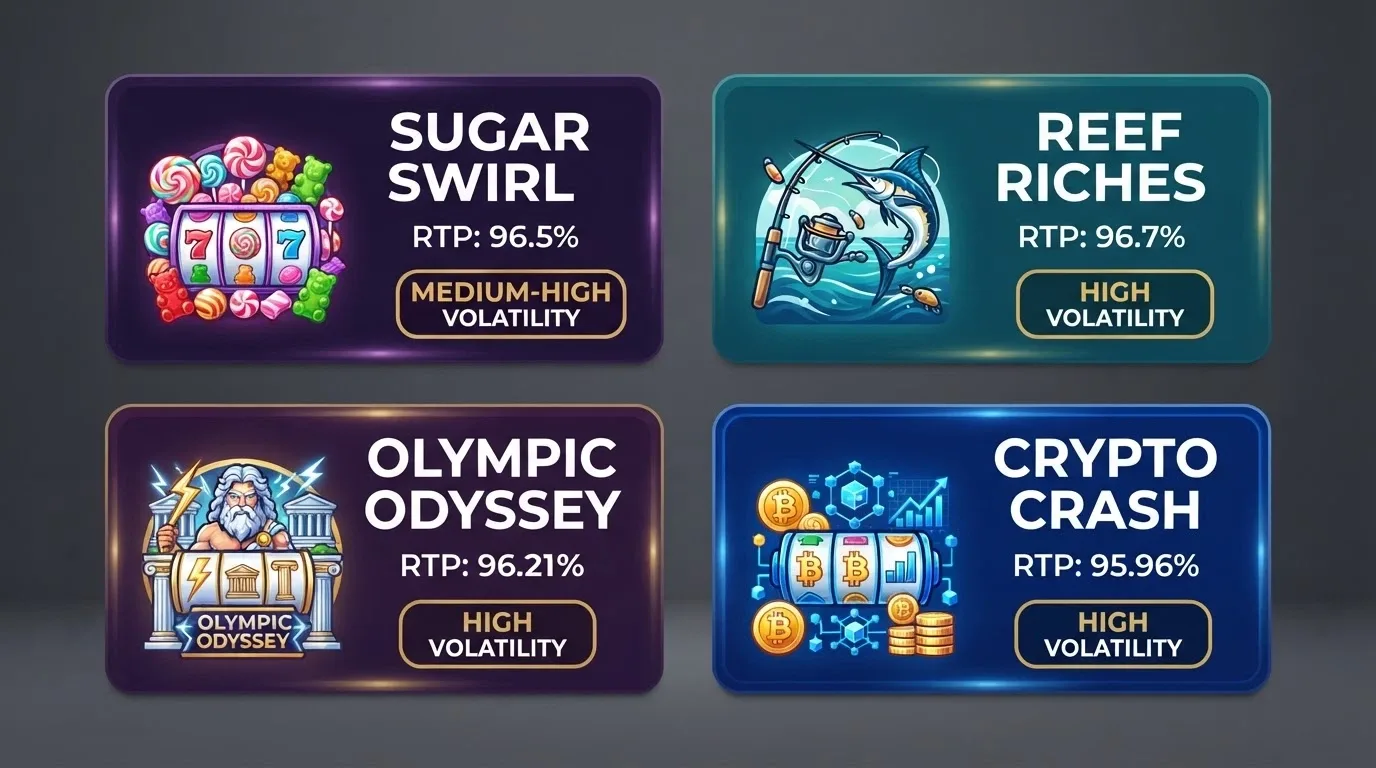
Gates of Olympus, at 96.21% RTP and 15,000x max win, is the title whose math most directly competes with the high-volatility end of the catalogue. Gates of Olympus 1000 is the follow-up with an enhanced multiplier cap, though the RTP for the 1000 variant is not confirmed in this run.
Crypto Bro (AvatarUX, January 2026) and Crypto Genesys (Pragmatic Play) are the two crypto-themed high-volatility titles with the deepest math. Crypto Bro runs a 6×4 layout with 4,096 paylines and a 20,000x max win — the deepest in the table. Crypto Genesys uses a scatter-pays format on a 6-reel tumbling grid, with multipliers from x2 to x1,000 and a 15,000x max win on a $0.20–$300 bet range. Both are titles whose volatility matches their theme: long quiet stretches, then a multiplier sequence that defines the session.
RTP and volatility — which numbers actually change what you take home
RTP and volatility describe two different things. RTP is the long-run theoretical return — what the game pays back, on average, across millions of spins. Volatility is the short-run experience — how that return is distributed across the spins a player actually plays.
A 96.5% RTP pokie pays back, on average, A$96.50 for every A$100 wagered. Over 100 spins at A$1 each, that is an average A$96.50 returned — but the actual result across 100 spins is distributed around that average, and the distribution’s shape is what volatility measures. High volatility means the distribution is wide: long runs of small losses, then occasional big wins. Low volatility means the distribution is tight: many small wins, fewer big ones.
The library range across ETH casinos is 94% to 97%. Titles above 97% return significantly more over sessions than the 94–95% average. A 3 percentage-point RTP gap (94% vs 97%) is worth A$30 per A$1,000 of turnover, or A$300 per A$10,000. For a player clearing a A$10,000 bonus at 40x wagering (A$400,000 turnover), the choice of game between 94% and 97% is worth A$12,000 in expected return. The game weighting rule that locks the wagering requirement to slots means the choice of slot is also the choice that determines the cost of the bonus.
For a player comparing two pokies both showing 96% RTP, the volatility is what differentiates the experience. Two high-volatility 96% titles will play more similarly to each other than a high-volatility 96% and a low-volatility 96% — even though both return the same in the long run. The expected-loss math is the same; the session experience is not.
Free-play mode — trying ETH pokies without risking a cent
Most major pokies at the featured operators carry a demo mode that runs without a deposit and without a wallet connection. Pragmatic Play’s titles — Sweet Bonanza, Big Bass Bonanza, Gates of Olympus — all carry demo play at the studio level, which is replicated at most ETH casinos that host them. The player loads the game, the casino loads the demo balance, and the game runs with the same math as the real-money version.
The point of demo mode is to test volatility and bonus-round frequency before staking ETH. A 100-spin demo session on a high-volatility title like Crypto Bro will reveal whether the player has the bankroll to absorb the dry stretches the math implies. A session on a medium-volatility title like Sweet Bonanza will reveal a tighter distribution, with smaller wins more frequently and a flatter session shape. Neither guarantees what real-money play will deliver, because real-money sessions are subject to the same math but rarely run to the sample sizes that smooth out variance.
Research does not confirm demo-mode availability at every featured operator, and a player who plans to test before depositing should check the specific operator’s site. What is consistent across the studios is that the demo build exists at the provider level — the question is whether the casino surfaces it without forcing a signup.
Live Dealer and Table Games With ETH Stakes
Live dealer studios accepting Ethereum bets
The live-dealer offering at ETH casinos runs primarily on Evolution, with Pragmatic Play Live as the secondary supplier. WinSpirit confirms both Evolution and Pragmatic Play among its providers — the only operator in the featured set where the live studio is explicitly named. Other operators in the set carry live-dealer sections but do not name the studios in the research this run.
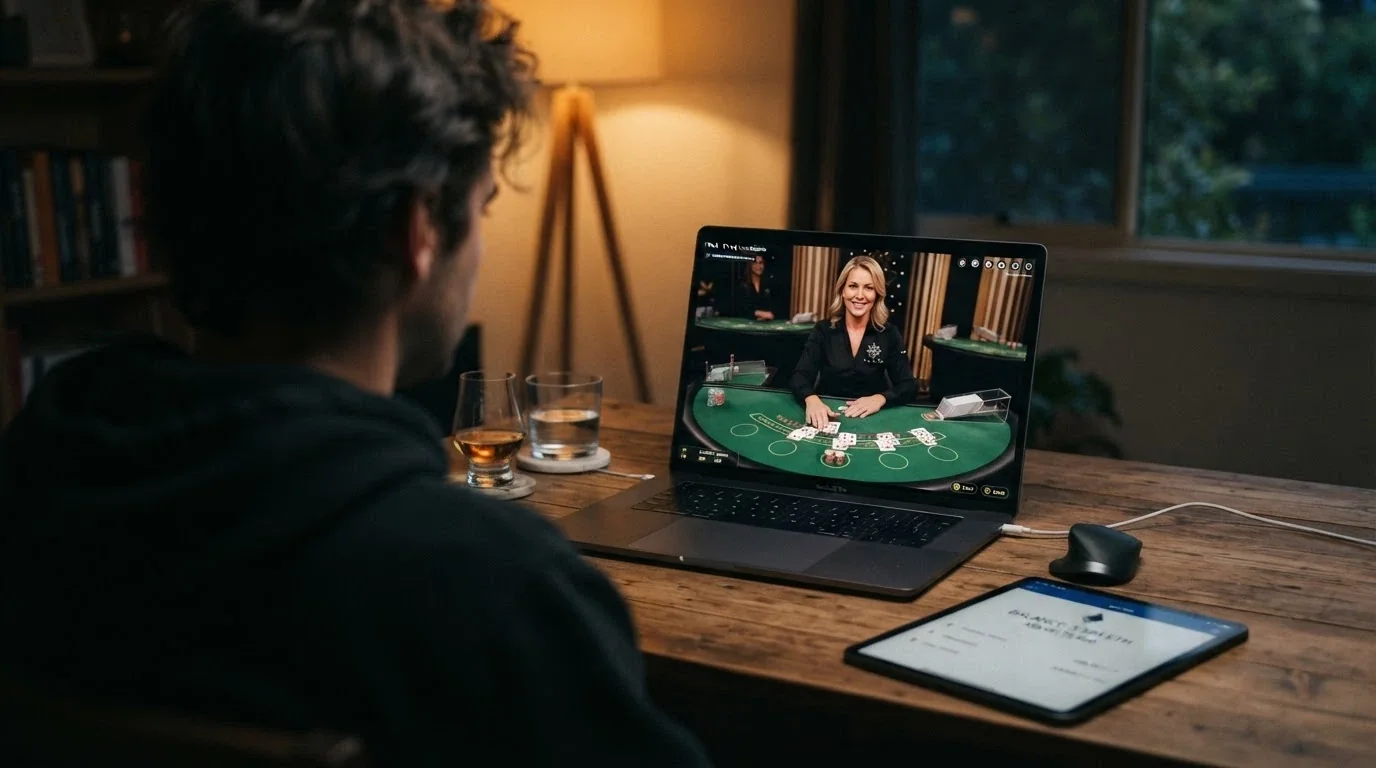
The Evolution experience is the one most players have a reference for. HD multi-camera streams, real croupiers in studio sets, blackjack/roulette/baccarat with side bets, game-show formats like Crazy Time and Monopoly Live. The chips at the table are denominated in fiat or crypto at the casino’s setting — at an ETH casino, a chip might be 0.001 ETH, and the player’s balance in the cashier converts at the casino’s spot rate. From the player’s perspective, the interface is the same as a fiat live casino: place a bet, watch the stream, collect the win.
The deposit-to-chip flow is the same as for slots. ETH lands in the casino balance, the player opens the live-dealer lobby, joins a table, and the cashier converts ETH to chip value at the casino’s stated rate. The conversion is internal; the player’s ETH stays ETH until withdrawal. At cashout, the chip balance converts back to ETH at the same or a current rate, depending on the operator’s policy.
For an Australian player, the live-dealer angle intersects with the game-weighting rule. Live-dealer play counts at 10% or not at all toward bonus wagering at every operator in the featured set. A player clearing a bonus on live blackjack is turning over ten times the equivalent slot amount to clear the same requirement — and most live-dealer operators cap bet sizes lower than the slot max bet, which slows the clearing pace further.
Blackjack, roulette and table-game RTP with crypto
Table games carry better odds than slots, in the abstract. Blackjack with basic strategy returns around 99.5%. European roulette (single zero) returns 97.3%. American roulette (double zero) returns 94.7% — which is below the slot average. The table-game advantage is structural: the house edge on most bets is fixed by the rules, and the player’s decisions move the realised RTP within a narrow band around the theoretical figure.
The catch is the bonus terms. Live casino and table games count at 10% or not at all toward wagering requirements across the featured operators. A player with a 40x wagering requirement on a A$1,000 bonus who tries to clear it on live blackjack at 10% weighting has to wager A$400,000 in blackjack to clear A$40,000 of effective turnover. At a A$10 max bet, that is 40,000 blackjack hands — months of play at a realistic session length. The math is structurally impossible.
The result is that the higher RTP of table games is locked behind cash play. A player who deposits ETH, plays live blackjack without a bonus, and withdraws at the end is getting the full 99.5% RTP. A player who takes the welcome bonus and tries to clear it on the same game is paying the slot-equivalent house edge across ten times the turnover, with no upside. The choice is binary: take the bonus, play slots; skip the bonus, play what the math says is best.
Operator-specific table RTPs are not in research. The standard RTP for the game type applies across the studios, with variations driven by side-bet rules and table limits rather than by the casino. A player who wants the highest-RTP blackjack should look for tables without side bets and with the standard 3:2 blackjack payout — both of which are studio-level settings, not casino-level.
Playing ETH Casino Games From Your Phone in 2026
Browser play vs dedicated casino apps
The dominant path for mobile ETH casino play in 2026 is the mobile browser, not a downloaded app. Apple’s App Store and Google Play both restrict real-money gambling apps to licensed operators in regulated jurisdictions, and an offshore Curaçao-licensed casino is neither. The result is that most ETH casinos do not ship a downloadable app — the website is the app, served as a responsive HTML5 page that loads in Safari, Chrome, or any modern mobile browser.
The browser experience is functionally equivalent to a desktop session for the games themselves. Pragmatic Play, Evolution, BGaming, AvatarUX all build their titles to the same HTML5 standard, and the casino’s cashier and lobby adapt to the mobile viewport. What a player loses without a dedicated app is some of the OS-level integration — push notifications, biometric login, the home-screen icon — but gains the freedom to move between operators without installing and uninstalling each one.
The ETH deposit flow on mobile is the same as on desktop. MetaMask mobile or Trust Wallet opens as a separate app, the player copies the casino’s wallet address or scans the QR code, sets the network (Arbitrum, Optimism, Polygon, mainnet), confirms the gas fee, and sends. The casino credits the balance after its confirmation count clears. The whole loop runs without ever leaving the phone.
Research does not confirm dedicated apps at any featured operator in this run. For a player who values a home-screen icon, the path is the browser’s “Add to Home Screen” option, which creates a launcher icon that opens the casino’s mobile site full-screen. It is not a native app — it cannot run in the background, cannot deliver push notifications — but it is close enough that most players cannot tell the difference from inside the casino.
New Ethereum Casino Launches Worth Knowing in 2026
A “new” Ethereum casino in 2026 means a brand that has launched recently enough to be on the market but not long enough to have an established track record on payout reliability, complaint volume, or community feedback. The recency is a double-edged signal: newer casinos may carry fresher game libraries, larger launch promos and more aggressive bonus structures, because they need to win players from the established brands. They also have no track record on whether they pay out, which is the one thing the player cannot verify at signup.
The diligence that applies to a new entrant is the same as for any offshore operator, applied more strictly. Check the licence — Curaçao is the most common for ETH casinos, with Anjouan and the Philippines as alternatives. Cross-reference the licence number against the regulator’s public register, where one exists. Check the game providers: a casino that lists Pragmatic Play, Evolution, BGaming, NetEnt and AvatarUX is hosting the same upstream catalogue as established operators; a casino that lists only unknown studios is hosting games whose math cannot be verified. Check the withdrawal terms — ETH withdrawal time, daily cap, KYC requirement — before depositing. Check community forums for unresolved complaints. The first deposit, where it happens, should be a small one, with a withdrawal test before committing further funds.
The featured set in this guide is built on Australian traffic share and on the offer terms research could verify this run. New entrants will not be in the set unless they have crossed both thresholds. For a player evaluating a brand that is not in the set, the verification work falls entirely on them — and the structural facts laid out in the section on Australian law apply to the new entrant as much as to the established one.
The Law Australian ETH Casino Players Need to Understand
The Interactive Gambling Act and why no online casino licence exists in Australia
The Interactive Gambling Act 2001 makes it an offence to provide online casino games, online pokies and in-play sports betting to a person in Australia. There is no licence for any of those products — not federally, not in any state or territory. The 2017 amendment closed loopholes offshore operators had used to argue they were not technically providing to Australians, and gave ACMA the power to direct ISPs to block illegal sites at the DNS level.
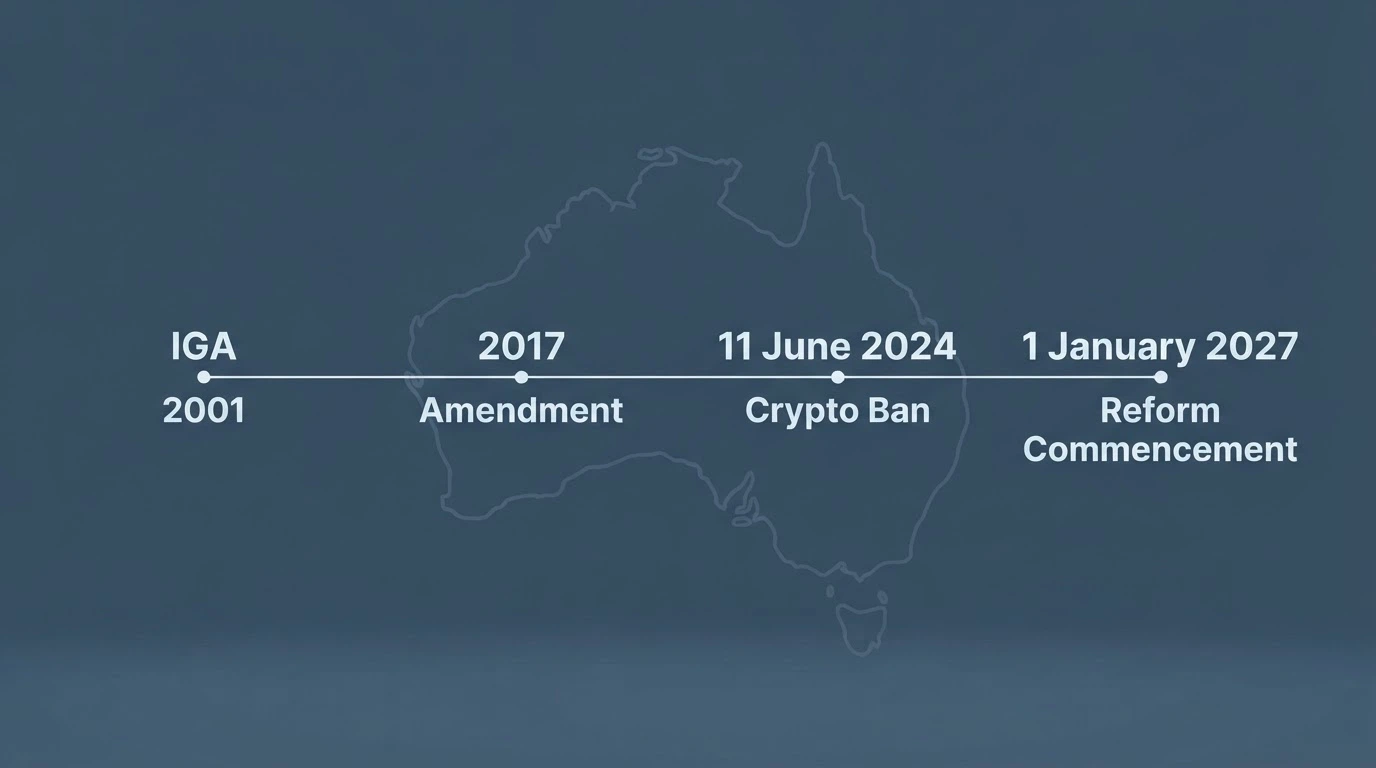
What is licensable in Australia is narrower: wagering on races and sport before the event begins, lotteries, keno. Those are licensed at the state and territory level, with the Northern Territory Racing and Wagering Commission (NTRWC) — administered through Licensing NT — issuing the long-dated licences (terms of up to 20 years) that the large online bookmakers hold. Sportsbet, bet365, Ladbrokes and the rest of the licensed cohort operate under NT licences. None of them offers an online casino product, because none of them can.
The minimum age for any commercial gambling activity in Australia is 18. The regulator is ACMA, which investigates complaints, issues formal warnings, refers operators for civil penalty proceedings, and directs ISPs to block illegal sites. Since the first blocking request in November 2019, ACMA has had 1,564 illegal gambling and affiliate websites blocked, with more than 225 illegal services withdrawing from the Australian market since the 2017 enforcement strengthening. The enforcement is active and ongoing — the block list is not a historical artefact but a current operational tool, and it can be extended at any time to a site that holds an Australian player’s balance.
The crypto payment ban and what it means for your ETH deposit
The Interactive Gambling Amendment (Credit and Other Measures) Act 2023 prohibited credit cards, credit-related products and digital currency as payment for online wagering from 11 June 2024. Operators that fail to enforce the ban face penalties of up to A$247,500. The ban applies to licensed Australian wagering operators — the NT-licensed bookmakers cannot accept crypto from an Australian customer, and the debit-card/bank-transfer/PayID/BPAY rails are the legal routes.
The International Comparative Legal Guide’s 2026 Gambling Laws and Regulations Report frames the practical consequence directly: the use of cryptocurrency for online wagering was recently prohibited following amendments to the Interactive Gambling Act, and an Australian asked for a crypto deposit by a gambling site is being served by someone outside the Australian rules.
That is the position an Australian player is in when they send ETH to any of the casinos in the featured set. The operator is offshore. The operator is not subject to the Australian prohibition, because the prohibition targets providers of prohibited services to Australians, and the operator is incorporated and licensed elsewhere. The operator’s licence is Curaçao (where confirmed) or unknown. The player is not prosecuted — the IGA targets the provider, not the customer — but neither does the player have an Australian regulator on the other end if the operator withholds funds or voids a win.
The Interactive Gambling Amendment (Gambling Reform) Bill 2026, passed on 19 August 2026 and commencing 1 January 2027, extends the framework further. From that date, banks and payment providers gain express authority to block transactions to illegal gambling operators. The current rails (debit card, bank transfer) already pass through Australian banks; the new authority makes the block explicit. Crypto rails do not pass through Australian banks in the same way — but the direction of travel, for both fiat and crypto, is toward a tighter perimeter around the licensed Australian market and a wider gap between it and the offshore operators.
The Digital Assets Framework Bill 2025, passed on 1 April 2026, is the broader piece of context. It establishes a regulatory framework for digital assets in Australia, separate from the gambling framework. The framework does not create a path for crypto to become a legal deposit rail at licensed wagering operators — the gambling prohibition predates the framework and is not affected by it.
What happens when an offshore casino refuses to pay
The recourse gap is the structural cost of being in this market. ACMA cannot recover anyone’s money from an offshore casino. There is no Australian complaints body with jurisdiction over a Curaçao-licensed operator. There is no industry ombudsman, no alternative dispute resolution service, and no Australian court order that the operator is obliged to recognise. The site can be blocked at the DNS level by Australian ISPs at any time, which means a balance on account can become inaccessible at a moment’s notice.
What a player can do, in order of effectiveness: file a complaint with the operator through its own customer-support process; document the blockchain transaction trail on Etherscan or a similar explorer; file a complaint with the Curaçao licensor where the licence is verifiable, recognising that the licensor’s compliance function is limited and slow; publish the complaint on community forums where it may attract the operator’s attention; and consult an Australian lawyer about civil recovery, recognising that enforcing a judgment against an offshore entity is expensive and not guaranteed.
None of those routes is a substitute for an Australian complaints body. ACMA can investigate, warn and block — but it cannot make an offshore operator pay. BetStop (covered in the next section) is for self-exclusion, not for fund recovery. The 1,564 blocked sites since November 2019 are evidence of enforcement activity, not of money recovered — the block list removes access; it does not return funds. A player who deposits ETH at an offshore casino is, in the recourse sense, on their own.
Where to Get Help When the Play Stops Being Fun
Deposit limits, time-outs and the tools offshore casinos actually offer
The responsible-gambling controls at reputable offshore casinos mirror the controls available at licensed operators: deposit limits (daily, weekly, monthly), session time-outs (the casino logs the player out after a set period), cool-off periods (24 hours to several weeks, during which the account cannot deposit or play), and self-exclusion (indefinite, until the player contacts support to lift it). These are tools the player sets on themselves, through the casino’s responsible-gambling section or via support.

The difference between an operator’s RG tools and the statutory protections of a regulated market is enforceability. At a licensed Australian operator, the deposit limit is a condition of the licence — the operator cannot lift it without the customer’s express consent, and the activity statement is auditable by the regulator. At an offshore casino, the deposit limit is a setting on the account, which the operator can technically adjust; the activity statement is the operator’s own product, which the player has no external way to verify; and self-exclusion is binding only as far as the operator chooses to honour it.
Research does not carry a per-operator RG tool audit for the featured set. What is reasonable to assume is that the larger operators carry the standard set of tools, and that smaller operators carry whatever the platform they run on provides. For a player who plans to use these tools, the verification work is the same as for bonus terms — check the responsible-gambling page before depositing, set the limits before the first session, and document the settings in case the operator changes them later.
BetStop, the National Gambling Helpline and why offshore sites are invisible to both
Australia’s responsible-gambling infrastructure is world-class — and it stops at the licensed border.
BetStop, the National Self-Exclusion Register, has been live since August 2023. One registration excludes a person from every Australian-licensed online and phone wagering service. As at 31 July 2026, the register carried 67,480 registrations, of which 41,290 exclusions were still active. 78% of registrants were under 40, and 38% had chosen lifetime exclusion. The register binds Australian-licensed services only — an offshore casino is not connected to BetStop, and a self-excluded Australian can still deposit and play at any operator in the featured set.
The National Gambling Helpline is 1800 858 858. It is free, confidential, and staffed 24 hours a day, seven days a week. Online counselling and chat are available through Gambling Help Online. The service is professional, free, and accessible. What it cannot do is recover funds from an offshore operator — a helpline counsellor can support a player through the decision to stop, can refer to financial counselling and to treatment, and can connect a player with state-based services, but cannot compel a Curaçao-licensed casino to pay a disputed balance.
The gap is structural. A self-excluded Australian who holds a BetStop registration is protected from licensed wagering operators. The same person is not protected from ETH casinos in the featured set, because none of those operators are on the BetStop register. A helpline call from that person is met with the full range of Australian support services, and with the explicit acknowledgement that the offshore operators are outside every framework Australia has built. The decision to stop playing at an offshore casino, once BetStop is registered, is one the player enforces themselves.
For problem gambling more broadly, the Australian Institute of Health and Welfare puts the figure at around 2.1% of adults — roughly 430,000 people. High-risk gambling sits at 1.8%. Those figures include everyone in the population, not just offshore casino players, but the population of Australians playing at ETH casinos is part of that base. The support infrastructure exists for them; what does not exist is a regulatory perimeter that prevents offshore operators from accepting them.
How We Reviewed These Ethereum Casinos
The review set is the ten operators in the operators skill reaching Australian players with ETH: Rocket Play, Skycrown, Royal Reels, WinSpirit, Stake, Rainbet, Scream Casino, FairGO, Bizzo Casino and Rocket Casino. The evaluation drew on operator sites, independent casino audits, ACMA’s published materials, and the International Comparative Legal Guide’s 2026 Australia report.
The anchor against which every operator was checked is the legal status. Online casino is prohibited in Australia under the Interactive Gambling Act 2001. No licence exists federally or in any state or territory. None of the ten operators holds an Australian licence, because none can. The Curaçao or unconfirmed licence status on each row is the fact, not a provisional finding — every operator in the set is offshore, every deposit rail that touches them runs outside Australian rules.
What the review measured: licence status and verification against the regulator’s register where possible; the welcome offer and its terms (match percentage, cap, wagering multiple, max bet, validity, max cashout); the no-deposit offer where one exists; ETH deposit and withdrawal performance (confirmation count, processing time, daily cap); the game library (provider count, named titles, provably fair coverage); the responsible-gambling tools available on the operator’s site. Where research could not confirm a figure, the cell in the comparison table reads as a dash, and the operator write-up acknowledges the gap.
What the review did not measure: a real-money playtest at each operator (out of scope for the research cycle); payout reliability over time (a single-run research cycle cannot establish a track record); the player experience at the cashier beyond what the operator’s own documentation states. The traffic-share figures from the operators skill reflect the proportion of tracked Australian traffic each operator captures within the offshore ETH casino market — they are not a measure of the licensed Australian market, which by definition excludes every operator in the set.
The limit of a single-run research cycle is the limit of this page. Where a bonus term, a withdrawal time, or a licence detail has changed between this run and the player’s deposit, the operator’s own terms page at the moment of deposit is the authoritative source. The review above is a snapshot, not a permanent record.
What an Australian Player Should Actually Do With This Information in 2026
The facts on this page converge on a single point: every ETH casino accepting Australian players is offshore, no Australian consumer protection applies, the crypto ban means the operator is outside Australian rules, BetStop does not cover ETH casino play, and ACMA can block the site at any time. Those are not minor caveats. They are the structural facts that frame every offer, every bonus and every payout on this page.
For a player who decides to proceed despite those facts, the diligence is straightforward. Check the licence — Curaçao is the most common, with a verifiable licence number on the regulator’s register where one exists. Read the bonus terms — wagering multiple, max bet, game weighting, validity window, max cashout — before claiming any offer. Test the withdrawal path with a minimum deposit and a small withdrawal before committing a larger balance. Use the responsible-gambling tools the operator provides — deposit limits, session time-outs, self-exclusion — and document the settings in case the operator changes them.
For a player who decides not to proceed, the licensed Australian market offers wagering on pre-event sport and racing through NT-licensed bookmakers, with debit card, bank transfer, PayID and BPAY as deposit rails, identity verification at signup, deposit limits and activity statements as standard, and BetStop registration as the self-exclusion mechanism. The product set is narrower — no online casino, no online pokies, no in-play betting — and the bonus offers do not include the ETH casino headline numbers. The recourse, the consumer protection and the regulatory perimeter are real, in a way they are not at any operator in this guide.
What this page cannot do is tell a reader which choice is right for them. The legal position, the offer mechanics, the recourse gap and the support infrastructure are all on the table above. The decision is the reader’s.
Frequently Asked Questions
Will I get in trouble for playing at an Ethereum casino from Australia?
No. The Interactive Gambling Act targets the provider of the prohibited service, not the customer accessing it. No Australian player has been prosecuted for using an offshore ETH casino. ACMA cannot recover your money, though, if the operator refuses to pay.
How much ETH do I need to start playing at a crypto casino?
The minimum is set per operator. LuckyDreams accepts 0.005 ETH (~A$25) across four networks. Royal Reels requires A$50 minimum withdrawal. Per-spin bet ranges start at 0.001 ETH at most ETH casinos. The total depends on session length and bet size.
Can I spin the reels with Ethereum at online casinos accepting Australian players?
Yes. Every operator in the featured set accepts ETH deposits across at least one network, most support all four (mainnet, Arbitrum, Optimism, Polygon). The pokies are the same titles (Pragmatic Play, BGaming, AvatarUX) as at fiat casinos, with the same RTPs and volatility.
How do I get my money back from an ETH casino that will not pay out?
File a complaint with the operator’s support, document the blockchain trail, complain to the Curaçao licensor where verifiable, and consult an Australian lawyer about civil recovery. None substitutes for an Australian complaints body. ACMA cannot recover funds from an offshore operator.
Does BetStop protect me if I sign up to an offshore crypto casino?
No. BetStop binds Australian-licensed wagering services only. An offshore ETH casino is not connected to the register, and a self-excluded Australian can still deposit and play at any of the featured operators. BetStop registration is a real protection against licensed operators, not offshore ones.
What kind of bonus can I claim with an Ethereum deposit?
The featured set covers the standard range: welcome match bonuses (100–200% on first deposit, A$1,000–A$30,000 caps), free-spin packages (50–500 spins), no-deposit free spins (30 spins at 30–45x wagering), no-deposit cash bonuses, and 10–25% crypto boosts at some operators.