
Fast Payout Casinos in Australia in 2026: The Offshore Reality
Every casino that pays Australians fast sits offshore, because there is no licensed online casino in this country — not federally, not in any state or territory. The Interactive Gambling Act 2001, strengthened in 2017, makes online casino games and online pokies a prohibited service across Australia, and the ACMA has used that authority to block more than 1,455 illegal gambling and affiliate websites since November 2019. A reader asking which fast-payout casino to use is asking which offshore operator offers the shortest wait between requesting a withdrawal and seeing AUD land in a bank account, an e-wallet or a crypto wallet. This page ranks ten of those offshore operators by tested payout speed, bonus terms and licence transparency, and lays out what that speed actually costs.
Data current as of 22 November 2026, verified against ACMA published enforcement actions, operator terms pages, CasinoAudit scores, and third-party payout testing from CardPlayer and PokiesAustralia.
Table of Contents
- Why “Fast Payout” Means Something Different for Australian Players
- Australia’s Fastest-Paying Online Casinos Compared
- The Payment Method That Gets Your Money in Minutes — and the Ones That Don’t
- Why Your 2026 Casino Bonus Is Probably Smaller Than the Advertised Number
- The Pokies Where Your Winnings Actually Land in Your Account
- Online Casino Is Illegal in Australia — Here Is What That Means for Your Money
- Staying Safe When the Australian Safety Net Doesn’t Reach Offshore
- How We Selected and Ranked Every Fast-Payout Casino on This Page
- What to Actually Do With This Information
- Frequently Asked Questions
Why “Fast Payout” Means Something Different for Australian Players
The label “fast payout” does the same work everywhere, but the conditions it operates under in Australia are not the conditions a UK or Ontario player faces. There is no local regulator to set a withdrawal floor, no local licence register to check, and no local complaints body to recover funds if an offshore operator stalls. Speed in this market is whatever an offshore casino and a non-Australian payment rail decide to deliver — which is why two Australian players at two different “fast payout” sites can wait 5 minutes or 5 days for the same transaction.
The framing matters for another reason: the term “Australian casino” in affiliate content is usually a misnomer. The site accepts AUD and targets Australian search terms, but the licence is Curaçao, the company is registered in another jurisdiction, and the ACMA may already be in the process of blocking its domain. Treating those sites as “Australian” because they take Australian dollars is the kind of label-looseness this page exists to correct.
The upside is real, though. Crypto withdrawals at USDT TRC20 and Solana genuinely clear in under five minutes; PayID payouts post in well under an hour once approved; e-wallets settle within one to six hours. The fast tier exists. It just runs through offshore operators with no Australian safety net underneath it.
What “fast payout” actually covers — and what it doesn’t
“Fast payout” is shorthand for the time between hitting the withdraw button and seeing the money usable somewhere. That time is governed by two separate delays stacked on top of each other: the operator’s internal approval window and the payment rail’s settlement window. Crypto has the fastest settlement window — minutes rather than days — but the operator still has to approve the withdrawal before any of that matters. A casino with a 48-hour approval queue can advertise “fast payouts” and still make a player wait two days for the first leg alone.
The label also covers a wide spread of actual numbers. “Under 60 minutes” means different things depending on the method: USDT TRC20 and Solana routinely settle in under five minutes; Ethereum and Litecoin land in five to thirty; Bitcoin takes thirty to sixty minutes for the network confirmations alone. PayID transfers land in under sixty minutes from approval, but only where the casino supports PayID for withdrawals — and not every Australian-facing casino does. POLi works for deposits only. There is no POLi withdrawal rail at all. A player who funded an account with POLi and then tried to withdraw to POLi would be stuck with a bank transfer, a card, or whatever else the cashier offered.
The “instant withdrawal” claim deserves a reader’s full attention, because it usually means “instant after we approve it.” That approval is where the bottleneck lives.
Every fast-payout casino available to Australians sits offshore
The Interactive Gambling Act 2001 prohibits providing online casino games, online pokies and in-play sports betting to a person in Australia. There is no licence for online casino anywhere in the country — not federally, not in any state or territory. Sportsbet, bet365 and Ladbrokes hold licences for pre-event wagering through state and territory regulators, principally the Northern Territory Racing and Wagering Commission (NTRWC), but those licences cover wagering products, not the online casino games this page discusses. Every operator reviewed here operates from a Curaçao licence or an equivalent offshore jurisdiction, and the ACMA has had to block multiple domains of most of them.
The IGA targets the provider, not the individual player. Australians are not prosecuted for depositing at an offshore casino. That is the only sense in which “Australian casino” is even partially accurate. But “not prosecuted” is not “protected” — there is no Australian consumer law covering a refused withdrawal, no ACMA process to recover funds, no BetStop coverage, and the domain can be blocked tomorrow with a balance still on it. Offshore status is the structural feature of every brand on this page, not an incidental one, and reading any review that uses “Australian casino” without flagging it should be a yellow flag.
Trust signals worth checking before you deposit a dollar
Without a local regulator backing the operator, the verification work falls on the player. These are the signals worth checking before any deposit lands:
- The licence jurisdiction and what a Curaçao permit actually entitles you to — typically a dispute channel with the licence holder, not with an Australian body
- The operator’s track record and whether the ACMA has had to block its domains before, which is a continuity-of-service risk regardless of how fair the games are
- Player complaint patterns on independent forums and audit sites, particularly around refused withdrawals and voided bonus winnings
- The absence of Australian consumer-law recourse when a withdrawal stalls or a bonus is voided
- Whether the casino is connected to BetStop or any equivalent self-exclusion register — none on this page are
Australia’s Fastest-Paying Online Casinos Compared
The ranking below pulls together ten offshore casinos accepting Australian players, weighted by tested payout speed where research carries one, bonus fairness adjusted for wagering burden, licence transparency, and ACMA blocking history. Where a figure is not confirmed this run, the cell carries the no-data marker rather than an invented number.

| Operator | Licence / AU Status | Welcome Bonus | Free Spins | ACMA Status |
|---|---|---|---|---|
| SkyCrown | Curaçao / offshore | 450% up to A$8,000 across 4 deposits | 400 (across 4 deposits) | Blocked (multiple domains) |
| RocketPlay | Curaçao / offshore | 100% up to A$1,000 + 200% up to A$1,000 | 100 (1st deposit) | Blocked (rocketplay20/23/24) |
| Royal Reels | Curaçao / offshore | A$2,500 across 3 deposits | 50 | Blocked (royalreels16/17) |
| Fastpay Casino | Curaçao / offshore | A$225 welcome | — | Blocked (fastpay-casino73/74/75) |
| BitStarz | Curaçao / offshore | 100% up to 1 BTC | 180 | Not blocked this run |
| JustCasino | Curaçao / offshore | A$5,000 | 400 | Blocked (justcasino5/7) |
| Goldenbet | — | — | — | Not blocked this run |
| Instant Casino | Curaçao / offshore | — | — | Not blocked this run |
| Neospin | — | — | — | Blocked (neospin7/8) |
| Stake | Curaçao / offshore | — | — | Not blocked this run |
A reader looking at this table should hold two things in mind at once. The “fast payout” promise is real at the top of the set — Fastpay, BitStarz and Goldenbet have either advertised or tested withdrawal times under an hour — and the legal reality underneath it is that ACMA has had to block at least one domain of six of these ten. Speed and exposure are not separate variables; they trade off.
How the ranking works: speed, safety and what the numbers actually measure
The ranking weighs tested payout speed where research has a figure from third-party testing, then adjusts for bonus fairness (a 450% headline with 40x wagering is not the same value as a smaller bonus with 20x), then for licence transparency (Curaçao disclosed beats unverified), then for ACMA status (a clean record is worth noting, but no record is not the same as a verified clean record). Where research lacks a payout figure — for any operator without a tested or audited score — the cell is empty rather than guessed.
The relative weight on each criterion matters. A casino with a 96/100 payout-speed score but a 30x wagering bonus and an ACMA-blocked domain still ranks behind one with a 90/100 score, lower wagering and a clean record, because the player is paying for that speed with exposure they cannot mitigate. The audit scores from CasinoAudit are weighted alongside, not above, the licence and ACMA signals. A reader who only reads the audit scores gets a partial picture of what they are buying.
SkyCrown: 450% Welcome Package With a 40x Wagering Anchor
SkyCrown’s headline figure is the largest in the set — a four-deposit welcome package totalling 450% deposit match up to A$8,000 plus 400 free spins, broken across first deposit 120% up to A$1,200 + 125 FS on Wolf Treasure, second 100% up to A$1,300 + 75 FS on Coin Volcano, third 80% up to A$1,500 + 50 FS on 15 Dragon Pearls, and fourth 150% up to A$4,000 + 150 FS on Mighty Wild: Panther Grand Diamond Edition. Wagering is 40x the bonus amount and 40x on free-spin winnings, with a 14-day validity, a A$7.50 maximum bet during clear-down and an A$5,000 maximum bonus-to-cash conversion per welcome tier. SkyCrown also runs a 20 free-spin no-deposit offer on Aztec Clusters at 25x wagering.
The maths are demanding. A player hitting the full A$8,000 bonus face needs A$320,000 in qualifying turnover before the bonus converts — at A$7.50 a spin, that is over 42,000 individual bets inside the 14-day window. The free spins add another A$300-to-A$400 in turnover at the same multiplier if they all land cleanly. SkyCrown runs 70+ game providers and holds a Curaçao licence. The ACMA has blocked multiple SkyCrown domains. A player who reads the wagering carefully and treats the bonus as a long playthrough rather than a gift will get value from this; a player chasing the headline will hit the A$5,000 cap well before clearing the package.
RocketPlay: The VIP Program That Never Expires and Real-Cash Cashback
RocketPlay splits its welcome across two deposits: 100% up to A$1,000 plus 100 free spins on the first deposit (minimum A$30), and 200% up to A$1,000 on the second (minimum A$75). Wagering is 40x on the bonus amount only, with a 5-day validity and a A$7.50 max bet. Free-spin winnings are capped at A$300, and the maximum win from either deposit bonus is A$5,000. The 5-day clock is the tightest in the set and shapes who this offer suits.
The longer arc is where RocketPlay earns its place. The VIP program runs 13 tiers and never expires — a contrast to the 12-month clocks some rivals run. Weekly sports cashback kicks in at VIP Tier 4 and is paid as real cash with no wagering, up to a maximum of A$7,500 per week at the higher tiers. RocketPlay holds a Curaçao licence, runs 3,000+ games, and tiered weekly withdrawal limits sit between A$5,000 and A$15,000. The ACMA has blocked rocketplay20, rocketplay23 and rocketplay24. Serious players aiming for the cashback tiers will find more value here than casual sign-ups chasing the welcome bonus.
Royal Reels: 5,400+ Pokies and a $10 No-Deposit Start
Royal Reels runs the largest pokie library in the set — over 5,400 pokies from 40+ providers — and backs it with a three-deposit welcome totalling A$2,500 plus 50 free spins, structured as 100% up to A$500 + 50 FS, then 75% up to A$750, then 100% up to A$1,250. Wagering is 30x to 35x on the bonus amount only, with a A$5 maximum bet during clear-down. Free spins run at A$0.20 per spin on a featured pokie. The headline entry point is the A$10 no-deposit chip, released after phone verification at 30x wagering.
The no-deposit chip is the genuine draw. A$10 in playable credit without funding the account is rare in this market, and the 30x multiplier is below the 40x standard. The welcome package itself is more modest than SkyCrown’s or RocketPlay’s but the wagering is lighter, which changes the realised value once the maths are run. Royal Reels holds a Curaçao licence, runs a 10-tier VIP program and has had royalreels16 and royalreels17 blocked by the ACMA. If you prioritize a massive pokie library and an accessible trial, this is the operator to beat.
Fastpay Casino: Payouts Under 10 Minutes, $75K Monthly Cap
Fastpay is the brand whose name is its selling point. The casino advertises e-wallet and cryptocurrency withdrawals processed in under ten minutes, with monthly withdrawal caps up to A$75,000. The cap is high enough that even a winning streak runs into the ceiling only at the upper end, and the speed claim is the strongest in the set for e-wallet and crypto rails. The casino holds a Curaçao licence.
The catch lives one layer down. Fastpay requires players to wager their deposits at least three times before requesting a withdrawal, with ten times for certain table games — an anti-money-laundering measure, not a bonus term. A player who deposits A$200 and tries to withdraw before turning A$600 in bets will be refused. The 3x rule is unusual in the set; most of the operators on this page apply it only to bonus funds. The ACMA has blocked fastpay-casino73, fastpay-casino74 and fastpay-casino75. Best for a player who has settled on a method and accepts the deposit-turnover precondition.
BitStarz: The Crypto-First Casino With a 96/100 Payout Score
BitStarz runs a 100% up to 1 BTC welcome bonus plus 180 free spins and carries a CasinoAudit payout speed score of 96/100 — the highest tested figure in the set. The casino operates under a Curação licence and runs a wide pokies library from multiple providers, with crypto deposits and withdrawals as its core offering. Crypto speeds apply directly: USDT TRC20 and Solana under five minutes, ETH and LTC five to thirty, BTC thirty to sixty.
The terms behind the bonus were not confirmed this run, so the wagering multiplier, validity window and maximum cashout are not stated here as known figures. What is known is the speed score and the crypto-native setup. A player who cares most about the payout speed and has crypto already set up has the best audited score in the set to work with. The unverified bonus terms are the trade-off — and the reason to read the bonus terms page before depositing rather than after.
JustCasino: 400 Spins and a Sub-24-Hour Payout Window
JustCasino offers A$5,000 in bonus funds plus 400 free spins, with a declared payout window of less than 24 hours and a CasinoAudit Payout Speed Score of 90/100. The casino operates under a Curaçao licence. Justcasino5 and justcasino7 were blocked by the ACMA in Q2 and Q3 2025 respectively.
The declared sub-24-hour payout window is the strongest commitment to a deadline in the set outside Fastpay’s under-ten-minute e-wallet claim. Whether the casino holds to that window on every withdrawal is something only ongoing testing can confirm — the ACMA blocks are also a continuity signal that no operator in this set can fully shake. Wagering, bonus validity and maximum cashout were not confirmed this run. The 400-spin count is the headline; the 24-hour payout promise is what differentiates the brand.
Goldenbet: PayID Withdrawals Tested at 28 Minutes
Goldenbet is the fastest tested PayID withdrawal in the set, posting in 28 minutes in third-party testing from PokiesAustralia. That figure is what earned the brand a place in this ranking — every other confirmed detail is thin. The licence is not confirmed, the welcome bonus is not confirmed, the game provider list is not confirmed, and the wagering terms are not confirmed this run.
The 28-minute figure is a single data point, not a guarantee. A PayID withdrawal time is governed by the casino’s approval queue and the bank’s settlement window — both can shift under load, and both vary by transaction. What is documented is the speed on the tested transaction. A player who specifically wants PayID over crypto and accepts the thin verification profile has a faster tested option than Lucky7’s 35 minutes; everyone else should treat the brand as a one-tracked operator.
Instant Casino: 90/100 Payout Speed, No Bonus Overpromise
Instant Casino runs three CasinoAudit scores worth holding onto: a Payout Speed Score of 90/100, a Bonus Fairness score of 85/100, and a Trust and Licensing score of 83/100. The casino operates under a Curaçao licence. The bonus specifics — welcome amount, free spin count, wagering multiplier, maximum cashout — were not confirmed this run.
The score profile is the cleanest balanced set in the ranking. A 90/100 payout score is competitive with BitStarz’s 96/100 on the metric that matters most for this page; the 85/100 on bonus fairness is the audit’s signal that the terms behind the headline number do not skew against the player; and the 83/100 on trust and licensing flags Curaçao without inflating it. The bonus specifics are not on the page because they were not confirmed. A reader who values audit scores over headline bonuses gets a clean read here.
Neospin: High-RTP Pokies Including 96.96% Elvis Frog in Vegas
Neospin earns its place for what is on the pokies floor, not what is on the cashier. The casino hosts Elvis Frog in Vegas at a 96.96% RTP, putting it in the upper tier of return-to-player among the games Australians can actually reach at offshore casinos. The ACMA has blocked neospin7 and neospin8.
The licence is not confirmed this run, and the welcome bonus, wagering terms and payout speed were not verified. What is verified is the presence of a high-RTP title in the library — and for a player whose priority is return rate over headline bonus, that is a different kind of value proposition. The volatility profile and max win on Elvis Frog in Vegas are not in the research this run, so the no-data marker applies elsewhere. Best for a pokies player who has already decided that RTP matters more than bonus size.
Stake: Australia’s Biggest Crypto Casino by Market Share
Stake holds a 1.28% share of the Australian online gambling market — the largest single operator footprint by this measure. The casino operates under a Curaçao licence and runs as a large crypto-native operator with an extensive game library. Welcome bonus, free spins, wagering and cashout terms were not confirmed this run.
Stake is on this list for a different reason than the rest. Every other brand is here because of a payout speed figure, a bonus headline or an audit score. Stake is here because it is the operator Australians actually use — and a player comparing the market needs to see it on the page even though the data this run does not include the bonus structure. The mismatch is the point: a page about fast payout bonuses cannot review an operator whose bonus structure is not in the research, but it can name the operator and explain why a reader might still be using it.
The Payment Method That Gets Your Money in Minutes — and the Ones That Don’t
The withdrawal method you pick changes your wait from five minutes to nearly a full week. Crypto at the speed end, bank transfer at the slow end, and a wide grey middle where PayID, e-wallets and cards each come with their own conditions. The table below compares what each rail actually delivers for an Australian player withdrawing from an offshore casino.
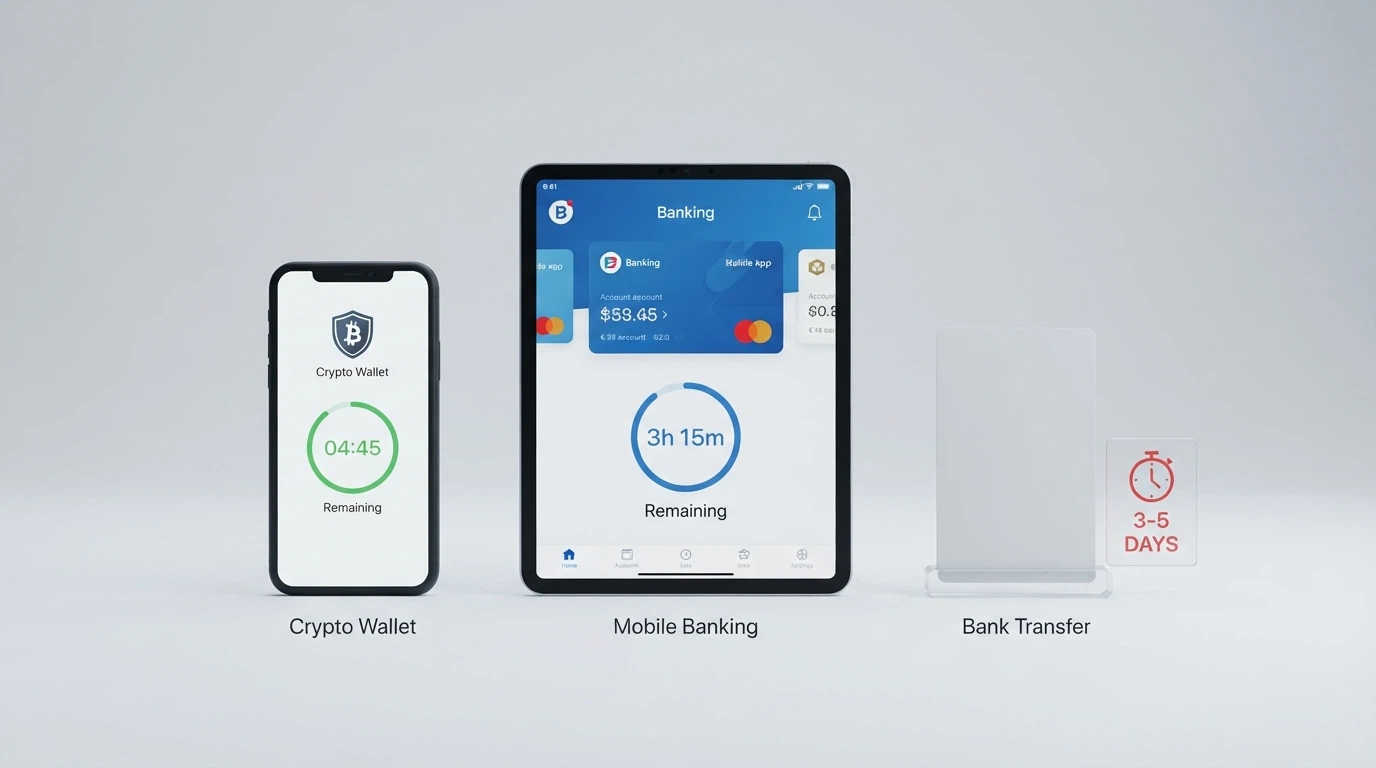
| Method | Deposit Supported | Withdrawal Supported | Typical Payout Speed | Approximate Fees |
|---|---|---|---|---|
| Crypto (USDT TRC20, Solana) | Yes | Yes | Under 5 minutes | A$0.02 – A$5 |
| Crypto (ETH, LTC) | Yes | Yes | 5 – 30 minutes | A$0.02 – A$5 |
| Crypto (BTC) | Yes | Yes | 30 – 60 minutes | A$0.02 – A$5 |
| PayID | Yes | Varies by casino | Under 60 min post-approval | None typically |
| E-wallets (Skrill, Neteller) | Yes | Yes | 1 – 6 hours post-approval | Currency conversion on AUD |
| POLi | Yes | No | — | — |
| Bank transfer | Yes | Yes | 3 – 5 business days | Varies |
| Visa / Mastercard | Yes | Less common | 2 – 5 business days | Varies |
The credit card and crypto ban for licensed online wagering, in force since 11 June 2024, does not bind the offshore casinos on this page. A site that accepts credit cards from Australians is operating outside Australian rules; the offshore brand can still take the deposit because it is not subject to the ACMA’s enforcement. That is one of the clearer signals an operator is outside the local framework.
PayID: instant in name, but check the withdrawal fine print
PayID runs on the New Payments Platform (NPP) and Osko rail, which is what makes deposits near-instant for most Australian bank accounts. Withdrawals depend on the casino. Tested PayID withdrawal times in third-party reviews ran 28 minutes at Goldenbet and 35 minutes at Lucky7 — well under an hour from approval in both cases. CardPlayer’s own testing found that once a casino approved the withdrawal, PayID “cleared within minutes of casino approval every time we used it.” That is the upper bound of what PayID realistically delivers.
The fine print is where it falls apart. Some Australian-facing casinos accept PayID deposits but do not support PayID withdrawals, leaving a player to withdraw via bank transfer, e-wallet or another route — and the speed advantage disappears the moment the rail changes. POLi, sometimes listed alongside PayID in payment-method sections, is deposit-only. There is no POLi withdrawal at any casino. A player who funds the account with POLi and expects POLi out is mistaken. Where a casino batches withdrawals at set times rather than processing them continuously, even a supported PayID payout can sit in the queue for hours before the rail kicks in.
E-wallets: the reliable middle ground for AUD payouts
Skrill and Neteller settle casino-to-wallet transfers within one to six hours of approval — slower than PayID, faster than bank transfer, and the most predictable option outside crypto. MiFinity and Neosurf appear as alternatives in this segment, though neither has the depth of testing that Skrill and Neteller carry in the data this run. The e-wallet’s second leg — moving money from the wallet to an Australian bank account — adds its own wait, and the currency conversion on AUD transactions is the real cost.
A Skrill or Neteller withdrawal in AUD triggers a currency conversion inside the wallet at the wallet’s own rate, which is rarely as favourable as the mid-market rate. A player withdrawing A$1,000 in EUR through Skrill and then converting back to AUD for a bank withdrawal can lose 1.5% to 3% to the conversion spread, on top of any wallet fee. Crypto sidesteps the conversion cost entirely because USDT is dollar-denominated. For a player who has already decided to use an e-wallet, MiFinity offers a comparable alternative; for a player who has not, crypto is the cleaner comparison.
Crypto: minutes, not days — the genuine speed option for Australians
Crypto is the genuine speed tier. USDT TRC20 and Solana settle in under five minutes in third-party testing, with Ethereum and Litecoin landing in five to thirty and Bitcoin in thirty to sixty. CardPlayer’s testing noted that “crypto is the fastest withdrawal option at any fast payout casino in Australia and avoids currency conversion fees entirely” — USDT TRC20 and Solana settled in under five minutes consistently. Network fees sit between A$0.02 and A$5 per transaction, low enough to be irrelevant for any withdrawal an Australian player is likely to make.
The local complication is the credit-card and crypto ban for licensed wagering, in force since 11 June 2024, with penalties of up to A$247,500 for operators that fail to enforce it. The offshore casinos on this page accept crypto because they operate outside Australian rules. A player using USDT from a self-custody wallet is paying network fees only and skipping both the conversion spread and the bank-processing delay. The risk is on the other side: the ACMA cannot recover funds from an offshore operator, and a blockchain transaction is irreversible once it has cleared.
Why Your 2026 Casino Bonus Is Probably Smaller Than the Advertised Number
A 450% welcome bonus sounds like a windfall until the wagering multiplier, the validity window and the maximum cashout are applied. The headline figure is what the casino wants a player to see; the realised value is what the player can actually withdraw after meeting the terms.

Take SkyCrown’s four-deposit welcome at the maximum figure of A$8,000 in bonus funds, with 40x wagering applied to the bonus amount and an average pokie return of 96%. The required turnover is A$8,000 × 40 = A$320,000. At an average pokie house edge of 4%, the expected cost of clearing that bonus — the average loss over a large number of spins — is A$320,000 × 0.04 = A$12,800. That is the average amount a player who completed the full wagering requirement would expect to lose, before counting the A$5,000 maximum bonus-to-cash conversion. The bonus pays out at most A$5,000; the expected cost of earning it is roughly A$12,800. The arithmetic inverts the marketing headline. This is an estimate over many spins at the stated assumptions — no individual player is guaranteed that outcome — and assumes only the bonus amount is wagered, not additional deposits.
Welcome bonuses worth claiming — and the turnover they actually demand
SkyCrown’s 450% package is the ceiling by headline figure, and the wagering burden scales with it. Royal Reels runs a tighter 30x to 35x wagering on a smaller A$2,500 package, which means a player at Royal Reels clears the bonus on roughly A$75,000 of qualifying turnover at the top end — a quarter of SkyCrown’s full-package turnover. RocketPlay’s 100% + 200% up to A$2,000 sits at 40x on bonus only with a 5-day validity, which is the tightest clock in the set. BitStarz and JustCasino headline with 1 BTC + 180 FS and A$5,000 + 400 FS respectively, but the wagering and validity terms behind those figures were not confirmed this run.
The realised value of a bonus is the bonus amount multiplied by the probability of clearing it before the clock runs out. A 450% package with a 14-day validity at 40x is achievable for a player running high-stake, high-volume sessions, and impossible for a casual player dipping in for an hour a day. The wagering multiplier is the published number; the validity window is what turns that number into a deadline. Read both.
No-deposit offers: free spins and chips with strings attached
Two operators in the set carry a no-deposit entry point. Royal Reels offers an A$10 no-deposit chip after phone verification at 30x wagering. SkyCrown offers 20 free spins on Aztec Clusters at 25x wagering, with a maximum win equivalent to roughly A$40. Neither is a path to a large payout, and both are designed as a way to test the cashier and the pokie library before committing funds.
The other eight operators do not currently offer a verified no-deposit promotion. A reader looking for one should not assume the absence from this page means none exists at the operator — it means the research this run did not confirm one. Checking the operator’s promotions page is the only way to be certain.
Cashout caps and wager-free cashback: the offers that actually pay
A bonus the player cannot withdraw is not a bonus — it is a turnover target. SkyCrown and RocketPlay cap bonus winnings at A$5,000 per welcome tier, which is a hard ceiling regardless of how well the bonus clears. Royal Reels sets cashout caps per offer, with the figure shown at activation. Fastpay Casino runs a monthly withdrawal ceiling of A$75,000, which is high enough that most players will not hit it. These caps shape the realised value of every bonus on the page, and they sit in the terms page the player should read before claiming.
The wagering-free offer is the rare exception. RocketPlay’s weekly sports cashback, from VIP Tier 4 upward, is paid as real cash with zero wagering — meaning a player who has reached Tier 4 can withdraw the cashback without further turnover. That is the closest thing to a fair bonus in this segment, and it is one of the reasons RocketPlay ranks well for players planning to stay with the brand.
The Pokies Where Your Winnings Actually Land in Your Account
RTP is the most important figure on a pokie’s loading screen, and the volatility profile is what decides whether a player with a finite bankroll can reach a withdrawal. The average pokie sits around 96% RTP, which means the house keeps roughly 4% of turnover over a long session. The titles that break above that average are the ones worth seeking out.
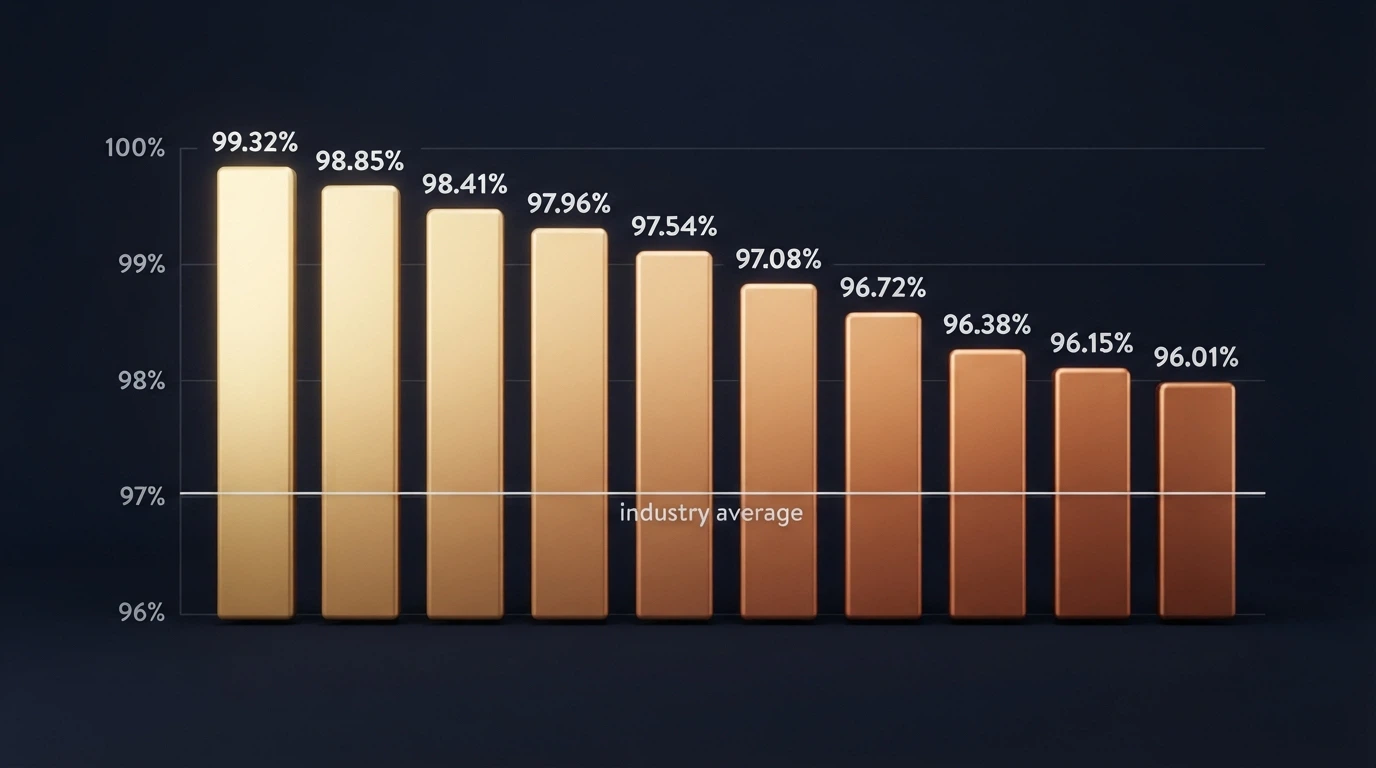
The highest-RTP pokies at Australian-facing casinos
Four titles break 98% RTP and form the genuine top tier. A wider band of high-RTP titles runs from 96% to 97% and makes up the bulk of what a careful player spins on.
| Pokie Title | RTP | Provider | Volatility | Max Win |
|---|---|---|---|---|
| Goblin’s Cave | 99.32% | Playtech | — | — |
| Mega Joker (supermeter) | 99.00% | NetEnt | — | — |
| Book of 99 | 99.00% | Relax Gaming | — | — |
| Blood Suckers | 98.00% | NetEnt | — | — |
| Book of Panda Megaways | 97.07% | BGaming | High | 10,000x |
| Temple Tumble | 96.25% | Relax Gaming | Very High | 7,767x – 9,600x |
| Tome of Dead | 96.21% | Play’n GO | Medium | 5,000x |
| Valley of the Gods | 96.2% | Yggdrasil | High | 5,800x |
| Wolf Gold | 96.01% | Pragmatic Play | Medium | 2,500x |
| Coins of Ra — Hold & Win | 96.18% | Betsoft | High | 3,600x |
The top four — Goblin’s Cave, Mega Joker, Book of 99, Blood Suckers — return more than 98 cents for every dollar wagered, which is exceptional by any measure. The caveat is that volatility and max win were not in the research this run for those four titles, and high RTP at low volatility is a different proposition from high RTP at high volatility. Razor Returns by Push Gaming publishes two RTP settings — 96.55% and 94.49% — depending on the casino, which is the kind of variation a player should check on the loading screen. Book of Dead by Play’n GO carries a default of 96.21% but ships in lower-RTP versions at 95%, 92%, 91.2%, 87.2% and 84.2% across different operators.
Volatility matters: how it decides whether you can actually withdraw
A 99% RTP pokie with extreme volatility can drain a session bankroll before any of the return comes back. Volatility measures the size and frequency of wins relative to the stake — a low-volatility pokie pays small amounts often, a high-volatility pokie pays large amounts rarely. Temple Tumble’s very high volatility with a 7,767x to 9,600x max win is the profile that can deliver a 10,000x hit on a single spin; it is also the profile that produces long dry stretches where nothing of consequence lands.
The pairing matters. A player with a A$200 bankroll chasing a 10,000x hit on Temple Tumble has a much smaller chance of reaching a withdrawal than the same bankroll on Wolf Gold’s medium volatility with a 2,500x max win. The 96.01% RTP on Wolf Gold is lower than the 96.25% on Temple Tumble, but the realised probability of cashing out at A$200 is higher. Players who want a long session with regular small wins should look at medium-volatility titles; players chasing a single transformative payout should accept the dry stretches that come with high or very high volatility.
Demo mode and free play: test every pokie before you bet real money
Demo mode is the only honest way to see how a pokie’s RTP actually behaves, because volatility and hit frequency are not visible in a single spin or even a single session. The offshore casinos on this page offer demo play on the bulk of their pokies libraries, though availability varies by title and operator. A player who takes 200 demo spins on a new pokie gets a feel for the hit rate that no spec sheet can give.
The practical order is straightforward: pick a title from the table above, run it in demo mode for at least a few hundred spins to gauge volatility, then play for real money only once the feel matches the description. Demo availability should be checked at the specific operator, because some titles run in real-money-only mode for licensing reasons, and a pokie that the player can test for free at one site may be restricted at another.
Online Casino Is Illegal in Australia — Here Is What That Means for Your Money
The Interactive Gambling Act 2001, strengthened by the 2017 amendment, makes it an offence to provide online casino games, online pokies or in-play sports betting to a person in Australia. There is no licence for online casino anywhere in the country — not federally, not in any state or territory. Every fast-payout casino on this page is operating outside Australian rules, and the ACMA has used its enforcement authority to block more than 1,455 illegal gambling and affiliate websites since November 2019. Around 220 illegal services have withdrawn from the Australian market since 2017 rather than face that enforcement.

What the Interactive Gambling Act bans — and what it doesn’t
The prohibition covers online casino games (blackjack, roulette, poker against the house, baccarat and similar), online pokies and in-play sports betting once a sporting event has started. Pre-event wagering on racing and sport is legal and licensed by state and territory regulators — principally the Northern Territory Racing and Wagering Commission through Licensing NT, with NT licences running for terms of up to 20 years. Lotteries and keno are licensed separately. Land-based casinos operate under state licences. The minimum age for any commercial gambling in Australia is 18.
The IGA targets the provider, not the individual player. An Australian who deposits at an offshore casino is not prosecuted. That is the only sense in which the activity is technically permitted at the player level. What the prohibition removes is every Australian protection that would otherwise apply — no local regulator complaint channel, no local licence register to check, no local law to recover a refused withdrawal, and no local mechanism to enforce a self-exclusion. The BetStop national register, live since August 2023, binds Australian-licensed wagering services; an offshore casino is not connected, and a self-excluded player can still deposit and lose at every brand reviewed here.
ACMA enforcement: 1,455 sites blocked and the brands on this page are on the list
The ACMA enforces the prohibition under section 313 of the Telecommunications Act 1997, asking Australian ISPs to block illegal gambling and affiliate websites at the DNS level. The agency’s enforcement volume in 2025 was steady: in Q2 (April to June) the ACMA completed 20 investigations into 24 gambling sites, found 30 breaches, issued 10 formal warnings and referred 73 websites for blocking. In Q3 (July to September) it ran 29 investigations into 30 sites, found 44 breaches, issued 20 warnings and referred 71 websites for blocking.
The Q2 2025 block list included alternate domains of brands on this page: fastpay-casino73, neospin7, justcasino5 and rocketplay20. The Q3 2025 list added fastpay-casino75, rocketplay23, rocketplay24, royalreels16, royalreels17, justcasino7 and neospin8. Multiple brands on this page have had more than one domain blocked. The practical risk for a player with an open balance is that a domain can be blocked tomorrow — the ACMA’s referrals do not come with a notice period, and the casino is under no obligation to migrate a player’s balance to a new domain.
The downstream consequences of offshore play are not theoretical. There is no Australian consumer protection. There is no Australian complaints body, and the ACMA cannot recover money on a player’s behalf. A player whose withdrawal is refused or whose bonus winnings are voided has recourse only through whatever dispute channel the Curaçao licence holder provides. BetStop does not reach any casino on this page.
The 2026 reform: what changes on 1 January 2027
The Interactive Gambling Amendment (Gambling Reform) Bill 2026 passed Parliament on 19 August 2026, with measures commencing on 1 January 2027. Three changes will reshape the offshore market for Australian players.
Banks and payment providers gain express authority to block transactions to illegal gambling operators, which is the change that most directly hits an offshore player — a transaction can be refused at the bank end without the casino being involved. Advertising restrictions tighten: no more than three wagering ads per hour between 6:00 am and 8:30 pm, no wagering advertising in the 15 minutes before a live sporting event until 5 minutes after it ends, and athletes, celebrities and influencers are barred from promoting wagering products. Direct marketing of inducements is prohibited for 14 days after a customer signs up, for three months after BetStop deregistration, and indefinitely for customers identified as at risk of gambling-related harm.
The credit-card and crypto deposit ban for licensed online wagering, in force since 11 June 2024 with operator penalties up to A$247,500, was the first wave. The 2026 reform is the second. None of it stops an offshore casino from accepting an Australian deposit — it tightens the rails and the marketing rather than the supply.
Staying Safe When the Australian Safety Net Doesn’t Reach Offshore
The Australian gambling-harm support infrastructure is real and free: the National Gambling Helpline on 1800 858 858 runs 24 hours a day, seven days a week; Gambling Help Online provides chat and email counselling at gamblinghelponline.org.au; and BetStop — the National Self-Exclusion Register — excludes a registered person from every Australian-licensed online and phone wagering service in a single step. None of it reaches an offshore casino. That gap is the most concrete single harm of the route the rest of this page describes.

About 2.1% of Australian adults — roughly 430,000 people — experience problem gambling, with the Australian Institute of Health and Welfare putting high-risk gambling at 1.8% in 2022. The number is the population-level scale of the issue BetStop and the helpline exist to address. Offshore casinos are outside both.
BetStop doesn’t cover a single casino on this page — the most important gap
BetStop went live in August 2023. As at 31 July 2026 it had recorded 67,480 registrations, of which 41,290 exclusions were still active — more than 60% of everyone who ever registered. Seventy-eight per cent of registrants were under 40 and 38% chose lifetime exclusion. The register binds Australian-licensed wagering services only. An offshore casino is not licensed in Australia, is not connected to the register, and will keep accepting a self-excluded person’s money.
This is the single most important fact on this page for any reader who has self-excluded or is considering it. BetStop is the strongest player-protection tool available to Australians, and it does not reach a single brand reviewed here. The ACMA’s blocking activity and the offshore operators’ domain-hopping response mean that even an actively self-excluded player with a stable internet connection can find an alternate domain, fund it and play. The decision to deposit at an offshore casino is the decision to step outside every Australian protection the IGA framework was built to provide.
Practical tools and where to get help
The tools that reach an offshore player are the ones the player brings with them. Available support:
- National Gambling Helpline on 1800 858 858 — free, confidential, staffed 24 hours a day
- Gambling Help Online at gamblinghelponline.org.au — chat and email counselling
- BetStop — the National Self-Exclusion Register — for every licensed wagering service in Australia (offshore casinos are not connected)
- Operator-side deposit and session limits, set in account settings before playing
- Reality checks and activity statements for in-session visibility on time and money spent
A reader who wants a deposit cap enforced by the operator they have chosen must set it before the first deposit, and the cap only applies while the player stays with that operator. Switching to a different offshore casino resets the limit. The support services above are the ones that operate independently of which casino a player uses.
How We Selected and Ranked Every Fast-Payout Casino on This Page
The ranking draws on four sources: ACMA published enforcement actions for blocking history, third-party payout testing from CardPlayer and PokiesAustralia, CasinoAudit scores for payout speed, bonus fairness and trust, and operator terms pages for bonus structure and wagering conditions. Every operator on the list has been checked against the ACMA blocked-site register; licence status was verified against the Curaçao register where research could confirm one.
The ranking criteria, in order of weight, are: tested payout speed where a figure is available, bonus fairness adjusted for wagering burden and cashout caps, licence transparency, and ACMA status. Where research lacks a payout figure — for any operator without a tested or audited score — the cell is left empty rather than filled with a guess. Where research lacks a confirmed bonus structure, the operator write-up states what is verified and covers the gaps qualitatively. No invented scores appear in the table or in the prose.
The same approach applies to the comparison tables on payment methods and pokies. Cells with no figure in research carry the no-data marker rather than a placeholder. The audit is intended to be reproducible from the same sources, and any reader who follows the methodology with current ACMA data and the same third-party testing will reach the same ranking.
What to Actually Do With This Information
The fastest payout available at an Australian-facing casino today is crypto at an operator that processes withdrawals quickly — both the method and the operator matter, and either one alone does not deliver the time on the page. A 450% bonus is only worth claiming if the player can clear the wagering within the validity window at a stake they can afford; the realised value of the bonus is what clears the multiplier, not the headline number. The legal reality — every option here is offshore with no Australian consumer protection, no BetStop coverage and no ACMA recourse for a refused withdrawal — should shape how much is deposited, because the safety net that applies to every other Australian financial product does not apply here.

Responsible-gambling tools only work where the operator offers them. The casinos on this page offer deposit and session limits, reality checks and activity statements in varying combinations; the player should check the specific operator’s responsible-gambling page before signing up. BetStop does not reach any of them. The National Gambling Helpline on 1800 858 858 and Gambling Help Online at gamblinghelponline.org.au are available regardless of which casino a player has been using.
The right choice is the operator that fits how a player actually plays, withdraws and manages a bankroll — not the loudest headline. A casual player who deposits once a month and wants a small AUD payout should look at PayID or e-wallets at an operator with a tested payout figure, not chase a 450% bonus they will not clear. A crypto-fluent player chasing the fastest possible withdrawal should look at Fastpay or BitStarz and accept the offshore status for what it is. A player who has self-excluded through BetStop should not be reading further down this page. For everyone else, the comparison table above is the decision set, and the operator write-ups below it are the closer read.
Frequently Asked Questions
What is the best crypto for fast casino withdrawals in Australia?
USDT on TRC20 and Solana settle in under five minutes in third-party testing and avoid currency conversion fees entirely. Ethereum and Litecoin land in five to thirty minutes. Bitcoin takes thirty to sixty minutes for the network confirmations alone. Pick the speed that matches how often the player withdraws and how comfortable they are with each network’s fee profile.
Are casino winnings taxable in Australia?
No. Under section 6-5 of the ITAA 1997, gambling winnings are not assessable income for ordinary players, and losses are not deductible under section 8-1 — the ATO treats recreational gambling as a personal activity, not a business. The only exception is a professional gambler running betting as a trade.
Can I use a credit card to deposit at an online casino in Australia?
Credit cards and credit-related products were banned for online wagering from 11 June 2024, with operator penalties up to A$247,500. A casino asking an Australian for a credit card deposit is operating outside Australian rules, and the protections that come with licensed wagering do not apply to that transaction.
What does “wagering requirement” mean on a casino bonus?
It is the multiplier applied to a bonus before any winnings convert to withdrawable cash — a 40x bonus on A$1,000 means A$40,000 in qualifying bets before the bonus clears. The figure measures the turnover, not the deposit, and the bonus plus winnings are usually lost if the validity window runs out first.
Are fast payout casinos safe for Australian players?
The offshore casino market serving Australians carries no Australian consumer protection — no BetStop coverage, no ACMA recourse for refused withdrawals, and the ACMA has blocked multiple domains of nearly every brand reviewed here. The fastest payouts in this market are real; the safety net Australian players expect from other financial products is not.
How does the ACMA block illegal gambling sites?
Under section 313 of the Telecommunications Act 1997, the ACMA asks Australian ISPs to block illegal gambling and affiliate websites at the DNS level. The agency has had 1,455+ sites blocked since November 2019, with 71 to 73 referrals per quarter in 2025, and the block list grows each quarter.