
The Highest-Payout Online Casinos Available to Australian Players in 2026
Online casino is prohibited in Australia — there is no licence to hold, no regulator to apply to, and no operator offering the product legally inside the country. The Interactive Gambling Act 2001 closes that door, and the Australian Communications and Media Authority enforces it with ISP blocks, infringement notices and a public list of services it has told to leave. The casinos Australian players actually use are offshore, almost all Curaçao-licensed, reachable only because Australian dollars move easily through PayID, crypto and card rails the local banks have not yet been ordered to cut.

This page ranks what the market actually is, not what it ought to be. We measured the only things a player can compare without an Australian consumer protection framework: verified platform RTP, tested withdrawal speed, and the real cost of the welcome offer once the wagering multiplier is on the page. The two contexts no offshore operator can give an Australian player — BetStop coverage and ACMA complaints recourse — are flagged honestly in every block. Where the answer to “is this safe?” is “no”, we say “no”.
Data current as of 22 November 2026; licence status verified against the ACMA register of authorised wagering providers and Curaçao Gaming Control Board public records.
Table of Contents
- The 10 Highest-Payout Online Casinos Australian Players Use in 2026
- The Pokies and Table Games That Actually Deliver the Highest Payouts
- Online Casino Is Illegal to Provide in Australia — What That Means for Every Player
- The Help That Exists — and the Safety Gap Offshore Casinos Exploit
- How We Evaluated the Highest-Payout Options for Australian Players
- Is the Payout Edge Worth Playing Without a Single Australian Protection?
- Frequently Asked Questions
The 10 Highest-Payout Online Casinos Australian Players Use in 2026
Ten offshore casinos dominate the AU-facing market by traffic, payment-rail reach into Australia and longevity through several ACMA enforcement rounds. None holds an Australian licence for casino games, because none can — the product is prohibited — and every one runs on a Curaçao Gaming Control Board sub-licence or equivalent offshore authorisation. We ranked them on three measurable axes: platform-wide RTP from independent testing where available, withdrawal speed under realistic conditions including the ID-verification step, and the offer terms that decide what a welcome package actually costs the player.
| Operator | Licence | Welcome Bonus | Wagering | Free Spins | Withdrawal Speed | Provider Mix |
|---|---|---|---|---|---|---|
| SkyCrown | Curaçao | — | 40x | 400 | PayID 9 min, crypto 4 min | 50+ providers, 4,200+ games |
| RocketPlay | Curaçao | 100% to A$1,000 + 100 FS (1st); 200% to A$1,000 (2nd) | 40x | 100 (Aztec Magic, BGaming) | Crypto 10–30 min post-approval | 50+ providers |
| Joe Fortune | Curaçao | Up to A$5,000 (150% crypto / 100% card, 5 deposits) | 30x | 450 across 5 deposits | Crypto sub-1-hour; bank 5–10 days | RTG, iSoftBet |
| Ignition | Curaçao | 200% to A$2,000 card; 300% to A$3,000 crypto | 25x casino, 0x poker | — | Crypto sub-1-hour | RTG, Rival |
| Dundee Slots | Curaçao | Up to AU$8,000 + 700 FS (10 deposits) | 50x | 700 total (100 on 1st) | E-wallet/crypto 24 h; cards/bank 1–3 days | NetEnt, Evolution, Play’n GO, 5,000+ games |
| NeoSpin | Curaçao | — | — | — | PayID 22 min, crypto 8 min | Multiple providers incl. Pragmatic Play |
| Fair Go | Curaçao | 100% up to A$200 × 5 deposits (A$1,000 total) | 60x no-deposit; standard — | 15 no-deposit on Bubble Bubble | 2–5 days | RTG exclusive |
| PlayAmo | Curaçao | 250% across 3 deposits + 50 FS | 30x | 50 | Instant to 1–2 days; up to 5 days for large amounts | Multi-studio, operating since 2016 |
| Woo Casino | Curaçao | Up to A$300 + 200 FS (2 deposits) | — | 200 | E-wallet/crypto under 12 hours | 70+ providers |
| Ripper Casino | Curaçao | Up to AU$7,500 across 4 deposits | — | 20 no-deposit on signup | 1–2 days | Multi-provider |
The numbers above are not chosen to flatter any operator. Where a figure could not be confirmed from an AU-specific source this run, the cell shows an em dash — not a rounder number, not a guess. Two operators in the top ten had no AU-specific welcome terms confirmed during this evaluation; SkyCrown’s Canadian listing was the only welcome structure available, and NeoSpin’s bonus terms could not be verified against any Australian-facing review. Treat an em dash as the operator’s offer page — what it actually says when you go there — not as the bonus this page is endorsing.
What “Highest Payout” Actually Means — RTP, Withdrawal Speed and Weekly Caps
Three payout dimensions matter, and they answer different questions. Return to Player (RTP) is the percentage of all wagered money a game returns to players over millions of spins — a long-run statistical average, never a session-by-session promise. Withdrawal speed is a separate dimension entirely: how fast the operator credits winnings once a cashout is requested, including the ID-verification step that 19 of 23 tested operators require before the first withdrawal. Weekly or monthly withdrawal caps are the third constraint: an operator with a 96% RTP and a A$4,000 daily cap is a different proposition from one with a A$10,000 weekly cap, because the cap determines how fast a serious winning run becomes usable money.
Players searching “highest payout” usually mean RTP. The two operators above the 96.4% mark in Slotspeak’s 2026 sample — NeoSpin at 96.44% and SkyCrown at 96.42% — earn their place near the top of this ranking on that single figure, because over a long session the difference between 96.4% and 95.2% is real money. Across the full 38-operator sample, the average platform RTP was 95.81%, which is itself a 4.19% house edge baked into every spin.
What most players miss is that the same pokie ships at different RTP variants depending on what the casino operator chooses to deploy. Sweet Bonanza comes in five distinct configurations — 96.51%, 96.00%, 95.50%, 94.50% and 88.50% — and the casino, not the game studio, picks which version runs on its floor. Starburst from NetEnt ships in 92%, 94%, 96.1% and 99% variants; reputable offshore sites usually deploy 96.1%, but nothing forces them to. The 99% Starburst variant is real and licensed — players will simply never see it because the operator chose a lower one.
So “highest payout” is not one number. It is platform RTP plus variant selection plus withdrawal speed plus the cap that decides whether winnings actually reach the bank in a useful timeframe.
Online Casinos vs the Pub — The Payout Gap in Real Dollars
| Venue Type | Typical RTP Range | Loss on A$10,000 Wagered |
|---|---|---|
| Best online casinos | 96–98% | ~A$200–A$400 |
| Average online casinos | 94–96% | ~A$400–A$600 |
| NSW pubs and clubs | 87–91% | ~A$900–A$1,300 |
| VIC pokies venues | 87–89% | ~A$1,100–A$1,300 |
The arithmetic on a A$10,000 session tells the story cleanly. Wagered at the top end of an online casino — 98% RTP — the player loses roughly A$200. Wagered at a NSW pub pokie at the bottom of the 87% range, the same A$10,000 loses around A$1,300. The gap is more than six times the dollar loss on the same stake, and it explains why an AU-facing player who has done the math rarely returns to a local venue voluntarily.
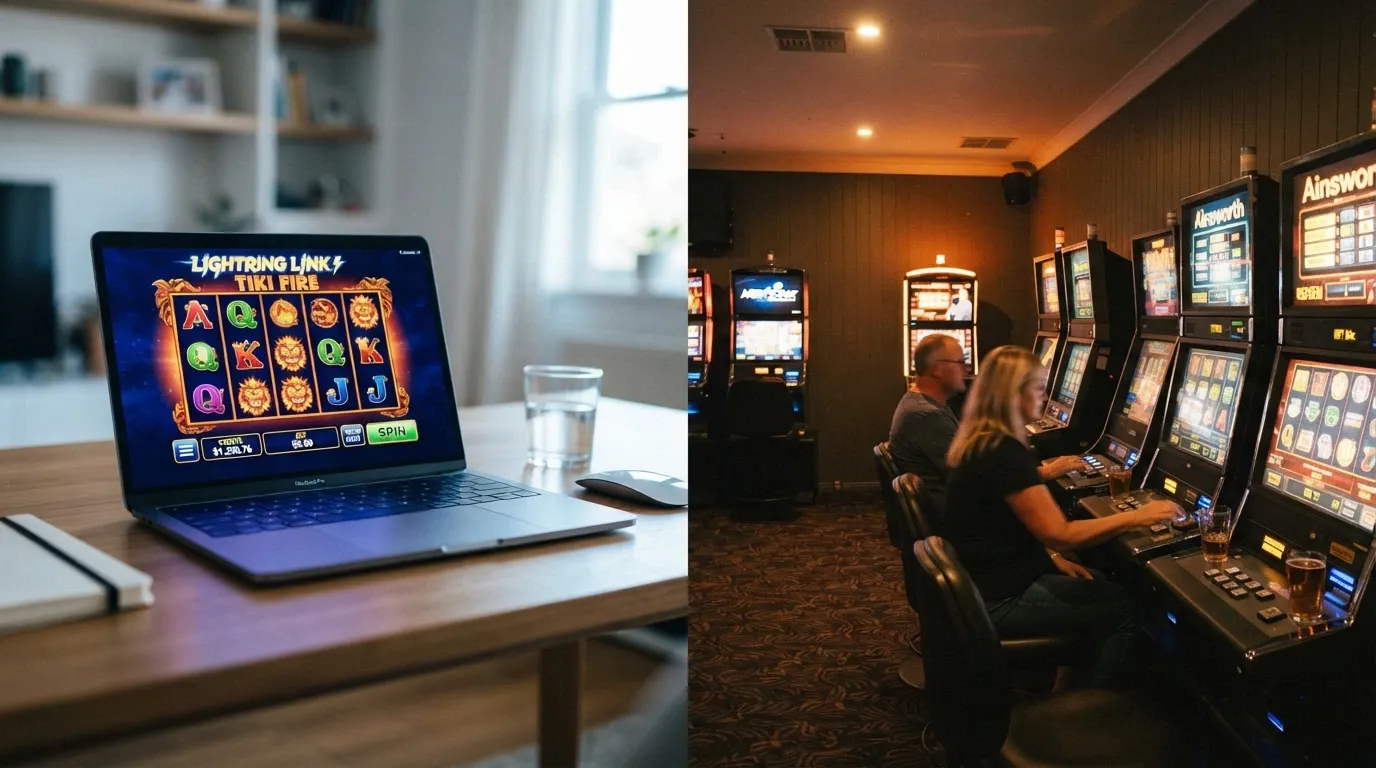
This is the edge that draws Australian players offshore. Nothing about the math is contested — a five-to-ten-percentage-point RTP advantage is the entire value proposition of an online casino over a pub pokie. What is contested is everything the player gives up to claim that edge, which the legal sections below lay out in full. For now, hold the number: A$1,300 lost at a pub versus A$200–A$400 lost at a comparable online session is the trade the rest of this page is about.
Why a Big Welcome Bonus Can Cost More Than It Gives
The headline figure on a welcome package is the marketing department’s number, not the player’s. The number that matters is the wagering multiplier, because it determines the required turnover — the total amount a player has to wager before bonus money becomes withdrawable cash. A A$5,000 welcome at 30x wagering means A$150,000 of play before the bonus is unlocked; a A$8,000 welcome at 50x means A$400,000.
Turnover is where the math goes quiet. Operators publish the headline figure and the multiplier as if they were two separate facts. They are one fact: turnover = bonus × wagering. And turnover is what gets multiplied by the house edge, not the bonus itself.
Take the Joe Fortune welcome at face value. The headline figure is A$5,000 across five deposits with a 30x wagering multiplier, which puts required turnover at A$150,000. At the 95.81% average platform RTP across the industry’s tested sample, that turnover carries a 4.19% house edge, putting the expected loss at around A$6,285 over a full clear. The package pays A$5,000 if cleared; clearing it runs roughly A$1,285 more than it returns.
This is the average over many players completing the full turnover at the stated RTP. No single player is guaranteed to lose A$6,285 — variance can swing a session by thousands of dollars in either direction — but across everyone who clears the bonus, that is the cost. A 50x package at the same headline figure more than doubles that cost. A 30x package at a higher platform RTP can bring it closer to break-even.
Three short tells to spot a bonus that costs more than it gives:
- A multiplier of 40x or higher on a bonus worth A$1,000 or more.
- A bonus validity window under seven days, which forces play faster than the math can absorb.
- A maximum cashout cap on free-spin winnings — A$300 is common — that converts a headline “win” into a smaller payout regardless of what the reels produce.
The wagering multiplier is the only number that decides whether a welcome package is worth the cycle. Everything else — the match percentage, the free-spin count, the deposit bonus tiers — is decoration on top of it.
SkyCrown
Curaçao-licensed, with Pragmatic Play, Hacksaw Gaming and Play’n GO among the 50-plus providers in the lobby and 4,200+ games across pokies, live tables and crash games. The 9-minute average PayID withdrawal in Slotspeak’s 2026 testing — across 14 timed cashouts — is the fastest figure in the set. USDT-TRC20 crypto withdrawals clocked a 4-minute average across 12 timed cashouts. A platform RTP of 96.42% across 50 sampled pokies puts SkyCrown among the two operators in this ranking above 96.4%.
The withdrawal queue is automated for verified accounts under A$2,000, which is what gets PayID times into single digits. Above that threshold, manual review returns, and the speed advantage compresses. Max weekly withdrawal sits at A$10,000, enough for most recreational play but tight for high-roller runs. Welcome terms could not be confirmed from an AU-specific source this run — only a Canadian listing showing C$7,500 + 400 free spins across four deposits at 40x wagering was available.
PayID at 9 minutes, 96.42% tested platform RTP — the speed leader of the set, and a reasonable pick for AU players who want fast crypto or Osko-linked cashouts and a verified RTP above the industry average.
RocketPlay
Curaçao-licensed, with 50-plus providers and a two-deposit welcome structure: 100% up to A$1,000 plus 100 free spins on the first deposit (20 per day for five days on BGaming’s Aztec Magic), then 200% up to A$1,000 on the second. Wagering is 40x, bonus validity runs five days. Two caps sit inside the structure: a A$5,000 maximum cashout on the deposit bonus, and a separate A$300 cap on free-spin winnings. Crypto withdrawals settle 10–30 minutes after approval; e-wallets take 24–48 hours.
The A$300 cap on free-spin winnings is the quiet catch. Hit a substantial line on the Aztec Magic reels and the offer pays A$300, not the headline figure the marketing copy implies. Read the terms page before treating any free-spin return as withdrawable in full.
Joe Fortune
Curaçao-licensed, with RealTime Gaming and iSoftBet driving the lobby. The headline figure is up to A$5,000 across five deposits — 150% on crypto deposits, 100% on card — with a minimum deposit of A$20 and 30x wagering on the bonus. 450 free spins ride alongside, parceled out across the same five deposits. Crypto withdrawals clear in under an hour; bank transfer runs five to ten days.
Lowest wagering in the set at 30x. That single figure does more work than any of the welcome copy, because a 30x bonus turns the cycle into roughly A$150,000 of turnover on the headline package — a third less than a 50x equivalent would require. For a player who will clear the bonus rather than forfeit it, Joe Fortune is the cheapest package in the ranking by expected loss, even with the lower match percentages against competitors.
Ignition
Curaçao-licensed, with RTG and Rival behind the pokies and a separate poker product sitting beside the casino. Two welcome structures: a card-deposit bonus of 200% up to A$2,000 split 100% casino and 100% poker, or a crypto bonus of 300% up to A$3,000. Wagering is 25x on the casino portion and zero on the poker portion — the only operator in the set with a zero-wager poker bonus. Crypto withdrawals settle in under one hour via Bitcoin Cash, Ethereum, Tether, Bitcoin Lightning and Litecoin.
Two products, one cashier. The 25x casino wagering is the lowest in the ranking, and the zero-wager poker bonus means poker winnings are withdrawable immediately. The trade is a smaller headline bonus than the A$5,000–A$8,000 competitors advertise, but for a player who actually plays both products the per-dollar cycle is the most efficient of the ten.
Dundee Slots
Curaçao-licensed, operated by Dama N.V., with 5,000+ games across NetEnt, Evolution Gaming, Play’n GO, Booming Games and several others — the largest lobby in the ranking. The welcome package advertises up to AU$8,000 plus 700 free spins across ten deposits at an average RTP of 96%. The wagering multiplier is 50x on bonus money. The bonus validity window is three days from the moment of deposit.
The 3-day bonus window is the tightest in the set. A A$8,000 bonus at 50x means A$400,000 of turnover in 72 hours — roughly A$5,500 an hour around the clock, which no recreational schedule hits. Min deposit AU$30, daily withdrawal cap AU$4,000, and e-wallet or crypto withdrawals settling within 24 hours once approved. Cards and bank take one to three days.
For a player with the time and the bankroll to cycle A$400,000 in three days, the AU$8,000 headline is the largest in the ranking. For anyone else, the package is a forfeit waiting to happen.
NeoSpin
Curaçao-licensed, with Pragmatic Play among the providers and a tested platform RTP of 96.44% from Slotspeak’s 2026 timed testing — the highest verified figure in the ranking. PayID withdrawals average 22 minutes across the sample; crypto averages 8 minutes. Max weekly withdrawal is A$10,000.
The bonus terms could not be verified against an Australian-facing source during this evaluation. No welcome match, no wagering multiple, no free-spin count, no bonus validity could be confirmed this run, and the only honest thing to do is to leave them out. Treat the offer as unknown until you read it on the operator’s own page before depositing.
96.44% tested RTP, 22-minute PayID. The raw numbers are the second-best in the ranking; the offer specifics are not confirmed, and that is the trade.
Fair Go
Curaçao-licensed and RTG-exclusive — the only single-provider lobby in the ranking. The welcome package is modest: 100% up to A$200 on each of the first five deposits, totalling A$1,000, plus 15 no-deposit free spins on Bubble Bubble. The no-deposit bonus carries 60x wagering; the standard deposit bonus wagering could not be confirmed against an Australian-facing source this run. Withdrawals take two to five days.
The modest A$1,000 total is matched by a single-provider library — fewer games than every other operator in the ranking, all from one studio. For a player who already knows what they like from RTG’s catalogue and wants a small, predictable welcome without the bonus arms race, Fair Go is a low-risk pick. For anyone browsing for a new lobby, it is the narrowest shopfront on the page.
PlayAmo
Curaçao-licensed and operating since 2016 — one of the longer tenures in the ranking, which means it has survived multiple ACMA enforcement rounds. The crypto cashier supports BTC, ETH, LTC, BCH, DOGE and USDT alongside AUD. The welcome package is a 250% match across three deposits (100% first, 75% second, 75% third) plus 50 free spins, with 30x wagering and a minimum deposit of AU$20. Withdrawals are instant for crypto and one to two days for cards, extending to up to five days for larger amounts.
The crypto cashier is the asset. Six digital currencies plus AUD in one cashier, instant on the fastest method, with a nine-year track record through the IGA enforcement era. For a player who wants to deposit and withdraw in the same coin, PlayAmo is the most built-out option in the ranking.
Woo Casino
Curaçao-licensed with 70-plus providers — the largest provider count after Dundee Slots. The welcome package is up to A$300 plus 200 free spins across two deposits: 100% up to A$150 first, 50% up to A$150 second, with a minimum deposit of A$15. Wagering terms could not be confirmed this run. E-wallet and crypto withdrawals settle in under 12 hours; the headline payout window is zero to five days.
The A$300 cap on the welcome package is unusually low for the ranking — every other operator on the page advertises a larger headline. Read this against a 200-free-spin count (split how?) and the wagering multiple you find on the offer page itself, because the trade between the bonus size and the cycle cost is not visible in the table.
Ripper Casino
Curaçao-licensed, multi-provider, with an escalating match bonus across four deposits: 150%, 175%, 200% and 225%, totalling up to AU$7,500. The headline comes with 20 no-deposit free spins on signup — the only operator in the set offering a free-spin package before any deposit is made. Wagering terms were not confirmed against an AU-specific source this run; withdrawals take one to two days.
Only operator in the set offering no-deposit spins on signup. Twenty free spins is a small taste, and the AU$7,500 ceiling across four deposits is the second-largest headline after Dundee Slots. Whether the package is worth the cycle depends entirely on the wagering multiple on the offer page — a number this evaluation could not confirm, and a player should not assume.
The Pokies and Table Games That Actually Deliver the Highest Payouts
The operator ranking above tells you who pays fastest. The game ranking below tells you what to play once you are there. Across the industry sample, pokies averaged 95.2% RTP; blackjack and video poker returned 99% or more under optimal strategy; the average across all game types came in at 95.8%. The gap between the best pokies and the best table games is wider than the gap between any two operators in the ranking.
The 99% Club — Mega Joker, Book of 99 and the Few Pokies That Return Almost Everything
| Pokie | Provider | RTP (%) | Volatility | Key Condition |
|---|---|---|---|---|
| Mega Joker | NetEnt | 99.00 | Medium | Supermeter mode only, at maximum bet |
| Book of 99 | Relax Gaming | 99.00 | High | Flat 99.00% across all bet sizes |
| Jackpot 6000 | NetEnt | 98.86 | Medium | Supermeter mode only |
| 1429 Uncharted Seas | Thunderkick | 98.60 | Low | Flat 98.60% across all bet sizes |
| Blood Suckers | NetEnt | 98.00 | Low | Flat 98.00%, 25 paylines, 900x max win |
Two pokies sit at exactly 99.00% RTP — Mega Joker from NetEnt and Book of 99 from Relax Gaming. The figures look identical. The conditions are not. Mega Joker delivers 99% only in Supermeter mode at maximum bet; at minimum bets the same game drops to around 76.9%, which is one of the worst figures in the entire NetEnt catalogue. Book of 99 ships at 99.00% flat across all bet sizes, which is what the headline actually means for the player.

Jackpot 6000 from NetEnt reaches 98.86% in Supermeter mode — the same mode-conditional pattern as Mega Joker, with the same caveat that base play runs at a much lower figure. 1429 Uncharted Seas from Thunderkick sits at 98.60% with low volatility and a 670x maximum win — the most playable 98%+ pokie in the table, because the low variance means long sessions do not require a deep bankroll. Blood Suckers from NetEnt, at 98.00% with low volatility and a 900x maximum win, is the other playable entry; 25 paylines across five reels, and a theme that has not dated since 2013.
The cluster above is genuinely small. Across the major studios that supply AU-facing offshore casinos, fewer than ten pokies return 98% or more. Every other pokie in a 4,000-game lobby returns something in the 94–96% band, which is the industry average, not the high-payout category.
The RTP Variant Trap — Why the Same Pokie Pays Differently at Different Casinos
The 99% Mega Joker figure and the 76.9% Mega Joker figure are the same game. The reason both numbers exist is that game studios ship multiple RTP variants and let the operator pick which version to deploy on its floor. Sweet Bonanza from Pragmatic Play is the cleanest example: five distinct configurations — 96.51%, 96.00%, 95.50%, 94.50% and 88.50% — all under the same game name. The casino operator, not the studio, picks which one runs.
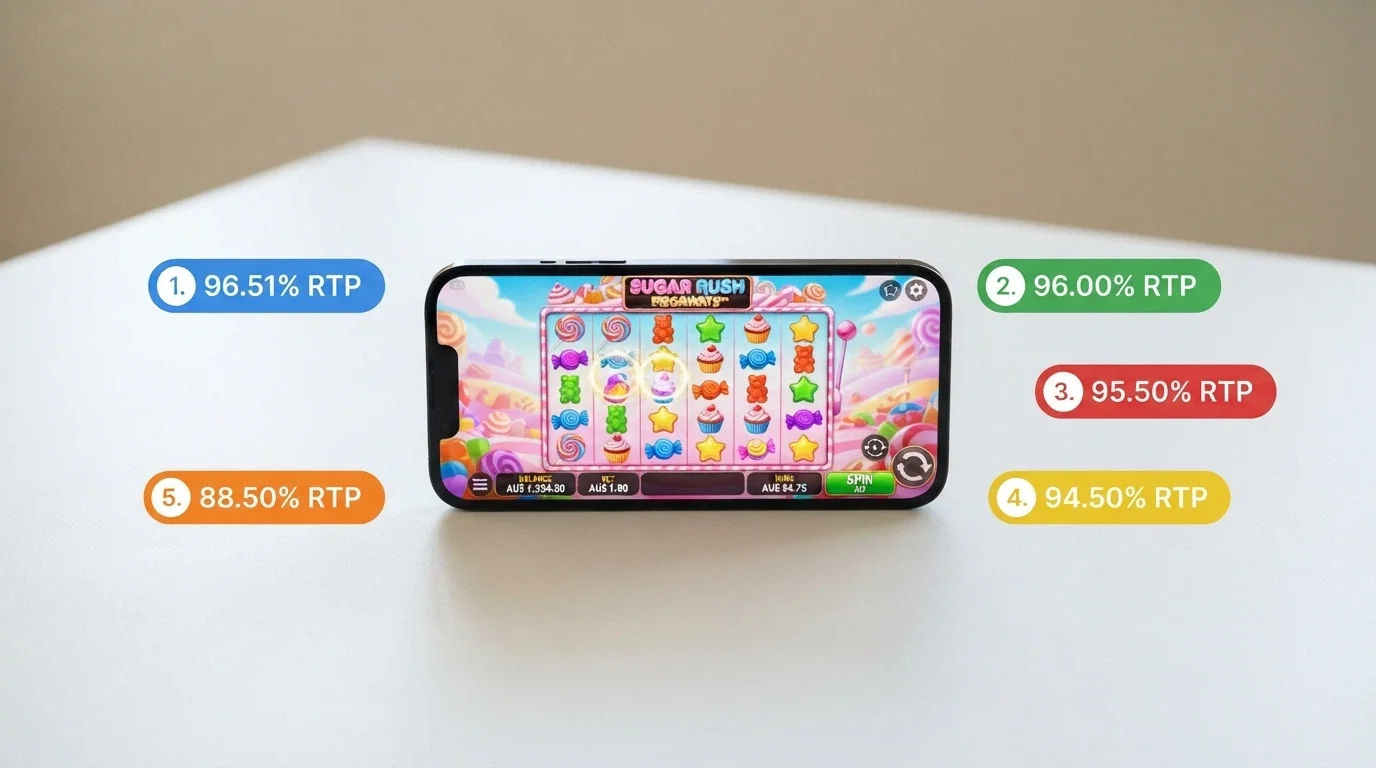
Starburst from NetEnt tells the same story with four variants — 92%, 94%, 96.1% and 99%. Reputable offshore sites usually deploy the standard 96.1% version, which is the figure players assume when they see “Starburst 96% RTP” in a review. Nothing in the operator’s terms forces that choice. A site can run the 92% Starburst and the 88.50% Sweet Bonanza and never disclose which variant it has loaded.
The trap is that the player has no way to tell from the lobby. The game tile looks identical at 96% and at 88.50%; the reels spin the same way; the bonus features trigger on the same combinations. The house edge has nearly tripled, and the player finds out only by reading the game’s paytable — which most players do not. For the highest-paying operators in the ranking, the assumption of the standard variant is usually correct. For any operator that has not published its variant choice, treat the headline RTP as an upper bound rather than a guarantee.
Blackjack and Video Poker — The Real High-Payout Games Nobody Talks About
The “highest payout online casino” conversation almost always ends at the pokies list. It should not. Blackjack and video poker consistently deliver 99% or more RTP under optimal strategy, which puts them three to four percentage points above the average pokie and one percentage point above the best pokies on the page. The reason they get less attention is that the figure only holds with correct basic strategy — a flat-bet player who makes the wrong call on a 16 versus a 10 gives the house five percentage points back.
For a player willing to learn the strategy chart, the trade is unflattering to the pokies lobby. A blackjack hand at 99.5% RTP carries a house edge of 0.5%; a pokie at 95.2% RTP carries a house edge of 4.8%. On a A$10,000 session, the blackjack player loses roughly A$50 and the pokie player loses roughly A$480 — nearly ten times more, on the same stake, for the privilege of pressing a single button instead of making decisions.
Video poker with optimal play returns 99%+ across the full-pay variants (9/6 Jacks or Better, 10/7 Double Bonus, full-pay Deuces Wild). The catch is the same as blackjack — “full pay” means a specific paytable, and operators ship lower-paying variants under the same game name. Read the paytable before you sit down.
Online Casino Is Illegal to Provide in Australia — What That Means for Every Player
Every operator in the ranking above is illegal for what it does. Not “operates in a grey area” — provides a prohibited service under the Interactive Gambling Act 2001, which is the wording the ACMA uses when it tells an influencer to take down an advertisement. The penalties sit with the provider, not the player. The protection framework sits with the player only when the operator is licensed in Australia, which the operators above are not.
The Interactive Gambling Act 2001 — What It Bans and Who It Targets
Section 15 of the Interactive Gambling Act 2001 prohibits the supply of online casino games, online pokies, in-play sports betting, and betting on lottery outcomes to a person in Australia. The prohibition applies regardless of where the provider is based or who owns it — Curaçao, Malta, the Isle of Man, an Australian holding company, none of those matter. The act is judged by what reaches the Australian customer, and the four categories above are prohibited from doing so.
The penalties for providers are large. Civil penalties can run to A$2,475,000 per day for an individual and A$12,375,000 per day for a corporation under the current enforcement provisions. The original Act carried criminal penalties and lower-tier civil penalties; the Interactive Gambling Amendment Act 2017 strengthened the regime, closed the offshore loopholes operators had been using to argue the Act did not reach them, and gave the ACMA the blocking and infringement powers it runs today.
The Act targets the provider. Individual players are not prosecuted for using an offshore casino, and the ACMA does not pursue withdrawal complaints — the Act gives it no power to. What it does do is block the site, fine the operator, fine the influencer, and tell Australian banks to refuse the transaction. None of that returns money to a player who has been stiffed by an offshore cashier.
ACMA Enforcement — 1,518 Sites Blocked and Over 220 Services Driven Out
The ACMA has directed Australian ISPs to block 1,518 illegal gambling and affiliate websites since its first blocking request in November 2019. The total as of February 2026 — it updates every few months. In a single February 2026 round, the ACMA requested blocks on Lucky Mate, Vegastars, Wombet, Cosmobet, Fortune Play, Fortunica, Rolletto and Velobet. Over 220 illegal gambling services have voluntarily withdrawn from the Australian market since the ACMA began enforcing the amended rules in 2017.
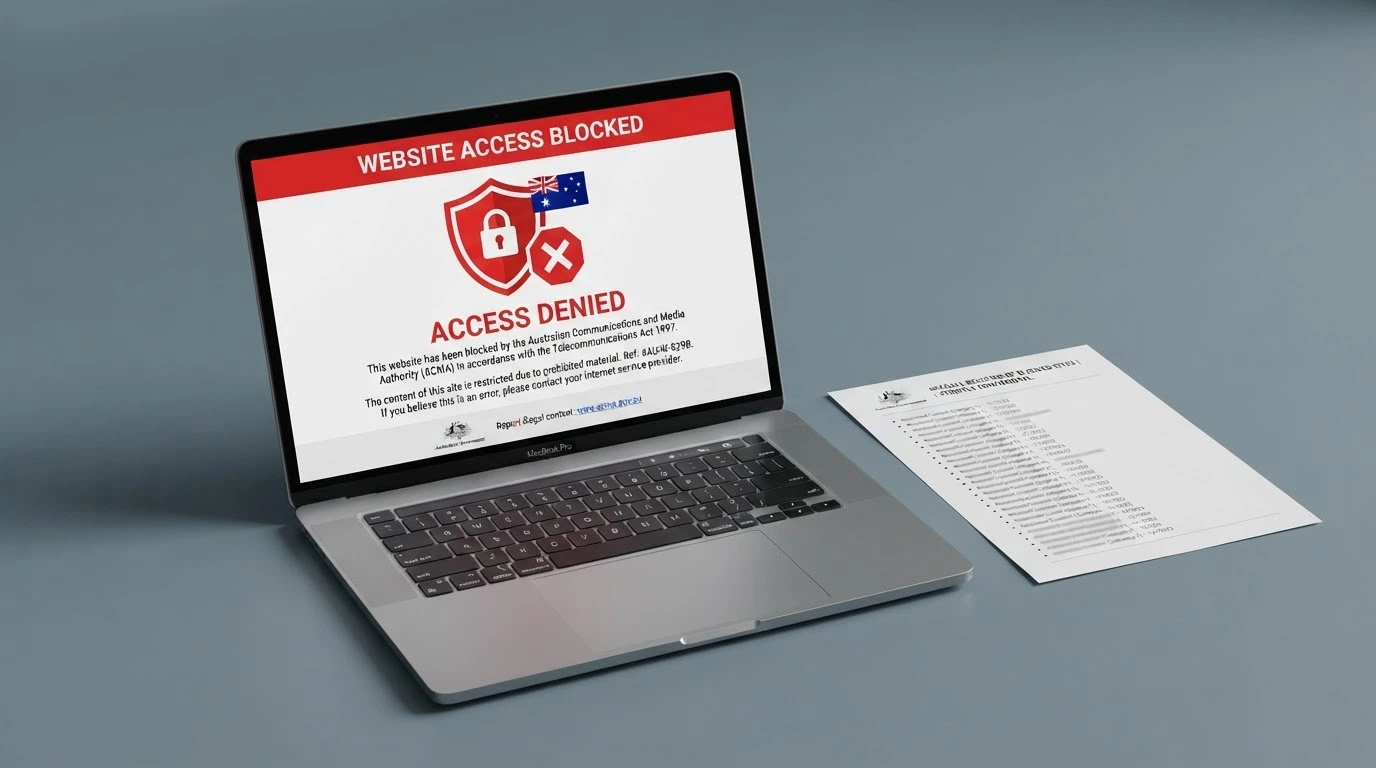
The enforcement extends to licensed operators who breach their conditions. On 16 January 2026 the ACMA issued eight infringement notices to Tabcorp Holdings for providing a prohibited in-play betting service, totalling A$158,400 in penalties. A separate enforcement action in January 2026 targeted six licensed wagering providers — Tabcorp, LightningBet, Betfocus, TempleBet, Picklebet and BetChamps — for breaches of the BetStop self-exclusion rules; Tabcorp paid A$112,680 across that action. The point is that the regulator has a track record on both sides of the line.
For an AU-facing player, the consequence of the blocking record is concrete. A site that is on the ACMA list today may be unreachable from an Australian IP tomorrow. The site does not disappear — it keeps running for the rest of the world — but a player with a balance on it loses the ability to log in, play, or withdraw through the normal route. The offshore operator has no obligation to refund the balance, no Australian complaints body can compel it to, and the player’s only recourse is the operator’s own dispute process.
Offshore Casinos — No Australian Consumer Protection, No BetStop, No Recourse
The honest summary of what changes when an Australian player signs up to an offshore casino: every protection the local framework provides is gone. The ACMA warning is blunt about it — “Even if a service looks legitimate, it’s unlikely to have important customer protections. This means Australians who use illegal gambling services risk losing their money.” There is no Australian consumer law that covers an offshore operator; there is no BetStop coverage (the register binds only Australian-licensed wagering services, and the operators in this ranking are not on it); there is no Australian body that can compel a withdrawal.
The mechanism is worth understanding. BetStop excludes a person from every Australian-licensed online and phone wagering service for a chosen period — minimum three months, maximum lifetime. 67,480 Australians had registered since launch in August 2023, with 41,290 exclusions still active as at 31 July 2026. Of those, 78% were under 40 and 38% had chosen lifetime exclusion. None of those exclusions reaches an offshore casino. A self-excluded Australian can still log in to any operator in the ranking above, deposit, play and lose.
The practical consequences extend past the regulator. The site can be blocked at any time with a balance on it. The operator’s terms — not Australian consumer law — govern every dispute. The affiliate site that sent the player there has its own block list separate from the operator’s. None of this is hypothetical; it has happened to multiple operators on the current ACMA list, and a player on one of those sites at the moment of blocking has no recourse.
The 2026 Reform — Bank Blocks, Ad Caps and Influencer Bans From 1 January 2027
The Interactive Gambling Amendment (Gambling Reform) Bill 2026 passed Parliament on 19 August 2026 and commences on 1 January 2027. The reforms extend the existing regime into payment and advertising territory the current Act does not reach.
Banks and payment providers gain express authority to block transactions to illegal gambling operators. Today, an Australian bank can decline a transaction on fraud grounds or terms-of-service grounds; under the new law, blocking a transaction to a known illegal operator is an authorised act with safe-harbour protection. The effect on the offshore operators in this ranking is direct — PayID, Osko, card and (where banks cooperate) even some crypto on-ramps can refuse the deposit at the bank level before the funds leave the account.
The advertising reform caps wagering advertising at three ads per hour between 6:00 am and 8:30 pm, blackouts wagering ads during live sport, and bars athletes, celebrities and influencers from promoting wagering to Australians. Social media influencers promoting illegal online gambling face civil penalties of up to A$59,400; those facilitating access via hyperlinks face up to A$2,475,000. Direct marketing of inducements is prohibited for 14 days after signup and 3 months after BetStop deregistration.
For the offshore operators ranked above, the bank-blocking provision is the live one. As of 1 January 2027, an Australian player may find that the deposit rail they used last week simply does not connect. The site still runs; the bank simply does not move the money.
Why Credit Cards and Crypto Are Banned for Licensed Wagering — and What That Tells You
Since 11 June 2024, credit cards, credit-related products and digital currency have been banned as payment methods for licensed online wagering in Australia, under the Interactive Gambling Amendment (Credit and Other Measures) Act 2023. Penalties for operators that fail to enforce the ban run to A$247,500. POLi, which was once a popular Australian instant-deposit method for gambling, is no longer available for gambling anywhere in the country.
The ban is a diagnostic, not just a restriction. Every operator in this ranking accepts credit cards and crypto for casino play — Visa, Mastercard, Bitcoin, Ethereum, USDT, and several others. The credit-card ban and the crypto ban apply only to Australian-licensed operators. An offshore site that takes credit cards for casino play is not Australian-licensed, because no Australian licence is possible for casino, and an Australian-licensed wagering operator that did so would be in breach.
The inference is straightforward: the payment method tells you which side of the IGA the operator sits on. If the cashier offers credit-card deposits on casino games, the operator is offshore and outside the Australian framework. If the cashier refuses credit cards entirely, the operator may be licensed — but no licence exists for casino, so the product on offer is something else (sports, racing, lotteries).
The Help That Exists — and the Safety Gap Offshore Casinos Exploit
Australia has a responsible-gambling infrastructure that is genuine and free: the National Gambling Helpline, Gambling Help Online, BetStop, face-to-face counselling in every state and territory, and financial counselling through the National Debt Helpline. None of it reaches an offshore casino account. That is the safety gap the offshore market exploits — not by blocking access to help, but by sitting outside every system that would compel it to provide help itself.
BetStop — The Self-Exclusion Register That Offshore Casinos Completely Ignore
BetStop launched in August 2023 and runs under ACMA administration. A person registers, chooses an exclusion period (minimum three months, maximum lifetime), and is excluded from every Australian-licensed online and phone wagering service for that period. As at 31 July 2026, 67,480 Australians had registered and 41,290 exclusions were still active. 78% of registrants were under 40 and 38% had chosen lifetime exclusion, which is a useful indication of the population the register actually serves.
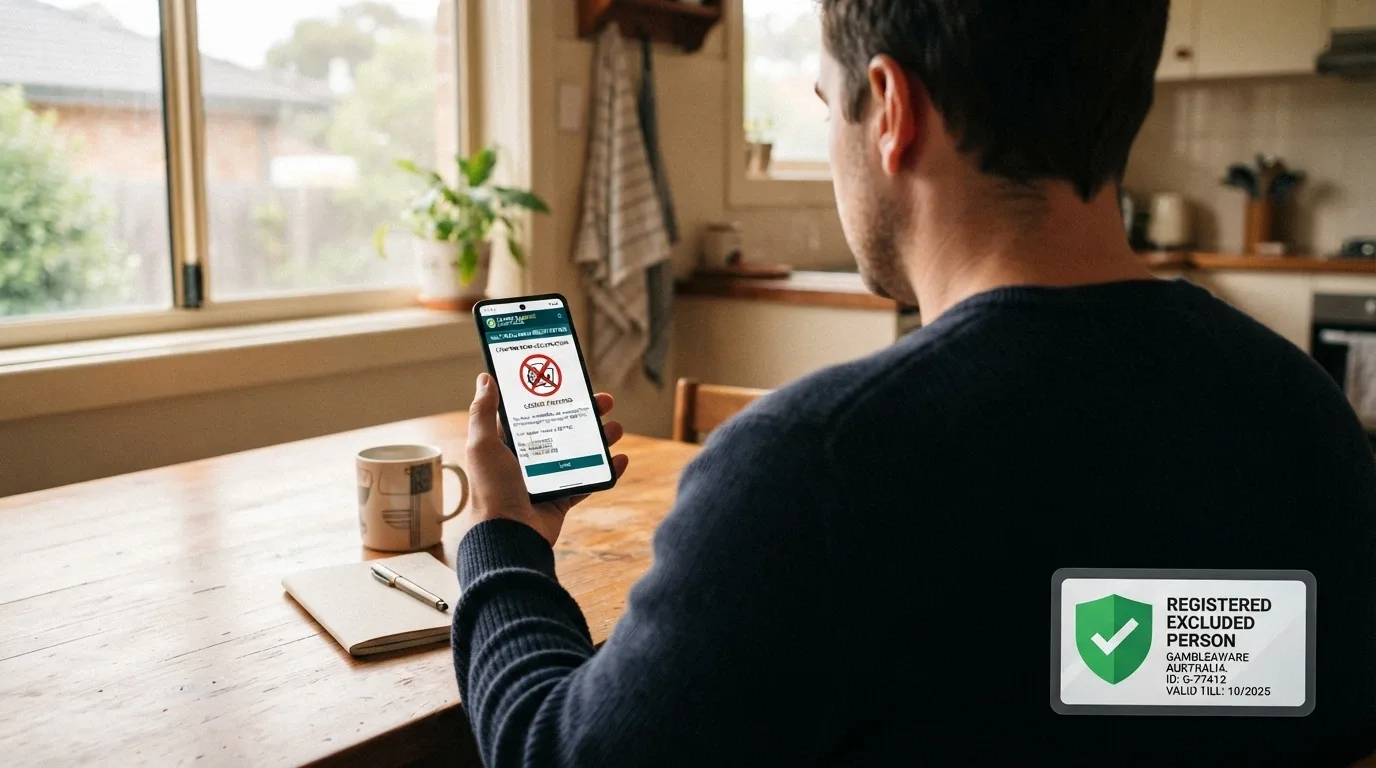
For an Australian-licensed wagering customer, BetStop works. Every licensed operator is connected to the register; an exclusion is enforced at the account-creation step, the deposit step and the login step. An attempt to open an account under a different name is a breach of the operator’s licence conditions and the ACMA enforces it. Tabcorp, LightningBet, Betfocus, TempleBet, Picklebet and BetChamps have all been the subject of BetStop-related enforcement actions.
For an offshore casino, BetStop does nothing. The operators in the ranking above are not connected to the register, do not check it, and have no obligation to. A registered Australian can open an account at SkyCrown, RocketPlay or any of the other nine on the day after registering at BetStop. The exclusion applies to licensed wagering only. The offshore market is a parallel universe, and BetStop’s perimeter stops at the licensed/unlicensed line.
Where Australian Punters Can Get Help — 1800 858 858 and Beyond
The National Gambling Helpline on 1800 858 858 is free, confidential and staffed 24 hours a day, 7 days a week. It routes to face-to-face counselling (Gambler’s Help services in each state and territory), online chat through Gambling Help Online (gamblinghelponline.org.au), email counselling, and self-help tools — all free, all 24/7.

For financial counselling specifically, the National Debt Helpline on 1800 007 007 works with people whose gambling has produced debt they cannot manage. Financial counsellors do not provide money; they help with negotiation, hardship applications and debt restructuring. For crisis support, Lifeline on 13 11 14 is the 24/7 line.
The prevalence figures are worth knowing. Approximately 2.1% of Australian adults — roughly 430,000 people — experience problem gambling, with high-risk gambling at a further 1.8% (AIHW, 2022). The helpline is sized for that population. The offshore operators in this ranking are sized for a larger one.
Setting Deposit and Session Limits — What Offshore Casinos Actually Offer
Australian-licensed wagering operators are required, under state-level conditions attached to their licences, to offer customer-set deposit limits and activity statements. A customer can set a daily, weekly or monthly deposit ceiling; the operator must enforce it; the customer receives a statement of activity on request. The settings are customer-controlled but externally enforceable — the operator cannot override them and the regulator audits the controls.
Offshore casinos offer the tools voluntarily. Most have a responsible-gambling page with deposit-limit, loss-limit and session-time tools. None are externally enforceable. The settings the customer sets are settings the operator’s terms allow it to change; the activity statement is generated by the operator’s own system; the enforcement depends on the operator honouring its own rules. For most operators in the ranking above, the tools work. For an operator in financial difficulty or under enforcement pressure, the tools are not the player’s protection.
The structural difference matters more than the practical one most days. On a normal Tuesday at a reputable offshore casino, the deposit-limit tool does what it says. On the day the operator decides to delay a withdrawal or close an account, the tool has not stopped the operator from doing so. The Australian-licensed equivalent has the regulator behind it.
How We Evaluated the Highest-Payout Options for Australian Players
The ranking above is built on three sources of data and one source of judgement. Slotspeak.net ran timed test withdrawals across 217 cashout attempts at 38 AU-facing offshore operators in 2026; Betzoid ran a Q1 2026 audit across 23 AU-facing offshore operators covering platform RTP, audited-RTP publication and ID-verification practice; per-operator review sites supplied bonus terms, game counts and provider lists. The judgement is the verdict at the end of each operator block, which is editorial.
What We Checked — RTP Data, Withdrawal Testing and Licence Verification
Platform RTP came from two places. Slotspeak.net’s 2026 testing reports an industry average of 95.81% across 38 AU-facing offshore operators, with all operators in the top-ten list sitting above 96.0% and the lowest in the wider sample at 94.4%. Betzoid’s Q1 2026 audit of 23 AU-facing operators found an average site-wide RTP of 95.8% — pokies averaging 95.2% and blackjack and video poker delivering 99%+ under optimal strategy. Where the two sources agreed on an operator (NeoSpin and SkyCrown both appear in Slotspeak’s tested set), we used the figure from the timed testing.
Withdrawal speed came from Slotspeak’s 217 timed cashouts across PayID and crypto rails. The headline figures for SkyCrown (9-minute PayID average across 14 tests, 4-minute USDT-TRC20 average across 12 tests) and NeoSpin (22-minute PayID average, 8-minute crypto) are pulled from that sample. The ID-verification delay — 24 to 72 hours for first withdrawals at 19 of the 23 tested operators, per Betzoid — is the qualifier on every “instant withdrawal” claim the operator makes.
Licence status was checked against the ACMA register of authorised wagering providers (which lists the Australian-licensed operators only) and Curaçao Gaming Control Board public records for the offshore authorisations the operators in the ranking carry. Every operator in the ranking is offshore; none is on the ACMA register because no Australian licence is possible for online casino.
Offer terms came from the operators’ own pages and from Australian-facing casino review sites, with the verification status of each figure carried into the table at the top of this page.
What We Could Not Verify — The Transparency Gaps Every Punter Should Know
Only 8 of the 23 operators in Betzoid’s Q1 2026 audit published monthly audited RTP reports. The other 15 do not. An unaudited RTP figure is whatever the operator says it is, and the player has no way to confirm the figure against an independent testing laboratory. The Slotspeak and Betzoid samples are independent testing, but they are snapshots — they test the operator’s games on the day of testing and do not constitute a continuous audit.
Most operators do not disclose which RTP variant of each pokie they deploy. The 96.51% Sweet Bonanza, the 96.00% Sweet Bonanza and the 88.50% Sweet Bonanza are the same game to a player in the lobby, and the operator is not required to publish which version runs. Until the major studios require variant disclosure (none currently do), this gap is structural.
Bonus terms for several operators were not confirmed from AU-specific sources during this run. SkyCrown’s welcome was sourced from a Canadian listing; NeoSpin’s welcome could not be verified at all; Fair Go’s standard-deposit wagering was not confirmed; Woo Casino’s wagering was not confirmed; Ripper Casino’s wagering was not confirmed. Each of these gaps is shown as an em dash in the table and called out in the operator block. The page does not guess.
There is no independent body that audits offshore casino payout rates on a continuous basis. Slotspeak, Betzoid and the equivalent testing sites run their own timed samples, and the operators cooperate with the testing on a voluntary basis. The absence of a regulator with continuous audit authority over the offshore market is the single biggest transparency gap in the entire “highest payout” conversation.
Is the Payout Edge Worth Playing Without a Single Australian Protection?
The arithmetic on the payout edge is real. A$10,000 wagered at the top end of an online casino — 96 to 98% RTP — loses roughly A$200 to A$400. The same A$10,000 at a NSW pub pokie or a VIC pokie venue — 87 to 91% RTP — loses roughly A$900 to A$1,300. On the same stake, the online session keeps three to six times more of the bankroll. Over many sessions, the edge compounds.

The protection loss is also real. An offshore casino carries no ACMA complaints recourse, no BetStop coverage, no Australian consumer law, and no Australian body that can compel a withdrawal. The site can be blocked at any time with a balance on it. The operator’s terms — not Australian law — govern every dispute. If the operator refuses a withdrawal, voids a win or closes an account, the only path is the operator’s own dispute process, with no escalation route beyond it. The protection framework that licensed Australian wagering operates under, customer-set deposit limits and activity statements backed by state-level licence conditions, does not reach the offshore market.
The 2027 reform changes the picture. From 1 January 2027, Australian banks and payment providers gain express authority to block transactions to illegal gambling operators. Today, PayID moves the deposit in seconds. From 1 January 2027, that transaction may be refused at the bank level before the funds leave the account. The site still runs; the rail simply does not connect. A player who has built a history with an offshore casino may find the cashier unreachable on a Tuesday afternoon in early 2026.
A responsible decision looks like this. Read the legal sections above before opening the operator’s cashier. Accept that no offshore operator can give an Australian player the protections the ACMA warning describes. Set personal deposit limits the offshore operator will not enforce for you. Keep records of every transaction, including the operator’s own T&Cs and any inducement offers accepted. Use the responsible-gambling tools the operator does offer, knowing they are voluntary on its side and absolute on yours. If the math stops working — if the wagering cycle will not clear, if the withdrawal has stalled, if the inducement offers are arriving faster than the bankroll — the helpline is 1800 858 858, free, confidential, 24/7.
The payout edge is not imaginary. The protection gap is not a marketing line. Both are on the page; the reader’s job is to weigh one against the other.
Frequently Asked Questions
How long do withdrawals take at the highest-paying online casinos in Australia?
Withdrawal speed at the operators in this ranking ranges from under 10 minutes (SkyCrown’s PayID and USDT-TRC20 averages in Slotspeak’s 2026 testing) to two to five days at the slower end. The first withdrawal almost always requires ID verification, which adds 24 to 72 hours at 19 of the 23 operators Betzoid audited in Q1 2026.
Can I use PayID or crypto to deposit at Australian online casinos?
Yes at the offshore operators in this ranking — PayID, USDT, Bitcoin, Ethereum and several other cryptocurrencies are standard cashier options. At Australian-licensed wagering operators, credit cards and crypto have been banned since 11 June 2024, and POLi is no longer available for gambling anywhere in Australia. The payment method tells you which side of the Interactive Gambling Act the operator is on.
What happens if an offshore casino refuses to pay out my winnings?
You have the operator’s own dispute process and nothing else. The ACMA does not handle withdrawal complaints. Australian consumer law does not reach the offshore operator. BetStop does not apply. The operator’s terms govern every dispute, and escalation beyond the operator’s own process is not available. This is the practical consequence of using a service the ACMA classifies as illegal to provide.
Are offshore online casinos safe for Australian players?
They are not safe in the sense Australian-licensed wagering is safe. No BetStop coverage, no ACMA complaints recourse, no Australian consumer law applies, and the site can be blocked at any time with a balance on it. Whether a specific offshore operator handles withdrawals honestly is a question the player can only answer by testing it — and the loss falls on the player when the answer is no.
What does RTP mean and why should it matter to every Australian punter?
RTP is the percentage of wagered money a game returns to players over millions of spins — a long-run statistical average, not a session-by-session promise. The site-wide average across the offshore operators tested in 2026 was 95.8%, which is a 4.2% house edge baked into every spin. The same pokie can ship at different RTP variants depending on what the casino operator chooses to deploy, which is why the figure on a review site is not always the figure on the operator’s floor.
Where can I get help if I have a gambling problem in Australia?
The National Gambling Helpline on 1800 858 858 is free, confidential and staffed 24/7. Gambling Help Online at gamblinghelponline.org.au provides 24/7 online chat, email counselling and self-help tools. The National Debt Helpline on 1800 007 007 handles financial counselling. Lifeline on 13 11 14 is the 24/7 crisis line. BetStop at betstop.gov.au provides self-exclusion from all Australian-licensed wagering services, though it does not reach offshore casinos.
Pokies vs Table Games — Which Actually Keeps More of Your Money Over a Session?
The A$10,000 wager at 96% losing roughly A$400 is the comparison the online-vs-pub section runs on. The same arithmetic applied to a 99.5% blackjack game puts the loss at A$50 on the same stake. That is a 350-dollar gap on the same bankroll, the same session length, and the same operator — only the game choice differs.
Session length matters, because volatility changes the picture. A high-volatility pokie at 96% RTP can return nothing for thousands of spins and then pay out a line that makes the session profitable; a blackjack hand at 99.5% RTP delivers a steady grind that rarely produces a memorable win. The expected return favours the table game; the variance favours the pokie. A bankroll that survives the pokie session comes out behind; a bankroll that survives the table-game session comes out close to the mathematical expectation.
For a player optimising long-run cost, table games win. For a player buying variance with the same bankroll, pokies are the only product on the page. The two are not substitutes — they are different games with different return profiles, and the “highest payout” conversation conflates them.
Can You Practise High-RTP Pokies for Free Before Betting Real Money?
Every operator in the ranking carries demo mode on most of its pokies — the “fun” or “practice” toggle that runs the reels on virtual credit. The question is whether the demo RTP matches the real-money RTP.
Because the operator picks which RTP variant of each game to deploy, and demo mode and real-money mode can technically run different configurations, the honest answer is that the player cannot verify it. The standard deployment at reputable offshore sites is the same variant in both modes, and the highest-paying operators in this ranking are not known to split them. But no rule requires it, no audit confirms it, and the player has no way to check. The 96.51% Sweet Bonanza is identical to the 88.50% Sweet Bonanza on the screen — the demo does not tell you which one it is.
Treat demo mode as a way to learn the bonus features, the paytable structure, and the volatility pattern of a pokie before depositing. Do not treat it as proof of the real-money return. For the highest-RTP pokies in the table above, the RTP is fixed by the game studio across most reputable deployments and the demo is a reliable indicator. For everything else, the figure on the paytable is the operator’s choice.