
Best Casino Apps in Australia: What the Home-Screen Icon Actually Leads To
A casino app in Australia, in 2026, is almost always a website disguised as an app. The icon on your home screen was not downloaded from the App Store or Google Play. It came from your phone’s browser, through a “Add to Home Screen” tap that quietly writes a shortcut file. The site behind it is offshore, unlicensed in Australia, and offering a product the Interactive Gambling Act 2001 makes it illegal to provide to a person here. That last sentence is the one most ranking pages skip. This one does not.

Current as of 13 September 2026, checked against the ACMA register and operator-published terms. Where the page lists an operator, that operator appears in the featured set; where data could not be independently verified, the page says so rather than filling the gap.
Table of Contents
- What a “Casino App” Actually Is in Australia
- The Offshore Brands Australians Actually Use — Ranked
- Your iPhone Won’t Find a Real-Money Casino App — Here’s Why
- Why Your 2026 Casino Bonus Costs More Than It Pays
- Crypto Casino Apps: Paying With What the Law Says You Can’t
- The Apps That Actually Pay Out — and the Catch
- Free Casino Apps: The Demo Mode That Keeps You Playing
- Australia’s Gambling Laws and the Offshore Casino Loophole
- Where to Get Help When the App Won’t Stop
- How We Evaluated These Casino Apps
- What Every Australian Punter Should Know Before Opening an App
- Frequently Asked Questions
What a “Casino App” Actually Is in Australia
A punter searching for “casino apps” in Australia is hunting for something that, in any other market, would be a downloadable file from a store. Here it is not. Every real-money casino app accessible to an Australian player is an HTML5 web application reached through the mobile browser — Chrome on Android, Safari on iPhone, Firefox on either. The storefronts do not carry them. Apple and Google do not list real-money casino apps for the Australian market, so what gets called an “app” is really a website, packaged as a home-screen shortcut.
Royal Reels’ library of around 1,800 titles (roughly 1,400 of them pokies) and SkyCrown’s 7,200-plus lobby sit behind that shortcut, alongside the live-dealer tables and instant-win titles that have quietly become the second pillar of an offshore casino game catalogue. Bizzo runs Aviator, Plinko and Mines alongside its conventional slots — instant-win games that round out the mix without displacing the pokies. The shape of the product has not changed in years: pokies dominate by count, live dealer takes the spend, instant-win fills the gaps.
Not an App Store download — how Australians actually get casino apps
The home-screen shortcut is the path, and it works because the underlying technology is HTML5 — the same standard that runs in any mobile browser. Punters open Safari or Chrome, navigate to the casino, tap the browser’s “Add to Home Screen” option, and an icon appears alongside the apps they actually downloaded. The shortcut opens in full-screen mode, hiding the URL bar and the rest of the browser chrome, and the result feels close enough to a native app that most users never notice the difference. They are not installing software. They are bookmarking a web page.
Why no real-money casino app in the App Store or Play Store in Australia comes down to store policy. Google Play and Apple’s App Store both prohibit real-money gambling apps in jurisdictions where the product is prohibited, and Australian federal law prohibits online casino outright. So the storefronts stay closed, and the browser stays open. iOS punters in particular have no other option — Apple does not permit sideloading, so the browser is the only door on iPhone and iPad.
Real-money pokies, live dealer and the games Australians actually play
Pokies are the centre of gravity. Royal Reels’ roughly 1,400 pokie titles out of 1,800 total games, and SkyCrown’s 7,200-strong library, both reflect an industry that loads slots first and everything else after. Live dealer has grown into the second pillar — Evolution and Pragmatic Play Live studios stream roulette, blackjack and game-show formats to mobile screens at frame rates the HTML5 browser handles without complaint. The third category, instant-win, is newer: titles like Aviator, Plinko and Mines run as a single round rather than a slot reel, and Bizzo’s library of them is the clearest indicator of where the catalogue is heading.
What the punter actually plays is mostly pokies. What the punter actually spends time on is a mix. The top 50 most-played pokies at Royal Reels averaged 96.4% return-to-player over a recent reporting window — a useful figure because it lets a player model what a spin will cost on average, and most offshore casinos do not publish the equivalent. New releases drop weekly. The catalogue churns. The genre does not.
The Offshore Brands Australians Actually Use — Ranked
Every operator in this ranking is offshore and unlicensed in Australia. There is no such thing as an Australian-licensed online casino because the licence does not exist — the Interactive Gambling Act 2001 prohibits the product and no state or territory offers the corresponding licence. What follows is therefore a ranking of offshore brands, drawn from publicly available market-share data, operator-published terms, and independent review sources. Where a brand carries deep data, the page leans on it. Where the data is thin, the page says so.

At a glance: the 10 casino apps Australians use most
| Operator | AU legal status | How you access it |
|---|---|---|
| SkyCrown | Offshore — no AU licence | Mobile browser (HTML5) |
| Rocket Play | Offshore — no AU licence | Mobile browser (HTML5) |
| Royal Reels | Offshore — no AU licence | Mobile browser (HTML5) |
| Bizzo Casino | Offshore — no AU licence | Mobile browser (HTML5) |
| Stake | Offshore — no AU licence | Mobile browser (HTML5) |
| Rainbet | Offshore — no AU licence | Mobile browser (HTML5) |
| Fair Go Casino | Offshore — no AU licence | Mobile browser (HTML5) |
| WinSpirit | Offshore — no AU licence | Mobile browser (HTML5) |
| Scream Casino | Offshore — no AU licence | Mobile browser (HTML5) |
| Vave Casino | Offshore — no AU licence | Mobile browser (HTML5) |
Every cell in the “AU legal status” column says the same thing because the law does — and that repetition is the point. Half the operator write-ups below carry deep, independently sourced figures; the other half carry little more than a name. The gap is honest, and the page works with what research actually turned up.
How we ranked them — and what “best” means here
“Best” on a page about offshore casinos has a narrower meaning than it does in a licensed market. The ranking reflects four things research could verify: bonus transparency, game-library depth, licence verifiability against a public register, and payout-speed evidence. Each operator’s write-up below names the data that backed its position and flags the data that did not. Five of the ten operators in this ranking carry no independently confirmed licence this run. Two carry licences that could be checked against a public register: Bizzo, on the Curacao register under Antillephone N.V. (licence 8048/JAZ2017-067), and Rainbet, on the Anjouan Gaming register (ALSI-152406029-FI2, valid through 13 June 2027, operated by RBGAMING N.V.). The other eight — SkyCrown, Rocket Play, Royal Reels, Stake, Fair Go, WinSpirit, Scream, Vave — require a reader to verify the operator’s own licence claim against a current register themselves.
SkyCrown
SkyCrown runs the largest game library on this list — over 7,200 titles — paired with a four-tier welcome package of up to A$8,000 plus 400 free spins. The wagering requirement is 40x on both bonus money and free spins, which puts it in the heavier band of the offshore market but not at the top end. Referral rewards add up to A$75 per friend with a low 10x wagering multiplier, a small sweetener the bonus headline does not advertise. Bank-transfer withdrawals clear within three days from a A$100 minimum — a slower rail than PayID or e-wallet, and one of the more useful reasons a player would still pick this brand: large bank transfers over A$20,000 a month tend to route through this channel.
The licence is the part to verify yourself. SkyCrown does not publish a regulator-issued licence number in a form research could confirm this run, and the operator’s own terms page is the place to check current standing. For a punter who wants the largest catalogue and is comfortable doing that check, SkyCrown is a credible pick. The bonus is heavy, the wagering is heavy, and the math sits where the page’s worked example sits later in this article.
Rocket Play
Rocket Play is the recurring-promotion operator in this set. The welcome is a two-step deposit match of 100% up to A$200 (some sources report up to A$300) plus 50 free spins, with deposit tiers at A$20 and A$75 — lower than most offshore brands, which is the operator’s strongest pitch for a small-bankroll punter. Wagering runs 30x to 40x depending on source, and that range is itself a tell: when two reputable reviews disagree by ten multiples, the operator’s own terms page is the version that matters at claim time.
Friday Spins run weekly on deposit tiers of A$30, A$75 and A$150, awarding 20 to 100 free spins on rotating titles at 40x wagering. Sunday Reload is a 50% match up to A$2,500 with a A$300 minimum. The cadence is the selling point. A player who shows up weekly and claims the reload can extend their bankroll well past the welcome package. The cost is the same as the welcome: 40x turnover on a bonus they have to clear.
The licence is unverified this run. Rocket Play appears in AU-facing offshore listings and was active as of recent review coverage, but the page cannot point to a specific regulator register entry. Check the operator’s own site before depositing.
Royal Reels
Royal Reels is the most transparently documented operator in this set. The welcome is a three-deposit structure totalling A$2,500 plus 50 free spins: first deposit matches 100% up to A$500, second matches 75% up to A$750, third matches 100% up to A$1,250. Wagering sits at 35x on the bonus only — the deposit itself is not subject to turnover, which is the friendlier of the two structures. The 50 free spins land at a fixed A$0.20 stake, totalling A$10 in headline value. A A$5 per-spin cap applies during clear-down, the kind of ceiling that pushes the bonus toward a defined play profile rather than a wild one.
The game library runs around 1,800 titles with roughly 1,400 pokies, and the average return-to-player across the top 50 most-played pokies is 96.4% — a figure the operator publishes and one of the few average RTPs available in the offshore market. That number matters because it is the input to the expected-loss calculation later in this article, and because most competitors do not publish it at all. Royal Reels’ payout tests show PayID deposits clearing in under 90 seconds.
The licence is unverified this run. Royal Reels does not present a regulator-issued licence number in a form that could be matched against a public register. The terms page is the place to verify current standing.
Bizzo Casino
Bizzo is the transparency play. The brand holds a Curacao licence — Antillephone N.V., number 8048/JAZ2017-067 — verifiable against the Curacao register, and it is one of two operators in this set whose licence could be independently confirmed this run. The mobile library runs to over 2,500 titles, all optimised for phone screens, and the operator publishes the return-to-player figure for each individual game rather than burying it in a category average. That is the closest an offshore casino in this set comes to the kind of audit trail a licensed AU wagering operator publishes by default.
Withdrawal processing runs 24 to 48 hours — slower than Royal Reels’ PayID rails, but consistent across recent review coverage. Instant-win titles (Aviator, Plinko, Mines) sit alongside the conventional slots and live dealer. Bonus terms are not confirmed this run, which means the page cannot quote a headline figure or wagering multiple for the welcome package. Treat the bonus as something to read in the operator’s own published terms before depositing, because the difference between a 35x and a 50x wagering requirement is the difference between a clearable bonus and one that eats a deposit.
Stake
Stake is a crypto-native giant and one of two operators in this set with a confirmed share of the Australian offshore market — 1.28% per available market-share data, matching Rainbet. The platform was built for Bitcoin and the altcoins, with provably fair games running on cryptographic verification rather than a conventional RNG audit. That is the structural pitch: a player can check that a game’s outcome was not retroactively altered, which is a different (and stronger) claim than “the game is fair” without evidence.
The Curacao licence is commonly reported but not independently confirmed this run from a primary source. Bonus data is similarly thin. The page describes Stake as a market-positioned crypto operator rather than a brand-by-brand bonus comparison, because that is what the research carries. For a punter already running a crypto wallet and comfortable with provably fair verification, Stake is a credible platform. For a punter comparing welcome bonuses, the comparison is empty.
Rainbet
Rainbet is the only operator in the set whose licence could be verified against a public register this run. The Anjouan Gaming licence (ALSI-152406029-FI2) is valid through 13 June 2027, operated by RBGAMING N.V. (company registration 16077). Anjouan is a smaller jurisdiction than Curacao, and the regulator’s reach is narrower, but a verifiable licence is a verifiable licence. The brand carries the same 1.28% Australian offshore market share as Stake.
The minimum withdrawal is A$15 or the currency equivalent — the lowest in the set, and a useful figure for a small-bankroll player. Bonus data is not confirmed this run. Like Stake, the write-up describes a market-positioned operator whose verifiable licence status and low withdrawal floor make it a credible option, with the welcome package treated as something to read in the operator’s own terms.
Fair Go Casino
Fair Go has targeted Australian players for years and was reviewed as recently as May 2026. That is about as much as the research carries for this brand — a long-standing AU-facing offshore name, a recent review timestamp, and a thin data set around bonus specifics, licence and game count. The brand is positioned in the same niche as Royal Reels: a pokies-heavy catalogue aimed at the Australian offshore market, with no-deposit and speed features referenced in prior coverage.
The write-up here is a warning against taking the name as evidence. Fair Go is established in the AU-facing offshore space. The bonus, the licence, the game count — none of those could be independently confirmed this run. Verify directly with the operator before depositing.
WinSpirit
WinSpirit is included in the ranking for completeness and covered with the appropriate caveats. The operator appears in AU-facing offshore listings, but no licence, bonus terms, game count or payment data could be independently verified this run. The write-up is therefore short by design: WinSpirit is positioned in the AU offshore space, and the reader is pointed to the operator’s own site for current terms. That is the honest shape of a brand with thin public data — the page names it, admits the data gap, and does not invent around it.
Scream Casino
Scream Casino sits in the same position as WinSpirit: an AU-facing offshore listing, no independently confirmed licence, no independently confirmed bonus or game count, and a write-up that names what is not known rather than filling it. The brand exists. The brand serves Australian players. The page cannot quote a welcome bonus or a wagering multiple. Verify current terms directly with the operator.
Vave Casino
Vave is the crypto-first operator with a BTC-denominated welcome package: up to 4 BTC plus 100 free spins spread across four deposits. First deposit matches 150% up to 1.5 BTC plus 100 free spins; second matches 100% up to 1 BTC; third matches 50% up to 0.5 BTC. The fourth deposit’s terms were not detailed in available sources. The minimum deposit is 20 USDT or the equivalent, and a separate no-deposit offer of 40 free spins has been reported for some visitors.
Wagering requirements vary by bonus and are viewable in the operator’s info tab rather than published as a single multiple. The licence is not confirmed from a primary source this run. The page presents Vave as a credible crypto-first option for a punter running a Bitcoin wallet, with the caveat that the bonus terms are less pre-packaged than Royal Reels’ or SkyCrown’s — a feature, not a flaw, for a player who wants to read the small print and pick a bonus that fits their bankroll.
Your iPhone Won’t Find a Real-Money Casino App — Here’s Why
Apple’s App Store and Google’s Play Store both block real-money casino apps in the Australian market. The reason is upstream: the Interactive Gambling Act prohibits the product, and the storefronts honour that. What this means in practice is that an Australian who types “casino” into the App Store sees free-play and social-casino apps (Heart of Vegas, Lightning Link), never a real-money product. The same is true on Google Play for the Australian region.

The path around the storefronts is the browser. Every offshore casino in this ranking is reachable through Safari or Chrome, and the experience on a modern phone is close enough to a native app that most punters stop noticing the difference after the first session. The HTML5 standard that the casino platforms run on delivers frame rates and touch response that match what a native app would deliver on the same hardware. The absence of an App Store listing is a legal artefact, not a performance problem.
Android: sideloading, browser installs and what the Play Store actually blocks
On Android, sideloading is theoretically possible — an .apk file from an offshore operator can be installed outside the Play Store’s review process. In practice, Google keeps the Play Store closed to real-money casino apps in Australia, and most operators do not bother distributing .apk files when the browser experience is good enough. Those that do bypass Google’s malware scanning and may request broader permissions than a browser install. The trade-off is real: a sideloaded app can do more to the phone, including things a browser cannot. For most punters, the home-screen shortcut installed through Chrome is the safer path.
The home-screen shortcut on Android works the same way as on iOS: open the casino in Chrome, tap the menu, select “Add to Home Screen,” and the icon appears with the casino’s logo. The shortcut opens in full-screen mode on launch. It is not an app, but it behaves like one for the purposes of access.
iPhone and iPad: the browser is the only door — and it works
iOS does not permit sideloading. Apple has not offered a path for real-money casino apps in Australia, and the App Store’s review process filters them out at submission. The result is that the Safari browser is the only door on iPhone and iPad, and the experience is consistent with what an Android user gets through Chrome. Tap the share icon in Safari, choose “Add to Home Screen,” and the casino sits on the home screen as a permanent icon.
What the punter gives up is small. Push notifications for new bonuses or live-dealer tables are not delivered the way they would be from a native app — a browser-based casino cannot push to the iOS notification system in the same way. What the punter gains is everything else: no App Store restrictions, no platform lock-in, and a path that works identically across iPhone and iPad.
Why Your 2026 Casino Bonus Costs More Than It Pays
A welcome bonus is a turnover target dressed up as free money. The headline is the bait, the wagering requirement is the cost, and the per-spin cap and the game’s RTP set the expected loss. Royal Reels’ A$2,500 + 50 free spins welcome — three deposits, 35x wagering on bonus only, A$5 per-spin cap during clear-down, with the top 50 pokies averaging 96.4% RTP — is the cleanest illustration on this page because the operator publishes enough of the numbers to do the arithmetic.

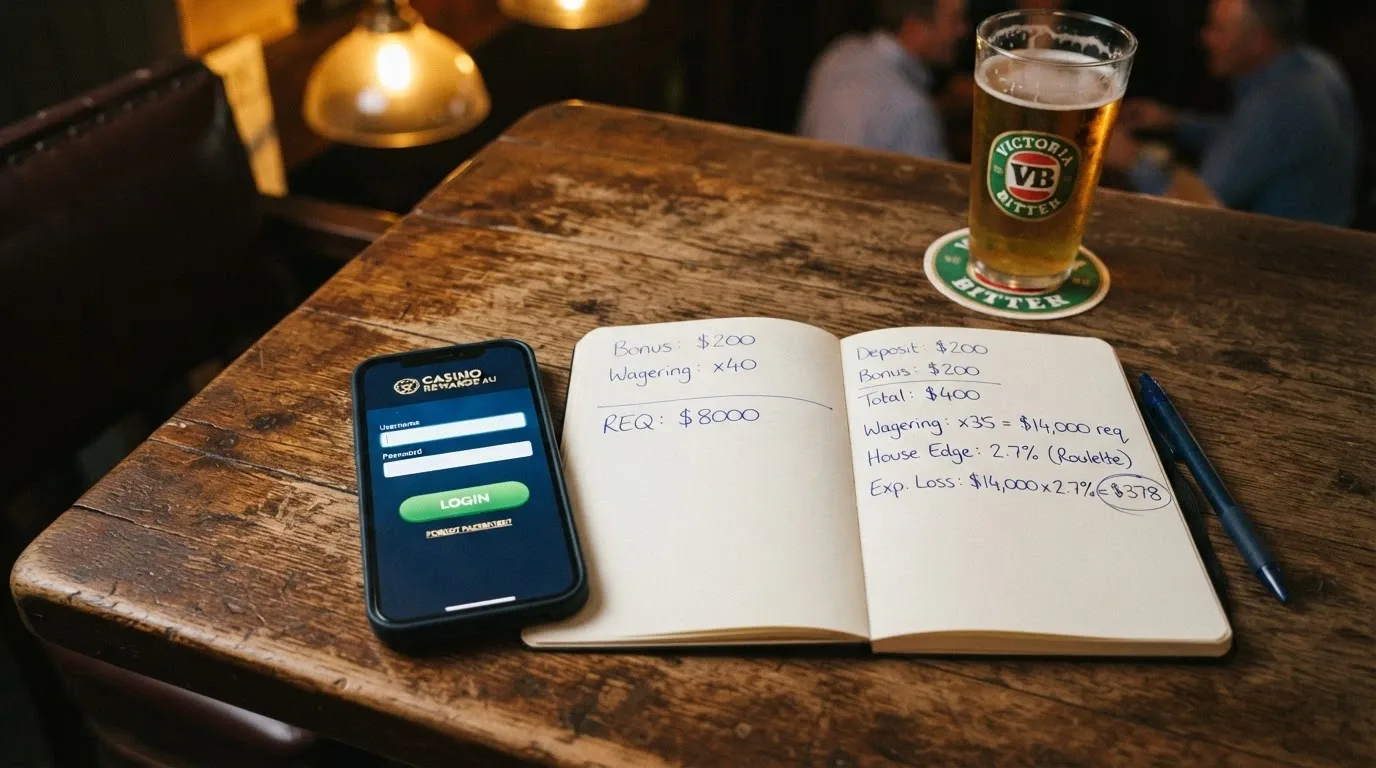
Here is the worked example: a player claims the maximum bonus across all three deposits, taking A$2,500 in bonus money. At 35x wagering on the bonus only, the required turnover is A$87,500 (A$2,500 × 35). At a A$5 per-spin stake and an average RTP of 96.4%, the expected loss on that turnover is A$3,150 (A$87,500 × 3.6% house edge). The player is mathematically paying A$650 more than the bonus they claimed to clear it, and the house edge is doing that work — not the bonus, not the wagering multiple, but the underlying math of slots at 96.4% over 17,500 spins.
This is not a scam. It is the structure. Every offshore welcome bonus carries this arithmetic, and the band of expected loss runs from a few hundred dollars on a small bonus to several thousand on a heavy one. The 50 free spins at A$0.20 each add A$10 in headline value, which the same math discounts to roughly A$0.36 in expected retention — the spins are a sampler, not a meaningful component.
Welcome bonuses: the big numbers, broken down
Royal Reels’ A$2,500 headline is a three-deposit match that tops out only if a player deposits A$500, A$1,000 and A$1,250 across the three deposits respectively. SkyCrown’s A$8,000 is a four-tier package of similar shape. Vave’s 4 BTC headline is the same structure denominated in Bitcoin rather than Australian dollars. In every case, the headline is a ceiling, not a default — most depositors claim a fraction of the headline on a single deposit and never come back for the later tiers.
A deposit of A$200 at a 100% match claims A$200 in bonus money. A deposit of A$500 claims the maximum first-deposit match of A$500 at Royal Reels. The gap between a typical deposit and the headline ceiling is the difference between a clearable bonus and a structural one. The bonus is sized for a player willing to deposit four or five thousand dollars across multiple deposits; for everyone else, the headline is aspirational.
Caswino’s 600% match up to A$15,000 plus 255 free spins across four deposits is the heaviest welcome figure on this page. A percentage that high with a cap that high almost always carries a wagering multiple at the heavier end of the market, and the math is the same shape as the Royal Reels example above. DeeSpin’s 150% match plus 150 free spins at 35x wagering is a lighter package with a cleaner cost profile. The band is wide, and the reader’s deposit size dictates which band the bonus actually lands in.
Free spins and no-deposit offers: the fine print that shrinks the value
A free-spin batch of 50 spins at A$0.20 each is worth A$10 in headline value before any math. The Royal Reels offer is precisely that: 50 spins at A$0.20, totalling A$10. After the 96.4% RTP drag, the expected retention from those spins is roughly A$3.60, and the headline-to-value gap is what the operator’s marketing conceals. SkyCrown’s 400 free spins carry a per-spin value that was not confirmed in the research available this run, which is itself a signal: when the operator does not publish the stake size on the bonus, the reader is being asked to read the terms page carefully.
No-deposit offers sit further down the value scale. 7Bit’s 30 free spins on Deep Sea carry a maximum win cap of A$50, a maximum bet of A$0.15 per spin, and a 3-day validity window — three restrictions that compound. The crypto no-deposit band is similar: 20 to 50 free spins, 50x to 60x wagering, a cashout cap of around 0.01 BTC, and a validity window short enough that most players clear a fraction of the wagering before the bonus expires. The offers are not worthless, but they are closer to a free demo than to a path to a withdrawal.
Wagering, caps and the real cost of clearing your bonus
The wagering band across this set runs from 30x to 60x on the bonus amount. Royal Reels’ 35x is at the lighter end. SkyCrown and Rocket Play sit at 40x. Crypto no-deposit offers run 50x to 60x. The difference between 35x and 60x is the difference between clearing a bonus in a manageable number of sessions and clearing one that requires either a large bankroll or a per-spin cap high enough to make the volume realistic.
Royal Reels’ A$5 per-spin cap is the friendliest ceiling on this page: at 35x wagering on A$2,500 of bonus, the player runs 17,500 spins at A$5 each. At five seconds per spin, that is roughly 24 hours of continuous play — a long session, but a finite one. The same math at a A$0.20 stake runs to 437,500 spins and is structurally un-clearable for a casual player. The cap is what makes the bonus practically playable, and it is also what limits the upside: a player cannot chase a large win during the clear-down.
Validity windows are the silent killer. Research did not confirm the validity window for most operators this run, and offshore brands commonly set 3- to 7-day windows on heavy-wagering offers. A 60x bonus with a 3-day window is mathematically un-clearable for a player who cannot run 1,000+ spins a day. Treat the validity window as a term to read directly from the operator’s own terms page before claiming any welcome offer on this list.
Crypto Casino Apps: Paying With What the Law Says You Can’t
Credit cards and digital currency (crypto) are banned as payment methods for online wagering in Australia, effective 11 June 2024 under the Interactive Gambling Amendment (Credit and Other Measures) Act 2023. The penalty for an operator that fails to enforce the ban is up to A$247,500. The ban applies to AU-licensed wagering services — offshore casinos are not covered by it because they are not licensed here. So an Australian punter who opens a crypto casino app and deposits Bitcoin is being served by an operator outside Australian rules, and the payment method is itself a tell: a site asking for credit card or crypto from an Australian user is, by definition, not an AU-licensed operator.
Vave’s 4 BTC welcome package denominates the bonus in Bitcoin, which means the dollar value of the bonus moves with the BTC/AUD exchange rate. A punter who deposits when BTC is at A$100,000 gets a different headline than a punter who deposits at A$80,000 — same Bitcoin amount, different Australian dollar value. The 20 USDT minimum deposit is the floor, not the ceiling. For a punter running a crypto wallet, Vave is structurally designed around the assumption that the player holds coins rather than AUD.
The deeper risk is structural rather than arithmetic. A crypto deposit to an unlicensed offshore operator is unrecoverable: there is no chargeback mechanism, no ATO complaint path, no Australian consumer law that covers the transaction. From 1 January 2027, banks and payment providers gain express authority to block transactions to illegal gambling operators, which means a fiat deposit to an offshore casino may become harder to route through a bank even before the operator refuses a withdrawal. The crypto route sidesteps that gate. It also sidesteps the protections a fiat deposit would carry.
The Apps That Actually Pay Out — and the Catch
Payouts are where an offshore casino shows what it is. PayID has become the dominant deposit rail for Australian-facing operators, with deposits clearing in under 90 seconds at Royal Reels and 30 seconds to 2 minutes across other tests. Withdrawals through PayID run roughly 15 to 60 minutes after a completed identity check — slower than deposits because the KYC process adds a step, but faster than the bank-transfer alternative. SkyCrown’s bank-transfer withdrawals clear within 3 days from a A$100 minimum. Bizzo’s e-wallet and card withdrawals run 24 to 48 hours. Top-rated sites process e-wallet withdrawals in under 24 hours with monthly caps up to A$20,000.
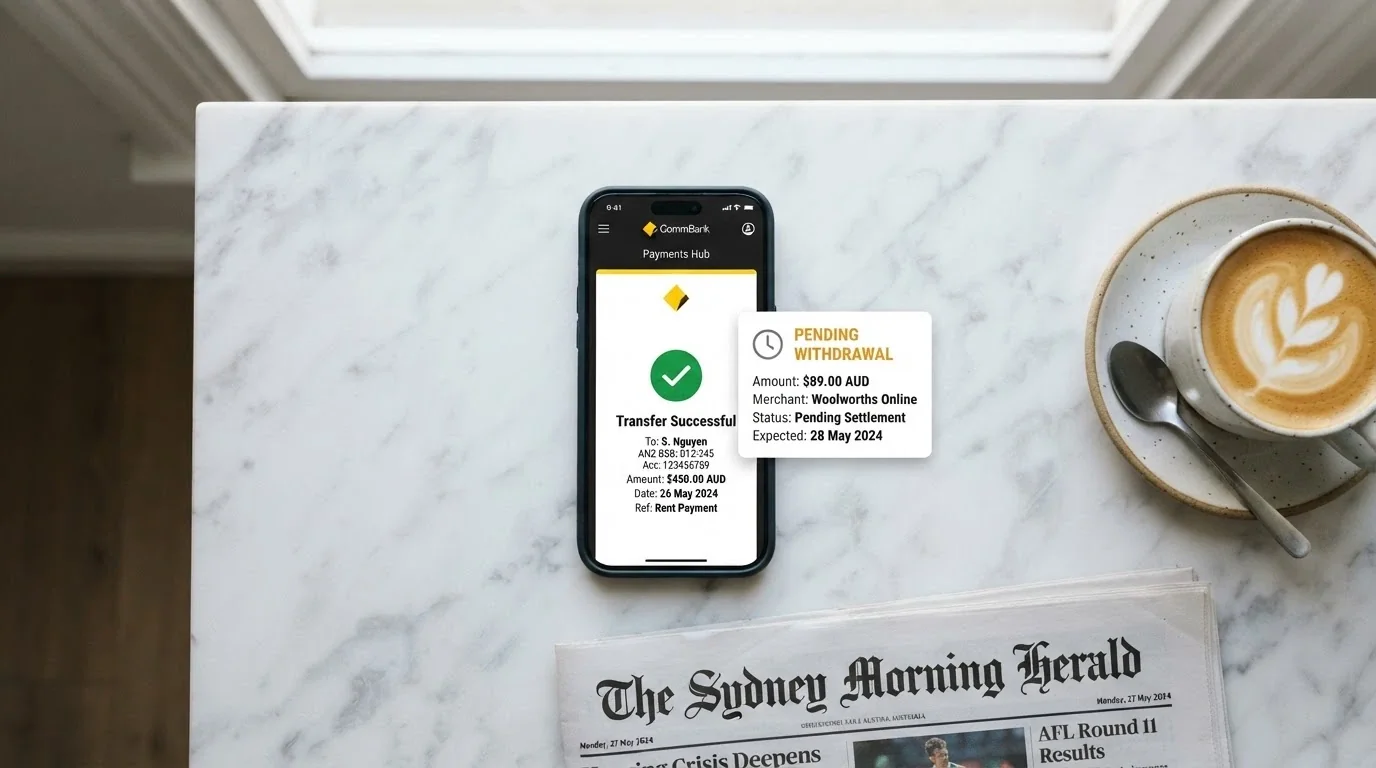
Rainbet’s A$15 minimum withdrawal is the lowest in this set. Royal Reels and SkyCrown sit higher. The minimum matters for a player who plays small and wants to test the payout rail before committing a larger bankroll. A casino that processes a A$15 withdrawal cleanly is more likely to process a A$1,500 withdrawal cleanly. A casino that delays the small withdrawal is signalling something.
PayID, bank transfer and the deposit-to-withdrawal loop
How money moves in and out at an offshore casino is structured around the deposit method. A PayID deposit typically routes back through PayID on withdrawal, with the identity check (KYC) sitting between request and arrival. A bank-transfer deposit typically routes back through bank transfer, with the slower rail and the higher minimum. Crypto deposits route back through crypto, with no KYC gate but also no chargeback option. The deposit method often dictates the withdrawal path before the player makes a deposit.
Identity verification is the universal gate. No withdrawal processes without a completed KYC check, and the time the check adds is often longer than the payment rail itself. A player who deposits through PayID and requests a withdrawal within an hour of signing up will wait for the KYC review before the PayID payout begins. A player who has verified their identity in advance — most operators let a player upload documents at signup — moves through the gate faster.
When an offshore casino refuses to pay: the recourse you don’t have
There is no Australian consumer protection that covers an offshore gambling contract. The ACMA enforces the prohibition by blocking sites and pursuing providers — it does not recover player funds. There is no Australian financial ombudsman that handles offshore gambling disputes. A Curacao or Anjouan regulator exists in theory, but neither offers the powers or accessibility of an Australian statutory body. A player who is denied a withdrawal from an offshore casino has, as a practical matter, the operator’s own complaints procedure and, in theory, the offshore regulator — with no guarantee of outcome from either.
The blocking risk compounds the problem. The ACMA has had 1,564 illegal gambling and affiliate websites blocked by Australian ISPs since November 2019, and more than 225 illegal services have withdrawn from the Australian market since 2017. A player whose balance sits on a blocked site cannot reach the operator to request a withdrawal. The balance is, for practical purposes, gone.
Free Casino Apps: The Demo Mode That Keeps You Playing
Free casino apps split into two categories, and the distinction matters. The first is the demo mode inside a real-money offshore casino — the same pokies, played with virtual credits, no cashouts possible. Royal Reels, SkyCrown and the rest of the set run demo mode as a sales tool: a player learns the mechanics of a pokie without risking money, and the transition from demo to real-money deposit is one button away. Demo mode is not a product. It is a funnel.
The second is the social casino — Heart of Vegas, Lightning Link, Slotomania and the rest. These apps operate legally as free-to-play products with in-app purchases for virtual currency. There is no real-money wagering, no cashouts, and no offshore operator behind them. They are found in the App Store and Google Play precisely because they do not offer what the law prohibits. A punter who wants a casino-style experience without the offshore route has these as the only legal option on a phone.
The line between the two is whether money moves. Demo mode in a real-money casino app does not move money, but the app exists to move it. A social casino app does not move money, and the app exists as a free-to-play product. The same screen, the same reels, the same mechanics. Different money underneath.
Australia’s Gambling Laws and the Offshore Casino Loophole
Online casino games — pokies, table games, live dealer, the full product — are prohibited in Australia under the Interactive Gambling Act 2001, strengthened by the Interactive Gambling Amendment Act 2017. There is no licence for online casino anywhere in the country, federally or in any state or territory. The Northern Territory Racing and Wagering Commission licenses wagering operators — Sportsbet, bet365, Ladbrokes and around 150 others — but wagering means pre-event race and sports betting, not casino games. The two products are governed by different laws, and the casino side of the line is closed.

The ACMA enforces the prohibition. It investigates complaints, issues formal warnings, pursues civil penalty proceedings, and directs ISPs to block illegal sites. Since November 2019, 1,564 illegal gambling and affiliate websites have been blocked (ACMA, March 2026), and more than 225 illegal services have withdrawn from the Australian market since enforcement was strengthened in 2017. The player is not prosecuted — the IGA targets the provider, not the individual — but the player also has no statutory right of recovery if an offshore operator refuses a payout, voids a win, or disappears.
The Interactive Gambling Act: what it bans, and what it doesn’t
The IGA prohibits online casino games, online pokies and in-play sports betting. It does not prohibit pre-event wagering on races and sport, lotteries, or keno — those products are licensed at the state and territory level, primarily through the Northern Territory for online bookmakers. The line in the IGA is between the product categories, not between the operators. A licensed Australian wagering operator cannot add a casino tab to its app. An offshore casino cannot offer pre-event race wagering through the same brand without falling under the wagering regime.
The enforcement model targets the provider. The maximum age is 18 for all commercial gambling. Penalties for providers flow through civil penalty proceedings and ISP blocking, not through criminal prosecution of individual players. A punter using an offshore casino app is not committing an offence — but the operator serving them is, and the enforcement mechanism (blocking, withdrawal from the market) is what shapes the operator landscape.
AU-licensed wagering vs offshore casino: what the punter actually loses
| Protection | AU-Licensed Wagering App | Offshore Casino App |
|---|---|---|
| Licence | State/territory wagering licence (NT, VIC, NSW etc.) | Offshore licence (Curacao, Anjouan) or none confirmed |
| BetStop coverage | Yes — all ~150 AU-licensed wagering services | No — offshore sites are not connected |
| ACMA recourse | Yes — regulator enforces player protections | No — ACMA targets the provider, not the dispute |
| Payment methods | Debit card, bank transfer, PayID/Osko, BPAY | Often credit card, crypto (both banned for AU wagering) |
| Advertising rules | Bound by state and federal advertising restrictions | Bound only by the offshore regulator’s rules (if any) |
| Withheld funds recovery | Possible through AU complaints bodies | No practical Australian recourse |
The two columns are not equivalent. The licensed wagering side carries every protection an Australian player has; the offshore casino side carries almost none. The middle column is what a player forfeits by opening an offshore casino app.
The 2026 reform and what changes for Australian punters in 2026
The Interactive Gambling Amendment (Gambling Reform) Bill 2026 passed Parliament on 19 August 2026. The measures commence 1 January 2027. They apply to licensed wagering operators, not to offshore casinos — which are already illegal and therefore outside the new framework. The reforms include: a cap of three wagering advertisements per hour between 6:00 am and 8:30 pm, a live-sport blackout from 15 minutes before to 5 minutes after a live event, a ban on wagering advertising inside sports venues and on player uniforms, and a prohibition on athletes, celebrities and influencers promoting wagering products. The reform also establishes AdStop, a national advertising opt-out register administered by the ACMA, and extends inducement marketing cooling-off periods: 14 days post-sign-up, three months post-BetStop deregistration, and indefinitely for at-risk customers.
The bank transaction-blocking authority, also from 1 January 2027, gives banks and payment providers express power to block transactions to illegal gambling operators. This is the closest the reform comes to affecting the offshore route directly — a fiat deposit to an offshore casino may become harder to route through an Australian bank. The crypto route remains open, structurally unaffected.
The risk in the reform is its asymmetry. Tighter rules on the licensed market, without equivalent offshore enforcement, may push more players toward offshore casinos — the only path not subject to the new advertising caps, the cooling-off periods, or the bank-blocking authority. The 1,564 sites already blocked illustrate the scale of the offshore market; the reform does not shrink it, and may inadvertently strengthen it by making the licensed product less competitive on attention and bonus terms.
Where to Get Help When the App Won’t Stop
The responsible-gambling infrastructure in Australia is built around licensed wagering, and the gap it leaves is the offshore route.

The National Gambling Helpline is 1800 858 858 — free, confidential, staffed 24 hours a day, 7 days a week. Online chat and counselling are available through Gambling Help Online (gamblinghelponline.org.au). The service covers all gambling harm, including offshore casino use, and is the first call for anyone who feels their play has moved past their control.
BetStop, the National Self-Exclusion Register, went live on 21 August 2023. One registration excludes a person from every Australian-licensed online and phone wagering service in a single step. As at 31 July 2026, BetStop had 67,480 registrations, of which 41,290 exclusions were still active — more than 60% of everyone who ever registered, which is the retention rate that tells you how many people come back and how many stay away. 78% of registrants were under 40; 38% chose lifetime exclusion. Self-exclusion runs from a minimum of three months to a lifetime ban.
BetStop does not cover offshore casino apps. The register binds Australian-licensed wagering operators and excludes the user from each one in a single step. An offshore casino is not licensed here, is not connected to the register, and will continue accepting a self-excluded person’s money. This is the most concrete harm of the offshore route: a person who has decided to stop gambling and registered with BetStop can still open an offshore casino app and deposit the next morning.
State-based self-exclusion programs exist alongside BetStop and cover land-based venues. About 2.1% of Australian adults — roughly 430,000 people — experience problem gambling, with high-risk gambling at 1.8% per the Australian Institute of Health and Welfare’s 2022 figures. The numbers are not niche. They are the population the infrastructure exists to serve, and the offshore gap is the part the infrastructure does not reach.
How We Evaluated These Casino Apps
The ranking on this page is built from publicly available data: market-share figures from operator-traffic datasets, operator-published terms pages, independent review sites, and the ACMA public register. The ten featured operators are drawn from the brands actively serving Australian players on mobile, filtering out licensed AU wagering brands (a different product) and free-to-play social casinos (a different product again).
The evaluation framework rests on four criteria, applied qualitatively rather than as a scored rubric: licence verifiability against a public register, bonus transparency (whether the operator publishes the wagering multiple, per-spin value, and validity window), game-library depth (size and the proportion of pokies vs other categories), and payout-speed evidence (PayID, bank transfer, e-wallet, crypto rails and their timelines). Where research confirmed a figure against a primary source, the page uses it. Where research did not confirm a figure, the page says so rather than estimating.
Two operators in the set carry licences that could be verified against a public register this run: Bizzo (Curacao, Antillephone N.V., 8048/JAZ2017-067) and Rainbet (Anjouan Gaming, ALSI-152406029-FI2, valid through 13 June 2027). Five of the ten operators carry no independently confirmed licence this run. The ranking reflects the data available at the time of review. Readers should verify current terms directly with each operator before depositing, because the welcome package, the wagering requirement, and the licence status are all things that change between this page’s writing and the reader’s next session.
What Every Australian Punter Should Know Before Opening an App
The decision this page supports is the reader’s, and the page has tried to give them the numbers to make it with their eyes open. The legal reality is that no Australian-licensed online casino exists, because the licence does not exist. The bonus mathematics is that a A$2,500 welcome at 35x wagering costs roughly A$3,150 in expected losses to clear, because the house edge does the work and the bonus is the hook. The payment-method tell is that credit card and crypto requests from an Australian user are evidence the operator sits outside AU rules, because those methods are banned for AU-licensed wagering. The BetStop gap is that self-exclusion through the national register does not reach any offshore casino, because the register binds only licensed operators.
The practical steps a punter can take: verify the licence yourself against the regulator’s own register before depositing, read the wagering terms and the validity window before claiming any welcome offer, set a deposit limit on the operator’s own responsible-gambling tools, and keep the National Gambling Helpline number (1800 858 858) saved. The 1,564 sites the ACMA has blocked since November 2019, and the 67,480 BetStop registrations, are not abstract figures — they are the size of the market and the size of the demand for a way out.
The one thing this page wants the reader to remember: the Australian regulatory system was built to keep people out of these apps, and every protection it offers stops at the border. The offshore casino app on the home screen is reachable. It pays out sometimes. The protection that a licensed wagering app offers — BetStop, ACMA recourse, the payment-method ban, the advertising rules — is not there. A punter who knows that and still chooses to open the app has decided with the information the system was designed to provide. A punter who does not know that is the gap the system was designed to close.
Frequently Asked Questions
Are casino apps legal in Australia?
No. Online casino games — pokies, table games, live dealer — are prohibited under the Interactive Gambling Act 2001, and no licence for them exists federally or in any state or territory. Every casino app accessible to an Australian player is operated by an offshore brand offering an unlicensed product. The IGA targets the provider, not the individual player, so a punter is not prosecuted for using one — but no Australian consumer protection applies, no ACMA complaints body can recover funds, and the ACMA can block the site at any time with a balance still on it.
Do casino apps in Australia accept PayID deposits?
Most do. Royal Reels and several others process PayID deposits in under 90 seconds, with tests across the offshore market ranging from 30 seconds to 2 minutes. PayID withdrawals run roughly 15 to 60 minutes after a completed identity check, with the KYC review usually longer than the rail itself. PayID is the closest the offshore route comes to the speed of a licensed AU wagering app’s deposit experience, and several operators route both deposits and withdrawals through it.
What happens if an offshore casino app refuses to pay my winnings?
There is no Australian recourse. The ACMA enforces the prohibition by blocking sites and pursuing providers — it does not adjudicate player disputes. There is no Australian financial ombudsman that handles offshore gambling contracts. A Curacao or Anjouan regulator exists in theory but does not offer the powers of an Australian statutory body. The player’s practical options are the operator’s own complaints procedure and, in theory, the offshore regulator — with no guarantee of outcome from either. A refusal to pay is a risk the offshore route carries, and the protection an AU-licensed wagering app offers is not available offshore.
Can I use a credit card to deposit at a casino app in Australia?
Credit cards are banned as a payment method for online wagering in Australia, effective 11 June 2024 under the Interactive Gambling Amendment (Credit and Other Measures) Act 2023. The ban applies to AU-licensed wagering services. An offshore casino app that asks an Australian user for a credit card is operating outside AU rules — the payment method is itself a tell. Crypto deposits are banned for AU-licensed wagering under the same law, with the same implication for the offshore route. Legal deposit routes for licensed AU wagering are debit card, bank transfer, PayID/Osko and BPAY.
How does BetStop self-exclusion work, and does it cover casino apps?
BetStop, the National Self-Exclusion Register, went live on 21 August 2023. One registration excludes a person from every Australian-licensed online and phone wagering service in a single step. Self-exclusion periods run from three months to a lifetime ban. As at 31 July 2026, BetStop had 67,480 registrations, of which 41,290 were still active. BetStop does not cover offshore casino apps — the register binds Australian-licensed operators, and offshore casinos are not connected. A person who self-excludes through BetStop is blocked from licensed wagering but can still access any offshore casino app.