
The best online casinos reaching Australian players in 2026, ranked honestly
 Available in AU
Every casino on this page is illegal under Australian law. That is the first sentence, because it is also the first thing a player needs to hear before the bonus numbers start looking attractive. Online casino games, online pokies and in-play sports betting are prohibited under the Interactive Gambling Act 2001, and providing those services to a person physically in Australia is an offence. There is no licence for online casino anywhere in Australia — not federally, not in any state or territory. The operator pages on this site do not show one because no regulator issues one. The IGA targets the provider, not the player, which is why these sites remain reachable from a laptop in Brisbane or Perth. But the protections gap is real, and the bonuses are smaller than they look.

Current as of 18 October 2026, with licence claims checked against the ACMA register and operator-published terms pages.
Table of Contents
- Why your 2026 online casino isn’t really Australian
- Top 10 offshore casinos for Australian players in 2026
- Why your 2026 casino bonus is smaller than it looks
- How your deposit lands offshore — and why the payment method matters
- Your phone is a casino now — what mobile play delivers in 2026
- The law every Australian casino player should read
- The real cost of the pokies — gambling harm in Australia by the numbers
- How we selected and ranked these casinos
- What to actually do about online casino play in 2026
- Frequently asked questions
Why your 2026 online casino isn’t really Australian
The offshore landscape Australian players actually see
The search-results page for “best aussie online casino” returns affiliate review sites, a handful of offshore operators, and nothing from the Australian government. That is the shape of the market. The ACMA has had 1,564 illegal gambling and affiliate websites blocked by Australian ISPs as of March 2026, and more than 225 illegal services have withdrawn from the Australian market since enforcement was strengthened in 2017. The withdrawals are a side effect of blocking pressure, not a sign that the product has been regulated; the operators simply moved to domains the ISPs had not yet been asked to block.
No operator holds an Australian casino licence because no Australian casino licence exists. The structural fact does the work that a hundred disclaimers usually do: if the licence cannot be issued, every page ranking these sites is ranking unlicensed operators. The “Aussie-friendly” label on an affiliate page is a marketing word, not a regulatory category. What it usually means is that the operator accepts Australian dollars, processes PayID, and has not been blocked yet.
Licensed wagering vs offshore casino — a difference every punter needs to understand
A page can list SportsBet, Bet365 and TAB next to an offshore casino and the two are not comparable. Australian-licensed wagering covers pre-event sport and race betting, lotteries and keno, and is licensed primarily by the Northern Territory Racing and Wagering Commission. Offshore casino covers pokies, table games and live dealer, and is licensed (if at all) by Curacao, Tobique or the Malta Gaming Authority. The two markets share a search-results page because the search engine has no way to know which is which, and because the affiliate business model does not reward the distinction.
The distinction costs a player who gets it wrong. BetStop, the National Self-Exclusion Register, binds Australian-licensed wagering services only. An offshore casino is not connected to the register. A person who has self-excluded can still deposit, still play, and still lose at a Curacao-licensed site, and no Australian regulator can reach the operator to stop it. Consumer protection does not travel with the licence. That is the difference between the two halves of a search-results page, and it is the difference a player notices only when something goes wrong.
Top 10 offshore casinos for Australian players in 2026
The table below ranks ten offshore casinos that accept Australian players. Every one of them operates outside the Australian licensing system — the ranking is by AU-market relevance and data availability, not by regulatory standing, because no such standing exists for this product. Where research did not carry a confirmed figure, the cell shows the article-language no-data marker rather than a number. The notes beside the table cover what the data does and does not show.
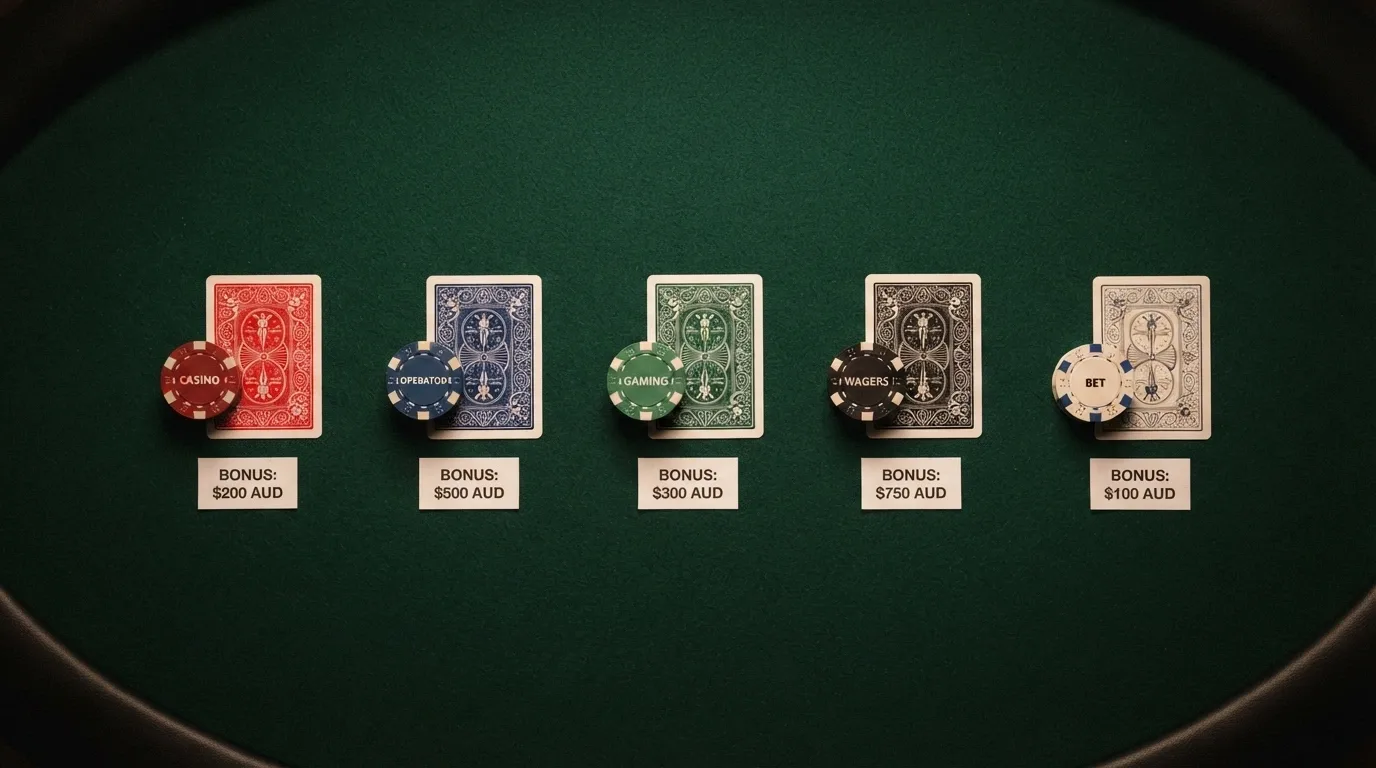
| Operator | Welcome bonus | Licence | Game providers |
|---|---|---|---|
| Rocket Play | Unbekannt | Curacao (verify on operator site) | Multiple providers (unbekannt) |
| SkyCrown | Up to A$3,000 + 350 free spins | Curacao | Multiple providers (unbekannt) |
| Royal Reels | AU$10 no-deposit + 50 free spins Friday drop | Unbekannt (verify on operator site) | 40+ providers, 5,400+ pokies |
| Stake | No traditional welcome match | Curacao (verify on operator site) | Multiple providers (unbekannt) |
| WinSpirit | Unbekannt | Unbekannt (verify on operator site) | Unbekannt |
| Rainbet | Unbekannt | Unbekannt (verify on operator site) | Unbekannt |
| Scream Casino | Unbekannt | Unbekannt (verify on operator site) | Unbekannt |
| FairGO | AU$50 free chip (no-deposit, code required) | Curacao (verify on operator site) | RTG (RealTime Gaming) |
| Bizzo Casino | A$2,500 + 300 free spins | Curacao eGaming | Evolution Gaming (live), multiple pokies providers |
| Rocket Casino | Unbekannt | Unbekannt (verify on operator site) | Unbekannt |
A reader looking at this table should notice three things at once. The first is the cluster of “unbekannt” cells — four operators (WinSpirit, Rainbet, Scream Casino, Rocket Casino) appear in the AU market but carried no confirmed data this run, so the table cannot tell you what their bonus is, who licensed them, or what they offer in the way of game providers. The second is the licence column: every “Curacao” entry should be read as a claim on the operator’s own terms page, not as a regulatory stamp. The third is that “no-deposit” appears exactly twice in the bonus column, and the same two rows carry the only “40x” wagering multiple research confirmed. The rest of the market operates on different terms, and a player comparing offers needs to read each terms page rather than the table.
Rocket Play — big-match welcome with a Curacao backbone
Rocket Play is positioned in the AU market as an operator with a welcome bonus, but the specific figure is not confirmed. The licence claim is Curacao, and that claim should be verified on the operator’s site before depositing — the research this run did not confirm the licence number, and an unverified licence is the kind of detail a player should not assume. The game provider spread is described as “multiple”, which is the bare minimum a player needs to hear. Verdict: an unverified-licence offshore operator — a player should consult the terms page directly.
SkyCrown — A$3,000 matched with 350 free spins
SkyCrown publishes one of the larger welcome bundles in the featured set: up to A$3,000 matched with 350 free spins, with a A$30 minimum deposit to qualify. The licence is Curacao. Crypto payouts are stated at 0–24 hours, which is the fast end of the crypto withdrawal range research confirmed. A player looking at SkyCrown is looking at a published offer rather than a market estimate, which is the more useful starting point. The 350 free spins are typically split across the first few deposits, and the 30x–50x wagering band that dominates the no-deposit market also dominates the free-spin component of a deposit welcome. The welcome figure is a ceiling, not a floor — a player depositing the A$30 minimum receives the match percentage on A$30, not on A$3,000. Verdict: one of the more transparent offers in the set, and the A$30 entry point keeps the minimum deposit low for a player testing the platform.
Royal Reels — no-deposit entry and 5,400+ pokies under one roof
Royal Reels is the only featured operator with a published no-deposit bonus: a AU$10 bonus after phone verification, before any deposit is made. The pokies library is the largest in the featured set, at 5,400+ titles from 40+ software providers, which is a real breadth point for a player who has a particular studio in mind. A 50 free spins rotating Friday drop carries 40x wagering and a A$100 max cashout on Sweet Bonanza, which is a concrete example of what a no-deposit-style free-spin offer looks like once the terms are applied. Withdrawals are described as instant for crypto and PayID, which is the best of both payment worlds. The licence was not confirmed this run and should be verified on the operator’s site. Verdict: the no-deposit entry point and the 5,400+ pokies library are the genuine differentiators; the wagering terms on the free spins are the kind a player should read before claiming.
Stake — crypto-only play with no traditional welcome bonus
Stake runs a crypto-only platform, which is the first signal that the operator sits outside Australian rules — credit cards and crypto are banned as payment for licensed Australian wagering since 11 June 2024. There is no conventional deposit-match welcome offer; the platform is built around ongoing promotions, a sportsbook, and a casino product that does not chase the welcome-bonus reader. The Curacao licence is unconfirmed this run and should be verified on the operator’s site. Stake’s offshore casino is distinct from the Australian-licensed sports-wagering entity that some readers may already know by name, and the two should not be conflated. Verdict: the right fit for a crypto-comfortable player who does not want a traditional welcome structure; a poor fit for anyone whose first question is “what is the sign-up bonus”.
WinSpirit — an AU-facing operator to verify
WinSpirit appears in the AU-market rankings carried by affiliate pages, but the specific welcome offer, licence jurisdiction and game provider spread were not confirmed this run. A player considering WinSpirit should treat the operator’s own terms page as the source of truth, rather than relying on a third-party ranking. What is known is the slot in the AU market: the operator reaches Australian players, accepts deposits, and is treated by affiliate reviewers as part of the offshore cohort. A reader who wants to compare on a like-for-like basis is comparing on data that the page does not have, and that asymmetry is itself the answer. Verdict: a presence in the AU market, a confirmation step the reader has to do themselves.
Rainbet — an AU-facing operator to verify
Rainbet ranks in the AU market by affiliate-page presence, and the same data gap applies here as for the other “verify” operators: bonus, licence and game-provider figures were not confirmed in this research cycle. A player evaluating Rainbet is evaluating a brand the page cannot characterise beyond its reach into Australia. The honest treatment is to name the operator, note the absence of confirmed figures, and direct the reader to the operator’s own published terms. A page that padded this block with imagined details would be writing fiction, and a reader who treats the operator’s own site as the only reliable source is reading more carefully than the page that skips the verification step. Verdict: same shape as WinSpirit — present, unconfirmed, the reader’s verification step.
Scream Casino — an AU-facing operator to verify
Scream Casino appears in AU-market listings and carries the same verification problem: specific terms, licence jurisdiction and game provider spread were not confirmed in research. A reader who reaches this block in the page is not being given a comparison point; they are being told the operator exists in the AU market and that the terms need to be read at source. The honest comparison point is the operators above and below it in the ranking, where research carried data. A player weighing Scream against SkyCrown or Royal Reels has more to weigh on either side than on this one, and that asymmetry is the editorial reason the “verify” operators sit where they do in the ranking. Verdict: a place in the ranking by market presence, not by data.
FairGO — the AU$50 free-chip entry point for RTG pokies fans
FairGO opens with an AU$50 free chip no-deposit bonus, which is the largest no-deposit entry in the featured set and the most generous by raw dollar value. The terms include a bonus code, which a player needs to enter at the right step; the code itself is not the editorial point, the offer value and the eligible games are. The signature software provider is RTG (RealTime Gaming), which is a single-studio catalogue rather than a multi-provider platform — a player who likes RTG’s specific pokies will be at home, a player who wants Evolution live dealer or a 40-provider library is in the wrong place. The Curacao licence is unconfirmed this run and should be verified on the operator’s site. Verdict: the right fit for a player who wants a real-dollar no-deposit entry and a single-studio catalogue; the wrong fit for a player who wants live dealer and a 5,000-pokie library.
Bizzo Casino — A$2,500 matched with published 30x wagering terms
Bizzo publishes a A$2,500 + 300 free spins welcome package with a stated 30x wagering requirement, and that combination is the most quotable in the featured set. The 30x figure is on the lower end of the market’s typical 30x–50x range, and the wagering multiple is the kind of detail a player can actually use to cost the offer (the section below works through the arithmetic). The licence is Curacao eGaming. Evolution Gaming provides the live dealer, and the pokies catalogue runs across multiple studios. The free-spin component of 300 spins will carry its own wagering terms, typically higher than the cash bonus multiple, and a player should expect to find those in the bonus terms rather than in the headline. Verdict: the clearest welcome in the featured set to cost against the wagering terms, and the operator a player should benchmark the others against.
Rocket Casino — an AU-facing operator to verify
Rocket Casino is the tenth operator in the ranking, present in AU-market listings and unconfirmed on the specific terms. The pattern is the same as the other “verify” operators: the operator reaches Australian players, but bonus, licence and game provider data was not carried in research. A reader comparing the ten-row table will see the asymmetry the table was built to disclose, and the honest reading of that asymmetry is that four of the ten operators in the page’s own ranking carry no data the page can stand behind. Verdict: present, unconfirmed, and the verification step the reader takes on the operator’s own terms page is the load-bearing one.
Why your 2026 casino bonus is smaller than it looks
Welcome and sign-up bonuses — what the headline number hides
A welcome bonus is a match percentage on a deposit, up to a ceiling, with a wagering multiple attached. The headline says “up to A$3,000”, and the player reading only the headline hears A$3,000. The match percentage — 100% in the SkyCrown case, 100% in the Bizzo case — is what determines what a player actually receives: 100% of a A$30 minimum deposit at SkyCrown is A$30, not A$3,000. The ceiling is the maximum the operator will match, and the minimum deposit floor is the smallest deposit that qualifies. A player who deposits A$30 at SkyCrown receives a A$30 bonus; a player who deposits A$3,000 receives a A$3,000 bonus. The headline figure is a ceiling, and a minimum-deposit player sees a fraction of it.
The gap between the advertised cap and what a minimum-deposit player receives is the kind of detail that changes a comparison. SkyCrown’s A$3,000 is reachable, but only at a deposit size most casual players will not make. Bizzo’s A$2,500 is the same shape. The two operators are best read against their wagering multiples rather than their headline figures, because the headline is set by the deposit and the ceiling, and the wagering multiple is set by the operator. A 30x multiple on A$30 is A$900 in turnover; a 30x multiple on A$3,000 is A$90,000 in turnover. The same multiple on a different deposit is a different job.
No-deposit bonuses, free chips and free spins — free but never costless
The no-deposit offer sits in a different category from the welcome match, because no deposit is required. A player receives a free chip (Royal Reels’ A$10, FairGO’s AU$50) or a bundle of free spins (typically 20 to 100 across the market, with 30x to 50x wagering) and the bonus is credited before any money moves. The “free” in “no-deposit” is the marketing word, and the wagering multiple, the maximum cashout cap and the eligible-title restriction are what the bonus actually costs. A no-deposit bonus is not a gift; it is a small stake with strings attached.
The Royal Reels 50 free spins Friday drop is a useful worked example. The spins land on Sweet Bonanza, the wagering multiple is 40x, and the maximum cashout is A$100. A player who wins A$200 from the spins on a sticky-bonus basis cannot withdraw A$200 — the cap is A$100. A player who wins A$50 and clears the 40x wagering can withdraw A$50 if it survives the cap. The arithmetic is in the terms page, not in the marketing banner, and a player who reads the banner alone is reading the wrong number. The Australian no-deposit bonus market in 2026 is mostly free-spin based, with 20 to 100 spins and wagering of 30x to 50x; the cash-chip no-deposit offers are rarer, and FairGO’s AU$50 is one of the larger examples.
A bonus cleared at 40x on a small win still loses money on average, because the wagering is done on real-money play at the casino’s house edge. The expected loss is a function of the turnover and the RTP of the eligible game, and it is the number a player should compare against the bonus value before claiming. A free chip of AU$50 at 40x wagering demands A$2,000 of turnover; at a 96% RTP that is an expected loss of A$80. A player who has won AU$50 from a no-deposit chip and clears the wagering has paid A$80 in expected loss to extract AU$50 in cash. The promotion has cost money to clear, which is the structural feature of every no-deposit offer on the market.
Wagering requirements — the multiplier that shrinks every bonus
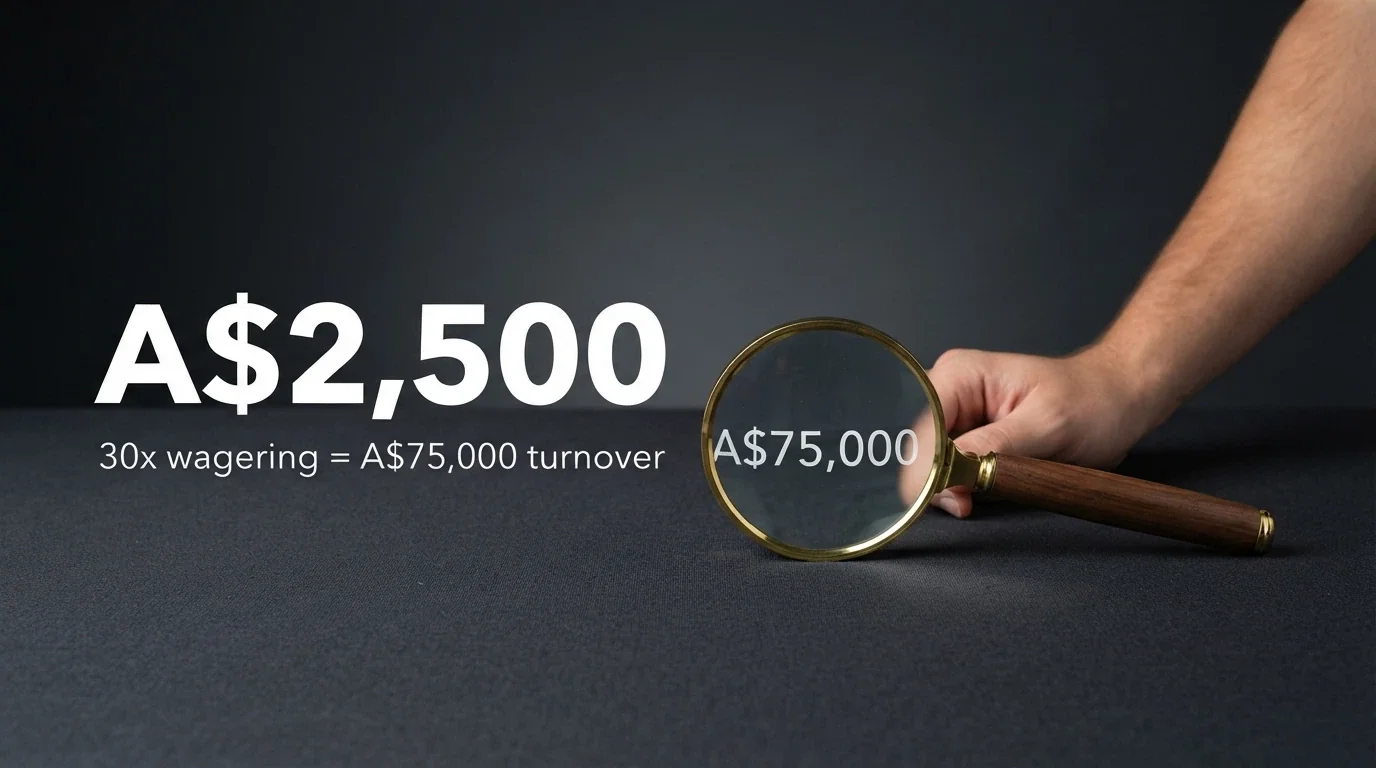
A wagering multiple is a turnover requirement: bonus × multiple = total turnover required before the bonus and any winnings attached to it can be withdrawn. Bizzo’s 30x on a A$2,500 bonus is A$75,000 of turnover; Royal Reels’ 40x on the free spins is 40 times the value of the free-spin winnings. The multiplier is the load-bearing number on the bonus terms page, and every other figure on the page either feeds into it or is constrained by it. The smaller the bonus, the smaller the turnover, and the smaller the expected cost. The larger the bonus, the larger the turnover, and the larger the expected cost. A higher multiple on a smaller bonus can cost more than a lower multiple on a larger one, because the multiplier is applied to the bonus, not to the deposit.
The RTP — return to player — is the second number that matters. Top-rated pokies reach up to 98% RTP, with 96%+ considered good and 97%+ considered high. A turnover of A$75,000 at 96% RTP carries an expected loss of A$3,000 (turnover × 1 − RTP), and that is the average cost of clearing the bonus. The bonus itself is A$2,500; the expected cost of clearing it is A$3,000. The bonus is negative-EV at clearance, and a player who treats it as free money is treating the wrong transaction. The wagering multiple is the operator’s edge, and the RTP is the game’s edge; together they determine the average cost of a cleared bonus.
The practical order goes like this. The player deposits, the bonus is credited, the player wagers the bonus amount (and usually the deposit amount as well, depending on the structure) until turnover reaches the required figure, and then the remaining balance is withdrawable. The expected loss over that turnover is what the bonus costs the player, and a bonus whose expected loss is larger than its face value is a bonus the player should not claim. The wagering multiple is the single best signal a player has for whether the offer is worth the time, and a player who reads only the headline figure is reading the wrong number.
How your deposit lands offshore — and why the payment method matters
| Method | Deposit speed | Withdrawal speed | Typical minimum | Typical maximum | Legal signal under AU rules |
|---|---|---|---|---|---|
| PayID | Under 60 seconds | 1–4 hours | A$10 | A$5,000–A$10,000 per transaction | Permitted (debit-style, not credit or crypto) |
| Crypto (USDT TRC-20, BTC, ETH) | Minutes | Under 15 minutes (USDT TRC-20) | Varies by operator | Varies by operator | Banned for licensed AU wagering since 11 June 2024 — acceptance is a signal the operator is outside AU rules |
PayID and crypto are the two deposit methods that dominate the AU offshore market in 2026, and they are not equivalent. PayID is a debit-style rails tied to an Australian bank account, and the bank sits one step away from the operator. Crypto is a value transfer that bypasses the bank entirely, and the operator receives it from a wallet rather than from a transaction. The two methods differ in speed, in regulatory treatment, and in what their acceptance signals about the operator. A player choosing between them is choosing between a familiar rails and a fast one, and the choice has a legal signal attached that a player should weigh.
PayID — seconds in, hours out
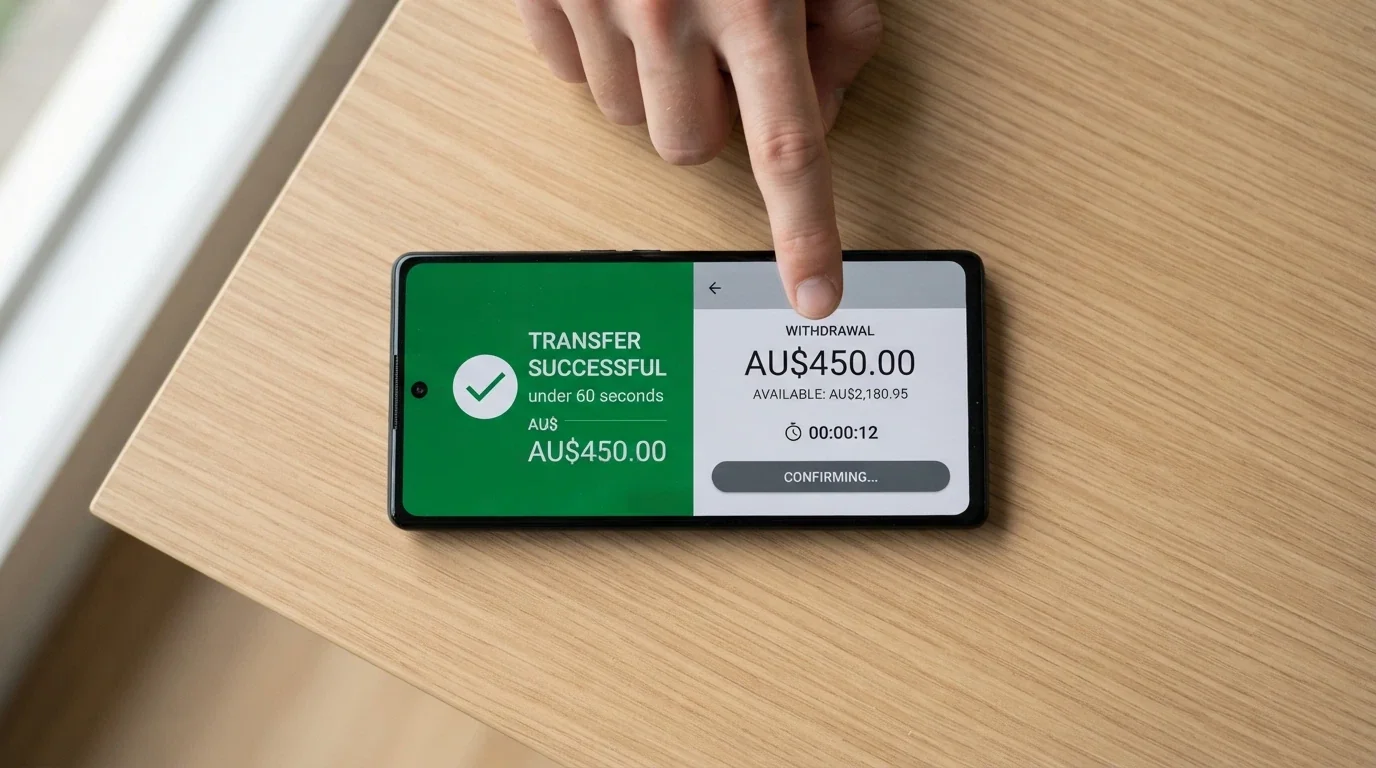
PayID is the fastest deposit method for Australian players at offshore casinos, and the most familiar. A PayID deposit settles in under 60 seconds at most operators, with a A$10 minimum and a A$5,000–A$10,000 maximum per transaction. The withdrawal side is slower: 1 to 4 hours is the typical window, which is the difference between a deposit that lands before a player has put the phone down and a withdrawal that needs a tea break. The speed is not a regulatory stamp; PayID acceptance tells a player the operator has set up Australian payment rails, not that the operator is licensed in Australia. Royal Reels, among the featured operators, is described as offering instant PayID withdrawals, which is the fast end of the PayID range.
A player treating PayID as a sign of regulatory standing is reading the wrong signal. PayID is a payment rail, not a licence, and an offshore casino can configure it the same way an Australian plumber can. The acceptance is a convenience, and the licence column of the table above is the regulatory signal — and every entry in that column is “Curacao” or “verify on operator site”, not “Australian regulator”. The fastest deposit in the world is still being made to an operator that is illegal under the IGA.
Crypto payments — speed, anonymity and the legal signal most players miss
Crypto withdrawals at offshore casinos can clear in under 15 minutes for USDT TRC-20, which is faster than PayID at the withdrawal step. The speed is genuine, and the convenience is real. Crypto deposits and withdrawals have grown to about 22% of total AU pokies volume in 2026, which is a market share figure that says the method is no longer niche. The acceptance is also a legal signal that most players miss, and it is the signal a player should weigh most heavily.
Credit cards, credit-related products and digital currency are banned as payment for licensed online wagering in Australia, commencing 11 June 2024 under the Interactive Gambling Amendment (Credit and Other Measures) Act 2023. An operator that fails to enforce the ban faces penalties of up to A$247,500. A site that accepts crypto from an Australian player is operating outside Australian rules, by definition — the licensed Australian wagering operators cannot accept crypto, and the offshore operators can. From 1 January 2027, banks and payment providers gain express authority to block transactions to illegal gambling operators, which means a crypto-accepting site will not be reachable through a bank-blocked transaction but is still reachable through a direct crypto transfer. The legal signal is that the operator is offshore, and the protection gap is that no Australian regulator can reach the operator when something goes wrong.
How fast you’ll actually get paid — payout speed compared
“Instant withdrawal” is a marketing claim, and the tested figures range from under 1 hour to over 5 hours for crypto, and 1 to 4 hours for PayID. The data the research carried is a market range rather than a per-operator benchmark for every featured brand. What is known:
- Wild Fortune tested 5h 24m average crypto withdrawal, with 3,800+ pokies and 0x wagering on 250 welcome free spins — a market benchmark, not a featured operator.
- Bitstarz tested 4h 18m average crypto withdrawal — a market benchmark, not a featured operator.
- PayID withdrawals sit in a 1–4 hour window at most operators.
- USDT TRC-20 can clear in under 15 minutes at the fast end.
- Royal Reels describes instant crypto and PayID withdrawals.
- SkyCrown states 0–24 hours for crypto payouts.
The variation between “under 15 minutes” and “24 hours” is the difference between two operators, both of which are offshore, both of which accept Australian players. A player who needs certainty about payout time should test with a small withdrawal before committing to a larger balance, because the headline figure is set by the operator and the experience is set by the verification and the rails.
Your phone is a casino now — what mobile play delivers in 2026
More than half of Australians who gamble now mainly participate online — 56.1% of individuals who gambled in the past 12 months, up substantially from the share a decade ago. The mobile experience is the default, and the laptop is the secondary screen. Offshore casinos reach the mobile market through mobile-optimised browser play rather than through dedicated apps, because the Apple App Store and Google Play restrict real-money casino apps in jurisdictions where the product is regulated or prohibited. A player who downloads an app from an offshore operator is typically downloading a .apk file direct from the operator rather than from a store, and the installation is the player’s responsibility rather than a platform’s.

The mobile experience is best judged against the games rather than the app: pokies translate well to portrait and landscape, live dealer games need a stable connection and a landscape orientation, and the cashier flow is the part of the mobile experience that most often goes wrong. A player testing a mobile casino for the first time is testing the cashier as much as the pokies, because a deposit that lands in under 60 seconds and a withdrawal that clears in 1 to 4 hours is the experience the marketing language describes, and the experience a player actually has is the test.
The law every Australian casino player should read
The Interactive Gambling Act 2001 — what it bans and who it targets
The IGA prohibits the provider, not the player. Online casino games, online pokies and in-play sports betting are prohibited, and providing such services to a person in Australia is an offence. The Act was strengthened in 2017, and the ACMA’s enforcement record since then is 1,564 illegal gambling and affiliate websites blocked by Australian ISPs (as of March 2026) and more than 225 illegal services withdrawn from the Australian market. The enforcement is provider-targeted: the ACMA blocks sites, refers cases, and works with ISPs, but it does not prosecute individual players. A player who has deposited at an offshore casino has not committed an offence under the IGA; the operator has.
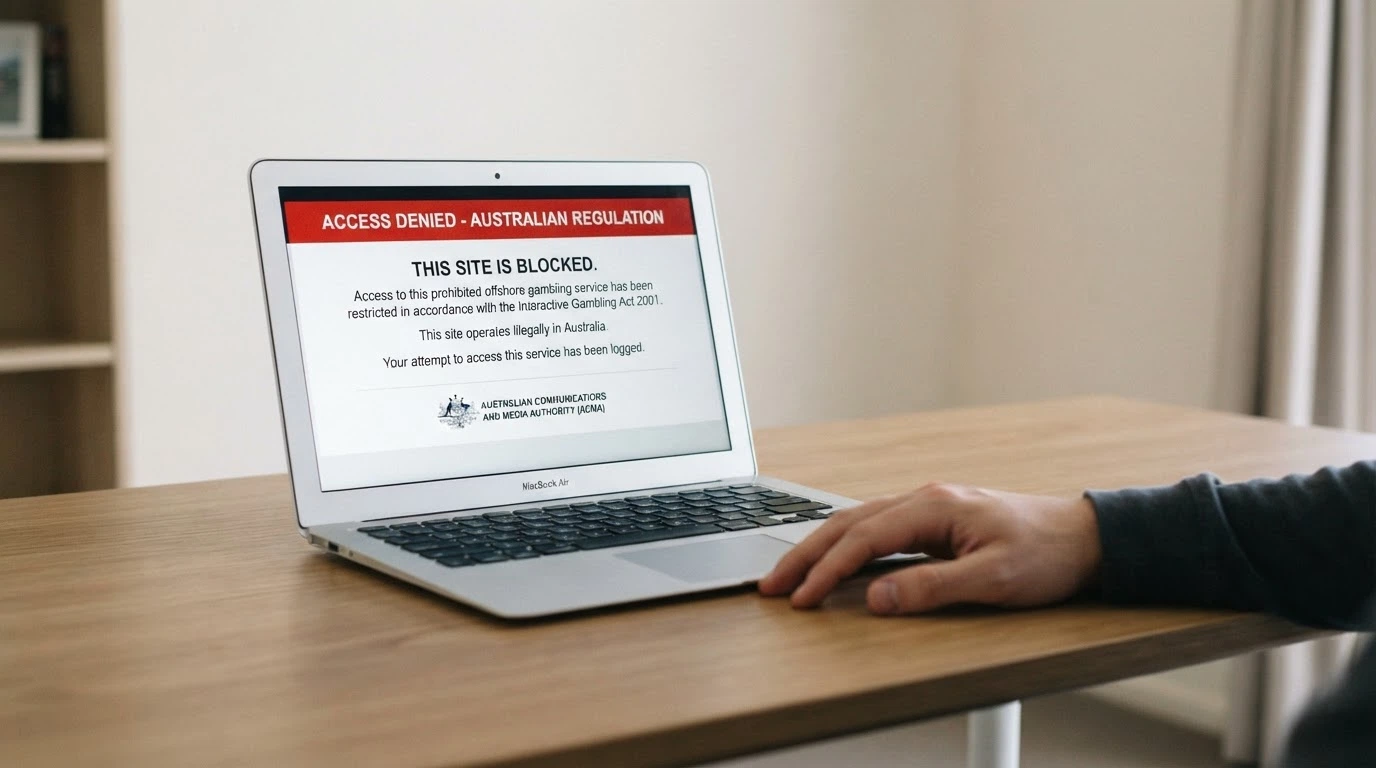
The structural fact is the load-bearing one: there is no licence for online casino anywhere in Australia — not federally, not in any state or territory. The IGA is not a law that an operator can apply for a permit under, because no regulator issues the permit. The prohibition is the regulatory position, and the offshore operators are illegal by virtue of providing the service, not by virtue of failing to apply for a licence that does not exist. The individual player is not prosecuted, the ACMA cannot recover money on a player’s behalf, and a site can be blocked with player balances remaining on it. The protections gap is the price of the market the page is describing.
The 2026 reform — what changes from 1 January 2027
The Interactive Gambling Amendment (Gambling Reform) Bill 2026 passed Parliament on 19 August 2026; its measures commence on 1 January 2027. The reform does not legalise online casino — online casino remains prohibited — but it reshapes the environment around licensed wagering. Key provisions:
- Advertising cap: no more than three wagering ads per hour between 6:00 am and 8:30 pm, with a live-sport blackout from 15 minutes before until 5 minutes after a live sporting event.
- AdStop: a national wagering advertising opt-out register administered by the ACMA, similar in concept to the Do Not Call register.
- Inducement restrictions: direct marketing of inducements is prohibited for 14 days after a customer signs up, for three months after a person deregisters from BetStop, and indefinitely for customers identified as at risk of gambling-related harm.
- Promotion restrictions: athletes, celebrities and influencers are barred from promoting wagering products, and wagering ads on uniforms of players and officials are banned outright.
- Payment blocking: from 1 January 2027, banks and payment providers gain express authority to block transactions to illegal gambling operators.
- Cost recovery: the ACMA’s costs of administering the reform measures are recovered via a levy on licensed interactive wagering service providers.
The payment-blocking provision is the one that touches the offshore market most directly. A player who deposits by PayID is making a bank-mediated transaction, and the bank has authority from 1 January 2027 to block the transaction. A player who deposits by crypto is making a transfer that bypasses the bank, and the authority does not reach it. The reform tightens the licensed market, restricts the licensed operators’ ability to advertise and induce, and gives the banks a tool to choke off bank-mediated payments to unlicensed operators. The crypto gap is the channel the offshore market will continue to use, and the crypto-acceptance signal on an offshore site is, post-reform as well as pre-reform, proof that the operator sits outside the regime.
Offshore casinos and your legal position as a player
The player is not the target of the IGA. That is the only piece of good news in this section, and it is the part most offshore-casino pages leave unsaid. The IGA targets the provider, the ACMA enforces against the provider, and the individual player is not prosecuted for depositing at a Curacao-licensed site. But that is the beginning of the legal analysis, not the end. What the player gives up by playing offshore is the set of protections that come with an Australian licence: no BetStop coverage, no Australian consumer protection, no complaints body to approach, no ACMA recourse to recover funds if the operator refuses a withdrawal or voids a win, and the structural risk that the site can be blocked with the player’s balance remaining on it.
A payment tells its own story. Credit cards and crypto are banned for licensed AU wagering since 11 June 2024, and a site that asks for either is by definition outside Australian rules. The acceptance is not a feature; it is a sign. The site is not licensed in Australia, the site is not subject to Australian consumer law, and the site can vanish or be blocked without notice. A player who weighs the bonus against this risk is reading the page the way it is meant to be read, and a player who treats the bonus alone as the comparison is reading the wrong number. The legal position of an offshore player is the position the rest of this page is built around: an unlicensed product, an unregulable operator, and a player without recourse if something goes wrong.
The real cost of the pokies — gambling harm in Australia by the numbers
Between March 2025 and March 2026, Australians lost A$36.0 billion to gambling. The figure is from The Australia Institute and it is the most-cited number in any harm data summary, because it is the only one that puts a dollar value on the year. Behind it, the prevalence data tells the same story in different units: an estimated 1,970,000 Australian adults are classified as at-risk or problem gambling; approximately 2.1% of adults (roughly 430,000 people) experience problem gambling; 2.9% of the adult population (an estimated 622,000 people) have serious gambling problems at PGSI 3+; and 15.1% of the adult population, an estimated 3,320,000 people, are experiencing some form of gambling harm from their own or others’ gambling. The model estimates approximately 3.29 million Australians aged 5 and over are affected annually by their own or another person’s gambling, including approximately 1.38 million adult affected others.
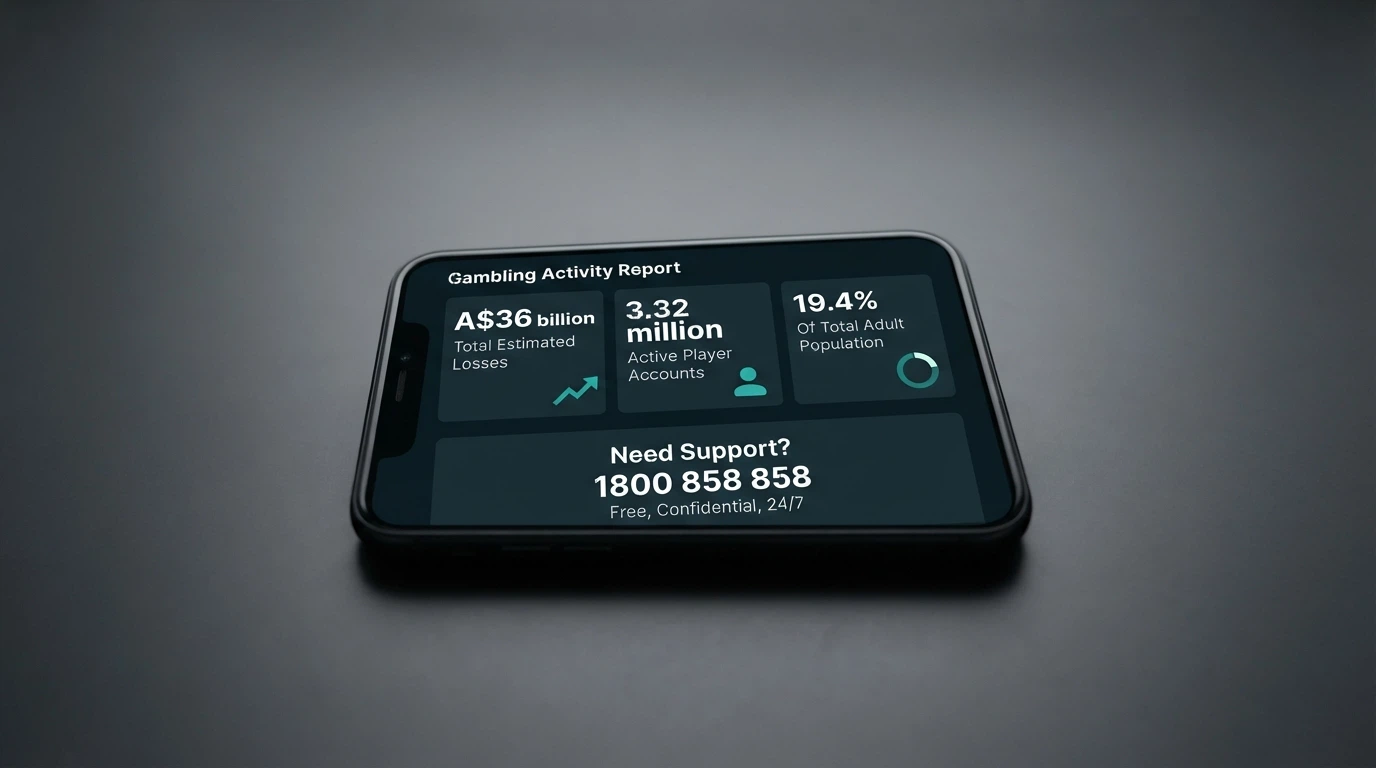
The trend is moving in the wrong direction. Risky gambling in Australia increased from 13.7% in 2024 to 19.4% in 2025, a rise of more than five percentage points in a single year. The annual health loss associated with gambling-related harm in Australian adults is estimated at over 400,000 Years Lived with Disability (YLDs), and the online shift that the mobile section described is happening at the same time. The data is not an aside — it is the context every casino page owes its reader, and the figures are the reason a ranking of offshore operators reads as a harm surface rather than a shopping list.
BetStop and self-exclusion — the safety net offshore casinos ignore
BetStop — the National Self-Exclusion Register — launched on 21 August 2023. To the end of Q3 FY 2025–2026, 59,830 people had registered to self-exclude from all licensed online and phone wagering providers in Australia, and as of 31 March 2026, 37,247 people had active exclusions. The register is the most concrete player-protection tool in the Australian system: one registration excludes a person from every Australian-licensed wagering service in minutes, and the operator-side enforcement is built into the licensing conditions. 78% of registrants were under 40, and 38% chose lifetime exclusion — the profile is younger than the gambling-harm-prevalence profile, and the lifetime-exclusion share is the share that has decided the question permanently.
BetStop binds Australian-licensed wagering services only. An offshore casino is not connected to the register, and a self-excluded person’s money is still accepted. The gap is the most concrete harm on this page, because it is the harm the system has built a tool against and then excluded the offshore market from. The Statutory Review of BetStop was published 25 February 2026 by the Department of Infrastructure, Transport, Regional Development, Communications, Sport and the Arts, and made 10 recommendations. From 1 January 2027, direct marketing of inducements is prohibited for three months after a person deregisters from BetStop and indefinitely for customers identified as at risk of gambling-related harm. The reform tightens the licensed market; the offshore market is unaffected by it.
Where to get help — helplines, counselling and practical first steps
The National Gambling Helpline is 1800 858 858 — free, confidential, staffed 24 hours a day, 7 days a week. Gambling Help Online, at gamblinghelponline.org.au, provides online chat and counselling for people who would rather type than talk. BetStop, at betstop.gov.au, is the entry point for self-exclusion from Australian-licensed wagering services, and the registration is the single most effective step a player who has decided to stop can take. The Gambling Harm Scales (GHS) screening tool, developed by Central Queensland University, is the basis of the Roy Morgan harm index and is available through the help lines.
Practical first steps beyond the helpline: a deposit limit set at a level the player can afford to lose, a take-a-break period the player commits to in writing, and an activity statement the player reviews each month. None of these steps is a substitute for the helpline, and none of them is necessary if the player has not decided there is a problem to solve. The number to remember is 1800 858 858. The site to visit is gamblinghelponline.org.au. The exclusion register is at betstop.gov.au. The rest of this page is information; those three resources are the action.
How we selected and ranked these casinos
The evaluation drew on the ACMA register, the published terms pages of each operator, the regulation skill’s AU backbone for legal and licensing facts, and the figures archive for harm prevalence and payment-method data. The operator pool is the set of offshore casinos that reach Australian players, and the selection criteria were welcome offer value (where confirmed), licence jurisdiction (Curacao, Tobique, MGA or unconfirmed), game provider spread, payment-method support (PayID, crypto, and the legal signal of each), and published wagering terms (where carried by research). The ranking ordered the operators by AU-market relevance and data availability, with the operators carrying confirmed data ranked above those that did not.
What the ranking does not measure: no hands-on deposit testing was done for this page, no player-complaint tracking was applied, and no AU regulatory standing was used as a criterion — because no such standing exists for this product. The licensed Australian wagering operators (SportsBet, Bet365, TAB, Ladbrokes, Ladbrokes Australia, PointsBet, Neds, Betr, Picklebet, Betfair, TABtouch) are excluded because they do not offer online casino games. They appear on related search-results pages and a reader who finds this page while looking for them is reading the wrong product: this page is about offshore casino, and the licensed wagering operators are a different market, with a different product, a different licence, and a different set of protections. The BetStop coverage is on their side. The no-coverage-at-offshore gap is on this page’s side.
What to actually do about online casino play in 2026
The page has laid out the rankings, the bonuses, the payments, the law and the harm data, and the conclusion a player should draw is the one the figures argue for. The honest trade-off is access to an unlicensed product against the absence of Australian consumer protection. The questions to ask before depositing: what is the licence, what is the wagering multiple, what is the maximum cashout on any no-deposit-style offer, and does the payment method itself signal where the operator sits relative to Australian law. A site that accepts credit cards or crypto is outside Australian rules, by definition. A site with a 40x wagering multiple on a free-spin win is offering a bonus that costs more on average than it returns. A site that is not connected to BetStop is a site where a self-excluded person’s money is still accepted.
The practical checklist: verify the terms on the operator’s site, because this page is a starting point and not a contract; register with BetStop if self-exclusion is the answer; know the helpline number (1800 858 858) before the deposit, not after. The page’s verdict is the one the data supports: a player either plays informed, having weighed the wagering multiple, the licence jurisdiction, the payment signal and the BetStop gap, or a player does not play. The choice is the player’s, and the page has tried to leave the reader with the figures that make the choice possible. A ranking of offshore operators is a ranking of unlicensed products, and a ranking of unlicensed products is a harm surface before it is anything else. The $36 billion in losses, the 3.32 million Australians in harm, the 19.4% rise in risky gambling, and the 5h 24m crypto withdrawal that still loses on average are the data the page is built on. Read the terms page, not the headline. Set the deposit limit before the deposit. The helpline is free, confidential and open 24/7.
Frequently asked questions
Is online casino legal in Australia?
No. Online casino games, online pokies and in-play sports betting are prohibited under the Interactive Gambling Act 2001, and there is no licence for online casino anywhere in Australia — not federally, not in any state or territory. The law targets the provider, not the player, which is why offshore sites remain reachable. But the protections gap is real: no BetStop coverage, no Australian consumer protection, no complaints body, and the ACMA cannot recover player funds.
Can I use PayID to deposit at Australian online casinos?
Yes, at most offshore casinos that accept Australian players. PayID deposits settle in under 60 seconds, withdrawals typically take 1 to 4 hours, and the minimum is around A$10 with a maximum of A$5,000–A$10,000 per transaction. PayID acceptance is a payment-rail convenience, not a regulatory stamp — the operator is still offshore, and PayID availability does not change the IGA position.
Are online casino winnings taxable in Australia?
No, for most players. Betting and gambling winnings are not assessable income under section 6-5 of the ITAA 1997, and losses are not deductible under section 8-1 — unless the person is carrying on a business of betting or gambling. The operator pays the wagering tax and the point-of-consumption tax; the player does not pay tax on winnings and does not get a deduction for losses.
Which online casinos accept Australian dollars (AUD)?
Most offshore casinos in the AU market accept AUD accounts, including the operators ranked on this page. A player depositing in AUD avoids the conversion fee that comes with a USD or EUR account, and the cashier page typically shows the AUD equivalent alongside any USD or EUR figures. The acceptance of AUD is a market-positioning choice, not a regulatory one — the operator is still offshore.
How fast are crypto withdrawals at Australian online casinos?
Crypto withdrawals at offshore casinos can clear in under 15 minutes for USDT TRC-20, with most operators sitting in a 1 to 5 hour range depending on the coin and the verification status. Crypto has grown to about 22% of total AU pokies volume in 2026, and the speed is genuine. The acceptance is also a legal signal: credit cards and crypto are banned for licensed AU wagering since 11 June 2024, and a crypto-accepting site is, by definition, outside Australian rules.
Can I get a no-deposit bonus at an Australian online casino?
Yes, at some offshore operators. Royal Reels offers a A$10 no-deposit bonus after phone verification, and FairGO offers a AU$50 free chip on signup (code required). The Australian no-deposit market in 2026 is mostly free-spin based, with 20 to 100 spins and 30x to 50x wagering, and the no-deposit offers carry maximum-cashout caps — typically A$100 to A$200 — that limit what a player can withdraw from a cleared bonus.
Published by the Microgaming Casinos AU team.