
Best 3-Reel Slots in Australia — Real-Money, Demo Play, and the Offshore Reality
 Available in AU
The three-reel pokie is the oldest format still spinning, and in 2026 it keeps drawing players who would rather read a single payline than juggle five reels and a scatter-pay bonus round. This page ranks the strongest 3-reel titles by return-to-player — the honest number in a format built on simplicity — and lays out, plainly, where Australians can actually play them and what protections disappear the moment a deposit leaves the country.
Current as of 18 October 2026 against the Interactive Gambling Act 2001, ACMA enforcement data, and operator licence claims verified against Curaçao and Anjouan registers.
Table of Contents
- What makes a 3-reel pokie different — and why simplicity still wins in 2026
- The 3-reel slots worth your time — ranked by RTP, not hype
- Every site offering 3-reel pokies to Australians is offshore — here is how they compare
- Free 3-reel pokies — try every title without spending a cent
- Real-money 3-reel pokies — what your deposit actually risks
- Australian pokies law — why no online casino holds a local licence
- Staying in control — the help Australia actually has, and where it stops
- Frequently Asked Questions
- Your move — what the 2026 3-reel pokies landscape actually means for your next spin
What makes a 3-reel pokie different — and why simplicity still wins in 2026
A classic 3-reel slot runs a 3×3 grid across one to five fixed paylines and a symbol set so familiar the screen needs no instruction panel: cherries, BARs, bells, red sevens, the occasional diamond. The format predates video slots by half a century. It has been called a museum piece more than once. It is anything but — three-reel titles still ship with the highest return rates in the industry.
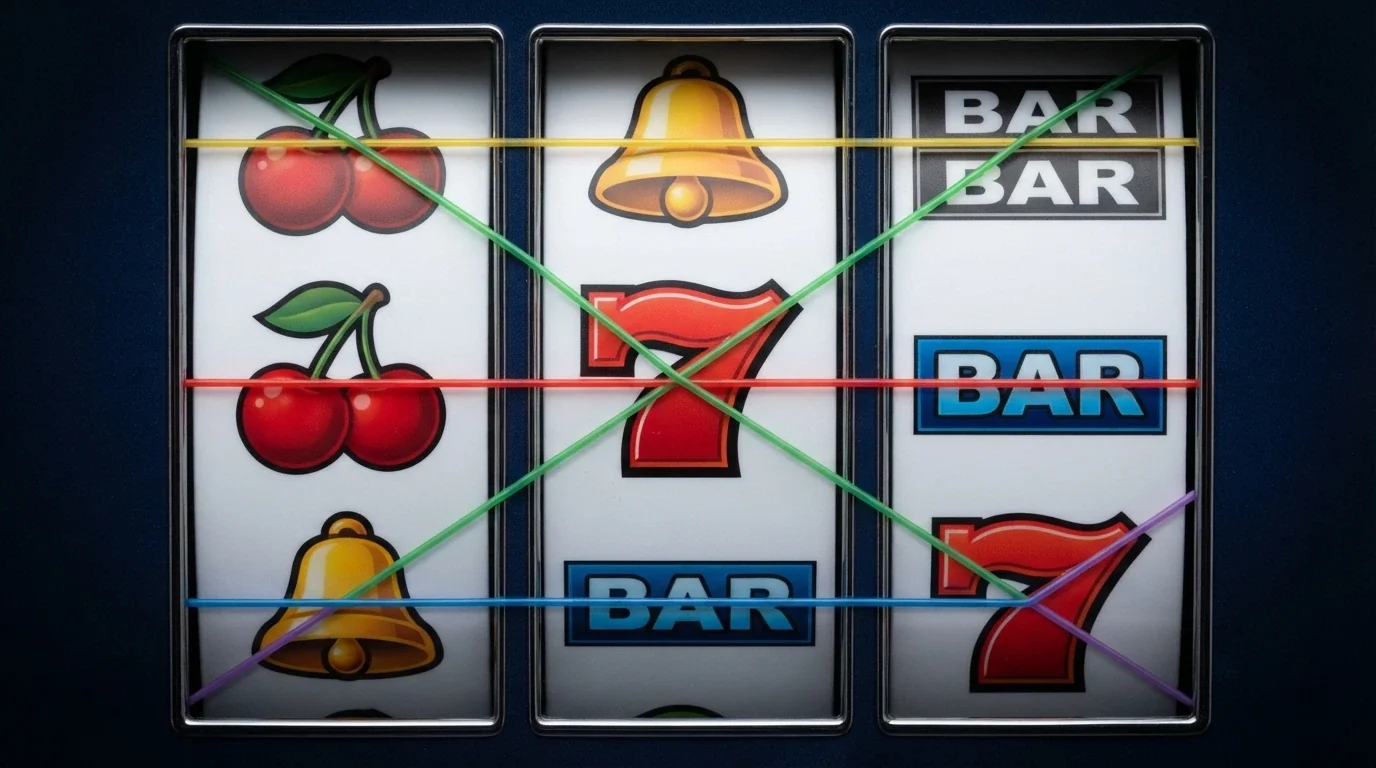
The anatomy of a classic 3-reel slot
Three vertical reels, three rows, between one and five fixed paylines running across the centre row, the top row, the bottom row, or both diagonals. The reels are software today, but the format mimics the stepper-reel cabinets that sat in pubs from the 1960s onward — physical reels that clicked into place, one symbol per stop.
That mechanical origin shows in how the game plays. Each spin produces a small number of outcomes. Wins are evaluated symbol-by-symbol against a fixed table. There is no scatter symbol to chase, no avalanche feature, no expanding wild. A cherry on the payline pays, or it does not.
The typical bet structure covers one credit per line across all active lines. Most classic 3-reelers sit between one and five active lines — a single payline changes the bet psychology sharply, because every credit committed is on a single line and every spin is a clean either-or.
3-reel vs 5-reel — what you gain and what you give up
Five-reel video slots are the dominant format in 2026. They carry 25, 50, sometimes 243 ways to win, layered bonus rounds, free-spin retriggers, multiplier trails. A 3-reel pokie offers none of that. The trade is what mathematicians call variance per decision: the player on three reels faces fewer symbols in play, fewer outcomes per spin, and a cleaner read on whether the math is paying back.
For the casual player, the practical difference is session length and decision density. A 3-reel session turns over the bankroll at a steady pace, with most spins producing some return or none at all. A 5-reel session burns more credits per spin and waits for the bonus to land.
Neither is objectively better. A player who wants feature entertainment and long dry stretches punctuated by feature hits prefers the five-reel format. A player who wants simple arithmetic and the most efficient return rate for a given stake leans three-reel.
Online vs land-based — the same symbols, a different machine
The original pokies — one-armed bandits, fruit machines — sat in Australian pubs and clubs as mechanical stepper cabinets. Players pulled a lever, watched three physical reels click into place, and either collected a handful of coins or pulled again. The same symbolism that defined those cabinets travels to online. Cherries stay cherries. Red sevens stay red sevens.
What the online version adds is configurability. Stakes adjust between fractions of a cent and several hundred dollars per spin in most modern 3-reelers. Autoplay does the clicking. The RTP is displayed openly for the titles that publish one. The mechanical reel is replaced by a certified random number generator producing identical-looking outcomes. The migration from cabinet to browser has not changed the game; it has changed who can play it, when, and at what stake.
The 3-reel slots worth your time — ranked by RTP, not hype
RTP — return to player, the percentage of all wagered money a slot returns over its lifetime — is the most honest ranking axis for the 3-reel format. Features do not carry the comparison the way they do on five-reel games. The math sits closer to the surface.
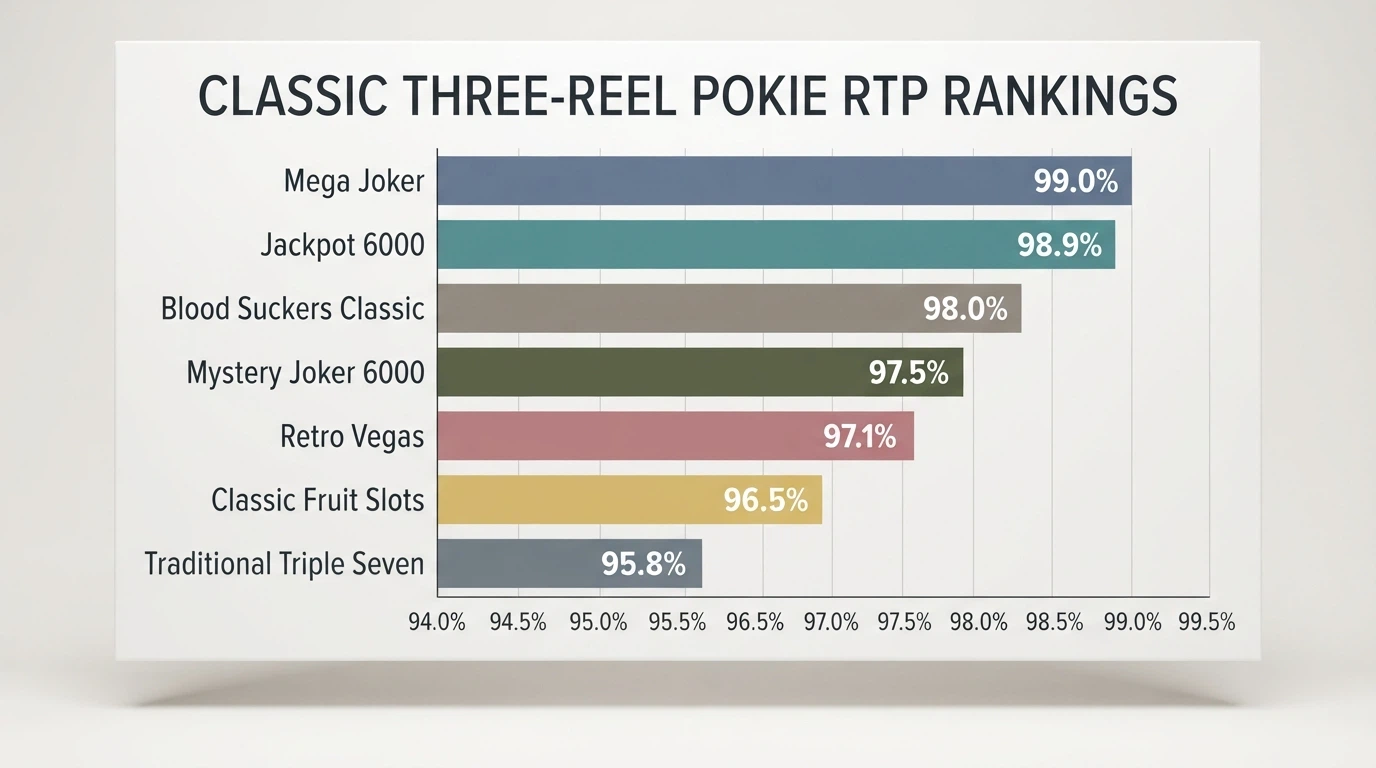
Most classic 3-reel pokies cluster between 94% and 96% RTP. A handful break above 97%. A few break above 98%. The titles below are ranked by published return rate, with provider, volatility and max win where research confirms them. Cells without confirmed data carry an em dash.
| Slot | Provider | RTP | Volatility | Max win |
|---|---|---|---|---|
| Mega Joker | NetEnt | 99.0% | High | x200 |
| Jackpot 6000 | NetEnt | 98.9% | High | x600 |
| Triple Bar | — | 98.0% | Medium-low | x40 |
| Fortune Gems 3 | TaDa Gaming | 97.13% | Medium | x10,125 |
| No Limit Bandit | Nucleus Gaming | ~96.92% | Medium | x500 |
| 777 Classic | Retro Gaming | 96.55% | High | — |
| Mystery Jack | Wazdan | 96.49% | — | — |
| Big Bass Bonanza 3 Reeler | Pragmatic Play | 96.07% | Medium | x2,000 |
| Mystic Reels | BGaming | 96.00% | Medium | x4,559 |
| Bigger Piggy Bank 3 Reeler | Inspired Gaming | 94.5% | Average | x1,000 |
| Red, White and Blue | IGT | 93.98% | Medium-high | 2,500 credits |
Two titles sit clear of the field. Mega Joker at 99.0% is the highest published 3-reel RTP in active circulation. Jackpot 6000 at 98.9% carries a defined maximum jackpot of 6,000 coins across five fixed paylines. Both are NetEnt products, both are high volatility, and both belong to the small cluster of 3-reelers that publish mechanical RTPs you can find on the provider’s own spec sheet.
The highest-RTP 3-reel slots — Mega Joker, Jackpot 6000 and the 97%+ club
Mega Joker’s 99.0% RTP is conditional. The headline figure only applies when the player activates Supermeter mode — a secondary game played at the top of the screen with the winnings from the base round, where the player chooses between collecting and betting into a higher-tier line. Play the base round alone and the RTP drops. The 99.0% figure is therefore a ceiling on optimal play, not a guaranteed level.
Jackpot 6000’s 98.9% hangs on similar optimal-play logic — the game’s headline return assumes the player uses its gamble feature to maximum effect. The slot has five fixed paylines, a defined maximum jackpot of 6,000 coins, and a max win figure of x600. The 6,000-coin ceiling is what the player actually wins at peak, not a theoretical multiplier.
Triple Bar at 98.0% sits just below the top tier, with medium-low volatility and a modest max win of x40. For a player who values frequent small returns over the chance of a single oversized line, Triple Bar is the calmer choice in the 98%+ group.
Classic fruit machines from IGT, NetEnt and the studios that built the format
Two studios defined the 3-reel category. IGT built the land-based legacy — Red, White and Blue carries the format’s most recognisable symbol stack at 93.98% RTP and a 2,500-credit max win on a single fixed payline. The 93.98% is below the 94–96% classic-slot average, and for that reason Red, White and Blue is a nostalgia title more than a math play.
NetEnt’s Mega Joker and Jackpot 6000 are the digital-era benchmarks. Both sit above 98% RTP. Both pay aggressively when the variance break opens. For 2026, newer providers — Pragmatic Play, Wazdan, BGaming, TaDa Gaming, Inspired Gaming, Nucleus Gaming — are adapting the format with bonus features built on top of the core grid.
Inspired Gaming released Bigger Piggy Bank 3 Reeler on 23 July 2026 and Gold Cash Freespins 2 on 25 August 2026. The studio’s interactive lead, Claire Osborne, framed the launch as building on a “proven foundation” of classic mechanics.
Bonus 3-reel slots — when three reels carry free spins, multipliers and jackpots
The format has moved beyond the bare fruit reel. Big Bass Bonanza 3 Reeler runs a 3×3 grid with five paylines and a free-spins round triggered by scatter symbols — Pragmatic Play’s fishing theme stretched onto a compact grid with a 2,000x max win at medium volatility.
Golden Clover 3×3, from R. Franco Digital, builds a multiplier reel into the format — a separate reel carrying x2, x3, x4 multipliers that combine with line wins on the main grid, plus a four-tier jackpot system (Mini x50, Minor x150, Major x400, Grand x750). That’s a feature density the format’s original pub cabinets never imagined.
Fortune Gems 3 from TaDa Gaming sits at 97.13% RTP with medium volatility and an outlier max win of 10,125x — the highest max win on the ranked list, by a wide margin. A traditional 3-reel frame carrying modern win potential.
Many older 3-reelers also carry a gamble or risk feature: after any win, the player can choose to double or quadruple the payout by picking a card suit or colour. The math on the gamble is usually worse than the base pay table, and convicting the feature as a net positive is hard — but the option exists.
Every site offering 3-reel pokies to Australians is offshore — here is how they compare
No online casino holds an Australian licence. None can. The Interactive Gambling Act 2001 prohibits online casino games and online pokies outright. The 10 operators in this ranking are all offshore, all unregulated by an Australian authority, and all vulnerable to ACMA blocking at any time.

The table below compares them on the dimensions an Australian player can actually weigh: licence jurisdiction, game-count and the small handful of bonus terms research confirms. The empty cells are not a refusal to report — research did not confirm them, and a blank cell is the honest line.
| Operator | Offshore licence | Game count |
|---|---|---|
| SkyCrown | Curaçao (Hollycorn N.V.) | 7,200+ |
| Fair Go | Curaçao (Deckmedia N.V.) | 280 |
| WinSpirit | Curaçao (Dama N.V.) | — |
| Rainbet | Anjouan | — |
| Rocket Play | Curaçao (Dama N.V.) | 5,000+ |
| Royal Reels | Curaçao (TechSolutions Group N.V.) | 4,000+ |
| Stake | Curaçao (Medium Rare N.V.) | 3,000+ |
| Bizzo Casino | Curaçao (TechSolutions Group N.V.) | — |
| Rocket Casino | Curaçao (Dama N.V.) | — |
| Scream Casino | — | — |
The licence column reveals the practical reality of the offshore route. Curaçao is the most common jurisdiction — the licence is cheap, fast to obtain, and covers most gambling products under a single regulator. Anjouan is a smaller jurisdiction with weaker consumer protections. Neither licence can be enforced from Australia, and neither operator is bound by ACMA rules.
How we scored them — the criteria behind every ranking on this page
The operator ranking on this page rests on the data research confirmed: licence jurisdiction, game-library size, and bonus terms where the operator published them and research verified them. Several operators in the featured set — Rocket Play, Royal Reels, Stake, Bizzo Casino, Rocket Casino, Scream Casino — carried unconfirmed data on at least the volatile bonus fields. Those operators appear in the ranking, but their write-ups state plainly what was verified and what was not.
On game count, a larger library is a weighted but imperfect proxy for 3-reel depth. SkyCrown’s 7,200+ titles almost certainly contain a larger absolute number of 3-reelers than Fair Go’s 280 — but a smaller library can also curate tighter. Fair Go runs on a single provider, RealTime Gaming, and an RTG-only library still carries the studio’s classic 3-reel titles.
On licence, Curaçao and Anjouan are presented as what they are: offshore jurisdictions with no Australian enforcement reach. They are not interchangeable with a local Australian licence, and no claim on this page puts them on equal footing.
SkyCrown — the biggest game lobby of the set, with an AU$8,000 welcome package
SkyCrown leads on scale. A 7,200+ game lobby under a Curaçao licence operated by Hollycorn N.V. — a known, multi-brand operator in the offshore space and not an unknown shell. The headline welcome package of up to AU$8,000 plus 400 free spins is real, and it is split across five deposits rather than paid in one shot.
The 40x wagering requirement applies to both the bonus amount and any free-spin winnings. A player depositing for the full AU$8,000 in match bonuses would be looking at AU$320,000 in required turnover before any bonus-derived winnings withdraw. The headline AU$150 max cashout from bonus funds sits on top of that. Bonus validity runs five days for cash bonus and one day for the free-spin allocation.
This is the marketing figure that needs puncturing. “Up to AU$8,000” quotes the maximum match across five deposits; “40x wagering” is what stands between that figure and a withdrawable balance; the AU$150 max cashout on bonus-derived funds caps what survives the playthrough in any case. Reading the headline without reading the wagering ends one way.
Fair Go — RTG exclusivity and a no-deposit bonus, with a 60x wagering catch
Fair Go runs on a single provider — RealTime Gaming, abbreviated RTG — and a 280-game library that is narrow by the set’s standards but heavily weighted toward classic formats. The five-deposit 100% match up to AU$200 each (AU$1,000 total) is a smaller package than SkyCrown’s, and the 30–40x wagering on the deposit match is mid-pack.
The interesting number here is the no-deposit offer: 100 free spins granted without funding the account, but carrying a 60x wagering requirement and an AU$180 max cashout. Converting a no-deposit bonus winnings of, say, AU$20 into withdrawable cash means satisfying AU$1,200 of required turnover on the slots before the AU$180 ceiling caps what actually pays out.
Fair Go is the operator for a player who wants a single-provider, RTG-led library and is interested in the no-deposit route. The wagering requirement on that free-spin offer is steeper than the deposit-match requirement on the same site.
WinSpirit — the lowest confirmed wagering multiple among the featured set
WinSpit offers a 100% match up to AU$500 plus 50 free spins, with 30x wagering applied to the bonus amount. Among the operators in this ranking with confirmed bonus terms, 30x is the lightest playthrough. The Dama N.V. operator group — the same stable as Rocket Play and Rocket Casino — runs a Curaçao licence.
The lighter wagering multiple is real and material. A AU$500 bonus at 30x leaves AU$15,000 in required turnover; the same bonus at 40x leaves AU$20,000. Across a weekend of play, the difference is meaningful. That said, the operator carries the same offshore risks as every other entry on this page, and research did not confirm the bonus validity window for this operator this run.
Rainbet — Anjouan-licensed with a 30-day bonus window
Rainbet is the only featured operator under an Anjouan licence rather than a Curaçao one. The 100% match up to AU$500 with 50 free spins carries 35x wagering on the bonus amount and 20x on the free-spin winnings, with a 30-day validity window on the bonus — substantially longer than the one- or five-day windows some Curaçao operators impose.
Anjouan is a smaller licence jurisdiction than Curaçao, and consumer protection under an Anjouan licence is weaker in practical terms. The 30-day validity is generous relative to the set, but the player has to weight that generosity against the same offshore withdrawal risk that applies to every entry on this page. Research did not confirm the operator group behind Rainbet this run.
Rocket Play — 5,000+ games under a Dama N.V. Curaçao licence
Rocket Play carries a 5,000+ game library — second-largest in the rank — operating under Dama N.V., the same Curaçao operator group as WinSpirit and Rocket Casino. Research did not confirm the welcome bonus amount, wagering multiple or validity window for the operator this run, so none of those numbers appear above.
What an Australian player can verify on the operator’s own terms page is the answer here: the bonus terms research could not pin down this run, and the player should confirm them independently before depositing. The Dama N.V. operation makes for a stable operating peer, but the licence date and bonus details remain unverified.
Royal Reels — 4,000+ games from TechSolutions Group under a Curaçao licence
Royal Reels runs a 4,000+ game library on a Curaçao licence from TechSolutions Group N.V. — the same operator group that runs Bizzo Casino. For an Australian player, the relevant point is the shared operator structure — two brands under one group are not unusual offshore, and the player’s contract is with the operator group, not the brand label.
Bonus and wagering details for Royal Reels were not confirmed this run. The verification gap covers the most volatile fields — welcome amount, playthrough multiple, validity window — and the player should pull those from the operator’s own terms page before committing a deposit.
Stake — 3,000+ games and a Curaçao licence from Medium Rare N.V.
Stake is the highest-profile brand globally in this ranking — a crypto-friendly operator with a 3,000+ game Curaçao licence from Medium Rare N.V. For Australian 3-reel players specifically, the offering is functionally similar to its stablemates: offshore, no BetStop coverage, no Australian enforcement. The brand recognition does not move the legal needle.
Bonus terms, wagering multiple and validity window for Stake were not confirmed this run. The bonus structure at Stake historically differs from the industry-standard welcome package, often using rakeback or sport-focused promotions instead of a casino deposit match — but the player should confirm what is currently offered before assuming.
Bizzo Casino — TechSolutions Group operator with a Curaçao licence
Bizzo Casino shares the TechSolutions Group N.V. operator with Royal Reels. The two brands effectively sit under the same corporate umbrella, with separate skins, separate marketing, and overlapping but distinct game lobbies. Bonus terms, wagering and game count were not confirmed this run for Bizzo Casino, and the same verification advice applies as for Royal Reels — confirm the operator’s current terms before depositing.
Rocket Casino — Dama N.V.-operated with a Curaçao licence
Rocket Casino rounds out the Dama N.V. trio in the ranking — alongside Rocket Play and WinSpirit — under a Curaçao licence. Game count and bonus terms were not confirmed this run, and what the operator offers specifically in 2026 should be verified before a deposit is committed.
Scream Casino — limited verified data at publication time
Scream Casino is the operator in this ranking where research confirmed the least. Operator group, licence jurisdiction, game count, welcome bonus and wagering multiple — none confirmed this run. That is not a refusal to report from the operator’s side; it is a research gap.
The honest line for a player considering Scream Casino: verify the operator, the licence register it claims to hold, and the bonus terms on the operator’s own terms page before depositing. A brand with no verifiable operator group and no confirmed licence is not equivalent to the others in this ranking, and the player should treat it accordingly.
Free 3-reel pokies — try every title without spending a cent
Most 3-reel titles are available in demo mode at the provider’s own site, at most affiliate pages, and at the offshore casinos after a quick sign-up. Demo mode spins the same reels and uses the same random number generator as the real-money version — the only difference is that the balance is play money and no withdrawal step exists.

Demo mode vs real-money play — what changes when the reels stop being free
The reels spin identically. The RNG output is the same algorithm drawing on the same outcome distribution. A player on demo mode sees the same hit rate, the same bonus feature frequency, the same symbol distribution as a player on the real-money version.
What changes is what surrounds the spin. There is no financial risk on demo play, no wagering requirement, no withdrawal step. Real-money play introduces all three — plus the emotional gradient that comes with each. Convincing yourself to walk away at the right moment is harder when each spin is funded by your own deposit.
What demo mode cannot tell a player is how a casino will handle a withdrawal request, how long a payout will take, whether a bonus carries restrictive terms, or what the support experience looks like when something goes wrong. The math is testable; the operator is not.
No download, no registration — where instant free play actually works
HTML5 has replaced the Flash player that powered the first generation of browser slots. Modern 3-reelers load in a browser window with no plugin, no install, no software download. Many providers — NetEnt, Pragmatic Play, Wazdan, BGaming — host demo versions of their titles directly on their own studio sites.
Affiliate pages also host demo versions of the slots they review, usually without any account creation. The catch is that affiliate pages earn a commission when the player proceeds to register and deposit, which is how the free play gets paid for. That is fine to use. It is worth knowing that it is the business model.
Real-money 3-reel pokies — what your deposit actually risks
Real-money play from Australia means depositing into an offshore account. The Australian options are limited by law. Credit cards, credit-related products and crypto are banned as payment for online wagering since 11 June 2024, with operator penalties up to AU$247,500 for accepting them. The legal deposit routes at Australian-licensed operators — debit card, bank transfer, PayID, Osko, BPAY — are largely the same payment methods on offer at offshore casinos, with the offshore side accepting methods that licensed operators cannot.
SkyCrown’s headline AU$8,000 welcome package, taken at the 40x wagering requirement and a 95% midpoint RTP for the classic-slot range (94–96%), produces a measured cost. The required turnover is AU$320,000 — AU$8,000 multiplied by 40. Wagered at a 95% return, expected loss on that turnover sits at AU$16,000 — five percent of AU$320,000 — across the lifetime of the bonus playthrough. The bonus amount, in other words, is not the cost measure. The turnover is, and the cost measure is a fraction of that turnover. The marketing figure is the price tag, the wagering multiple is the multiplier, and the RTP is the haircut — formula: expected loss = required turnover × (1 − RTP) is plain arithmetic.
The Australian player faces this cost inside an offshore framework. There is no Australian consumer protection authority that can compel a payout, no ACMA complaints process that recovers funds, no banking ombudsman that can reverse a transaction once it clears locally and lands in a Curaçao or Anjouan bank account. A bonus is the headline figure. A real-money slot is the drain on the deposit that follows.
How withdrawals work at offshore casinos — and why they sometimes do not
Withdrawal at an offshore casino runs through the same payment infrastructure as deposit, in reverse. Debit card, bank transfer, crypto — the offshore sites accept what licensed operators cannot, and the player using crypto has reduced recourse at both ends. Verification requests during the first withdrawal are common — proof of identity, proof of address, sometimes proof of the deposit method itself.
The risk crystallises at the withdrawal step. If the operator refuses a withdrawal — voids winnings, closes the account, claims a bonus violation — there is no Australian body to complain to. ACMA can direct ISPs to block the site, which is a public-safety measure, not a refund mechanism. ACMA cannot recover anyone’s money. The site’s regulator, if Curaçao or Anjouan, is in a different country and operates under its own enforcement process. The refund lever does not exist.
A player who has ever seen their account balance disappear over a misinterpreted bonus term at an offshore site is a player who has learned this lesson the hard way.
Australian pokies law — why no online casino holds a local licence
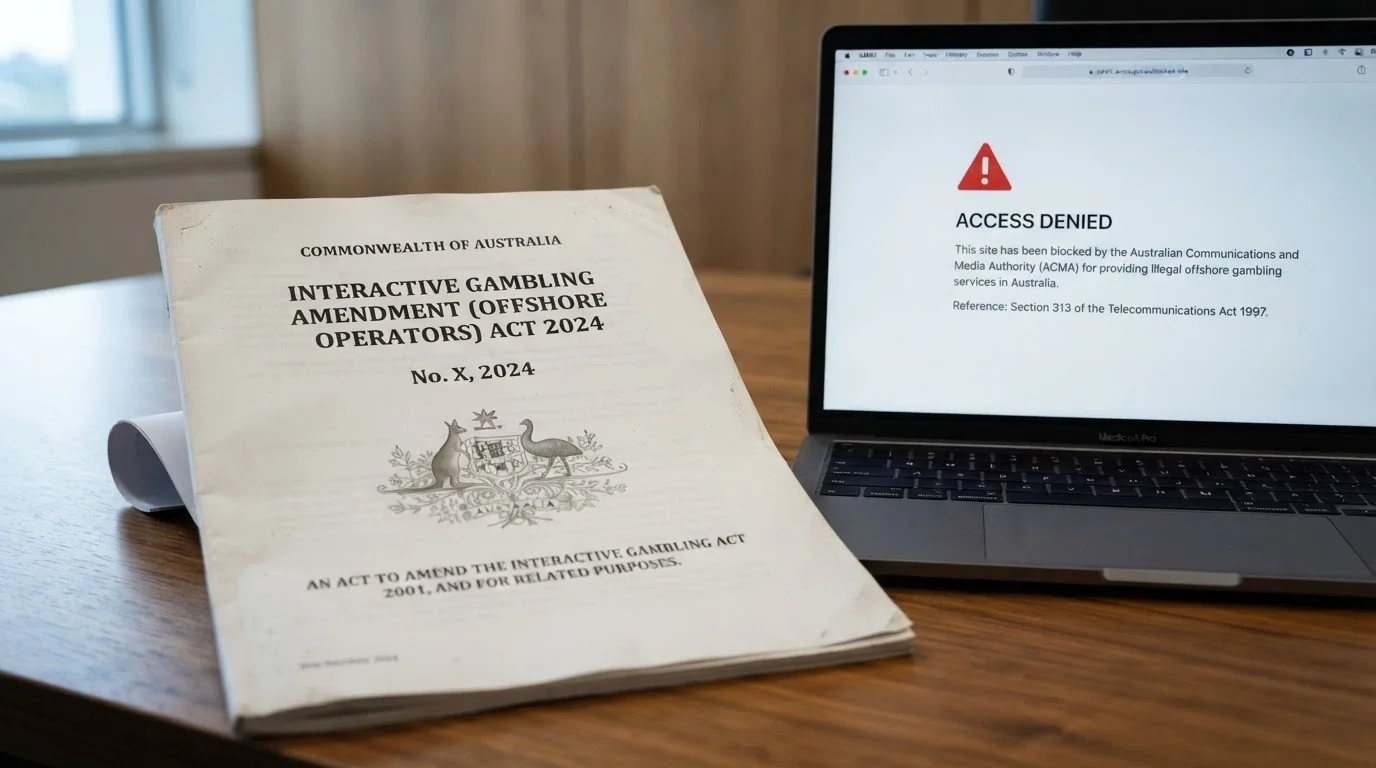
The Interactive Gambling Act 2001 prohibits online casino games and online pokies outright, in Australia. The 2017 amendment closed the loopholes offshore operators had used and gave the ACMA its enforcement powers. The 1,564 blocked sites — as of March 2026 — are the visible residue of that enforcement. The 225+ services that have withdrawn from the Australian market since 2017 are the quieter one.
The Interactive Gambling Act 2001 — what it bans and what it does not
The statute defines prohibited interactive gambling services to include online casino games, online pokies (slots), and in-play betting on a sporting event once it has begun. Permitted and licensable under state and territory frameworks: wagering on racing and sport placed before the event begins, lotteries, keno. The big online bookmakers holding Northern Territory licences — Sportsbet, bet365, Ladbrokes, around 50 others — operate under that carve-out, and the carve-out is for wagering products, not casino games.
Enforcement targets the provider, not the player. Individual Australians are not prosecuted for choosing to play at an offshore casino. They lose Australian consumer protections in doing so — that is the cost built into the structure, and that is what the offshore route actually means.
Licensing for online wagering is concentrated in the Northern Territory under the NTRWC, administered through Licensing NT. State and territory frameworks coexist for land-based casinos and lotteries, but the online casino product is prohibited everywhere. The minimum age for all commercial gambling is 18.
Offshore operators and your money — the protections you lose
Every casino on this page is offshore. That is the single most consequential fact for an Australian player choosing to deposit. The protections an Australian consumer takes for granted — complaints bodies, dispute resolution, banking ombudsman — none of those reach offshore. ACMA cannot recover a player’s lost deposit. BetStop does not exclude from an offshore casino. A banking chargeback on an offshore wagering transaction is at the bank’s discretion and at the bank’s risk appetite. A site can be blocked at any time with a balance still on it.
The payment methods themselves are a tell. An offshore casino accepting credit cards and crypto is accepting what Australian-licensed operators cannot accept since 11 June 2024 — the site is operating outside Australian rules by definition. That does not make it fraudulent. It makes it offshore, and offshore is a different legal universe from Australian-licensed wagering.
The 2026 reforms — what changes on 1 January 2027
The Interactive Gambling Amendment (Gambling Reform) Bill 2026 passed Parliament on 19 August 2026. Its measures commence 1 January 2027. The reforms target wagering advertising, inducement marketing and payment blocking — but they do not legalise online casino. The format remains prohibited.
The advertising changes: no wagering ads during live sport from 15 minutes before to 5 minutes after an event, between 5am and 8:30pm. No more than three wagering ads per hour on TV in that same window. No radio wagering ads during school drop-off and pick-up times. No broadcasting of sporting odds. No wagering advertising inside sports venues or on uniforms. Athletes, celebrities and influencers barred from promoting wagering products.
The inducement changes: direct marketing of inducements prohibited for 14 days after a customer signs up with a licensed wagering operator, and for three months after a BetStop deregistration. Inducements for at-risk customers are barred indefinitely.
The payment changes: banks and payment providers gain express authority to block transactions to illegal gambling operators from 1 January 2027. That authority closes one of the offshore route’s most practical gaps — the bank transfer that has been easy to make until now will be easy to refuse.
Staying in control — the help Australia actually has, and where it stops
Australia has built a serious responsible-gambling infrastructure. The hard fact is that every element of it is wired into the licensed wagering system and does not reach an offshore casino.

Where to get help right now:
- National Gambling Helpline — 1800 858 858 — free, confidential, staffed 24 hours, every day of the year
- Gambling Help Online — gamblinghelponline.org.au — online chat and counselling
- BetStop — the National Self-Exclusion Register — betstop.gov.au — registers a person with all Australian-licensed online and phone wagering services; minimum exclusion period three months, maximum lifetime
- Lifeline — 13 11 14 — for crisis support beyond gambling-specific help
BetStop reports 67,480 registrations as of 31 July 2026, with 41,290 exclusions still active — more than 60% of all-time registrants. 78% of registrants are under 40; 38% chose lifetime exclusion. About 2.1% of Australian adults — roughly 430,000 people — experience problem gambling. These are real figures, and they are the reason a player who feels their own gambling slipping should reach for the phone first, not last.
Spotting the signs — how problem gambling shows up and where to get help
Behavioural warning signs include spending more than intended, chasing losses, borrowing to fund play, hiding gambling activity from family or colleagues, neglecting work or relationships, and feeling anxious or irritable when not playing. None of these is diagnostic on its own; several together warrant a conversation with someone who can help.
The first call is 1800 858 858 — National Gambling Helpline. Free, confidential, 24/7. The online option is Gambling Help Online at gamblinghelponline.org.au, with chat and email counselling. BetStop registration at betstop.gov.au excludes from around 150 licensed wagering providers in Australia for a minimum of three months, extendable up to lifetime. None of those tools reach an offshore casino, which is why the offshore route carries the additional harm of self-exclusion being ineffective against the very sites a worried player would most want it to cover.
Frequently Asked Questions
Are 3-reel pokies legal to play online in Australia?
No, online casino games including pokies are prohibited in Australia under the Interactive Gambling Act 2001. While licensed wagering on racing and sport is permitted, online casinos are offshore and illegal. ACMA actively enforces this ban by blocking access to these sites, and players lose all Australian consumer protections when they deposit offshore.
What is the difference between 3-reel and 5-reel slots?
A 3-reel pokie uses a compact 3×3 grid with fixed paylines and a classic feel, often carrying high RTPs and simple, predictable mechanics. A 5-reel video slot is more complex, featuring 25 to 243 ways to win, elaborate bonus rounds, free-spin triggers, and more variance. The trade-off is session length and decision density.
What is the maximum win on classic 3-reel slots like Mega Joker?
Classic 3-reelers vary significantly in payout structure. Mega Joker, for instance, offers a 99.0% RTP and a max win of x200, while Jackpot 6000 carries a defined maximum jackpot of 6,000 coins, effectively capped at x600. Fortune Gems 3 is an outlier in the format, offering a max win of 10,125x.
Are online casino winnings taxable in Australia?
Generally, no. Gambling winnings are not assessable income under section 6-5 of the ITAA 1997, and gambling losses are not deductible under section 8-1, provided you are not carrying on a business of betting or gambling. If you are deemed to be gambling as a business, different rules may apply under ATO criteria.
What happens if I play at an offshore casino and the operator refuses to pay?
If an offshore operator voids winnings or closes your account, there is no Australian consumer protection body that can compel them to pay. ACMA cannot recover lost funds, BetStop does not apply to offshore casinos, and bank reversal rights for crypto or card deposits are extremely limited and at the bank’s discretion.
The slot rankings use researched RTP figures from the published specification of each title — provider spec sheets, slot review sites, and the stated return percentages each game publishes. Provider and volatility columns carry values where research confirmed them, and an em dash where no figure was verified. No slot on the list has been ranked by hype or by review aggregation; the ranking axis is the math.
The operator ranking borrows the league table on game-count, licence jurisdiction, and the bonus terms research confirmed. Six of the ten featured operators carry unconfirmed data on at least the volatile bonus fields — their write-ups state plainly what was verified and what was not, rather than printing figures that could mislead.
The legal backbone of the article is the Interactive Gambling Act 2001, the Interactive Gambling Amendment Act 2017, the Interactive Gambling Amendment (Credit and Other Measures) Act 2023, the Interactive Gambling Amendment (Gambling Reform) Bill 2026, ACMA enforcement data through March 2026, and BetStop statistics from the same agency. The responsible-gambling section uses the Australian Institute of Health and Welfare’s prevalence figures and ACMA’s BetStop register data.
Your move — what the 2026 3-reel pokies landscape actually means for your next spin
The strongest 3-reel pokies in 2026 are genuinely good games. Mega Joker at 99.0% RTP, Jackpot 6000 at 98.9%, Fortune Gems 3 with its 97.13% RTP and 10,125x max win — these are titles that stand on their mechanics and their math, and the format’s clean decision-making rewards a player who pays attention to the numbers. The best of them beat the wider casino industry’s average RTP.
Nothing on this page changes the fact that playing them from Australia means depositing into an offshore account with no Australian licence behind it. Demo mode costs nothing and removes the offshore exposure entirely; for the titles above, demo mode is available through the providers themselves and through most affiliate pages. The real-money route is the route where the protections vanish — no BetStop, no consumer protection, no bank reversal rights, and ACMA’s enforcement is a block, not a refund.
For a player choosing to play for real money: verify the licence on the operator’s terms page, read the bonus terms — including wagering, max cashout and validity — before claiming, check the operator’s withdrawal history on independent player forums, and never deposit more than what can be lost to a site that cannot be compelled to pay out. The math on the slot will always favour the house. The math on the player side is at least partly negotiable through choice of operator and choice of deposit size. That is the lever.
Prepared by the Microgaming Casinos AU editorial staff.