
The $5 No-Deposit Casino Bonus Doesn’t Exist in Australia
 Available in AU
That headline is not a riddle. A $5 no-deposit casino bonus is a real product in international markets — a small cash credit handed to a new account holder before any deposit has been made. In Australia it is also a product no licensed operator can legally sell you, because no licensed online casino operates in Australia to sell it. This page examines that contradiction: the nature of the offer, the reasons Australia cannot support it, and what a $5 actually buys on the products Australians can legally use.

Current as of 18 October 2026. Operator and licence claims verified against state and territory wagering registers, the Northern Territory Racing and Wagering Commission’s public records, and the Australian Communications and Media Authority’s enforcement register. Bonus-term fields per operator were not confirmed from live sources this run; bonus analysis is qualitative rather than per-brand.
Table of Contents
- Why a $5 No-Deposit Casino Bonus Doesn’t Mean What You Think in Australia
- The Bonus Terms That Actually Matter (and the Ones That Don’t)
- Why Your PayID Deposit Won’t Protect You at an Offshore Casino
- The Operators Australians Actually Use — and Which Ones Hold a Licence
- The Legal Reality Most Bonus Round-Ups Skip
- What BetStop Actually Covers (and the Gap Most Reviews Miss)
- How We Chose and Checked Every Operator on This Page
- Where Your $5 Is Safest in 2026 — and What to Avoid
- Frequently Asked Questions
Why a $5 No-Deposit Casino Bonus Doesn’t Mean What You Think in Australia
The $5 No-Deposit Casino Bonus Explained — and Why Australia Has None
A no-deposit bonus is what its name says: a small bonus credited to a new account before the player has deposited. Internationally it usually runs between $5 and $20 in cash, or the equivalent in free spins, and it exists to let a player try the casino floor without committing their own money first. That is the genuine article.
The Australian edition is a refusal. Under the Interactive Gambling Act 2001, providing online casino games and online pokies to a person in Australia is prohibited, and no state or territory issues an online casino licence that would let an operator make such an offer. The permitted and licensable online products are wagering on races and sport placed before the event begins, lotteries, and keno — and none of those carries a casino-style sign-up bonus in the way the term is used overseas.
That is not a quirk of licensing. It is the law, written into the only piece of federal legislation that governs what an Australian can be offered online. A page about “the best licensed online casinos in Australia” is describing something that does not exist, and the rest of this page is the rest of that sentence.
What a $5 Minimum Actually Buys on the Products Australians Can Legally Play
The $5 still has work to do. It is just on a different counter. Australia’s permitted online products — wagering on races and sport placed before the event, lotteries, keno — all accept a minimum deposit that small, and the legal deposit routes for licensed wagering include debit card, bank transfer, PayID/Osko and BPAY. Credit cards, credit-related products and digital currency are banned as payment for online wagering from 11 June 2024, with penalties of up to $247,500 for an operator that fails to enforce the ban, so the path a $5 takes to a wagering account is narrower than the path overseas.
A $5 bet on a Saturday race, a $5 multi on a Friday night of football, a $5 entry into a keno draw — those are the products where the headline number still means what it says. They are not a casino bonus and they will not pay out the way a pokie bonus page promises, but they are real, they are licensed, and they are protectively regulated in a way the offshore casino offer is not. The page that follows explains both sides of that trade and what each one actually costs the person paying for it.
The Bonus Terms That Actually Matter (and the Ones That Don’t)
The first figure to read is not the bonus number. It is the wagering multiple attached to it. The dollar amount is the headline. The fine print is the deal.

What a No-Deposit Bonus Promises — and What It Costs to Claim
The marketing line of a no-deposit bonus is that the casino credits the player a small amount before any of their own money is at risk. The mechanical truth is that the casino is loaning the player the chance to play, and the loan is repaid in play-through before any winnings can be withdrawn. A bonus credited without a deposit almost always carries three ordinary conditions: a max-cashout ceiling that limits what can be kept, a wagering multiple that defines the work, and an identity-verification hurdle that gates the withdrawal.
The model “free” in this context is a presentation choice, not a description. The bonus costs the casino the time it takes to enforce the conditions; it costs the player the time it takes to clear them. The arithmetic of clearing lives in the next section, and it is the section that decides whether the offer is worth the time.
Wagering Requirements: The Fine Print That Eats Your $5
A wagering requirement — also called a turnover or play-through — is the number of times the bonus amount must be wagered before winnings become withdrawable. A 40x wagering requirement on a $5 bonus means $200 in required turnover. That is the figure to compare against the headline bonus, because the headline is the smaller of the two, and the marketing word that hides behind this arithmetic is “free”.
Game weighting is where the number quietly gets larger. Pokies typically count 100% toward wagering, but table games and live casino products often count only 5% to 20%. A player who opens a blackjack hand to “use up” their bonus can find they have done a fraction of the work they thought they had. A high wagering multiple combined with low game weighting is what makes a small bonus effectively unclaimable, and it is the real shape of the offer behind the headline.
For a $5 no-deposit bonus at 40x, assume the player wagers only on a 100%-weighted pokie. They must run $200 through the machine before a withdrawal unlocks — and that is before any cap on winnings is applied. The “free” credit is a loan of $5 at a play-through cost of $200, with whatever ceiling the operator has set on top.
Bonus Codes, Match Rates and Expiry — the Variables That Change the Deal
Three further levers decide whether a welcome offer is generous or hollow. The bonus code is the first: a string entered at sign-up or at the deposit screen that activates the offer, and the difference between an offer that lands in the account and one that simply does not exist for that player. The match rate is the second: a 100% match doubles a deposit, a 50% match adds half of it, and the headline figure (“up to $500”) almost always describes the top of the scale rather than what a $5 deposit actually attracts. A $5 deposit at a 100% match rate produces a $10 bankroll, not the $500 figure a reader may have skimmed past.
Validity windows are the third. A bonus is almost always time-limited — typically seven to thirty days — and any unused bonus balance plus any winnings tied to it expire when the window closes. A small bonus with a short window can vanish before the wagering is cleared. That is not a player error; it is the offer’s structure, and the structure is the same on every reputable site.
Pokies-Specific Bonus Traps Most Players Miss
The landing page says the bonus is the player’s. The pokie can say otherwise. Most bonus terms exclude a list of titles from wagering contribution, cap the bet size during bonus play (often at a maximum of $5 per spin), and apply weighting rules that treat pokies unevenly across the lobby. Demo-mode and fun-play versions of the same titles usually do not advance the bonus either, which matters more than it sounds when a player is “trying” a new title inside a wagering window.
The reader who treats a bonus as a coupon rather than as a small loan will miss most of those conditions. The structure is consistent; the landing page is the part that varies, and the landing page is also the part the bonus was written to flatter.
Why Your PayID Deposit Won’t Protect You at an Offshore Casino
PayID is fast. PayID is also neutral about where the money lands. The protection lives in the destination, not the rail.
How PayID and Osko Process a $5 Deposit in Seconds
PayID links a bank account to a mobile number or email; Osko is the near-instant settlement layer that runs on top of the New Payments Platform. From the player’s side, a PayID deposit looks like a normal instant transfer between accounts. From the bank’s side, it is a normal instant transfer between accounts. The gambling operator at the other end is just the account the money is sent to, and that is where the protection question begins.
Minimum-deposit thresholds at Australian licensed wagering operators are typically set low — a $5 deposit is well within the floor of any major Australian bookmaker. Some operators set the minimum higher, but a five-dollar deposit is a normal size for the market. The legal deposit routes are debit card, bank transfer, PayID/Osko and BPAY; credit cards and crypto are out. That is the menu for licensed wagering, and PayID is the fastest option on it.
Why Instant Deposit Doesn’t Mean Instant Withdrawal
Deposit speed and withdrawal speed are not the same thing, and at an offshore casino they are not even on the same axis. At a licensed wagering operator, withdrawals sit behind a verification check, an internal approval window, and a payout method the operator has agreed to honour. Some payout methods are PayID; others are bank transfer; the choice is the operator’s, and the timing is theirs too.
At an offshore casino the operator is not bound by an Australian consumer-protection framework, there is no Australian complaints body, and there is no Australian regulator to escalate to if a withdrawal stalls. A PayID deposit rail does not guarantee a PayID withdrawal option, and even when one exists, it does not guarantee that the operator will process it within a time the player is willing to wait. The instant-deposit half of the experience is the easy half. The withdrawal half is where the absence of an Australian licence shows up.
The Operators Australians Actually Use — and Which Ones Hold a Licence
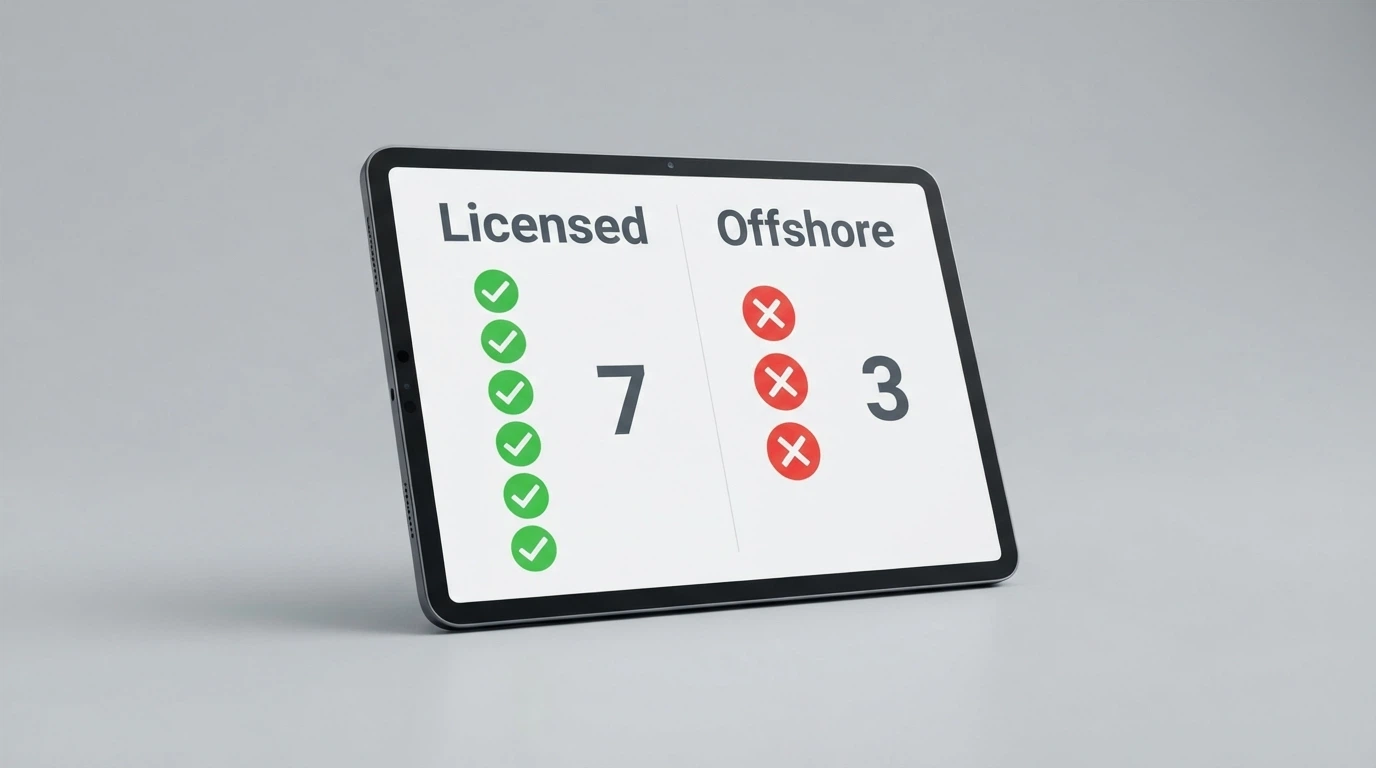
The clearest fact about the Australian market is the split in it. Of the ten most-used brands tracked in Australia, seven hold an Australian wagering licence and three operate as offshore casinos without one. The comparison below shows the split at a glance.
| Operator | Licence status in Australia | Primary product | Market share (%) |
|---|---|---|---|
| SportsBet | AU licensed wagering (Northern Territory) | Wagering | 19.57 |
| Tab | AU licensed wagering (state-based) | Wagering | 11.54 |
| Rocket Play | Offshore casino, no AU licence | Online casino | 9.40 |
| Skycrown | Offshore casino, no AU licence | Online casino | 8.55 |
| Bet365 | AU licensed wagering (Northern Territory) | Wagering | 6.56 |
| Ladbrokes | AU licensed wagering | Wagering | 4.53 |
| TABtouch | AU licensed wagering (state-based) | Wagering | 4.28 |
| PointsBet | AU licensed wagering | Wagering | 2.66 |
| Royal Reels | Offshore casino, no AU licence | Online casino | 2.51 |
| Neds | AU licensed wagering | Wagering | 2.25 |
Three offshore brands together account for 20.46% of the AU tracked set. Seven licensed brands account for 51.39%. The remaining 28.15% sits with brands outside the top ten. The offshore slice is large enough to be a market fact, and small enough to be a policy question — that is the shape of the conversation the rest of this page joins.
SportsBet
SportsBet is the largest brand in the AU tracked set, at 19.57% market share, and the only thing that surprises a reader about that figure is how unsurprising it is once they see the product. SportsBet is licensed under the Northern Territory wagering model and runs as a sports and racing bookmaker — no casino product, no pokies, no sign-up bonus in the offshore style. The AU footprint is built on AFL, NRL, racing and the long tail of international sport, plus a deep integration with sports media that keeps the app in front of Australian bettors at the moment they are deciding what to back.
A reader looking for a $5 no-deposit casino bonus will not find it here, because the category does not exist on a SportsBet account. A reader looking for a licensed Australian wagering account with PayID and consumer protection will. The brand’s value to the second reader is what it actually is.
Tab
Tab — the various state TABs operating under their umbrella bodies — sits at 11.54% market share on the strength of a retail and online racing and sport wagering product that runs deep into Australian habit. The TAB is what a generation of Australian punters grew up walking into, and the online product is the same counter on a phone. State-based wagering licensing is the regulatory frame, racing and sport is the menu, and casino play is not on it.
Tab is the wagering brand for a reader who wants the licensed incumbent and is not looking for a casino product at all. The slot in this ranking is its incumbent position. It is not a casino destination and it never has been.
Rocket Play
Rocket Play is the highest-traffic offshore casino brand in the AU tracked set, with 9.4% market share, and the figure is the headline. Rocket Play holds no Australian licence because no Australian casino licence exists for it to hold. Online casino is prohibited in Australia under the Interactive Gambling Act 2001, and the operator sits outside the Australian consumer-protection framework that a licensed wagering brand sits inside. ACMA enforcement has been directed at sites in this category since 2017, and the 2027 reform will hand banks and payment providers express authority to block transactions to operators in this group.
Rocket Play is a real product on real Australian screens. It is also the product the rest of this page warns against. A reader considering this brand should weigh the offer against the IGA framework before depositing.
Skycrown
Skycrown is the second offshore casino brand in the tracked set, at 8.55% market share, and the profile is close enough to Rocket Play’s that the analysis does not need to repeat itself. Skycrown holds no Australian licence, runs outside the Australian consumer-protection framework, is not connected to BetStop, and sits in the category the ACMA has been blocking since 2019. The brand is a casino destination; it is not a wagering operator; it is not an Australian-licensed anything.
The protection gap between this brand and a licensed Australian wagering operator is the gap the page is built around. Skycrown’s traffic is real, and the protection is not.
Bet365
Bet365 is a global wagering brand, and the 6.56% market share it holds in Australia is a wagering share, not a casino share. The AU product is licensed under the Northern Territory model and runs as a sports and racing bookmaker — the global Bet365 casino product is not offered to Australian customers because it cannot be. The AU app is a familiar screen: the green colour, the live sport, the multi-builder, and no casino lobby.
For a reader who uses Bet365 elsewhere and is searching for the AU edition of its casino product, the answer is that there is no AU edition of that product. There is an AU edition of the wagering product, with full PayID support and an Australian licence behind it. The brand’s value to an Australian reader is the wagering half, not the casino half the brand carries in other markets.
Ladbrokes
Ladbrokes is a familiar UK bookmaking name operating under an Australian wagering licence, with 4.53% market share. The Australian Ladbrokes product is racing and sport wagering, with no casino content on the AU app. The brand recognition comes from the global parent; the Australian regulatory frame is the standard Northern Territory and state wagering model.
The brand is worth treating as a licensed Australian wagering operator with a familiar name on the front. A reader who came looking for a casino bonus will not find one on Ladbrokes AU, as that product category is entirely absent from the Australian app.
TABtouch
TABtouch is Western Australia’s state wagering operator, at 4.28% market share with a state-based licence behind it. The product is racing and sport wagering, with a strong WA racing focus and the kind of retail backing that lets a regional punter walk into a TAB agency and place the same bet they are about to place on the app. Casino play is not on the menu.
TABtouch earns its place through what it actually offers: a WA racing-heavy licensed bookmaker with retail reach behind it and a state regulator in front of it.
PointsBet
PointsBet is an Australian-founded wagering operator at 2.66% market share, licensed under the Australian wagering framework and best known for its points-betting product — a spread-betting-style wager where the payout moves with the margin of victory. The product is wagering only; the casino lobby is not offered in Australia.
A reader who values the brand for the spread-betting niche will find the same product here, with an Australian licence and consumer protection behind it. A reader who came for a casino bonus will find that the Australian product does not support it.
Royal Reels
Royal Reels is the third offshore casino brand in the AU tracked set, at 2.51% market share, and the regulatory profile is the same as the other two. Royal Reels holds no Australian licence, runs outside the Australian consumer-protection framework, is not connected to BetStop, and sits in the enforcement category the ACMA has been acting on since 2017. The brand’s name suggests pokies; the brand’s licence status confirms what the Interactive Gambling Act section lays out.
The reader’s choice on Royal Reels is the same choice the article reaches at its close, and the IGA section is the part of the page that explains why.
Neds
Neds rounds out the AU tracked top ten at 2.25% market share, licensed under the Australian wagering framework and running as a racing and sport bookmaker. The product is wagering only, the licence is Australian, and the casino menu is not offered. Neds sits in the licensed seven; the analysis is the same as for the other licensed operators in the list.
A reader comparing Neds against the offshore brands in the ranking is making the comparison the page is built around. The licensed side of that comparison is the side with PayID, BetStop coverage and Australian consumer law.
The Legal Reality Most Bonus Round-Ups Skip
Most pages listing “$5 casino bonuses” for an Australian audience skip the part of the answer that actually decides the question. The Interactive Gambling Act is the part.

The Interactive Gambling Act and What It Actually Bans
The Interactive Gambling Act 2001 prohibits online casino games and online pokies as interactive gambling services provided to people in Australia, and the prohibition applies nationwide — not federally and not in any state or territory is an online casino licence available. The permitted and licensable online products are wagering on races and sport placed before the event begins, lotteries, and keno, through operators licensed by a state or territory. The minimum gambling age for any of those products is 18. The IGA targets the provider rather than the individual player, so the offence sits with the operator that offers a prohibited interactive gambling service to a person in Australia; the player is not prosecuted under that offence.
Land-based casinos exist in Australia and are state-licensed — Crown and The Star are the well-known examples — but those licences do not extend to an online casino operation. The casino in Sydney is not the legal anchor for an online pokies site, and reading the licence the wrong way is a common mistake at the top of a search page. Australia also does not set a federal deposit, loss or stake ceiling for online gambling, because the product those ceilings would govern is banned outright. Australia caps the payment method and the marketing instead.
| Aspect | Licensed AU wagering operator | Offshore casino site |
|---|---|---|
| Status under the Interactive Gambling Act 2001 | Permitted product (race/sport wagering, lotteries, keno) | Prohibited product (online casino, online pokies) |
| Australian licence | Issued by a state or territory; NTRWC / Licensing NT acts as the de facto national licensor for major online bookmakers | None exists to hold |
| ACMA enforcement perimeter | Outside it | Inside it — 1,564 sites blocked since November 2019; more than 225 services withdrawn since 2017 |
| BetStop coverage | Binds the operator | Not connected to the register |
| Payment methods under AU law | Debit card, bank transfer, PayID/Osko and BPAY permitted; credit cards and crypto banned from 11 June 2024 | Not subject to AU payment rules; accepts whatever its home jurisdiction allows |
| Wagering tax | NT 5% wagering tax plus 0.05% racing levy; states typically apply 10–15% POCT on net wagering revenue | Operator’s home jurisdiction |
ACMA Enforcement: Site Blocking, Withdrawals and the 2027 Escalation
The Australian Communications and Media Authority has been directing Australian internet service providers to block illegal gambling and affiliate websites since November 2019. The cumulative figure is 1,564 sites blocked as of March 2026, and more than 225 illegal services have withdrawn from the Australian market since enforcement was strengthened in 2017. The withdrawals are the part that matters: an operator that leaves the market removes the marketing, the affiliate links and the deposit route, and a player who was using it is left to find a new home for the next session.
From 1 January 2027, banks and payment providers gain express authority to block transactions to illegal gambling operators under the 2026 reform. That is the step the policy had been missing until now: the ACMA could ask an ISP to block a site, but until 2027 it could not ask a bank to block a deposit. The reform closes that gap, and an offshore casino that finds its deposit rail cut off in 2026 has a different kind of business problem on its hands.
How the 2027 Reform Changes the Landscape for Australian Players
The Interactive Gambling Amendment (Gambling Reform) Bill 2026 passed Parliament on 19 August 2026, and its measures commence on 1 January 2027. The reform package is the largest update to Australian gambling law in a generation, and three of its changes will reshape the marketing that surrounds the products on this page.
From 1 January 2027, federal advertising restrictions apply: no more than three wagering ads per hour between 6:00 am and 8:30 pm, plus a live-sport blackout from 15 minutes before a live sporting event until 5 minutes after it ends. Direct marketing of inducements is prohibited for 14 days after a customer signs up, for three months after a person deregisters from BetStop, and indefinitely for customers identified as at risk of gambling-related harm. BetStop itself is strengthened, and the inducement ban that follows deregistration removes the marketing that would otherwise target a person who has just left the register.
The combined effect is to clamp the marketing surface that licensed wagering operators can use, while the offshore casinos remain outside those rules — until the bank payment-blocking powers from 1 January 2027 start to bite at the deposit rail itself.
What BetStop Actually Covers (and the Gap Most Reviews Miss)
BetStop is a real consumer shield. It is also narrower than most pages admit.
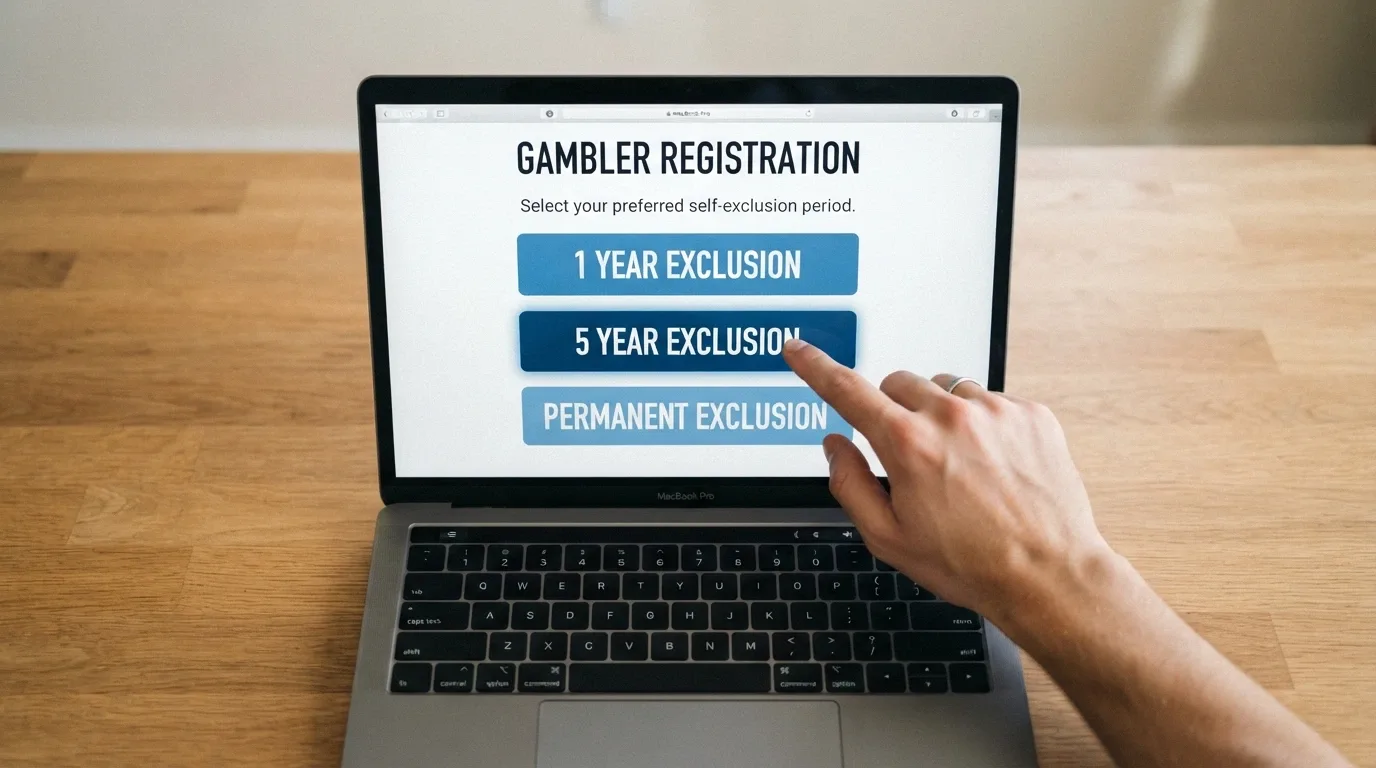
BetStop: What Three Years and 67,000 Registrations Tell Us
BetStop — the National Self-Exclusion Register — went live in August 2023. As at 31 July 2026, three years in, the register held 67,480 registrations, of which 41,290 exclusions were still active. The demographic profile is informative: 78% of registrants were under 40, and 38% chose lifetime exclusion rather than a fixed-term period. The uptake tells a story about demand for the tool, and the lifetime share tells a story about how long a self-exclusion decision tends to last once it is made.
The hard boundary is in the second sentence. BetStop binds Australian-licensed wagering services. An offshore casino is not licensed here, is not connected to the register, and will keep taking a self-excluded person’s money. That is the gap most reviews miss: the self-exclusion the player thought they had put in place stops at the Australian border, and the offshore casino the page keeps returning to is exactly on the other side of it.
From 1 January 2027 the 2026 reform strengthens BetStop and bans direct marketing of inducements for three months after a person deregisters from the register, which addresses the period when a self-excluded person is most at risk of being pulled back in by marketing. The reform does not, however, address the offshore gap — an offshore casino is not an Australian-licensed wagering service, and BetStop does not bind it.
The Help That Is Actually There: Helpline, Counselling and Practical Limits
The support infrastructure an Australian player can reach is real, and it works regardless of which kind of operator a person has been using.
- The National Gambling Helpline is 1800 858 858 — free, confidential, staffed 24 hours a day, seven days a week.
- Gambling Help Online (gamblinghelponline.org.au) provides online chat and counselling.
- Licensed wagering operators may offer customer-set deposit limits and activity statements under state or territory conditions, and those conditions differ between jurisdictions — ask the operator what its toolset includes before relying on it.
- Harm prevalence: about 2.1% of Australian adults — roughly 430,000 people — experience problem gambling, with the Australian Institute of Health and Welfare putting high-risk gambling at 1.8% in 2022.
These numbers and services do not depend on which side of the licensed-versus-offshore line the player is on. The infrastructure is the same either way.
How We Chose and Checked Every Operator on This Page
The operator set on this page is drawn from the AU tracked-market-share shortlist. Each brand was checked against official state and territory wagering registers and the Northern Territory Racing and Wagering Commission’s public records; the offshore brands were checked against the ACMA’s enforcement record and the absence of an Australian register entry. The ranking order is by tracked market share; the licence-status column reflects what the registers and the ACMA records show.

The criteria are qualitative, not scored. No invented weighting or composite score sits behind the order. Bonus-term fields per operator were not confirmed from live sources this run, and the analysis on bonus structure in the earlier sections is the qualitative shape of the market rather than a per-brand audit. Where a field would have required a per-brand figure this page does not have, the analysis was written around the gap rather than around an invented number, and the gap is itself information a reader can act on.
Where Your $5 Is Safest in 2026 — and What to Avoid
The reader who reached this page was looking for a casino bonus. The evidence on the page points to a different answer, and the answer is not a recommendation of a specific operator.

One Path Has Protection — the Other Has a Bonus That Isn’t Worth the Risk
A $5 deposited with an Australian-licensed wagering operator buys a $5 bet on a licensed product, processed through PayID, covered by Australian consumer law, and bound by BetStop if the player chooses to self-exclude. The deposit is reversible through the operator’s complaints process, the operator is licensed, and the regulator behind the licence has a name and an address.
A $5 deposited with an offshore casino buys a “free” bonus whose headline figure is smaller than the turnover commitment it requires, processed through a payment rail that does not require the destination to be licensed, with no Australian complaints body to escalate to and no BetStop coverage. The “free” credit is a loan of $5 at a $200 play-through cost on a typical 40x bonus, before any max-cashout cap is applied.
The two products are not the same product, even when the dollar amount is. The choice the page reaches is a description of that gap, not a recommendation of an operator. A reader with a $5 to spend in 2026 can put it where the protection is, or where the bonus is. The two are not the same place.
Frequently Asked Questions
Is It Lawful to Run an Internet Pokies Site for Australian Residents?
No. Providing online casino games and online pokies to a person in Australia is prohibited under the Interactive Gambling Act 2001, and no state or territory issues an online casino licence. The offence sits with the operator that offers the service; the individual player is not prosecuted. Land-based casino licences do not extend to online pokies.
What Do Turnover Conditions Actually Mean for a $5 Freebie?
A turnover condition — also called a wagering requirement — is the number of times a bonus must be wagered before winnings become withdrawable. A 40x turnover on a $5 no-deposit bonus means $200 must be run through eligible games first. Game weighting often drops table games to 5–20%, and a max-cashout cap limits what can be kept.
How Does an Instant Bank Transfer Work at Aussie Gambling Sites?
PayID links a bank account to a mobile number or email; Osko is the near-instant settlement layer on top of the New Payments Platform. A PayID deposit at a licensed wagering operator typically lands in seconds. Legal deposit routes are debit card, bank transfer, PayID/Osko and BPAY; credit cards and crypto are out.
Does the Self-Exclusion Register Block Unlicensed Operators Too?
BetStop binds Australian-licensed wagering services. An offshore casino is not licensed here, is not connected to the register, and will keep taking a self-excluded person’s deposits. BetStop is the right tool for licensed wagering; it is not a tool for offshore casinos. The gap is one a self-excluded player needs to know about.
Do Punters Need to Declare Gambling Wins on Their Tax Return?
Betting and gambling winnings are not assessable income under section 6-5 of the ITAA 1997 for an ordinary punter, and losses are not deductible under section 8-1 unless the person is carrying on a betting or gambling business. A recreational player declares neither wins nor losses; a professional should get advice.
Where Can Someone Get Free Help for a Pokies Problem Right Now?
The National Gambling Helpline is 1800 858 858 — free, confidential, staffed 24 hours a day, seven days a week. Gambling Help Online (gamblinghelponline.org.au) provides online chat and counselling. BetStop is the National Self-Exclusion Register for licensed wagering operators. The helpline and Gambling Help Online work regardless of where a person has been playing.
Written by the editors at Microgaming Casinos AU.