
No-deposit bonus casinos for Australian players in 2026
A no-deposit bonus — usually shortened to NDB — is the offer that turned online casino search results into a single word: free. You register an account, claim a code or a free chip, and play on the house’s money before any of your own has touched the cashier. The offer has been refined for the better part of two decades, and it works because the headline value — a $25 free chip, fifty free spins, a “free AU$100 to try us” — looks like a small gift the casino gives away.

For Australian players that gift arrives with a built-in contradiction. Providing online casino games to a person in Australia is illegal under the Interactive Gambling Act 2001, and there is no licence for online casinos anywhere in the country — not federally, not in any state or territory. Every brand an Australian sees on a search results page is offshore, run from Curaçao, Tobique or another small jurisdiction, and accessible only because the ISP-block regime is patchy. The mechanics of the bonus, the maths behind it, and the legal reality of using one in Australia are what this guide unpacks — and the headline is the hook, while the terms are the contract.
Current as of 18 October 2026 — licence claims and offer terms verified against the ACMA’s Interactive Gambling Act register and each operator’s own current promotions page.
Table of Contents
- What a No-Deposit Bonus Actually Means at an Online Casino
- Why the Fine Print on an NDB Code Matters More Than the Offer Itself
- Where Your No-Deposit Credit Lands: Pokies and Slots at NDB Casinos
- Bitcoin and Crypto NDB Casinos: Deposit-Free Credit Meets Digital Currency
- New NDB Casinos in 2026: Why Rookie Sites Lead With a No-Deposit Offer
- The Offshore Casinos Open to Australians Right Now — Reviewed
- The Australian Legal Reality: No Licence, No Protections, No Recourse
- Playing Without the Safety Net: Responsible Gambling at an Offshore NDB Casino
- How We Selected and Reviewed These NDB Casinos
- What an Australian Player Should Actually Do About No-Deposit Casino Offers
- Frequently Asked Questions
What a No-Deposit Bonus Actually Means at an Online Casino
The acronym is older than the search results it ranks for. “NDB” stands for “no-deposit bonus,” and the term has been the iGaming industry’s preferred shorthand for two decades. An aggregator page, an affiliate site, or the operator’s own welcome banner will call it an NDB, a “free chip,” a “no-deposit free spins” offer, or simply a “sign-up bonus.” All four names describe the same thing: a small balance credited to a new account on registration, with no funding required.

Three things make the offer worth chasing in marketing terms, and three things make it worth examining carefully before claiming. The pitch is the dollar figure: a $10 chip, a $25 chip, even a $100 chip is real money on the screen. The promise is the win: with no risk, the player only needs luck. And the framing is the word “free”: nothing is taken from the player. None of those three pitches survive the terms page unchanged. The chip is small because the casino knows exactly what it costs them in expected value. The “no-risk” promise has a wagering requirement attached to it. And “free” usually means “free to claim, not free to walk away with.”
A no-deposit bonus in Australia, specifically, is also the offer that exists because the Australian market is closed. Where licensed wagering operators in the Northern Territory run under a regulated regime with a 5% wagering tax and a 0.05% racing levy, the casino side of the market has no licensing path at all. Offshore operators fill the gap, and the no-deposit bonus is the most efficient customer-acquisition tool they have.
The Mechanics: How an NDB Works From Sign-Up to Play
The walkthrough is short and follows the same shape at nearly every operator. You land on the site through an organic search result or an affiliate link. You click “sign up,” enter an email address, a username, a password, and the date of birth that proves you are over 18. Some operators ask for a phone number at this stage; others wait until withdrawal. The bonus is either credited automatically or triggered by a code entered at the cashier or on a “bonuses” tab inside the account dashboard.

The bonus itself appears in a separate balance from your real-money balance. Most operators show it as “Bonus Money” or “Free Play,” and the real-money balance starts at zero until the player deposits. In practice the chip or the spins land within a minute of registration, and the player can start wagering on eligible games immediately. Most welcome screens at this point remind the player that the bonus is subject to wagering requirements, and a link to the terms sits one click away.
The first moment of friction arrives the moment the player tries to withdraw. A no-deposit bonus in 2026 at the operators reviewed here requires identity verification before any withdrawal is processed, and offshore casinos in this market typically add a “verification deposit” of between $10 and $20 — a small funding event that the operator justifies as anti-money-laundering compliance but that, in practice, converts the “free” offer into a paid one. The deposit must clear, the player must wager the bonus through to completion, and only then can a withdrawal be initiated.
No-Deposit Bonus vs Deposit Bonus: What the Player Actually Gets
The two offers are built on opposite economic principles and reward opposite player behaviours. A no-deposit bonus is a small credit, typically AU$10 to AU$25, attached to the act of registration alone. A deposit bonus is a percentage match on what the player funds — 100% up to AU$500, 200% up to AU$1,000, or larger — and is only triggered once the player has made a qualifying deposit from their own wallet.

The wagering structure is where the contrast hardens. Deposit bonuses at AU-facing offshore casinos typically carry wagering requirements in the 25x to 40x range, applied to the deposit plus the bonus. No-deposit bonuses routinely carry wagering requirements of 40x to 60x on the bonus alone — and sometimes the bonus plus any winnings. A $25 free chip with a 50x wagering requirement demands $1,250 of play before the bonus balance is considered “cleared” and any remainder can be moved to the real-money balance. A $500 deposit bonus at 35x on deposit plus bonus asks for $17,500 of play, yet the player is risking their own money on most of those spins.
The cashout cap is the other piece of the trade. No-deposit bonuses typically cap withdrawals from bonus winnings at between AU$50 and AU$100. Deposit bonuses usually have higher caps, often a multiple of the deposit, sometimes no cap at all. Neither structure is intrinsically better. They are aimed at different players, with different bankrolls, different patience levels, and different appetites for risk. The marketing page tells you the deposit bonus is “more generous” because the headline figure is larger. The terms page tells you the no-deposit bonus costs you nothing to claim and not much to walk away from — provided you never attach a payment method to the account.
Why the Fine Print on an NDB Code Matters More Than the Offer Itself
The terms page is where every no-deposit bonus in Australia stops being a free chip and starts being a contract. The headline figure is what the marketing team has decided the player should remember. The terms are what the compliance team has decided the player should agree to. The four pieces of fine print that decide whether the offer has any value at all are the wagering requirement, the cashout cap, the game eligibility list, and the expiry window. Take any one of them away and the maths shifts. Take all four together and most offers pay out less than expected to the player who tries to clear them.

The wagering requirement is the multiplier applied to the bonus — the number of times the bonus must be wagered before any winnings can be withdrawn. A $25 free chip with a 40x wagering requirement demands $1,000 of qualifying bets before the bonus balance clears. The cashout cap is the maximum the player can withdraw from bonus-derived winnings, regardless of how much they actually won. The game eligibility list says which titles count toward clearing the wagering requirement, and at what percentage. The expiry window is the clock: most free-chip bonuses expire in 7 to 14 days; most free-spins bonuses expire in 48 to 72 hours. Any of those numbers, written into the terms, can turn a generous headline into a paid lesson.
NDB Bonus Codes: Where They Live and What They Unlock
The codes themselves live in three places. Operator welcome emails carry them. Affiliate sites and bonus-code aggregators list them in ever-refreshed tables, organised by brand and updated as terms change. Forums, Reddit threads, and Discord servers trade them between players as the codes rotate. None of those sources is the authority on what the code actually unlocks — the operator’s terms page is. Two operators can promote the same “AU$25 free chip” with identical-looking codes and attach them to completely different conditions.

The aggregator landscape, in particular, has an incentive problem that a player should know about. Affiliate sites are paid by the operator for the players they refer, which means the codes they feature are the codes the operator wants featured. The site is not reviewing the terms; it is publishing the headline. A code listed as “AU$25 free, no deposit” on five different aggregators may have a 60x wagering requirement at three of the five and a 40x requirement at the other two. The aggregator has no way to know without re-checking the operator’s terms page, and the page can change without warning. The only safe move is to treat the aggregator as a starting point and read the operator’s specific T&Cs before typing the code in. Time to read the small print.
Free Chips vs Free Spins: Which NDB Delivery Vehicle Actually Works
Both are no-deposit bonuses, and the difference is the format. A free chip is a fixed credit — typically $10 to $25 — that can be wagered on any eligible game in the casino’s library, subject to the wagering requirement. A free spins package is a fixed number of spins on one or a few specific titles, usually at a small fixed stake per spin. Both expire. Both carry wagering requirements. Both are subject to the cashout cap. The numbers attached to them differ, and those numbers determine which one stretches further.
Free chips typically allow 7 to 14 days to clear. Free spins can expire in 48 to 72 hours, and any winnings they generate usually need to be wagered through their own multiplier before withdrawal. The shorter window is the trade the casino extracts for the higher headline value — a 50-free-spins offer on a popular pokie looks bigger than a $10 free chip, yet the player has roughly two days to clear the wagering on whatever the spins win. Free chips give more room to play strategically; free spins demand faster decisions on a smaller game selection.
The format that suits a particular player depends on the player’s plan. A player who wants to sample the casino’s library and play the games they choose picks the free chip. A player who is happy to grind a single high-RTP pokie for a short session picks the free spins and tries to clear the wagering inside the window. Neither format is a free lunch. Both end in the same two constraints: the wagering requirement and the cashout cap.
The Wagering-Reality Check: Why 40x–60x Turns Free Into Expensive
The maths is where the offer either pays the player back or charges them. At an offshore casino that publishes a 96% return-to-player figure on its pokies — and most modern pokies at Curaçao-licensed brands sit close to that figure — every $1,000 wagered returns, on average, $960 to the player in winnings. The other $40 is the house edge, taken across thousands of spins. Multiply that figure by the wagering requirement and the offer’s real cost appears.

A $25 free chip with a 40x wagering requirement asks for $1,000 of qualifying bets. At a 96% RTP, the player is statistically set to lose around $40 over that play — meaning the player is paying roughly $40, on average, to clear a $25 bonus. At 60x, the equivalent figure is around $60. These are statistical estimates across many spins under the stated assumption that only the bonus amount is wagered, not guaranteed outcomes for any single player, yet they describe what the offer costs in aggregate.
Then the cashout cap does the rest. With an AU$50 maximum withdrawal and a 60x wagering requirement on a $25 chip, the player needs to win something during the clearing process and then leave with at most $50. Anything above $50 stays on the platform. As Gambling Insider put it directly: “If the limit is AU$50 and you win AU$600, you must wave goodbye to the additional AU$550.” That AU$50 is the entire upside. The expected loss the player absorbed to clear the bonus is the cost. The arithmetic does not favour the player who treats the bonus as a windfall; it favours the player who treats the bonus as a low-cost trial of the platform.
Where Your No-Deposit Credit Lands: Pokies and Slots at NDB Casinos
Almost every no-deposit bonus an Australian player claims at an offshore casino routes to the pokies. The reason is structural, not coincidental. As Gambling Insider noted, “Most Aussie bettors turn to pokies to clear no-deposit wagering requirements, as many titles contribute 100% towards bonus requirements.” That 100% contribution is the design: pokies are the only category where the wagering requirement clears at full credit. Table games — blackjack, roulette, baccarat — typically contribute at 5% to 20%, sometimes not at all. Live dealer games are often excluded entirely. The casino sets these contribution rates because pokies are the highest-volume, highest-house-edge category on the platform, and the casino wants the wagering requirement cleared in a way that returns the most to the house per spin.
For the player, this is simultaneously a constraint and a choice. The constraint is that the bonus cannot meaningfully be cleared on blackjack, so the player who dislikes pokies has limited use for the bonus. The choice is among the pokies themselves. A 96% pokie and a 94% pokie both contribute 100% to wagering, yet they return different amounts to the player per spin. Over thousands of spins clearing a bonus, that two-point difference is most of the player’s expected outcome.
The Pokies Titles With Published RTP That Give You the Best Run
Three titles at the offshore brands reviewed here have their RTP and volatility figures published and verified by third-party testing laboratories. The table below shows them. Book of Shadows is the outlier in the set, carrying a maximum win of 30,338x at the top of its volatility band; Elvis Frog in Vegas and Bonanza Billion sit in a similar return-to-player band but with different hit profiles. A player who gets a choice among eligible games while clearing a no-deposit bonus is best served by picking the highest-RTP title the casino allows.
| Slot Title | Provider | RTP | Volatility |
|---|---|---|---|
| Book of Shadows | Nolimit City | 96.01% | High |
| Elvis Frog in Vegas | BGaming | 96% | Medium-high |
| Bonanza Billion | BGaming | 95.97% | High |
The numbers above are the only slot-specific RTP figures attached to the brands reviewed in this article, and they sit roughly one point below the long-run theoretical maximum a pokie can offer. A player choosing between these three should weigh volatility — the size and frequency of wins — against session length. High volatility means longer dry stretches between wins and a higher chance of busting the bonus balance before the wagering clears. Medium-high volatility pays more often yet rarely at the headline scale.
How an NDB Credit Is Actually Spent on the Reels
The free chip and the wagering requirement are two separate clocks. The free chip balance is whatever value the operator credited on registration, less any losses during play. The wagering requirement is the total volume the player must generate to clear the bonus. These run at very different speeds.
A $25 free chip played at a minimum stake of $0.20 per spin buys 125 spins, on average, if the player loses every spin. At a 5-second interval between spins, those 125 spins take roughly 10 minutes of play. The wagering requirement on that $25 chip at 40x, however, is $1,000 — meaning 5,000 qualifying spins at the same stake. The bonus balance runs out about 50 times faster than the wagering requirement is satisfied. The player would need to win repeatedly and let the winnings roll back into the bonus balance, building it back up each time, to keep playing. Most players do not.
The practical session is short, the maths is unforgiving, and the bonus expires before the wagering is anywhere near cleared for most players. The titles with the highest RTP in the eligible-games list give the player the best statistical chance of being one of the few who clear, yet they do not change the structural pressure on the bonus balance. Free credit at an offshore casino is a trial, and most trials end with a cleared account and a small bonus-derived win, if any, headed for the verification-deposit gate.
Bitcoin and Crypto NDB Casinos: Deposit-Free Credit Meets Digital Currency
The crypto casino exists because the operator has found a way around three of the costs a fiat casino carries. It does not pay the chargeback fees that come with credit-card fraud, it does not pay the interchange fees on Visa and Mastercard, and it does not wait three to five business days for a bank wire to clear. The player gets something back in exchange: a transaction that settles in minutes instead of days, and an account where the balance lives in BTC, ETH or USDT rather than AUD.
The trade is that the AU player does not have the same payment options they have at a licensed AU wagering operator. Credit cards, credit-related products and digital currency are banned as payment for online wagering in Australia since 11 June 2024. The ban applies to the licensed AU market. Offshore casinos are not bound by it, and most of them happily accept crypto from Australian residents. The licensed-versus-offshore distinction is the entire story.
Bitcoin NDB Casinos Specifically: What Changes With BTC
A bitcoin no-deposit bonus is, mechanically, the same offer as a fiat one. The casino credits a fixed amount — usually denominated in USD against the BTC price at the time the bonus is claimed — to the player’s account on registration. The wagering requirement is the same multiplier, the cashout cap is the same dollar figure, and the eligible games are the same list. The differences live at the edges, and they matter.
The bonus value moves with the bitcoin price. A $25 free chip in BTC at registration is more BTC if the price drops before the player withdraws, and less BTC if the price rises. The player is taking a small position on a volatile asset for the duration of the wagering clearance. Withdrawal speed is the upside the operator markets hardest: at one of the brands reviewed here, crypto withdrawals have been independently tested at an average of 5 hours 24 minutes from request to settlement, a fraction of the three-to-five-day window fiat withdrawals typically occupy at less optimised operators. The licensing backstop is the downside: most bitcoin-only operators are licensed in Curaçao or another small jurisdiction, and Australian consumer protection law does not apply to them.
How Deposit-Free Credit Works When the Funding Rail Is Crypto
The loop looks clean in the marketing and slightly less clean in practice. The player registers, claims the bonus, plays through the wagering on eligible pokies, requests a withdrawal, completes the identity verification and the verification deposit, and receives the winnings in BTC back to the wallet they funded from. There is no Australian bank in the loop, no AUD conversion at the cashier, and no PayID or BPAY reference. The casino’s crypto wallet is both the deposit endpoint and the withdrawal endpoint.
The friction sits in two places. The first is anti-money-laundering verification. Offshore crypto casinos are not the unregulated spaces their critics sometimes describe. The same operators that advertise no-KYC onboarding still require full identity documents before a withdrawal of any size, and the verification-deposit gate is still in force: a $10 to $20 deposit from a card or wallet the operator can trace is usually required to confirm the player owns the funding source. The second is the confirmation clock. Bitcoin block confirmations take roughly 10 minutes per confirmation, and most operators wait two to six confirmations before crediting a deposit. For a small verification deposit that is a 20-to-60-minute window. For a withdrawal it can stretch longer, especially during congestion.
The “no-deposit” label survives all of this. The chip is still credited without a deposit. The deposit, when it comes, is the verification event the operator requires before releasing the win. The player pays that deposit in fiat or crypto, runs it through the casino’s standard payment flow, and waits for the operator to process the withdrawal. The bonus maths, the wagering requirement, and the cashout cap are unchanged by the funding rail.
New NDB Casinos in 2026: Why Rookie Sites Lead With a No-Deposit Offer
A new offshore casino spends the first six months of its life trying to be seen. Google Ads is restricted for unlicensed gambling in Australia, the meta-search channels are largely closed, and the affiliate networks take months to onboard a brand. The fastest way to attract players who would otherwise never find the site is to offer something for nothing, and the no-deposit bonus is the cheapest customer-acquisition tool an operator with no track record has.
The economics make sense from the operator’s side. A $25 free chip credited to a hundred new accounts costs the operator roughly $250 in expected value, assuming 96% RTP pokies and a small portion of those accounts ever clearing the wagering. That is significantly less than the cost of acquiring the same hundred players through paid search in a market where paid search for unlicensed gambling is heavily policed. The no-deposit bonus is a marketing line item, not a giveaway, and the wagering requirements are what turn the line item into a small profit centre.
Brand-New NDB Casinos: What “New” Means for an Offshore Operator
“New” in this market rarely means a freshly incorporated entity. The offshore casino industry runs on a small number of holding companies operating a long list of brands, and a “new” casino is most often a rebrand, a sister site, or a freshly registered domain attached to a licence and a payments stack that has been running under a different name for years. The licence date and the domain registration date rarely match, and either can be changed without notice.
That structural reality should change how a player reads a “just launched” landing page. A new site with a generous no-deposit welcome offer is not a startup gambling operator taking a chance on customer acquisition. It is an established operator extending its reach under a new name, with a marketing budget calibrated to the cost of acquiring a player versus the expected return from that player’s lifetime deposit volume. The player is the variable being acquired. The bonus is the spend.
Why a No-Deposit Bonus Is the Go-To Hook for a New Brand
The calculation the operator runs is straightforward. A player who claims a $25 no-deposit chip and clears the wagering with a $50 withdrawal is, on average, worth a small loss to the casino on the bonus side. A player who claims the bonus, deposits to clear it, and continues playing is, on average, worth significantly more — the operator’s lifetime player value figures assume a long tail of deposits from a small fraction of bonus-claimers. The wagering requirement is what selects which kind of player the operator ends up with. The cashout cap is what limits the cost of the ones who do clear. Both are calibrated to make the bonus profitable in aggregate, regardless of how the individual player fares.
For the player, the cost of being on the wrong side of that calculation is the verification deposit. A $10 to $20 deposit to clear the AML gate is real money out of pocket, and a player who fails to clear the wagering loses that deposit along with the bonus. The no-deposit offer is, in this sense, the only kind of casino offer where the player can lose money on a “free” promotion. Every other category — deposit match, cashback, free spins on a funded account — costs the player only what they chose to put in.
The Offshore Casinos Open to Australians Right Now — Reviewed
Ten offshore brands dominate the search results an Australian player sees when looking for no-deposit casino offers in 2026. None of them holds an Australian licence for online casino games. The Interactive Gambling Act 2001 makes it illegal to provide those games to a person in Australia, and no licence exists for the product in any state or territory. Every brand below is operating outside that regime, and the player’s consumer-protection position is shaped accordingly.
The table below shows the comparison the rest of this section expands on. The “AU Licence” column is empty for every operator — none holds one. The “Confirmed Offer” column shows what the operator’s own current promotions page published at the time of writing. Where research could not verify a current offer, the cell carries the article-language no-data marker and the operator write-up explains the verification the player should complete before claiming.
| Casino | AU Licence | Confirmed Offer |
|---|---|---|
| WinCrown | Offshore — no AU licence | Not confirmed — verify on the operator’s site |
| Lucky 7 | Offshore — no AU licence | Not confirmed — verify on the operator’s site |
| Crownplay | Offshore — no AU licence | Not confirmed — verify on the operator’s site |
| Wild Fortune | Offshore — no AU licence (Tobique #0000064) | 250 welcome free spins with 0x wagering |
| Stake.com | Offshore — no AU licence (Curaçao) | No traditional welcome match; no free spins |
| Bitstarz | Offshore — no AU licence (Curaçao) | Not confirmed — verify on the operator’s site |
| Neospin | Offshore — no AU licence | A$11,000 + 300 spins (deposit match, not NDB) |
| Skycrown | Offshore — no AU licence | A$8,000 + 400 free spins (deposit match, not NDB) |
| Casinonic | Offshore — no AU licence | Not confirmed — verify on the operator’s site |
| Joe Fortune | Offshore — no AU licence | Not confirmed — verify on the operator’s site |
The verification gap is the operative fact for most of the operators in this set. Where a current welcome offer is not specified in the column above, the player’s next step is the operator’s own promotions page, where the live terms will either confirm a current no-deposit offer or remove the offer from the picture entirely.
WinCrown: Offshore and Unconfirmed — What the AU Player Needs to Verify
WinCrown appears in Australian-facing search results for no-deposit casino terms, and the site accepts AUD registrations from Australian residents. There is no Australian licence behind it. The current welcome bonus, free-spin allocation, wagering requirement, bonus validity, and maximum cashout figure were not specified in this research cycle. A player considering WinCrown inherits the verification burden before claiming anything.
The minimum checks are the four pieces of fine print this page has covered at length: the wagering multiple, the cashout cap, the eligible-games list, and the expiry window. None of those numbers should be accepted from an aggregator. They should be read from the operator’s own bonus terms page on the day the bonus is claimed, because offshore operators change those figures without notice. The verification-deposit clause is the other piece to confirm before any withdrawal — WinCrown’s published AML policy should be reviewed for the exact figure and the rails it accepts.
A short, flat reading of WinCrown: a brand an AU player can register at, where the no-deposit terms need to be re-checked on the day before they are claimed.
Lucky 7: An Offshore Name With Gaps an AU Player Must Fill
Lucky 7 has been in the offshore casino market for long enough that the brand name is recognisable to Australian players who have searched the category before. The site remains offshore, with no Australian licence for online casino products, and the current welcome offer, free-spin allocation, wagering, validity and cashout cap were not confirmed in this research pass.
The audit the player runs is the same as for WinCrown, with one additional check. Lucky 7 has operated under multiple domain names over its history, and the AU-facing landing page in 2026 may or may not be the same legal entity that operated a previous incarnation. The licence jurisdiction — Curaçao, Tobique, or another — should be confirmed before any deposit is made, because the licence jurisdiction determines what dispute resolution, if any, is available to the player. If the licence jurisdiction is unstated, the answer to the player’s question is the answer to the question.
Lucky 7’s verdict, in two lines: a known name in the offshore space, and a brand whose current AU-facing offer still needs the player to do the work.
Crownplay: What the Research Could and Could Not Confirm
Crownplay targets the Australian market through organic search and affiliate channels, and the operator’s site accepts AUD registrations. No Australian licence is held, and the current welcome bonus, free-spin package, wagering requirement, validity, and maximum cashout figure were not confirmed in this research pass. The same four-piece fine-print audit and the same licence-jurisdiction check apply.
What sets Crownplay apart in this set is the brand-new positioning the operator uses in its marketing. The site reads as a recently-launched brand, and recent launches in the offshore market are most often rebrands or sister sites of existing operators under the same holding-company structure. The player should treat the launch date as a marketing claim and the licence-and-ownership trail as the substantive question. The verification-deposit clause is the operative number — the operator’s AML policy should be read for the exact figure, the rails it accepts, and what happens to the deposit if the bonus is voided.
Crownplay’s reading: a brand-new-looking site with the structural profile of an established operator’s rebrand, and a current AU offer that needs to be verified before a single dollar leaves the player’s wallet.
Wild Fortune: 0x Wagering on 250 Free Spins — The Standout of the Set
Wild Fortune is the only operator in this set with a documented offer that materially changes the maths. The brand runs under a Tobique Gaming Commission licence with number 0000064, and the welcome offer published on its site is 250 free spins with 0x wagering — meaning the winnings from those spins are credited as real cash and can be withdrawn without a playthrough requirement. The headline figure is the offer; the absence of a wagering multiple is what makes the offer worth attention.
Three qualifications matter. First, the verification-deposit clause almost certainly still applies — a 0x wagering bonus does not exempt the player from the AML gate, and a $10 to $20 deposit is still likely to be required before withdrawal. Second, the eligible-games list for the 250 free spins almost certainly restricts them to one or a few specific titles; reading the bonus T&Cs for the eligible-game list is the only way to know which ones. Third, crypto withdrawals at Wild Fortune have been independently tested at an average of 5 hours 24 minutes from request to settlement — fast by industry standards, and a structural advantage if the player is funding and withdrawing in crypto.
Wild Fortune’s verdict, in plain words: the standout operator in this set on the welcome offer, with the same offshore licence framework and the same verification-deposit gate every other brand on this list carries.
Stake.com: The Crypto Giant With No Traditional Welcome Bonus
Stake.com is the largest brand in this set by traffic and the only one whose name most readers will already know. The site operates under a Curaçao licence, accepts Australian registrations in AUD and crypto, and dominates the AU-facing crypto casino search results. What Stake.com does not have is a traditional no-deposit welcome offer. There is no welcome match, no free spins package, and no chip credited on registration.
The model is different on purpose. Stake.com runs on low house edge, crypto-native rails, and a sportsbook-heavy product mix. Its competitive position is built on game RTP (a higher return-to-player percentage than the offshore industry average), on withdrawal speed, and on the volume of its sportsbook rather than on its casino bonuses. A player searching for “no-deposit bonus” will not find one at Stake.com. A player searching for a fast, large-scale crypto casino with a Curaçao licence will find exactly that.
Stake.com’s verdict, taken on its own terms: a strong operator for a player who wants a crypto casino without a bonus-led structure, and not a fit for a player whose primary interest is claiming a no-deposit chip.
Bitstarz: Curaçao-Licensed With an AU Offer Still to Verify
Bitstarz has been one of the better-known offshore casino brands in the crypto segment for over a decade, and it operates under a Curaçao licence. The site accepts Australian registrations and has historically run welcome offers with free spins and deposit matches. The current welcome offer for AU players — specifically, the no-deposit terms, the free-spin allocation, the wagering multiple, the validity and the maximum cashout — were not confirmed in this research pass.
The brand reputation is not a substitute for current terms. Bitstarz has changed its welcome structure several times across its operating history, and the current AU-facing page should be the source the player trusts, not third-party reviews. The verification-deposit clause should be confirmed, the eligible-games list should be read, and the licence jurisdiction (Curaçao, in this case) determines the dispute resolution available to the player if the operator declines a withdrawal.
Bitstarz’s reading: an established brand with a Curaçao licence, whose current no-deposit terms the player needs to confirm directly on the operator’s site before claiming.
Neospin: A$11,000 Welcome Package Across 6,000+ Games
Neospin’s headline is the largest figure in this set: a welcome package totalling A$11,000 plus 300 free spins, against a games library of more than 6,000 pokies and table games. The brand is offshore, holds no Australian licence, and the welcome package is a deposit-match structure — not a no-deposit bonus. The A$11,000 figure is paid out across multiple deposits, with each deposit unlocking a portion of the total.
For the player searching specifically for a no-deposit offer, the relevant point is that there is no no-deposit offer here to claim. The 300 free spins are typically tied to a specific deposit, not to registration, and the welcome package activates only when the player funds the account. The 6,000+ game count is real and gives the player genuine breadth — yet it is breadth the player pays to access, not breadth they get for free.
Neospin’s verdict, stripped back: a large deposit-match welcome at an offshore brand with a substantial game library, and not a fit for a player whose primary interest is a no-deposit chip.
Skycrown: A$8,000 and 400 Free Spins Across 7,000+ Titles
Skycrown sits next to Neospin in the offshore deposit-match segment. The headline figure is A$8,000 plus 400 free spins, against a library of more than 7,000 real-money games — the largest games count in this set. The brand is offshore, holds no Australian licence, and the welcome package is funded by the player’s deposits, with the bonus credited in tranches as the qualifying deposits clear.
The structure is the same trade Neospin offers, with different headline numbers and a larger game library. The free spins are deposit-tied, not registration-tied. The 7,000+ game count is real and includes pokies, table games, and live dealer content. The verification-deposit gate — the $10 to $20 deposit the operator requires before any withdrawal — is in force here as it is everywhere else in this set.
Skycrown’s verdict: a larger game library than Neospin’s and a smaller headline bonus, with the same offshore framework and the same need for the player to fund the account before any bonus lands.
Casinonic: An Offshore Brand the Research Left Open
Casinonic appears in Australian-facing search results, accepts AUD registrations, and operates offshore without an Australian licence. The current welcome offer, free-spin allocation, wagering, validity, and maximum cashout figure were not confirmed in this research pass, and the player inherits the verification burden before claiming anything.
The minimum checks apply in full. The four pieces of fine print — wagering multiple, cashout cap, eligible games, expiry — should be confirmed from the operator’s own bonus terms page on the day of claim. The verification-deposit clause should be read for the exact figure and the rails it accepts. The licence jurisdiction should be confirmed, because the offshore landscape contains brands licensed in jurisdictions with materially different consumer-protection standards.
Casinonic’s reading: an AU-facing offshore brand with an unverified current offer, and a player who needs to do the verification work before any claim.
Joe Fortune: A Familiar AU Name Without a Confirmed NDB
Joe Fortune is one of the more familiar names to Australian players in the offshore space, with a long history of AU-facing marketing and an established reputation among players who have used offshore casinos for years. The brand is offshore, holds no Australian licence, and the current welcome bonus, free-spin allocation, wagering requirement, validity, and maximum cashout figure were not confirmed in this research pass.
The brand familiarity does not substitute for current terms. Joe Fortune’s welcome structure has changed several times across its operating history, and the AU-facing page should be the source the player trusts. The verification-deposit clause, the eligible-games list, the wagering multiple, and the cashout cap should all be confirmed before any claim. The offshore licence framework applies, and the consumer-protection position is the same as every other brand on this list.
Joe Fortune’s verdict: a brand many AU players will recognise, with a current no-deposit offer that needs to be confirmed directly on the operator’s site before claiming.
The Australian Legal Reality: No Licence, No Protections, No Recourse
The Interactive Gambling Act 2001 is the statute that makes the Australian online casino market what it is. It prohibits the provision of online casino games, online pokies and in-play sports betting to a person in Australia. There is no licence for online casinos anywhere in the country — not federally, not in any state or territory. Sports and racing wagering is licensed by state and territory regulators, with the Northern Territory Racing and Wagering Commission operating as the de facto national licensor for online bookmakers, yet the casino side of the market has no licensing path at all.
The statute targets the provider, not the player. The individual player is not prosecuted under the IGA. What that means is not “the player is protected.” It means the player has no Australian legal recourse if the offshore operator declines a withdrawal, voids a bonus, or seizes a balance. The Act’s design is to keep the product out of the country, not to compensate the player who finds it elsewhere. Two countries, one offer, and only one of them will answer the phone if something goes wrong.
The ACMA and the IGA: Who Enforces What Against Whom
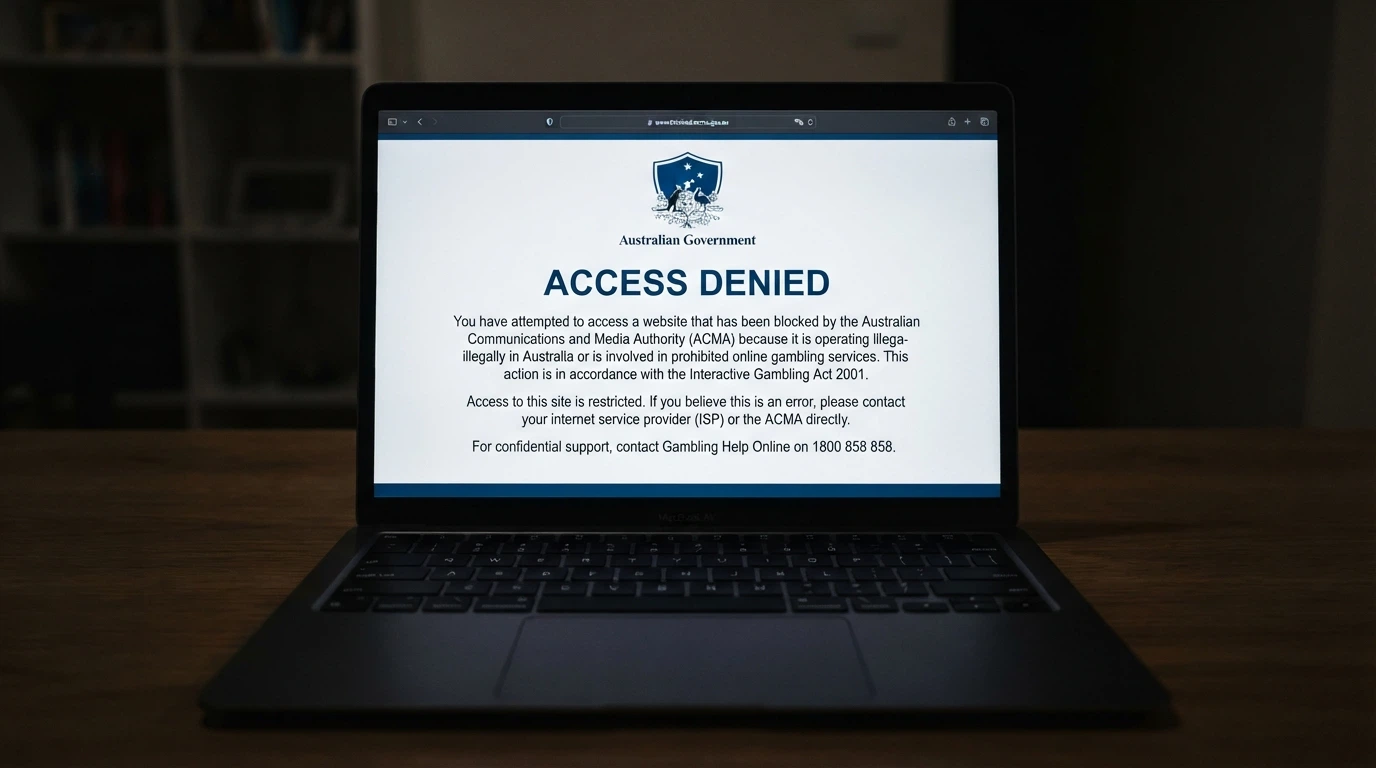
The Australian Communications and Media Authority is the federal regulator that enforces the online prohibition. Its primary tool is the ISP-blocking regime introduced under the Interactive Gambling Amendment Act 2017. Since November 2019, the ACMA has asked Australian ISPs to block more than 1,564 illegal gambling and affiliate websites, and more than 225 illegal services have withdrawn from the Australian market since the 2017 strengthening. The block list is published and updated regularly.
The civil penalties for illegal providers are large. An individual provider can face penalties of up to $2,475,000 per day; a corporate provider can face penalties of up to $12,375,000 per day. These figures are aimed at the operator, not the player, and they explain why most licensed AU-facing brands have either withdrawn from the market or restricted themselves to licensed wagering products. The enforcement that affects the player is indirect — the operator rebrands, the domain changes, the player’s account and balance transfer to the new domain with varying degrees of friction.
The practical risk to a player sitting at an offshore casino is that the site is added to the ACMA block list mid-session. The site stops resolving, the operator’s customer support routes the player to a new domain, and the player’s balance and bonus state travel to that new domain with whatever proof the operator’s system requires. Some operators handle this smoothly. Some do not. The player’s recourse if the operator mishandles the migration is the operator’s own complaints process — there is no Australian complaints body that can compel an offshore operator to pay.
What the 2026 Reform Changes — and What It Does Not
The Interactive Gambling Amendment (Gambling Reform) Bill 2026 passed Parliament on 19 August 2026. Its measures commence on 1 January 2027. The reform tightens the rules around advertising and inducements in the licensed wagering market — the AU-facing bookmakers, not the offshore casinos. It does not legalise online casino games, does not create a licensing path for online casinos, and does not extend any Australian consumer protection to players using offshore brands.
What this means for a player using an offshore casino is that the reform does nothing for them. The offshore brand is outside its scope, the player is outside its protection, and the casino side of the market remains unlicensable. The reform is aimed at licensed wagering operators tightening their inducement spend, not at the offshore brands filling the gap the licensed market leaves. Reading the reform as making offshore casinos “safer” is reading it wrong.
The reform’s effect on the AU-facing player is indirect. The licensed wagering operators may run fewer promotions, less aggressive free-bet offers, and tighter inducement rules under the new framework. That makes the licensed wagering market a slightly less generous place to be a customer, and the offshore market a slightly more attractive-looking place to look for a deal. The trade-off is that the offshore market carries none of the protections the licensed market still offers.
The Payment Block: Credit Cards, Crypto and the Verification-Deposit Trap
The Australian payment ban for online wagering is the most concrete piece of friction an AU player hits when funding an offshore casino. Credit cards, credit-related products and digital currency are banned as payment for online wagering since 11 June 2024. The ban applies to the licensed wagering market — the AU-facing bookmakers regulated under the IGA. Offshore casinos are not bound by the ban, and most of them accept credit cards and crypto from Australian residents anyway.
The legal deposit routes for licensed wagering remain debit card, bank transfer, PayID/Osko, and BPAY. POLi, which used to be a popular deposit method, is no longer a payment method anywhere in Australia. PayID and Osko are the instant-transfer rails most AU-facing players now use for licensed wagering deposits; both clear within seconds.
For an offshore casino, the verification deposit is the friction point that converts “no-deposit” into “deposit.” A player who clears the wagering on a $25 free chip and wins $80 wants to withdraw. The operator’s AML policy demands a $10 to $20 deposit from a card or wallet the operator can trace before processing the withdrawal. That deposit is real money, the player can lose it if the operator voids the bonus, and the player must fund it from a rail the AU market partly restricts. For a player whose bank blocks gambling-related credit transactions, the verification deposit is the moment the bonus stops being a free trial and starts being a paid one.
Playing Without the Safety Net: Responsible Gambling at an Offshore NDB Casino
The Australian responsible-gambling infrastructure is built for licensed wagering. BetStop, the National Self-Exclusion Register, launched on 21 August 2023 and covers only Australian-licensed online and phone wagering services. Offshore casinos are not connected to the register. A player who registers with BetStop and then opens an account at an offshore casino is not protected by BetStop — the offshore casino has no integration with the Australian register, has no obligation to check it, and cannot be compelled to close the account.
As of 31 July 2026, 67,480 people had registered for BetStop, and the registry’s active exclusions were dominated by younger adults — 78% of registrants are under 40, and 38% have chosen lifetime exclusion. The data tells a clear story about who is using the register and how seriously they are taking it. None of those protections reach the offshore casino the player is sitting at while reading this section.
The National Gambling Helpline is the resource that does reach the player regardless of where they play. The number is 1800 858 858, the line is free and confidential, and it is staffed 24 hours a day, 7 days a week. Gambling Help Online, at gamblinghelponline.org.au, provides the same service online. Both are funded by the Australian government, both are available to any AU resident, and neither requires the player to disclose the offshore brand they have been using.
Setting Your Own Limits When the Platform Does Not Enforce Them
Offshore casinos commonly offer deposit-limit tools, session-timer settings, and reality-check prompts inside the player’s account. The structural difference from the licensed AU market is that those tools are voluntary for the operator to offer and unenforceable for the player to invoke. A licensed AU operator must, by the regulator’s responsible-gambling code, enforce a deposit limit the player has set; an offshore operator is not bound by any equivalent obligation.
Three practices work regardless of what the platform offers:
- A separate bank account or payment instrument for gambling spend, with a hard monthly limit the player enforces manually.
- A session timer on the player’s phone or computer, not inside the casino’s software — a kitchen timer set to a maximum session length is the simplest version.
- A written rule about when a session is over — a stop-loss figure, a stop-win figure, and a stop-time, each decided before play begins.
The reality of an offshore casino’s limits is that the operator can lift them at the player’s request with no regulatory consequence. The player who has set a $100 daily deposit limit and then emails support asking for it to be raised will, at most offshore brands, receive the raise within 24 hours. The platform is a tool, not a backstop.
Australian Help Resources That Work Regardless of Where You Play
The National Gambling Helpline at 1800 858 858 is the single most useful number on this page for a player who feels their gambling is moving beyond what they can control. It is staffed by trained counsellors, free to call from any Australian phone, available around the clock, and confidential. Gambling Help Online at gamblinghelponline.org.au provides webchat and email support for players who prefer text to voice. Both services work regardless of whether the player is using a licensed AU bookmaker, an offshore casino, or no platform at all.
The context for using those services is the prevalence data. An estimated 2.1% of Australian adults — roughly 430,000 people — experience problem gambling, and a further 1.8% sit in the high-risk band. The numbers have been broadly stable across recent AIHW surveys, and they describe a population the responsible-gambling infrastructure was designed for. A player who feels the early warning signs — chasing losses, hiding play from family, borrowing to fund sessions — is the player those services are designed to help. The offshore casino does not change that calculation; it only makes the help lines more important, because the platform the player is on has no obligation to.
How We Selected and Reviewed These NDB Casinos
The selection criteria were four. The brand had to be actively accessible to Australian residents in 2026, meaning the site accepted AUD registrations and processed deposits from AU funding rails. The brand had to be present in AU-facing search results for no-deposit casino queries, organic or paid. The brand’s licence status had to be confirmable from a public register. And the brand’s current welcome offer, where published, had to be transcribable from the operator’s own current promotions page.
The sources used were the ACMA’s register and enforcement notices for licence status and AU enforcement data, the operators’ own current promotions pages for offer terms, Gambling Insider’s no-deposit coverage for the bonus-term ranges that define the market, PayoutVerdict for independently-tested crypto withdrawal times, Esports.GG for the games-library counts at the deposit-match brands, CasinoA.org for the verification-deposit practice, and SpinBit NZ and BetterBonus for the third-party-tested slot RTP figures at the specific pokies named on this page.
The limitation is the verification gap. Several operators in this set do not publish a current AU-facing no-deposit offer at all, and the bonus terms at those brands could not be confirmed in this research pass. Where the table column reads “Not confirmed — verify on the operator’s site,” that is what the audit found. Offshore operators change welcome offers, wagering requirements and cashout caps without notice, and any reader planning to claim a bonus should re-check the operator’s terms page on the day they claim. No numeric score is assigned to operators. The ranking is qualitative and reflects what could be confirmed in this research cycle.
What an Australian Player Should Actually Do About No-Deposit Casino Offers
The verdict is the same shape regardless of which operator the player has clicked through to. No-deposit bonus casinos accessible from Australia are offshore, unlicensed by any Australian regulator, and offer no Australian consumer protection. The bonus maths — a 40x to 60x wagering requirement on a $25 free chip against an AU$50 to AU$100 cashout cap — means the average player never withdraws anything, and the small fraction of players who do clear the bonus surrender any winnings above the cap. The verification deposit converts the offer from a free trial to a paid risk at the moment the player requests a withdrawal, and a $10 to $20 deposit that disappears because the bonus is voided is a real loss on a promotion the player was told cost nothing.
Three things follow for a player who decides to proceed anyway. First, choose the operator whose current terms are publicly published — the standout in this set is the only one with 0x wagering on its welcome offer, and the others either publish terms the player can verify or do not, with that distinction determining how much of the verification work the player inherits. Second, fund the verification deposit with the smallest amount the operator accepts, on the rail with the lowest chargeback risk to the player, and treat that deposit as the maximum the player is prepared to lose on this specific bonus. Third, read the eligible-games list before claiming and pick the highest-RTP pokies on it, recognising that the 96% figure the slot table on this page describes is a long-run average and not a guarantee of the next spin.
The legal reality is the part the marketing never mentions. The Interactive Gambling Act 2001 makes the product illegal to provide, and the ACMA’s enforcement targets the provider. The player is not prosecuted but is also not protected. If the operator voids a withdrawal, seizes a balance, or changes its terms mid-promotion, the player’s only recourse is the operator’s own complaints process — and the player’s only real protection is the discipline they bring to the bonus themselves.
No winner has been picked here — only the licence status, the current offer terms where confirmable, the bonus maths, the legal framework, the payment restrictions, and the help resources. The next move belongs to the reader.
Frequently Asked Questions
Is it actually legal to use a no-deposit bonus casino in Australia?
The Interactive Gambling Act 2001 prohibits providing online casino games to Australians. The ACMA enforces that against providers, not players — the player is not prosecuted. Yet the player has no Australian recourse if an offshore operator declines a withdrawal or voids a bonus. The licensed AU market’s protections stop at the border.
How much can I realistically cash out from a no-deposit bonus?
Typical no-deposit bonuses cap withdrawals from bonus winnings at between AU$50 and AU$100. A player who wins AU$600 on a bonus with an AU$50 cap walks away with AU$50; the remaining AU$550 stays on the platform. The cap is the entire upside, and the wagering cost is the price the player paid.
Why do no-deposit bonuses have such high wagering requirements?
The 40x to 60x wagering multiple at most offshore brands exists because operators price the bonus to be profitable in aggregate, not generous. Every wagered dollar returns a percentage to the house, and the multiple keeps the offer profitable even when only a small fraction of players clear it.
How do I verify my identity to withdraw ndb winnings?
Offshore casinos typically require a government photo ID, a proof of address within three months, and a $10 to $20 verification deposit from a traceable source before processing a no-deposit withdrawal. The deposit is the AML gate that converts the offer from free to paid and can be lost if the bonus is voided.
Can I use PayID or crypto for the verification deposit an ndb casino demands?
PayID and crypto are usable at most offshore casinos. Credit cards, credit-related products and digital currency have been banned for Australian online wagering since 11 June 2024, but the ban applies to licensed AU operators, not offshore. A verification deposit via PayID or a personal crypto wallet uses a rail restricted locally but unenforced offshore.
What happens if the casino blocks my withdrawal or voids my win?
Two scenarios end a bonus. The operator voids it for a breached term — a max bet, an eligibility rule, an expiry window — removing the bonus balance, any winnings, and the verification deposit. Or the operator declines to pay, citing a missed term. The only recourse is the operator’s complaints process; no AU body has jurisdiction.
Can an Australian Player Actually Use an NDB Casino?
The short answer is yes. Offshore casino sites actively accept Australian registrations, process AUD deposits through PayID and a small set of other rails, and run a customer-service operation in or close to Australian time zones. The fact that providing these games to a person in Australia is illegal under the Interactive Gambling Act 2001 does not stop a Curaçao-licensed operator from running an AUD cashier. Enforcement targets the provider, not the player, and the player is not prosecuted for using an offshore casino.
The enforcement that does exist targets the supplier side of the market. Since November 2019, the ACMA has asked Australian ISPs to block more than 1,564 illegal gambling and affiliate websites, and more than 225 illegal services have withdrawn from the Australian market since 2017. The block list is a moving target: operators rebrand, change domains, and resurface within weeks. From the player’s seat, the practical risk is not prosecution. It is that the site they registered with last month has been blocked this month, the balance they were about to withdraw is on a domain that no longer resolves in Australia, and the operator’s customer support has stopped responding to emails.
What “accessible” does not mean is “protected.” None of the Australian consumer protection regime that applies to licensed wagering — the ACMA’s complaints function, the BetStop national self-exclusion register, the responsible-gambling code that licensed operators are required to follow — reaches an offshore casino. The player trades one for the other, and the next sections walk through exactly what that trade looks like in dollar terms.