
Casino Promo Codes in Australia: The Full Picture Behind the Bonus
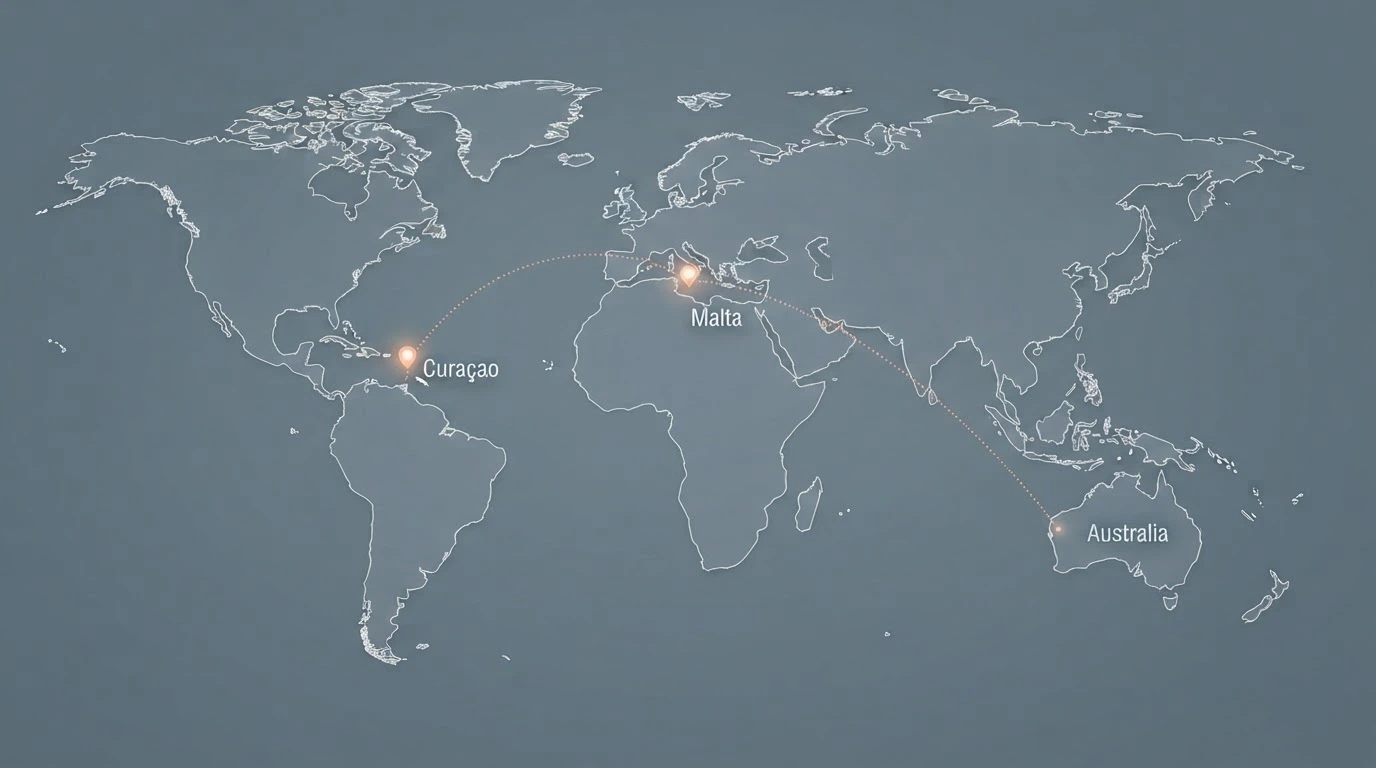
Every casino promo code an Australian can actually redeem belongs to an operator that has no Australian licence. That is not a marketing footnote. It is the single fact the rest of this page sits on top of, because the Interactive Gambling Act 2001 prohibits online casino games, online pokies and in-play betting being provided to a person in Australia — full stop. No state or territory issues an online casino licence. The codes still arrive in inboxes, on affiliate listicles and across social channels, because the operators offering them sit in Curaçao, Malta and other offshore jurisdictions, beyond the ACMA’s domestic reach. Reading what one of these codes is worth, and what it costs, starts with that divide.
Current as of 18 October 2026 and cross-checked against the Interactive Gambling Act 2001 and the ACMA’s published enforcement record.
Table of Contents
- How Casino Promo Codes Actually Work
- Why Your 2026 Bonus Is Smaller Than It Looks
- The 2026 Casino Promo Code Line-Up
- Why Australia Has No Licensed Online Casinos
- Bonus Chasing — When the Free Spins Stop Being Free
- How We Evaluated Every Casino on This Page
- Before You Redeem That Code — What Actually Protects You
- Frequently Asked Questions
How Casino Promo Codes Actually Work
A casino promo code is a short alphanumeric string a player enters during registration, at the cashier or on a bonus-claim page to unlock an offer — free spins on a named pokie, a free chip of bonus cash, or a percentage match on a deposit. The code is the trigger. Without it, the same bonus may not appear, or may appear on different terms. With it, the operator’s terms page binds what the bonus does, what games it works on, what the player must wager before any withdrawal and how much can come back out. The code itself is almost incidental; the terms it unlocks are the offer.
Mechanically, a code differs from an “automatic” bonus in one respect only — somebody has to type it in. An automatic bonus credits the moment a player meets the qualifying action (a minimum deposit, a first login) without any code at all. Operators use codes for two reasons: to track which affiliate site, email list or marketing channel drove the player, and to gate offers behind a specific promotion window. Both reasons are commercial. Neither changes what the bonus does once it lands.
What a Casino Promo Code Is
A code reads like a password — WELCOME100, BOOKOFSPINS, FS25AU — and it functions like one, in that the operator’s system checks the string against its current campaign list and credits the matching offer. The string does not change the underlying mechanics. A 100% match up to A$1,000 with 100 free spins is the same offer whether the code is ROCKET100 or applied automatically. The string just tells the operator which campaign the player belongs to, which affects nothing on the player’s end except that the offer has to be claimed before it expires.
Why operators use codes at all: a single bonus program can be sliced into dozens of campaigns with different caps, different free-spin games, different wagering multipliers and different expiry windows. A code is the routing token that picks one campaign out of the catalogue. From the player’s side, this means codes time out. The same string that worked last month may not work today, and a new code may have appeared in its place. From the operator’s side, codes let marketing teams test which bonus shape converts better without rewriting the bonus engine.
How to Find and Redeem a Promo Code
The path runs in four moves. First, find the code — on an affiliate bonus list, in an email from the casino, on a review site or in a forum thread. Second, copy it. Third, register a new account with the casino, or log into an existing one, and paste the code into the bonus field during the sign-up flow or at the cashier before making the qualifying deposit. Fourth, see whether the bonus credited — if it did not, the code was mistyped, the campaign is closed, or the player is on a bonus already that the new code does not stack on top of.
The mechanics are simple, and that is part of the problem. The redemption takes seconds; the terms attached to it are where the real cost hides. A 40x wagering requirement on a A$20 bonus means A$800 of turnover before any withdrawal — and that is the spec that decides whether the bonus is worth claiming at all. Reading the code in is the easy half. Reading what it costs is the half the marketing does not surface.
Where Promo Codes Appear
Four channels carry most of the codes an Australian player will ever see. Affiliate listicles and bonus-aggregator sites dominate — every top-10 result on a “best casino promo codes Australia 2026” search is one of these pages, structured as ranked tables with a code, an offer amount and a wagering figure per operator. Operator newsletters are the second channel: once a player has registered with one casino, sister-site emails arrive offering reload bonuses and seasonal codes. Casino review pages are the third — they cross-reference affiliate offers with operator-published terms, and the better ones include a wagering-and-cashout breakdown. Forum threads and social channels are the fourth, and the least reliable: codes posted in player forums are often expired, geo-blocked or copy-pasted from campaigns that closed months ago.
Reliability varies by channel. Affiliate listicles carry fresh codes because they are paid to be current; operator emails carry the operator’s own offers with full terms attached; review pages sit between the two and usually link out to the operator’s own terms. Forum threads and social posts carry the lowest reliability — they exist because somebody posted them, not because anybody verified them. The first three channels are the ones a player can act on; the fourth is the one to treat as background colour at best.
Online Casino Codes vs Land-Based Perks
A promo code at an online casino and a loyalty perk at a land-based casino are not the same proposition, and the comparison matters because an Australian who treats them as interchangeable misses what they have signed up for.
The land-based side is straightforward. Crown Melbourne, The Star Sydney and their equivalents hold state-issued gaming licences. Their loyalty programs, room comps, dining credits and member events are bound by Australian consumer law, the relevant state gaming authority’s rules and a complaints body the player can actually reach. If a loyalty offer is misrepresented, the player can take the matter up with the casino and, if that fails, with the state regulator. The offers sit inside an Australian legal framework.
The online side is not that. An offshore casino accepting an Australian player operates under whatever licence its home jurisdiction issues — most often Curaçao, in one case Malta, in three RTG-flavoured cases the licence has not been publicly confirmed. None of those licences is Australian. None of them gives the player recourse to an Australian regulator, an Australian complaints body or Australian consumer law. A bonus at an offshore casino is a private contract between the player and an operator sitting in another jurisdiction, governed by that operator’s own terms page. Reading the terms is not optional; it is the only consumer protection the player has.
Why Your 2026 Bonus Is Smaller Than It Looks
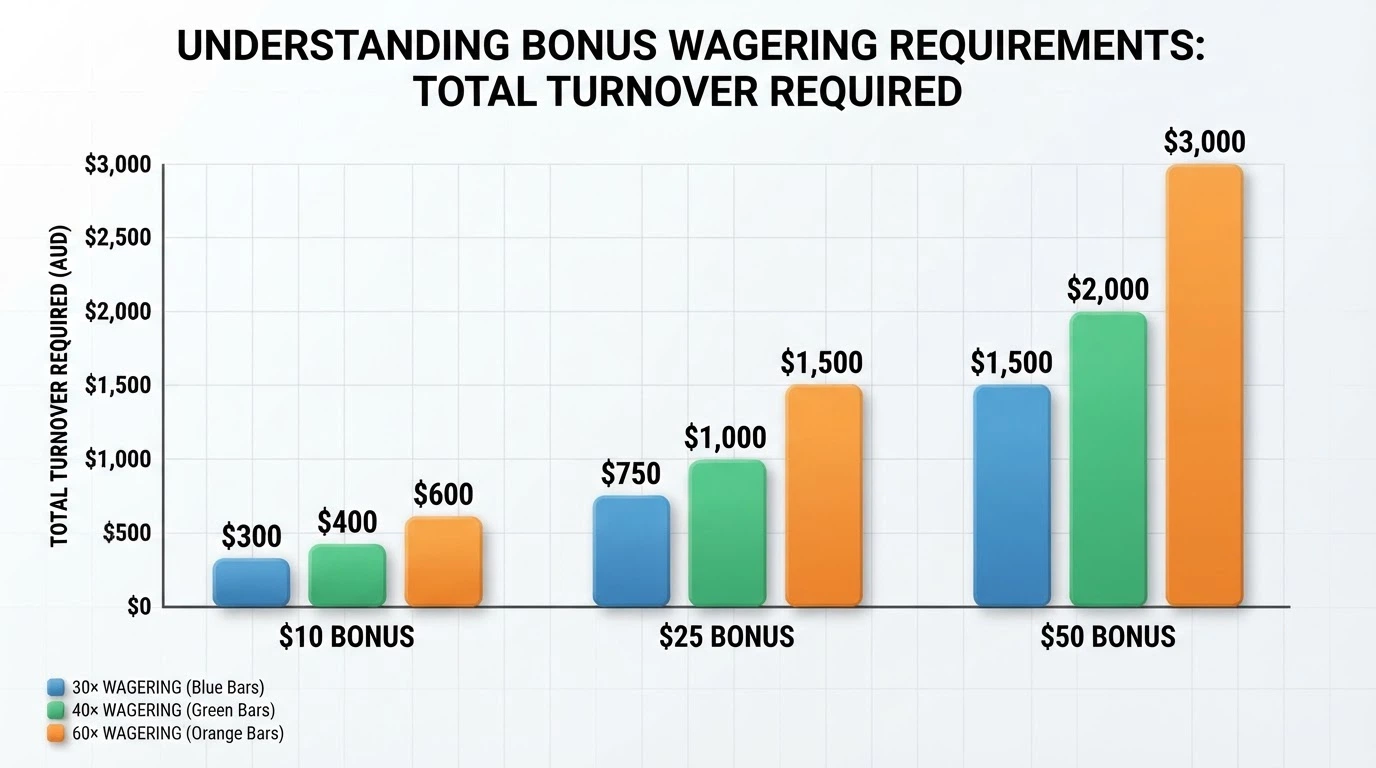
The number on the banner — A$1,000, 100 free spins, A$8,000 + 400 free spins — is the headline. The wagering multiplier, the max cashout, the game contribution percentage, the max bet during wagering and the validity window are the fine print that shrinks the real value. Across the Australian-facing offshore market, the most common range for a no-deposit bonus is A$10 to A$50 in bonus cash or 20 to 100 free spins. The most common wagering multiplier sits between 30x and 50x. A A$20 no-deposit bonus at 40x means A$800 in turnover before any withdrawal, and the house edge on that turnover — typically a few percent per spin at the pokies that contribute 100% — comes out of the player’s pocket before the wagering requirement is even close to cleared.
That gap between the advertised number and the realised value is the subject of this section. Every sub-section unpacks one of the mechanisms that closes it.
No-Deposit Codes — The Free Taste
A no-deposit bonus asks for nothing from the player up front — no deposit, no card details beyond what registration requires, no commitment. In exchange, the player gets a small slice of bonus value, typically A$10 to A$50 in bonus cash or 20 to 100 free spins. The word “free” is doing a lot of work there.
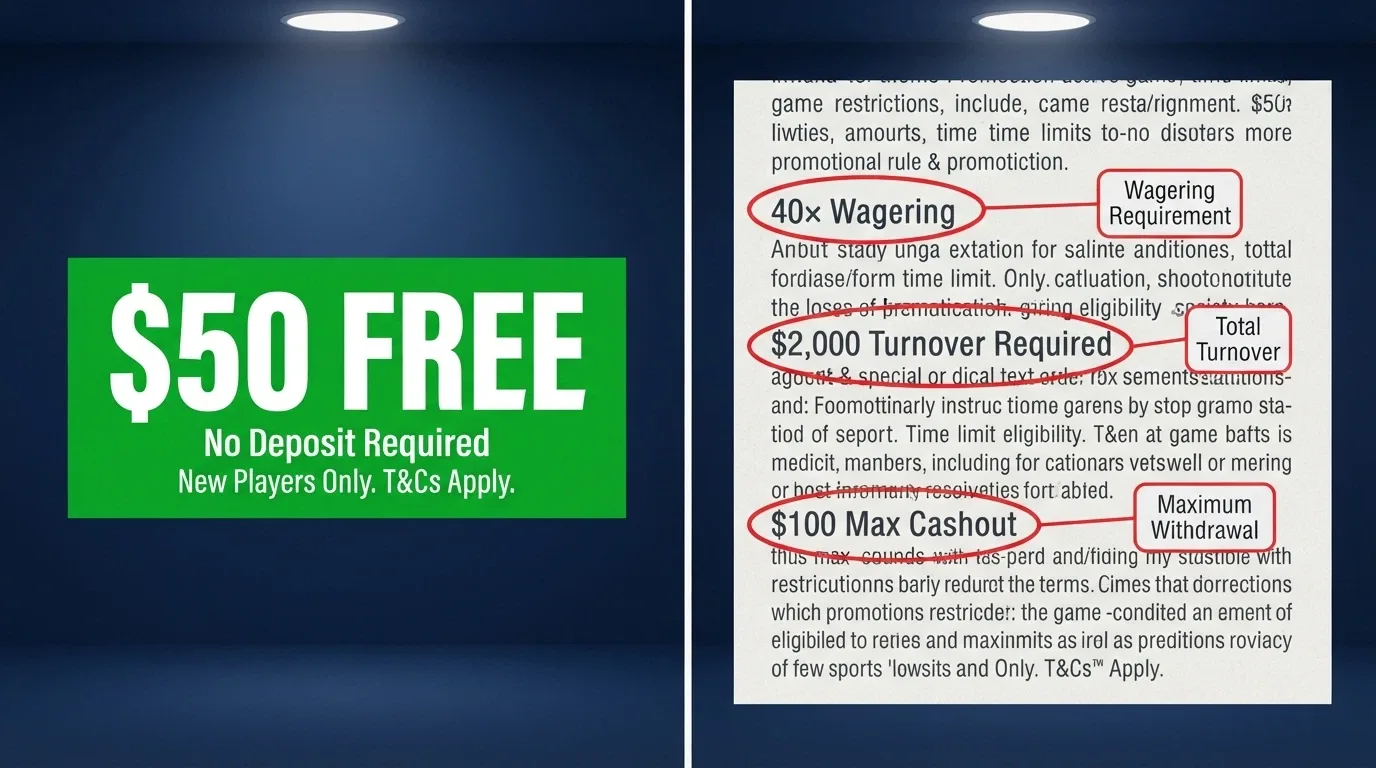
A A$20 no-deposit chip at 40x wagering requires A$800 in bets before any withdrawal. The math is mechanical. A A$50 no-deposit chip at the 60x multiplier carried by three of the operators on this page requires A$3,000 in turnover before any withdrawal. Then the max cashout cap kicks in — for many no-deposit bonuses the cap is A$100 to A$180, regardless of how high the balance climbs during wagering. Then the max-bet rule during wagering — usually A$5 to A$7.50 per spin or hand — caps how fast the turnover can be built. Then the expiry window, which on many no-deposit offers is 5 to 7 days, puts a clock on the whole thing.
A player who treats a no-deposit bonus as a free taste is right about what it is. A player who treats it as a path to a payout is reading the headline and skipping the math.
Free Spins vs Free Chips — What Lands in Your Account
A free-spins bonus credits a fixed number of rounds on a specific pokie at a fixed stake per spin, usually A$0.10, A$0.20 or A$1.00 depending on the campaign. A free-chip bonus credits a fixed dollar amount of bonus cash, which the player can usually spend across most of the casino’s pokie library (and sometimes on table games, though the wagering contribution on table games is commonly 0% to 10%).
The two formats trade off differently. Free spins lock the player to one game at one stake — there is nothing to optimise, no choice of where to play. Free chips give the player flexibility to pick a game with a higher return-to-player, but the wagering multiplier on free chips is often higher than on free spins, sometimes as high as 60x at the RTG-flavoured operators in this set. Free spins also expose the player to a single pokie’s volatility — a high-volatility game can burn through 100 spins in a few minutes with very little return, while a low-volatility game grinds out smaller wins over the same window.
Which gives the player more real value depends on the campaign’s specifics. A 50-free-spins offer at a 0% contribution rate is worth nothing. A 50-free-spins offer on a high-RTP pokie at a 40x multiplier on spin winnings only is worth running. A A$10 free chip at 60x wagering with a A$100 max cashout is worth thinking about for ten minutes before claiming.
Real-Money Codes — Deposit Matches and Welcome Packages
A deposit-match bonus doubles or triples the player’s first deposit up to a stated cap. RocketPlay’s published structure is the clearest example in the featured set: a 100% match up to A$1,000 plus 100 free spins on Aztec Magic on the first deposit (minimum A$30), and a 200% match up to A$1,000 on the second deposit (minimum A$75). Skycrown stretches the structure across four deposit tiers, advertised at up to A$8,000 plus 400 free spins in total, with a minimum A$20 qualifying deposit.
Three things matter beyond the headline percentage. First, the wagering multiplier applies to the bonus amount only at the better operators, and to bonus plus deposit at the worse ones. A A$1,000 deposit matched at 100% with a 40x-on-bonus-only requirement means A$400 of turnover; the same match with a 40x-on-bonus-plus-deposit requirement means A$800 of turnover. Second, the free spins attached to the welcome package carry their own wagering — they do not come wagering-free as part of the deposit match. Third, multi-tier packages lock the player into repeated deposits to reach the full advertised value. The headline figure at the top of the page is the sum of all four tiers; reaching it means four deposits, four wagering cycles and four expiry windows.
Slots-Specific Promos and Game Restrictions
Most promo codes at Australian-facing offshore casinos work only on pokies, and even then only on titles from a short list of providers. Pragmatic Play, NetEnt, Hacksaw Gaming and NoLimit City games typically contribute 100% toward wagering requirements. Table games, live dealer games and most non-pokie products contribute 0% to 10%. A player who claims a bonus and starts playing blackjack against the wagering requirement will see their balance move but their wagering progress stay flat — because the bets are landing on a 10%-contributing category, the requirement ticks up at one-tenth the speed it should.
Some bonuses go further and lock the wagering to specific titles. RocketPlay’s first-deposit free spins are on Aztec Magic by BGaming, and its no-deposit spins are on Book of Pyramids. BitStarz’s 50 no-deposit spins are on Gold Rush. 7Bit’s 20 no-deposit spins are on West Town. PlayCroco’s no-deposit spins are split between Coyote Cash 2 (75 spins) and Elemental Adventures (100 spins). Each of those title restrictions is part of the campaign. Play a different pokie and the spin winnings still count toward the bonus, but the player has chosen a different game than the one the bonus was designed around — which means different volatility, different hit rate, different house edge.
The Wagering Trap — Why 40x Isn’t What You Think
A 40x wagering requirement means 40 times the bonus amount must be turned over in qualifying bets before any withdrawal. A A$20 bonus at 40x means A$800 of turnover. A A$100 deposit matched 100% at 40x-on-bonus-only means A$4,000 of turnover. The arithmetic is mechanical.
What the multiplier hides is the second loss layered on top. Every spin at a pokie that contributes 100% carries the house edge — the difference between 100% and the game’s return-to-player percentage. A pokie with a 96% RTP, which is a typical figure for the providers in this set, returns A$96 for every A$100 wagered in the long run. The remaining A$4 is the house edge, and that A$4 is paid out of the player’s pocket on every spin. Across A$800 of required turnover at a 96% RTP, the expected loss is roughly A$32 — money the player spends on the way to clearing the wagering, regardless of whether the bonus is ever cashed out.
In short: A$800 of turnover is not a free path to a A$20 bonus. It is A$800 of real-money play with a A$20 bonus attached. Most players do not clear the requirement, because most players run out of balance before they run out of turnover. The bonus is the bait. The turnover is the trap.
The worked figure the page carries through: a A$20 bonus at 40x wagering produces A$800 of required turnover. At a A$0.20 stake per spin, that is 4,000 spins. At five seconds per spin, that is roughly 5.6 hours of continuous play. The bonus is worth A$20 of bonus cash; the path to it is more than a working day of pokies.
Max Cashout Caps and Bet Limits
A player clears the wagering requirement and the balance reads A$500. The terms cap the withdrawal at A$100. The other A$400 is forfeit — that is a max-cashout cap doing its work. Max-cashout caps are most aggressive on no-deposit bonuses, where the cap is often set at a multiple of the chip amount (5x for several RTG-flavoured operators, meaning a A$10 free chip caps at A$50, a A$50 free chip caps at A$150 to A$180). On deposit-match welcome bonuses the caps are usually higher — Skycrown’s published AU$500 per-bonus cap sits at the strict end, while RocketPlay’s general withdrawal caps of A$2,500 per day, A$7,500 per week and A$15,000 per month sit at the loose end.
Max-bet rules during wagering are the second squeeze. Most no-deposit bonuses cap the stake at A$5 to A$7 per spin or hand; RocketPlay’s deposit-match bonus caps it at A$7.50. The cap is enforced: a single bet over the limit typically voids the bonus and any winnings from it. It is not negotiable. It is also the reason the wagering requirement takes as long as it does — a A$800 turnover requirement at A$5 per spin is 160 spins, which at five seconds per spin is 13 minutes; the same turnover at A$0.10 per spin is 8,000 spins, which is over 11 hours.
The two rules together — max cashout and max bet — turn a bonus designed to look generous into one that rewards grinding over aggression, and that grinds most players down before they reach the cap.
Bonus Expiry, Game Contribution, and the Fine Print
A bonus expires in 5 days at RocketPlay, in 7 days at Skycrown. Pokies contribute 100% to wagering; table games contribute 0% to 10%. The max bet is A$5 to A$7.50 during wagering, and exceeding it voids the bonus.
Each of those rules is independently enforceable. A bonus expires on a timer that starts the moment it credits, not the moment the player is ready to use it. A player who deposits, claims a bonus, gets called away from the computer and comes back two days later has lost a third of the validity window before spinning a single reel. The game-contribution rule is enforced the same way — the casino’s system tracks turnover per category, and a player who splits play between pokies and table games sees their wagering progress slow to a crawl. The max-bet rule is enforced automatically; the bet that trips it is the bet that voids the bonus.
None of this is hidden, exactly. Every operator on this page publishes the terms in a page the player can read before claiming. The terms are not the problem. The problem is that the marketing banner rarely links to them, the affiliate listicle rarely quotes them and the player’s first read of the offer is the headline.
The 2026 Casino Promo Code Line-Up
Every casino on this page accepts Australian players and none of them holds an Australian licence, because no online casino licence exists in Australia. The table below shows what each operator’s published terms actually offer and where the data stops. Cells with no number carry an em dash because the operator did not publish a verified figure for that field at the time of review, not because the offer does not exist.
| Casino | Licence | No-Deposit Offer | Wagering on No-Deposit | Game Providers |
|---|---|---|---|---|
| RocketPlay | Curaçao (not AU) | 20 FS on Book of Pyramids | 40x | BGaming, Pragmatic Play, NetEnt, others |
| Skycrown | Malta Gaming Authority (not AU) | 100 FS (phone verification) | — | — |
| Fair Go Casino | Not confirmed (not AU) | A$10–A$50 free chip | 60x | RTG |
| BitStarz | Curaçao (not AU) | 50 FS on Gold Rush (no code required) | — | Pragmatic Play, NetEnt, BGaming, others |
| 7Bit Casino | Curaçao (not AU) | 20 FS on West Town or $10 free chip | — | — |
| WinSpirit | Not confirmed (not AU) | — | — | — |
| Stake | Curaçao (not AU) | — | — | Stake Originals + third-party |
| Bizzo Casino | Curaçao (not AU) | — | — | — |
| PlayCroco | Not confirmed (not AU) | 75 FS on Coyote Cash 2 / 100 FS on Elemental Adventures | 60x | RTG |
| Ozwin Casino | Not confirmed (not AU) | A$50 free chip | 60x | RTG |
Three takeaways from the table. First, the no-deposit offers that publish a wagering multiplier cluster at the high end of the market range — 60x for the three RTG operators and 40x for RocketPlay, against a market range of 30x to 50x for no-deposit bonuses generally. Second, the providers column is thinnest where the licence column is thinnest, because operators that publish a Curaçao or MGA licence are also the ones that publish their provider list. Third, the data gaps are not the operator being coy — they are the operator not having published the figure in a place that could be verified. The first thing a player should do on any of these sites is read the bonus terms page directly, because the figures above are what was published when this review was compiled, not what may be in place today.
RocketPlay
RocketPlay publishes the most complete bonus picture of any operator in the featured set. The welcome package runs in two tiers: a 100% match up to A$1,000 plus 100 free spins on Aztec Magic by BGaming on the first deposit (minimum A$30), and a 200% match up to A$1,000 on the second deposit (minimum A$75). The wagering requirement is 40x on the bonus amount only, with a maximum bet of A$7.50 while wagering and a 5-day validity window per bonus. The no-deposit offer is 20 free spins on Book of Pyramids, triggered by submitting a verified user review rather than by a deposit, with 40x wagering on any winnings and a maximum cashout of roughly A$85.
The withdrawal caps sit on the loose end of the market: A$2,500 per day, A$7,500 per week, A$15,000 per month. Those caps are not bonus-specific; they are the operator’s general withdrawal ceiling, which means a player who clears the wagering on a small bonus is not bottlenecked by a per-bonus cashout cap the way Skycrown players are. The combination of bonus-only wagering, a published provider list (BGaming, Pragmatic Play, NetEnt and others) and a withdrawal ceiling that scales with volume makes RocketPlay the most readable offer in the set — the terms are not friendly, but they are spelled out. For a player who wants to know what they are signing up for before they sign up, that is worth something.
Skycrown
Skycrown runs the largest advertised welcome package in the featured set — up to A$8,000 plus 400 free spins across four deposit tiers, with a minimum qualifying deposit of A$20. The wagering requirement is 30x on the bonus amount, the lowest in the set, with a 7-day expiry window per bonus. The no-deposit offer is 100 free spins, gated by mobile phone number verification rather than by a deposit.
Two terms cut the headline number back down. First, the AU$500 maximum cashout per bonus is one of the tightest caps in the set — a player who climbs to A$5,000 in cleared bonus funds across the four tiers will be able to withdraw A$500 of that per bonus, not A$5,000. Second, the 7-day expiry on a four-tier welcome package is tight. The player has a week per tier to clear 30x the bonus and reach the cashout cap; missing the window forfeits that tier’s balance. Skycrown holds an MGA licence (Malta), not an Australian one, and the MGA’s reputation is stronger than Curaçao’s, but MGA consumer-protection reach does not extend to a player sitting in Australia. For a player who can deposit A$20 four times in quick succession and grind through 30x wagering inside a week per tier, Skycrown’s headline number is reachable. For most players, it is not.
Fair Go Casino
Fair Go runs on RTG (RealTime Gaming) software, which means the pokie library is the RTG catalogue — fewer titles than the multi-provider operators, but a recognisable set of pokies long associated with Australian-facing offshore play. The no-deposit offers are A$10 or A$50 free chips, delivered via coupon codes from affiliate listings.
The wagering requirement is 60x on no-deposit bonuses, the highest published figure in the featured set and well above the 30x to 50x market range. The max cashout is roughly 5x the chip amount — around A$150 on a small chip, around A$180 on most free-chip and free-spin coupons. The licence has not been publicly confirmed at the time of this review, which is itself a signal: the operators that hold a verifiable Curaçao or MGA licence publish it in the footer; the ones that do not publish one usually do not hold one a player can check. For a player who is happy on RTG pokies and willing to grind 60x wagering for a capped payout, Fair Go’s no-deposit structure is honest about what it is. For a player who wants to verify the licence before depositing, the data gap is the answer.
BitStarz
BitStarz publishes the simplest no-deposit claim in the set: 50 free spins on Gold Rush, no bonus code required. The casino holds a Curaçao licence, supports a multi-provider library (Pragmatic Play, NetEnt, BGaming and others), and is one of the more established brands in the offshore space.
The data gap is what the offer’s terms do not confirm publicly — the wagering multiplier on the 50 no-deposit spins, the max cashout cap and the bonus validity window are not in the publicly indexed material this review could verify. BitStarz’s strength is the brand recognition and the provider line-up. Its weakness, from a reviewer’s standpoint, is that the no-deposit offer’s terms page was not reachable through the channels the audit could use, which means a player should read the bonus terms directly on the operator’s site before claiming. For a player who is comfortable with Curaçao licensing and a multi-provider pokie library, BitStarz is a known name. The no-deposit offer is worth claiming only after the terms page has been read.
7Bit Casino
7Bit runs a Curaçao licence and a multi-provider library. The no-deposit offer splits into two options: 20 free spins on West Town, or a $10 free chip. The choice is unusual in the featured set — most operators offer one format or the other, not both — and the split is presumably designed to let a player pick the format that fits their play style. The free-spins option locks the player to one game at one stake; the free-chip option gives flexibility but usually carries a higher wagering multiplier.
The terms that the audit could not verify — wagering on the no-deposit offer, max cashout, validity window — leave the same gap as BitStarz. For a player who wants the flexibility of choosing between spins and a chip, 7Bit is one of the few operators in the set offering the choice. For a player who wants to see the terms before claiming, the operator’s own bonus page is the place to read them.
WinSpirit
WinSpirit appears in Australian-facing casino directories and operates offshore. What could be verified is the offshore status and the AU-facing presence. What could not be verified is the licence jurisdiction, the current bonus terms, the wagering multiplier on any active offer, the max cashout cap, the bonus validity window and the game-provider line-up. The operator’s own site is the only place a player can read the current terms, and a data gap of this size on a review is itself a risk signal.
For a player who is comparing offers, the most useful thing to say about WinSpirit is what is not known. The casino exists, it accepts Australian-facing traffic, and the rest of the profile is the operator’s own site to fill in. Any code an affiliate or directory lists for WinSpirit should be verified against the operator’s current bonus terms before being entered at the cashier.
Stake
Stake holds a Curaçao licence and runs a crypto-first operation. Its game library splits between Stake Originals — a set of proprietary in-house games that cannot be found at any other operator — and third-party pokies from external providers. The defining feature of Stake in the offshore space is the absence of a traditional welcome bonus. No deposit-match package, no no-deposit free spins, no promo-code welcome offer. Stake’s promotional model is built around ongoing rakeback, weekly races and crypto-denominated reload offers rather than a first-deposit match.
For a player who came to this page looking for a welcome bonus, Stake is not the answer. For a player who came looking for a crypto-native casino with proprietary games and ongoing promotions rather than a sign-up package, Stake is one of the more distinctive operators in the offshore space. The lack of a welcome offer is not a gap in the profile; it is the profile.
Bizzo Casino
Bizzo runs a Curaçao licence and is listed across Australian-facing directories. What could be verified: the licence jurisdiction and the AU-facing presence. What could not be verified at the time of this review: current bonus terms, the wagering multiplier on any active offer, the max cashout cap, the bonus validity window and the game-provider line-up. The audit reaches the same conclusion as for WinSpirit: any code an affiliate or directory lists for Bizzo should be checked against the operator’s own current terms before being claimed.
For a player who is choosing between operators with similar directory presence and Curaçao licensing, Bizzo and WinSpirit are at parity on the data the audit could verify. The differentiator between them — terms, providers, payout speed, game library — sits behind the operator’s own login page.
PlayCroco
PlayCroco runs on RTG software, putting it in the same provider cluster as Fair Go and Ozwin. The no-deposit offers split across two formats: 75 free spins on Coyote Cash 2, or 100 free spins on Elemental Adventures. The wagering multiplier is 60x, in line with the other two RTG operators in the set. The licence has not been publicly confirmed.
The direct comparison with Fair Go runs along three axes: bonus format (free spins versus free chip), spin count (75 or 100 versus a chip worth A$10–A$50) and game library (Coyote Cash 2 and Elemental Adventures versus the rest of the RTG catalogue). A player who prefers free spins over a free chip, and who likes the Coyote Cash / Elemental Adventures titles, will find PlayCroco’s offer more generous than Fair Go’s chip-based structure on raw spin count. The 60x multiplier applies to both. For a player already on RTG pokies, PlayCroco is the spin-focused alternative to Fair Go’s chip-focused structure.
Ozwin Casino
Ozwin is the third RTG-flavoured operator in the set, alongside Fair Go and PlayCroco. The no-deposit offer is a single A$50 free chip — the simplest structure of the three: one value, one coupon, no game pre-selection. The wagering multiplier is 60x, in line with the other RTG operators. The licence has not been publicly confirmed.
The direct comparison across the three RTG operators runs like this: Ozwin offers a A$50 free chip with no game pre-selection, Fair Go offers a A$10 or A$50 free chip with the same multiplier, and PlayCroco offers 75 or 100 free spins on named titles with the same multiplier. A player who wants a chip and dislikes having to use it on a specific pokie will find Ozwin’s offer the most flexible of the three; a player who prefers spins and a named title will find PlayCroco’s offer more interesting. For an RTG-only player, the choice between the three is a choice between chip format and spin format at the same 60x multiplier.
Why Australia Has No Licensed Online Casinos
The Interactive Gambling Act 2001 prohibits providing online casino games, online pokies and in-play sports betting to a person in Australia. No licence for online casino exists in any state or territory. The statute has been in force since 2001 and was strengthened by the Interactive Gambling Amendment Act 2017. The Australian Communications and Media Authority (ACMA) enforces it. The product every promo code on this page unlocks is, on the providing side, illegal in Australia. That is the structural fact the rest of this section unpacks.
The IGA — One Law, One Prohibition
The Interactive Gambling Act 2001 does not regulate online casinos — it bans them outright. The prohibited products are online casino games, online pokies and in-play betting on a sporting event once it has started. The permitted and licensable products are wagering on races and sport placed before the event begins, lotteries and keno, through operators licensed by a state or territory. The de facto national licensor for online wagering is the Northern Territory Racing and Wagering Commission (NTRWC), administered through Licensing NT. Licences run for terms of up to 20 years. The minimum age for any commercial gambling activity in Australia is 18.
The ACMA’s enforcement record is substantial. Since its first blocking request in November 2019, the ACMA has had 1,564 illegal gambling and affiliate websites blocked by Australian ISPs as of March 2026. More than 225 illegal services have withdrawn from the Australian market since enforcement was strengthened in 2017. In the first quarter of 2026 alone, the ACMA reviewed 422 gambling enquiries and complaints, completed 25 investigations into 60 gambling sites, found 44 Interactive Gambling Act breaches and referred 109 cases for further action. The enforcement is real, sustained and ongoing. It is also, by design, aimed at the provider side of the transaction.
The individual player is not prosecuted under the IGA. The Act targets the provider. An Australian who uses an offshore casino is not breaking the law by playing; the offshore casino is breaking the law by offering the product. That distinction matters, because it explains why the casino’s bonus page is still reachable from Australia even though the casino itself is the target of an ACMA investigation — the law is structured to prosecute the supplier, not the customer.
Offshore Codes — Legal Grey Area Explained
The grey area is not the player’s exposure — the player is not prosecuted. The grey area is everything else. An offshore casino offering a welcome bonus to Australians is breaking the Interactive Gambling Act’s prohibition on providing the service, not merely an advertising rule. The ACMA cannot recover a player’s losses from an offshore operator, because the ACMA’s jurisdiction ends at the Australian border. There is no Australian consumer-law recourse against an offshore casino. There is no Australian complaints body that can compel a payout. BetStop does not cover offshore casinos. If the casino refuses a withdrawal, stalls on KYC, applies a dormancy fee or closes the account, the player’s options are the casino’s own internal dispute process (if one exists), the casino’s home-jurisdiction regulator (if the casino is licensed at all and if that regulator will hear a complaint from an Australian) and the small claims track in the operator’s home jurisdiction.
The site-blocking regime adds a second layer of risk. When the ACMA directs Australian ISPs to block an illegal site, the block is DNS-level. The site disappears from Australian view. Any balance a player holds on that site at the moment of blocking is still on the operator’s books, but the player has lost access to the cashier. The money is not gone — it is unreachable. Whether it ever comes back depends on the operator, and the operator has no obligation to return it because no Australian regulator is reading over its shoulder.
The 2026 Reform — What Changes on 1 January 2027
The Interactive Gambling Amendment (Gambling Reform) Bill 2026 passed Parliament on 19 August 2026. Its measures commence on 1 January 2027 — that is the operative date. The reform tightens the net around offshore operators without changing the core prohibition, and it adds several new restrictions that affect how wagering is advertised, how inducements are marketed and how payments move.
Advertising restrictions take effect from 1 January 2027: wagering advertising is banned during live sporting events (from 15 minutes before the event to 5 minutes after), capped at 3 wagering ads per hour on television between 6:00 am and 8:30 pm, and prohibited from featuring athletes, celebrities and influencers. Radio ads are barred during school travel times. Broadcasting sporting odds is banned. Online wagering ads can only be shown to logged-in, verified 18+ users who have not opted out.
Payment blocking gains statutory teeth on the same date. From 1 January 2027, banks and payment providers have express authority to block transactions to illegal gambling operators. The credit-card and crypto ban has been in force since 11 June 2024 under the Interactive Gambling Amendment (Credit and Other Measures) Act 2023; the 2027 reform extends the blocking power from card networks to the broader payments stack. An Australian player trying to deposit at an offshore casino in 2027 may find the transaction declined at the bank level, regardless of which payment method the cashier accepts.
Inducement marketing is restricted from 1 January 2027: direct marketing of inducements is prohibited for 14 days after a customer signs up with a licensed wagering operator, for three months after a person deregisters from BetStop, and indefinitely for customers identified as at-risk of gambling-related harm. A Wagering Advertising Opt-out Register, administered by the ACMA, will be established as a one-stop shop for opting out across all services. Foreign matched lotteries and online keno (“pocket pokies”) are banned. The reform is law, with a start date; it is not yet binding, and it is not speculation.
For an Australian player redeeming an offshore casino promo code, the 2027 reform does not change the prohibition — that has been in force since 2001. What it changes is the friction. Payment blocking makes depositing harder, the inducement cooling-off rules tighten the marketing licensed operators can run, and the advertising restrictions narrow the visibility of licensed wagering offers in the channels where offshore codes currently circulate. The offshore offer is still illegal to provide; it is just also harder to fund.
Payment Methods — The Offshore Giveaway
Credit cards, credit-related products and digital currency (crypto) have been banned as payment for online wagering in Australia since 11 June 2024, under the Interactive Gambling Amendment (Credit and Other Measures) Act 2023. An operator that fails to enforce the ban faces penalties of up to $247,500. A licensed Australian wagering operator accepts debit cards, bank transfers, PayID/Osko and BPAY — and it verifies the customer’s identity before accepting any of them.
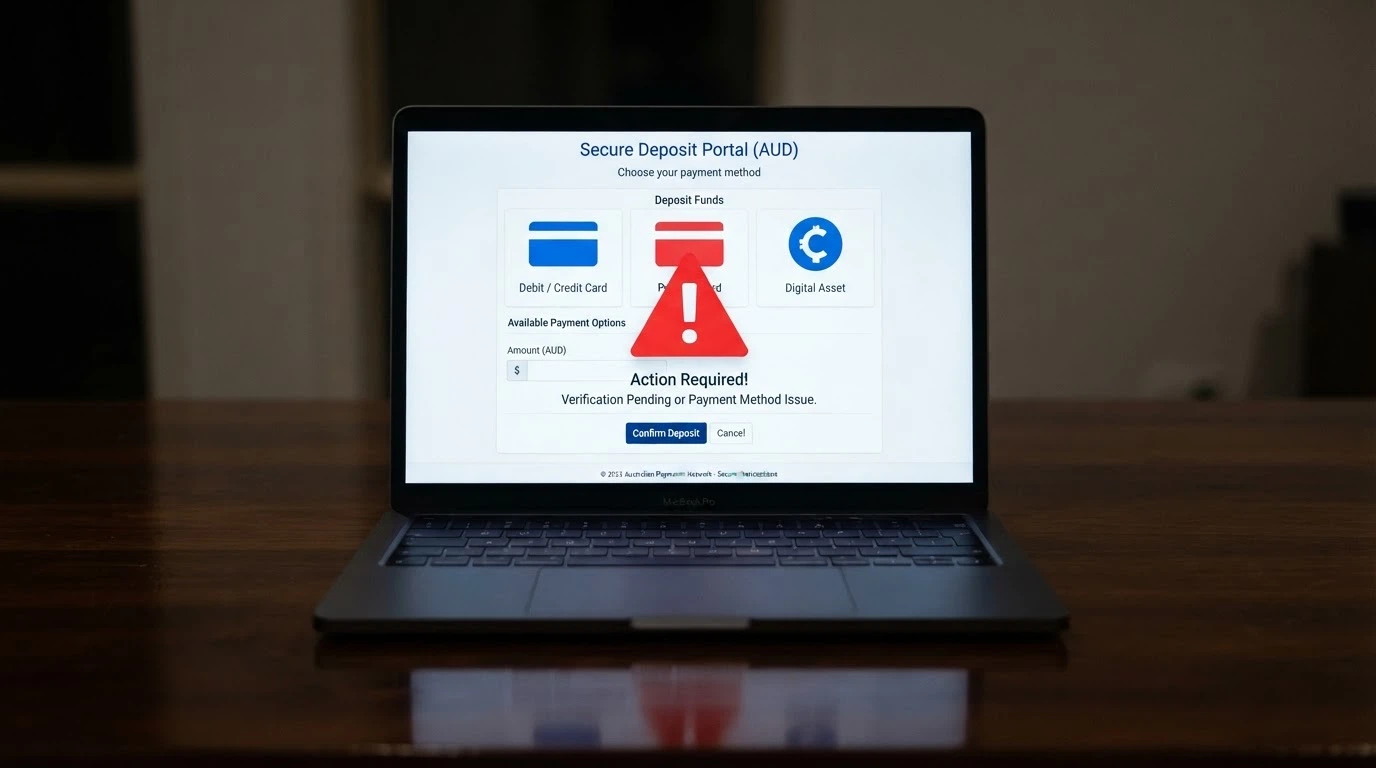
The corollary is the giveaway. A casino deposit page showing Visa, Mastercard or Bitcoin icons is the fastest way to confirm the operator is offshore. A licensed Australian operator does not accept any of those payment methods, by law. The icons are not a UI choice; they are a jurisdictional signal. A player who lands on a cashier page with credit-card and crypto options knows they are looking at an operator outside Australian rules before they read a single term.
From 1 January 2027, the payment-blocking power described in the previous sub-section adds a second layer. Banks and payment providers gain express authority to decline transactions to illegal gambling operators. The icons on the cashier page may be present, but the bank may refuse the transaction at its end. The offshore operator is still the operator; the bank is now a checkpoint.
Terms That Trap — What the Fine Print Doesn’t Say
Offshore casino terms contain clauses that a licensed Australian operator could not include, because the relevant state or territory gaming authority would not allow them. Bonus confiscation clauses, dormancy fees on inactive accounts, reversal windows on withdrawals (where the operator can reverse a payout at its discretion for a set period after issuing it), and KYC stall tactics (where the verification process is used to delay a withdrawal indefinitely) are all common in offshore terms. None of them is enforceable under Australian consumer law, because none of them applies to an Australian-licensed operator.
The traps that show up in the bonus terms themselves are described elsewhere on this page — the A$100 to A$180 max cashout cap on no-deposit bonuses, the 0% to 10% game-contribution rate on table games, the A$5 to A$7.50 max-bet rule, the 5-day to 7-day expiry window. Each of those terms is in the bonus terms page a player can read before claiming. The trap is not that the terms exist; the trap is that the marketing banner does not link to them and the affiliate listicle rarely quotes them.
For an Australian player, the asymmetry is the point. A licensed wagering operator’s terms are reviewed by a state or territory regulator and can be challenged through an Australian complaints process. An offshore casino’s terms are reviewed by no Australian regulator and can be challenged only through the casino’s own process or through the casino’s home-jurisdiction regulator (if the casino is licensed at all and if that regulator will hear the case). Reading the terms is the only consumer protection an Australian player has at an offshore casino. Reading them slowly is the only one that works.
Bonus Chasing — When the Free Spins Stop Being Free
Promo codes are designed to convert a free taste into a deposit habit. The wagering requirement is the engine: it forces a player who wants to clear the bonus to keep depositing, keep spinning and keep grinding until the balance runs out or the requirement is met. Australian harm data shows the machine is working. An estimated 3.29 million Australians aged 5 and over are affected annually by their own or another person’s gambling. Around 1.97 million Australian adults are classified as at-risk or problem gambling. The annual health loss associated with gambling-related harm in Australian adults is estimated at over 400,000 Years Lived with Disability. Participation rose from 57% in 2019 to 65% in 2024; 15% of Australian adults experienced gambling harm in the past 12 months, up from 11% in 2019 — equivalent to around 3 million Australians. On average, gamblers at the highest risk levels affect six other people. Two-thirds of those who participate in sports and race betting are classified at some risk of gambling harm.
A no-deposit bonus at 40x wagering is the smallest version of this engine. A A$20 bonus requires A$800 of turnover. Once that turnover runs out, the casino’s next offer — a deposit match, a reload bonus, free spins on the next deposit — is sitting in the player’s inbox, ready to convert the cleared (or failed) no-deposit attempt into a fresh cycle of deposits. That is the marketing logic. It is also the harm pathway.
How Wagering Requirements Drive Harm
The mechanics of harm start with a single bonus. A player claims a A$20 no-deposit chip, starts spinning, loses the bonus and part of their deposit before clearing the wagering, and tops up with another deposit to “give it another go”. The second deposit triggers a deposit-match offer, which has its own wagering cycle, which has its own max cashout, which has its own expiry window. By the third cycle, the player is depositing to clear bonuses rather than playing to win, and the bonus has stopped being a benefit and started being a trigger.
The numbers behind the trigger are stark. A A$20 bonus at 40x wagering means A$800 of turnover, and a typical pokie return-to-player of 96% means an expected loss of roughly A$32 across that turnover — paid by the player, on the way to clearing the bonus. The bonus is worth A$20 in bonus cash. The path to it costs A$32 in expected loss before any withdrawal is even possible. A player who repeats this across three or four no-deposit offers has spent more than A$100 in expected losses to access roughly A$80 of bonus value, and has conditioned themselves to view each new offer as worth claiming.
This is the loss-chasing dynamic the wagering requirement is engineered to produce. The bonus is the hook; the requirement is the rod; the next deposit is the line. Australian harm data — 15% of adults experiencing harm in the past 12 months, up from 11% in 2019, 67% of sports and race bettors at some risk — describes the population the engine catches.
BetStop and Its Offshore Blind Spot
BetStop, the National Self-Exclusion Register, launched on 21 August 2023. A single registration excludes a person from every Australian-licensed online and phone wagering service. Approximately 150 licensed wagering providers are connected to the register. As of 31 March 2026, 59,830 people had registered and 37,247 had active exclusions. As of 31 July 2026, the figures stood at 67,480 registrations and 41,290 active exclusions. Seventy-eight per cent of registrants were under 40; 38% chose lifetime exclusion.
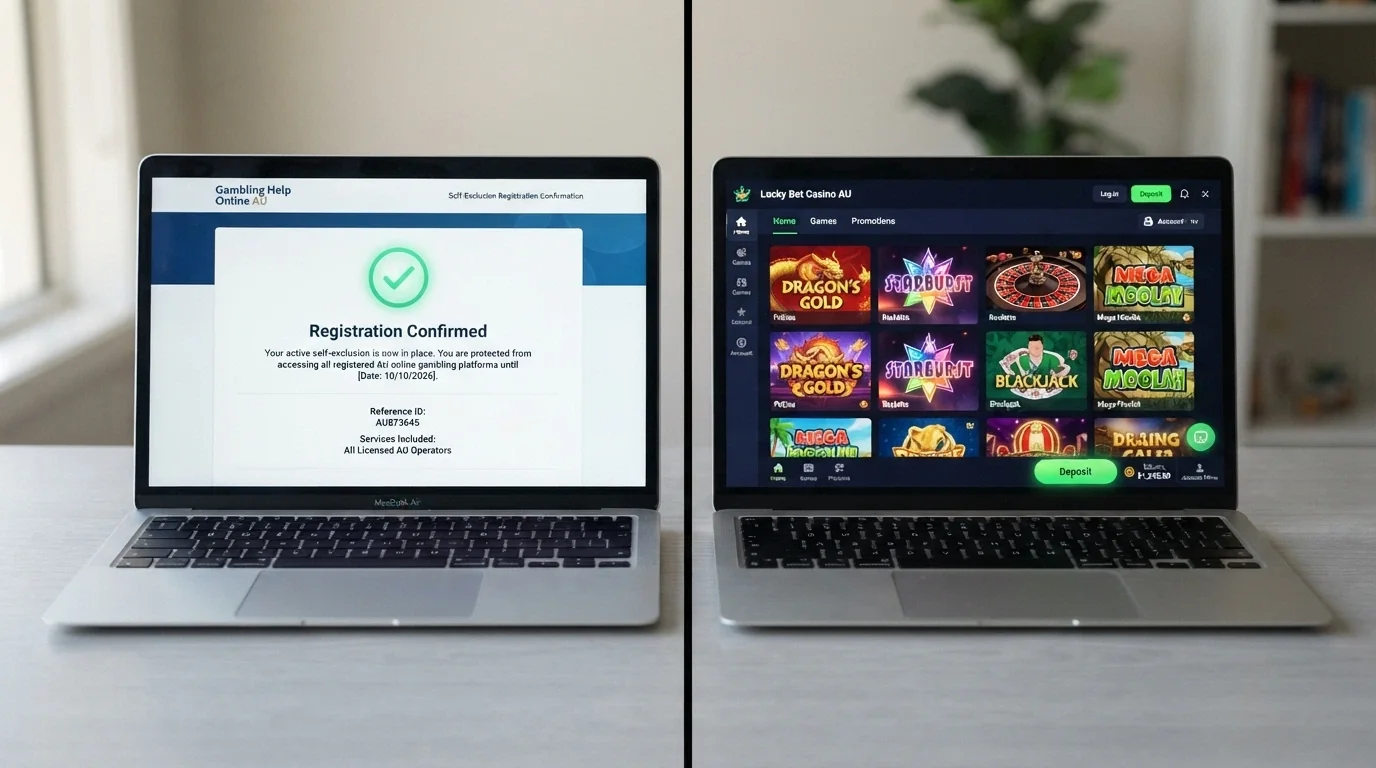
Awareness is the gap. According to the Australian Gambling Research Centre at the Australian Institute of Family Studies, only one in three wagerers (33.5%) know BetStop exists; around one in four Australian adults (26.5%) are aware of it. The register is large in absolute terms and small in coverage terms. The statutory review of BetStop, published on 25 February 2026, made 10 recommendations focused on community awareness, reducing circumvention and strengthening protections.
The offshore blind spot is the second gap. BetStop binds only Australian-licensed wagering services. An offshore casino is not licensed in Australia, is not connected to the register, and will keep accepting a self-excluded person’s deposits. A player who registers with BetStop and then redeems a promo code at an offshore casino has excluded themselves from the licensed system and left themselves unprotected in the unlicensed one. The gap is not a bug; it is the structural consequence of the offshore category being outside Australian jurisdiction. As Dr Kei Sakata, Executive Manager of the Australian Gambling Research Centre, observed in 2025: despite an estimated five million wagerers nationwide, including 400,000 high-risk gamblers, just 30,000 individuals currently have active exclusions through BetStop.
Self-Exclusion, Deposit Limits, and Where to Get Help
The practical tools for an Australian player exist on three levels. At the licensed-system level, BetStop excludes a player from Australian-licensed wagering services across all connected operators in a single registration. At the operator level, licensed wagering operators offer customer-set deposit limits and activity statements under their state or territory conditions, which differ by jurisdiction. At the help-service level, the National Gambling Helpline is 1800 858 858 — free, confidential, staffed 24/7 — and Gambling Help Online (gamblinghelponline.org.au) provides online chat, email counselling and self-help tools.
The tools work inside the licensed system. They do not reach into offshore casinos. A self-exclusion registered with BetStop does not stop an offshore casino from accepting a deposit; an operator-level deposit limit set with a licensed wagering provider does not carry over to an offshore site; the help services are available regardless of where a person plays, but the protective mechanisms they connect to are licensed-system mechanisms. The first step for a player who is using offshore promo codes is recognising that the tools that work in the licensed system are the same tools that do not reach the offshore system, and that the help services exist precisely because the offshore system does not protect the player.
Recognising problem-play in oneself or in someone close is the next step. Signs include chasing losses, depositing to clear a bonus rather than to play, hiding play from family or colleagues, lying about time or money spent, and continuing to play after deciding to stop. The harm data — 15% of adults, 3.29 million Australians affected, six other people affected per high-risk gambler — describes a population the warning signs are not hard to find in. The National Gambling Helpline (1800 858 858) and Gambling Help Online (gamblinghelponline.org.au) are free, confidential, available 24/7 and reachable regardless of where a person plays.
How We Evaluated Every Casino on This Page
The operators on this page were drawn from Australian-facing casino directories and cross-checked against the ACMA’s published enforcement record, the Interactive Gambling Act 2001 and each operator’s own published bonus terms. No operator was taken at its own word, and no operator’s marketing claim was used as a substitute for its terms page. Where the terms page was unreachable or did not contain a verifiable figure, the cell in the comparison table carries an em dash rather than an estimate — the absence of a figure is itself information, and the audit prefers to show the gap rather than fill it.
The selection criteria were three. First, the operator had to be Australian-facing — visible from an Australian IP address, listed in AU-facing directories or accepting Australian players through its cashier. Second, the operator had to have a documented promo-code offer, either published on its own site, listed by an affiliate aggregator or both. Third, the operator had to be reviewable on the basis of its own published terms, with the licence jurisdiction, wagering multiplier, max cashout and game-provider line-up as the four primary comparison axes.
The ranking criterion was depth of verified bonus data, not bonus generosity. RocketPlay publishes the most complete bonus picture in the set, which is why it leads the comparison table — not because its bonus is the largest, but because the reader can see what the bonus is. Skycrown runs second for a similar reason: the headline number is the largest in the set, and the published terms (30x wagering, AU$500 max cashout per bonus, 7-day expiry) tell the reader what the headline leaves out. Fair Go, PlayCroco and Ozwin sit in the middle of the table because their RTG-flavoured structure is comparable but their licence data is incomplete. BitStarz and 7Bit sit further down because the no-deposit offer is documented but the wagering and cashout terms could not be verified. WinSpirit, Stake and Bizzo sit at the bottom of the table because the data gap is largest there — WinSpirit and Bizzo have a verifiable offshore presence but no verifiable bonus terms, and Stake has a verifiable Curaçao licence but no traditional welcome bonus to compare.
What the evaluation did not use: user reviews, affiliate commission rates, operator self-reporting without verification, and any figure that could not be traced to a named source in the inputs to this page. The audit preferred to leave a cell empty rather than fill it with a figure that could not be sourced.
Before You Redeem That Code — What Actually Protects You
The promo code is real, the bonus lands in the account and a win is possible. Every protection an Australian-licensed operator must provide is absent the moment a player clicks through to an offshore casino. There is no Australian licence, because no online casino licence exists in Australia. There is no Australian consumer-law recourse, because the operator is not in Australian jurisdiction. There is no Australian complaints body that can compel a payout. BetStop does not reach the offshore casino. The ACMA cannot recover funds. The bank may decline the transaction from 1 January 2027 onward. The wagering requirement and the max cashout cap are the two mechanisms that do the most work in shrinking the bonus’s real value, and they are enforced by the operator on its own terms.
The decision that protects the player’s money is the one made before the deposit. Read the bonus terms page on the operator’s own site, not on the affiliate listicle. Check the licence jurisdiction in the footer. Note the wagering multiplier, the max cashout cap, the max bet during wagering, the game-contribution rate and the validity window. Note whether the operator accepts credit cards or cryptocurrency — if it does, it is offshore by definition. Note whether the no-deposit bonus is actually no-deposit, or whether it is gated by phone verification, a “verified user review” or some other action that the marketing banner does not mention.
The 2026 reform changes the friction from 1 January 2027 onward. Payment blocking makes depositing harder; inducement cooling-off rules tighten the marketing licensed operators can run; advertising restrictions narrow the visibility of wagering offers in the channels where offshore codes currently circulate. The prohibition itself does not change — it has been in force since 2001 — but the path around it gets narrower.
The help services exist regardless of where a player plays. The National Gambling Helpline is 1800 858 858, free, confidential and staffed 24/7. Gambling Help Online (gamblinghelponline.org.au) provides online chat, email counselling and self-help tools. BetStop (the National Self-Exclusion Register) excludes a player from approximately 150 Australian-licensed wagering services in a single registration; it does not reach offshore casinos, and that gap is itself a reason to understand what a promo code unlocks before entering it at the cashier.
Frequently Asked Questions
Why do some Australian casino promo codes not work — are they expired or geo-blocked?
Codes time out and campaigns close. An affiliate listicle may carry a code from a campaign that ended weeks ago, and the operator’s system will reject it on entry. Geo-blocking is a separate failure: if the operator has decided to block Australian IP addresses — usually after an ACMA investigation or a payment-processor flag — the cashier will not load regardless of which code is entered, because the player is being stopped before the bonus field appears. Both failures look the same to the player — no bonus credited — but they have different causes. A stale code is a marketing failure; a geo-block is an enforcement signal.
What happens to my money if an offshore casino blocks Australian users?
The balance remains on the operator’s books but the cashier is no longer reachable from an Australian IP. The block is DNS-level, enforced by Australian ISPs at the ACMA’s direction. The money is not lost in a technical sense — it is held by an operator the player can no longer contact through the channel the player used to deposit. Whether it comes back depends on the operator, and the operator has no Australian regulator reading over its shoulder. A player who suspects a casino is about to be blocked should withdraw the withdrawable balance before the block lands.
Does BetStop cover the casino I am playing at, or only licensed wagering sites?
BetStop covers Australian-licensed wagering services only. Approximately 150 licensed operators are connected to the register. An offshore casino accepting Australian players is not connected to BetStop, will not see the registration, and will keep accepting deposits from a self-excluded person. The register is the right tool for excluding from licensed wagering; it is not the right tool for excluding from offshore casinos. The two systems are structurally separate.
How do I know if an online casino accepting Australians is licensed or offshore?
No online casino licence exists in Australia, so a casino accepting Australian players is offshore by definition. The licence jurisdiction is published in the footer of most legitimate operators — Curaçao, Malta, occasionally other jurisdictions. An operator that does not publish a licence in the footer should be treated as unverified. The second giveaway is the cashier: credit cards and cryptocurrency are banned for licensed Australian wagering; an operator that accepts either is offshore. The third giveaway is the bonus terms page: an offshore operator’s terms are not reviewed by an Australian regulator, and they typically include clauses (max cashout caps on no-deposit bonuses, short validity windows, bonus confiscation clauses) that a licensed Australian operator could not legally include.
Can I win real money with a no-deposit bonus code in Australia?
Yes — but the path from bonus balance to withdrawable cash is narrow. A A$20 no-deposit bonus at 40x wagering requires A$800 of turnover before any withdrawal, and the house edge on that turnover (typically a few percent at the pokies that contribute 100%) is paid by the player on the way. The max cashout cap — often A$100 to A$180 on no-deposit bonuses — limits what can come out regardless of how high the balance climbs. A player who clears the wagering inside the validity window and stays under the max bet can withdraw up to the cap; a player who misses the window or trips the max bet forfeits the bonus and any winnings from it. The win is possible; the conditions on it are the point.
What does a 40x wagering requirement mean on a casino bonus?
A 40x wagering requirement means the bonus amount must be turned over 40 times in qualifying bets before any withdrawal. A A$20 bonus at 40x means A$800 in turnover; a A$100 deposit matched 100% at 40x-on-bonus-only means A$4,000 of turnover. The requirement applies to specific games — typically pokies contribute 100%, table games 0% to 10%. A max-bet rule during wagering (usually A$5 to A$7.50 per spin) caps the stake, and an expiry window (usually 5 to 7 days) caps the time. The arithmetic is mechanical; the player’s expected loss across the required turnover is the cost the marketing banner does not mention.
Are crypto deposits safe at offshore casinos targeting Australians?
Crypto deposits are banned as payment for licensed Australian wagering since 11 June 2024, so a casino accepting crypto is offshore by definition. The transaction itself is recorded on a blockchain, which gives a verifiable trail, but the casino’s terms govern what happens to the funds after they land in the operator’s wallet — bonus terms, max cashout caps, KYC verification before withdrawal, dormancy fees on inactive balances. None of those terms is reviewed by an Australian regulator. The blockchain protects the deposit; it does not protect the balance once the casino’s terms take over. From 1 January 2027, banks and payment providers gain express authority to block transactions to illegal gambling operators, which may make the deposit itself harder to complete.