
Australia’s offshore high-roller casino market: bonuses, limits and the law in 2026
Online casino play is prohibited in Australia. No licence exists, not federally and not in any state or territory, and the Interactive Gambling Act 2001 makes providing one an offence. That is where the legal market ends, and where this page starts. The high-roller bonus market Australians are actually searching for lives entirely offshore: ten operators, none of them licensed in Australia, all of them reachable from an Australian IP address and all of them chasing the same deposit sizes. The bonuses are real. The wagering requirements are real. The absence of Australian consumer protection is real, too. This page ranks the ten, lays out the bonus terms research has been able to verify, and explains the protections the reader gives up by walking through an offshore cashier.

Data current as of 18 October 2026, verified against ACMA enforcement publications, operator terms-and-conditions pages and archived affiliate audit data.
Table of Contents
- Why Australia’s high-roller casino scene runs entirely offshore
- The 10 offshore casinos courting Australian high rollers in 2026
- Why your 2026 high-roller bonus is smaller than it looks
- The pokies and table games where high-stakes play actually pays
- High-roller play on mobile: apps, browsers and what breaks
- Playing from Australia: what the law actually says
- When the stakes outrun the player: harm, limits and where to get help
- How we chose and ranked these high-roller casinos
- The offshore high-roller trade-off: what you gain and what you give up
- Frequently asked questions
Why Australia’s high-roller casino scene runs entirely offshore
The Interactive Gambling Act 2001, strengthened by the 2017 amendments, makes providing an online casino to a person in Australia a criminal offence. Section 15 of the Act carries a penalty of 5,000 penalty units per day of contravention. Civil penalties reach A$2,475,000 per day for an individual and A$12,375,000 per day for a corporation. The penalty scale is built for operators, not players; the individual player is not prosecuted, but the product the player wants to buy is banned outright. There is no federal or state licence for online casino anywhere in the country, and there is no path to one being issued in 2026.
What this means in practice: every high-roller casino bonus on this page comes from an offshore operator. The Australian Communications and Media Authority (ACMA) enforces the prohibition, having had 1,788 illegal gambling and affiliate websites blocked by Australian ISPs since November 2019, with over 230 illegal services voluntarily withdrawing from the Australian market since enforcement was strengthened in 2017. The pace has not slowed. In Q1 2026 the ACMA conducted 25 formal investigations into 60 gambling websites, found breaches in 23 cases, issued 13 formal warnings and referred 109 sites for blocking.
The high-roller market exists because the legal market refuses to serve it. Australian players with deposit sizes in the four- and five-figure range are not the target of licensed online wagering, which is restricted to pre-event racing and sport. Offshore operators have filled the gap with welcome packages, VIP tiers and withdrawal caps scaled to a different player profile than the standard punter.
This page covers the ten operators the AU-facing market routes the most high-roller traffic to in 2026, the bonus terms research has verified, the high-RTP pokies where high-stakes play actually shrinks the house edge, the payment methods Australians can still use to fund an offshore account and the legal and harm picture that frames the whole trade.
What counts as a high roller in Australian online play
There is no single dollar figure that separates a high roller from a recreational player, and offshore operators do not publish a uniform threshold. The category is defined by a cluster of behaviours, not a single line: deposit size, per-spin or per-hand stake, VIP tier entry, and the operator’s internal segmentation of players who warrant a dedicated account manager.
In practice, the deposit-and-stake cluster that puts a player on a high-roller track at the operators on this page starts around A$200 to A$500 per deposit and A$5 to A$10 per spin on pokies, with VIP reload bonuses unlocking at deposit tiers several times the standard reload ceiling. The high-roller first-deposit bonus at Wild Tokyo, for example, requires a minimum deposit of A$200 to access; the standard bonus is available at a fraction of that. Standard reloads at most operators cap around A$200 to A$500 on a single deposit; VIP reloads at the same brands can reach A$1,000 to A$3,000. The operator’s own segmentation does the classification, and the segment is defined by deposit velocity and size as much as by lifetime value.
Australian-facing operators court this segment specifically because the margin profile is different. A recreational player depositing A$50 a week is profitable on volume but capped by stake size; a high roller depositing A$5,000 a week on a 50x wagering bonus generates turnover in five figures before the bonus clears, and the operator’s expected value per dollar of bonus is set against that turnover. The VIP cashback at StoneVegas (10% to 25% on net losses, paid weekly with no wagering) and the A$50,000 monthly withdrawal cap for verified VIP accounts at Wild Tokyo are not concessions made to a recreational player. They exist because the player behind them deposits at a rate worth competing for.
Online vs land-based: the high-roller experience compared
The high-roller experience at an online casino is shaped by speed, anonymity and scale in ways the physical floor does not match. The most concrete comparison is at the table: live dealer blackjack at Evolution VIP tables at AU-accessible offshore operators carries limits reaching A$10,000 per hand. That is the ceiling of the online live-dealer experience. The physical high-roller room in a Crown or Star property in Australia runs higher per-hand limits and a different product (physical chips, a human dealer, a host who knows your name), but it sits behind a photo ID check, a credit check and the casino’s own AML and responsible-gambling protocols.
What the digital experience trades for that ceiling is anonymity and pace. An offshore online player deposits with PayID or crypto, plays 600 to 800 spins an hour at A$10 a spin, and never speaks to anyone. The speed of play is the structural difference: a live dealer table deals 60 to 80 hands an hour; a pokie at A$10 a spin running 5-second spins generates A$7,200 an hour in turnover, against A$600 to A$800 an hour at a A$10 blackjack hand. The dollar risk per hour on the online side is not smaller. It is faster, and the player can run it in pyjamas at 2 a.m.
Comps work differently. Land-based comps are rooms, meals and show tickets negotiated through a host. Online comps are cashback percentages, reload bonuses and faster withdrawals. The land-based relationship is built in person and protected by the operator’s own commercial interest in keeping the player at the property; the online relationship is built in a CRM and protected by the operator’s interest in keeping the player’s deposits flowing. Neither is more or less generous in absolute terms. The categories are not comparable.
Real-money high-stakes play: what is actually at risk
The stakes that define high-roller online play are measured in dollars per spin, not dollars per session. A high-roller pokies session at A$10 a spin running 5-second spins turns over A$7,200 an hour. At A$50 a spin (the upper end of the high-roller stake cluster, and double the A$10 max-bet-while-wagering ceiling at some operators) the same session turns over A$36,000 an hour. The dollar figure that matters is the hourly turnover, not the deposit.
The max-win ceiling is what makes the volatility readable. Wanted Dead or a Wild (Hacksaw Gaming) caps at 12,500x the stake: at A$50 a spin, the maximum payable win is A$625,000. Mental (Nolimit City) caps at 66,666x: at A$10 a spin, A$666,660. San Quentin xWays (Nolimit City) extends the ceiling to 150,000x at maximum stake, with bonus buy options priced from 100x to 500x the base bet. Nolimit City titles routinely carry max-win ceilings exceeding 100,000x. The headline number is the maximum payable, not the expected outcome, and the volatility that makes the maximum payable also makes it exceptionally rare: max-win titles cluster around 96% RTP, in line with standard pokies, and the 150,000x ceiling sits on the long tail of a distribution that pays out small amounts most of the time.
The distinction the bonus terms force a player to learn is between turnover and deposits. Turnover is the total amount wagered across all spins during a session or a bonus; deposits are what the player funds the account with. A 50x wagering requirement on a A$2,500 bonus generates A$125,000 in required turnover, which has nothing to do with how much the player deposited. The two figures live in different columns of the same bonus sheet, and confusing them is the most expensive error a player new to high-roller terms can make.
The Australian high-roller market in 2026
The AU high-stakes player base sits on top of a market the ACMA is actively shrinking. The 1,788 sites blocked since November 2019, the 230-plus services withdrawn, and the quarterly investigation volumes (133 sites referred for blocking in Q4 2025, 109 in Q1 2026) describe a regulator that is not slowing down. On 16 January 2026 the ACMA issued 8 infringement notices to Tabcorp Holdings Limited for providing a prohibited interactive gambling service, totalling A$158,400. The penalty was for in-play betting, not online casino, but it sets the precedent for how the regulator uses the civil-penalty provisions against a licensed Australian wagering operator; the offshore operators, with no domestic presence to penalise, are reached through ISP blocking instead.
Offshore operators continue to target Australian high rollers because the deposit profile is worth reaching. The player’s legal position under the IGA is unchanged: the Act targets the provider, not the customer, and no Australian has been prosecuted for playing at an offshore casino. The site can be blocked, though, and a balance sitting on a blocked site is a balance the player may not be able to withdraw. That is the practical cost, and it is not theoretical: the ACMA blocking programme has run continuously since 2017.
The 2026 reform adds a second front. From 1 January 2027, banks and payment providers gain express authority to block transactions to illegal gambling operators, and wagering advertising is capped at no more than three wagering ads per hour between 6:00 am and 8:30 pm, with a live-sport blackout. The reform does not legalise online casino. It tightens the perimeter around it.
Payment routes: PayID, crypto and the credit-card ban
The payment-method mix available to an Australian high roller is shaped by what is banned for licensed wagering, not by what an offshore cashier accepts. Credit cards, credit-related products and digital currency (crypto) are banned as payment for online wagering since 11 June 2024, with penalties of up to A$247,500 for non-compliant operators. The legal deposit routes for licensed wagering in Australia are debit card, bank transfer, PayID/Osko and BPAY.
An offshore casino is not bound by the Australian payment ban, and the cashier pages on the ten operators on this page typically offer a broader range than a licensed Australian wagering operator could. N1Bet, for example, carries the widest AUD-compatible payment selection among tested high-roller operators: POLi, PayID, Visa/Mastercard, bank transfer and three major cryptocurrencies. Crypto is the only method that gives the player a meaningful degree of deposit anonymity, and it is also the one that Australian banks will gain express authority to block from 1 January 2027. PayID is the fastest AUD rail: PayID withdrawals process within 8 hours in testing at reviewed operators. POLi and bank transfer are the fallback rails for players who do not want to hold crypto.
The credit-card ban and the crypto ban are best read as signals, not as borders. An offshore operator asking for a credit card or a crypto deposit is operating outside the Australian rules, and the payment method is the most visible tell of that fact.
The 10 offshore casinos courting Australian high rollers in 2026
The table below ranks the ten operators by bonus value scaled to high-roller deposit sizes, withdrawal capacity, and VIP programme quality. No operator holds an Australian casino licence, because no Australian casino licence exists. Where research has not verified a specific bonus term or withdrawal cap this run, the cell carries the no-data marker rather than a figure research did not supply.

| Operator | Best high-roller bonus or cashback offer | Wagering & key restriction |
|---|---|---|
| Lucky Ones | 150% up to A$3,000 + 200 FS on first deposit; four-deposit package reaches A$20,000 + 500 FS | 40x bonus + FS, 7-day clearance; A$8 max bet; A$5,000 winnings cap on deposit bonus; A$4,000/day, A$30,000/month withdrawal |
| Wild Tokyo | High-roller first deposit: 110% up to A$2,500 + 250 FS | 50x cash and FS, 5-day window; A$10 max bet; A$200 minimum deposit; A$10,000/week standard, A$50,000/month VIP |
| StoneVegas | Weekly cashback 10%–25% on net losses, paid Mondays, no wagering | No wagering on cashback; A$30,000/month withdrawal cap; six tiers, automatic enrolment |
| Rocket Play | — | — |
| Skycrown | VIP reloads A$1,000–A$3,000 on a single deposit | — |
| Stake | — | — |
| Royal Reels | — | — |
| N1Bet | Cashback from 8% at second VIP tier | A$25,000/week withdrawal cap; POLi, PayID, Visa/Mastercard, bank transfer, 3 cryptocurrencies |
| Scream Casino | — | — |
| FairGO | — | — |
The ranking above compares bonus and limit terms, not safety or consumer protection. No operator in the table holds an Australian casino licence, and no operator is reachable through the Australian consumer protection system. The next sections walk through what each operator actually offers.
Lucky Ones — largest welcome package of the featured set
Lucky Ones carries the largest headline welcome package of the ten operators on this page, structured across four deposits and reaching up to A$20,000 plus 500 free spins. The first-deposit leg is the largest in percentage terms: 150% up to A$3,000 plus 200 free spins, delivered as 40 free spins per day over five days. The minimum deposit to trigger the first leg is A$20.
The 40x wagering requirement applies to both the bonus and the free spins amount, with a 7-day clearance window. At the maximum first-deposit bonus of A$3,000, that 40x is A$120,000 in required turnover before a dollar of bonus winnings can be withdrawn. The A$8 max bet while wagering caps the size of any single spin during the clearance period, which constrains the high-stakes player whose natural stake is higher. The deposit bonus winnings are capped at A$5,000 regardless of what the play produces: even on a session that returns more, the payable amount is A$5,000.
Standard withdrawal caps sit at A$4,000 per day and A$30,000 per month. A player running a A$30,000 monthly withdrawal ceiling on a single A$20,000 bonus is at the cap for the month, with no headroom until the calendar rolls. The Diamond Club VIP tier unlocks faster support and higher limits, though research has not verified the specific Diamond Club thresholds or cap increases this run. A Curaçao licence has been reported by multiple review sites but was not verified against the register this run. For a high roller, the value is in the headline figure and the multi-deposit structure; the cost is in the 40x turnover obligation, the A$5,000 winnings ceiling and the A$8 bet cap that limits spin size during clearance.
Wild Tokyo — the dedicated high-roller bonus tier
Wild Tokyo runs a separate high-roller track alongside its standard welcome bonus, and the high-roller track is the more interesting one for a player whose deposit size is in four figures. The standard welcome is 100% up to A$500 plus 200 free spins; the high-roller first-deposit bonus is 110% up to A$2,500 plus 250 free spins, available from a minimum deposit of A$200.
The 50x wagering applies to both the cash bonus and the free spins winnings, and the clearance window is five days. At the maximum high-roller bonus of A$2,500, that 50x is A$125,000 in required turnover to be completed in five days. The A$10 max bet while wagering is double the A$5 standard at most operators and is the widest max-bet ceiling in the featured set, allowing higher-stakes pokies sessions during clearance without triggering the bonus-voiding rule. Standard withdrawal caps sit at A$10,000 per week, and verified VIP accounts move to an A$50,000 monthly ceiling, five times the standard at most AU-facing operators. Wild Tokyo holds a Curaçao eGaming licence and launched in 2022; the licence was not verified against the register this run. For a high roller who can clear A$125,000 in five days, the bonus-to-turnover ratio and the A$50,000 VIP ceiling make this the most clearance-friendly track in the set.
StoneVegas — no-wagering cashback across six automatic tiers
StoneVegas does not lead with a welcome bonus. Its value to a high roller is the VIP cashback programme, which is structured differently from the welcome-package model on the rest of the page. There are six tiers, enrolment is automatic from the first bet, and weekly cashback starts at 10% and rises to 25% on net losses. Cashback is calculated on net losses per week and paid each Monday, with no wagering requirement on the cashback payment. The A$30,000 monthly withdrawal cap is the only structural limit research has verified.
The no-wagering condition is the structural difference. A welcome bonus with 40x or 50x wagering obliges the player to turn over a multiple of the bonus before any winnings become withdrawable. Cashback with no wagering is paid in cash, on a Monday, and the player can withdraw it, redeposit it or play it through without a turnover obligation. For a high-volume player generating net losses across a week, the cashback is a fixed-percentage rebate on those losses rather than a future turnover obligation. Research has not confirmed a welcome bonus at StoneVegas this run, which means the operator’s positioning is on the recurring cashback rather than on a headline welcome figure. For high-volume players prioritizing consistent weekly value over one-off welcome bonuses, StoneVegas provides the most reliable return structure.
Rocket Play — a high-volume AU-facing brand
Rocket Play ranks third in Australian market share among AU-facing offshore operators in the operators skill this run, behind only the operators that lead the ranking above. The operator has an established Australian player base, which makes it a familiar name to players who have already moved between offshore brands. The market-share position is the most concrete claim research carries.
Specific high-roller bonus terms, withdrawal caps and VIP programme details have not been confirmed for Rocket Play this run. The operator is not excluded from the ranking on that basis: the market-share position is a fact, and the absence of confirmed bonus terms is itself information. A player considering Rocket Play should treat the standard terms-and-conditions check as part of the deposit decision, the way they would for any operator not specifically named in the table above. The operator’s standing in the AU-facing market is its distinguishing feature, and the bonus and limit profile that goes with that standing has to be checked at the cashier.
Skycrown — VIP reloads that rival welcome packages
Skycrown’s distinctive feature is a VIP reload structure that can reach A$1,000 to A$3,000 on a single deposit, several times the standard reload ceiling of A$200 to A$500 at most operators. For a high roller who has moved past the welcome package and is funding ongoing play, the reload is the recurring offer, and the VIP reload at Skycrown is the most generous recurring offer in the featured set.
Research has not confirmed wagering requirements, withdrawal caps, max-bet restrictions or the specific VIP tier that unlocks the A$1,000-to-A$3,000 reload range. The reload structure is the verified fact, and the terms attached to it are not. A player considering the Skycrown VIP reload should treat the deposit trigger and the reload amount as the starting point for a terms check, not as the whole picture. The reload ceiling is high relative to the standard; whether the rest of the bonus structure is competitive depends on what the terms say, and that is a page-by-page read.
Stake — the crypto-native platform with an Australian following
Stake is a crypto-native operator with a dual sportsbook-and-casino product, popular with Australian players who want deposit anonymity and fast crypto settlements. The platform’s appeal is the cashier: crypto deposits and withdrawals clear without the banking rails that Australian players are increasingly locked out of under the 2024 credit-and-crypto ban, and the speed of settlement is what makes the model work for a high-volume player.
The crypto-native model sits in tension with the Australian payment framework. The credit-card and crypto ban applies to licensed wagering operators, not to offshore casinos, which is why Stake can still accept crypto from an Australian player; from 1 January 2027, banks and payment providers gain express authority to block transactions to illegal gambling operators, and the crypto rail may narrow further. Stake does not hold an Australian casino licence, and no Australian casino licence exists. Specific bonus terms, withdrawal caps, wagering requirements and VIP programme details for Stake have not been confirmed this run, and the operator’s standing in the ranking is on the product model rather than on a verified bonus figure.
Royal Reels — strong name recognition among Australian players
Royal Reels is a long-standing brand in the Australian-facing offshore market, with name recognition that puts it on the shortlist of operators an Australian player will have heard of before they start comparing. The brand’s positioning and game library are the assets research carries; specific high-roller bonus, withdrawal-cap, wagering and VIP terms have not been confirmed this run.
The name recognition is a real market position. A player who has played at one AU-facing offshore casino and is considering a move to another is more likely to consider a brand they have already heard of, and Royal Reels sits in that list. The absence of confirmed bonus terms is not a verdict against the operator; it is the limit of what this run’s research has been able to verify. A player evaluating Royal Reels should check the current terms and conditions directly, the way they would for any operator not specifically named in the bonus table.
N1Bet — the widest AUD payment selection among featured operators
N1Bet’s distinguishing feature is the cashier. The operator offers POLi, PayID, Visa/Mastercard, bank transfer and three major cryptocurrencies in a single deposit page, which is the widest AUD-compatible payment selection among the high-roller operators tested this run. For an Australian player funding an offshore account, the breadth matters: PayID is the fastest AUD rail, POLi covers players who do not use PayID, and the crypto options cover players who want deposit anonymity or who have been locked out of AUD rails by their bank.
The withdrawal cap is A$25,000 per week, which is a workable ceiling for a high-volume player who is not running a six-figure monthly turnover. Cashback starts at 8% from the second VIP tier, which is a smaller percentage than StoneVegas’s headline 10-to-25% but a usable recurring offer on the second-tier progression. Specific welcome-bonus terms for N1Bet have not been confirmed this run, and the operator’s standing in the ranking is on the payment-method breadth and the withdrawal cap rather than on a verified welcome figure. For a player whose primary filter is the payment-method list, N1Bet is the strongest match in the set.
Scream Casino — an emerging brand in the AU offshore market
Scream Casino is a newer entrant in the Australian-facing offshore casino market, and its positioning is the established product rather than a verified bonus figure. The operator has been building an Australian player base, and the brand is reaching players who are rotating between AU-facing offshore operators rather than players who are committing to a single brand.
Specific high-roller bonus, withdrawal-cap, wagering and VIP terms have not been confirmed for Scream Casino this run. The operator is in the ranking because it is reaching Australian high-roller players; the bonus and limit terms that go with that reach are not on this page. A player considering Scream Casino should treat the standard terms check as the first step, the same way they would for any operator not specifically named in the bonus table. The operator’s standing is the market presence, not a verified offer.
FairGO — an established AU-facing brand
FairGO is a long-standing offshore brand with an Australian-facing identity, and the brand’s market presence is the distinguishing feature. The operator has been in the AU-facing market long enough to build name recognition among players who have been using offshore casinos for years, and that standing puts it in the conversation alongside the operators with more visible bonus programmes.
Specific high-roller bonus, withdrawal-cap, wagering and VIP terms have not been confirmed for FairGO this run. The operator’s position in the ranking is on the brand presence and the AU-facing identity rather than on a verified offer. For a player who has been rotating between AU-facing offshore operators and is considering a brand they have already heard of, FairGO is on that list. The bonus and limit profile that goes with the brand presence has to be checked at the cashier.
Why your 2026 high-roller bonus is smaller than it looks
A high-roller welcome package is structured to look like a gift. The wagering requirement turns it into a turnover obligation, the cashout cap turns the result into a ceiling, the validity window forces the play to happen inside a few days, and the max-bet rule constrains the size of any single spin during clearance. Each of those four mechanisms is set against the player. Together they define the real cost of the bonus.
The Wild Tokyo high-roller bonus is the clearest worked example in the set. The headline is 110% up to A$2,500 plus 250 free spins. The 50x wagering multiplier on the cash bonus turns the A$2,500 into A$125,000 in required turnover. The 5-day validity window forces that A$125,000 of play into 120 hours of clock time. The A$10 max bet while wagering caps the size of any single spin during clearance, which constrains the speed at which the turnover can be run. The structure of the bonus is a turn the player must complete, not a prize the player receives.
Welcome bonuses: the headline number vs the real cost
A 150% match up to A$3,000 at Lucky Ones is the largest single-leg welcome bonus in the featured set. The 40x wagering on bonus plus free spins at the maximum match turns A$3,000 of bonus into A$120,000 in required play. The A$5,000 cap on deposit bonus winnings is the ceiling on what the player can walk away with from the bonus, regardless of what the play produces. The 7-day clearance window is the clock on the obligation. The A$8 max bet while wagering caps the spin size during the clearance period.
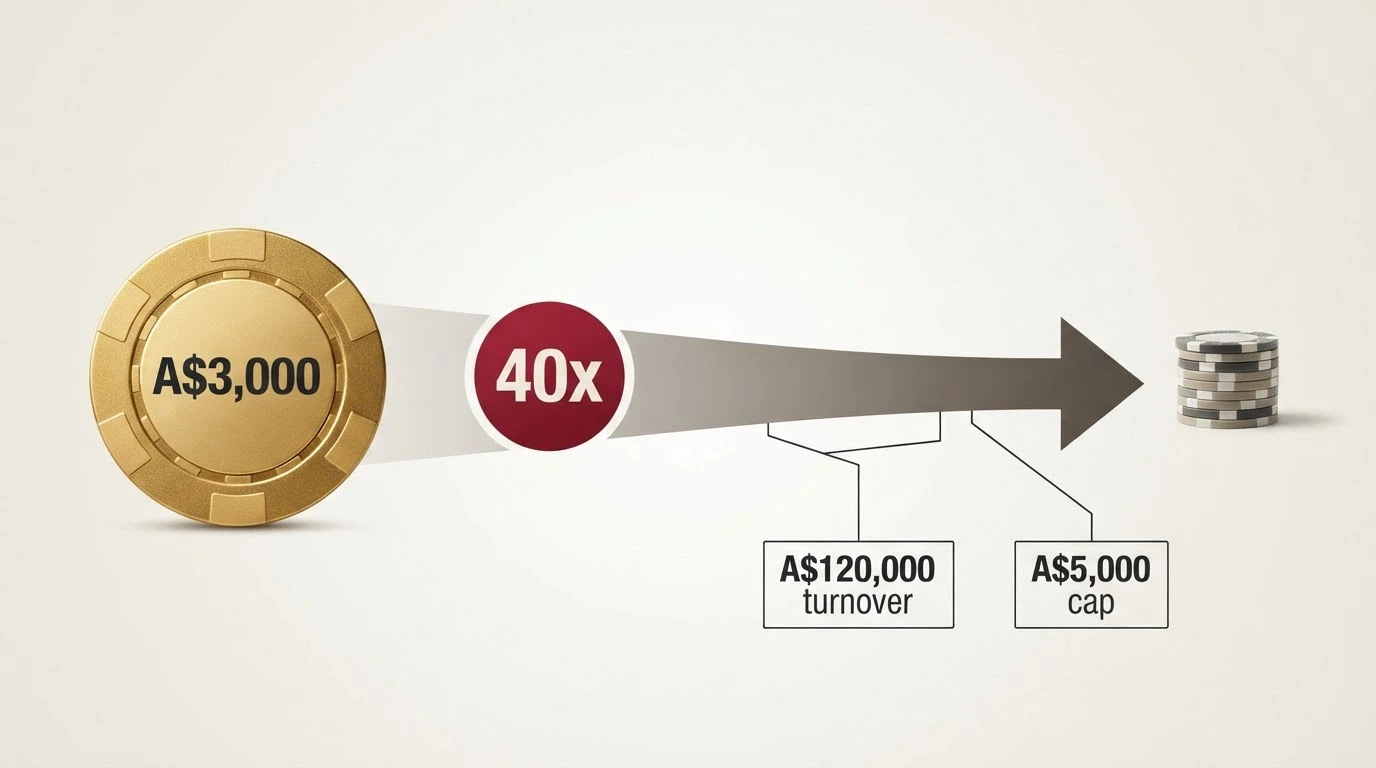
The 50x wagering at Wild Tokyo is higher than the 40x at Lucky Ones, but the A$10 max bet is also higher, which lets a player with a larger natural stake run the turnover at a more comfortable spin size. The trade-off is a higher turnover obligation in a shorter window: A$125,000 in five days, against A$120,000 in seven. Neither is a soft offer. Both convert a headline bonus into a clearance job, and the job has to be completed before a dollar of bonus winnings can be withdrawn.
The A$5,000 winnings cap at Lucky Ones is the structural feature that separates a high-roller bonus from a recreational one. A player running A$120,000 of turnover at a 96.5% RTP title (the RTP cluster of the high-RTP pokies on this page) expects an average return of A$115,800, against A$120,000 staked. The expected loss on the bonus clearance is the turnover multiplied by the house edge. The A$5,000 cap is a separate ceiling: it limits what the player can withdraw from the bonus, not what the player can win during the bonus. A player who hits a max-win sequence during the clearance period walks away with A$5,000, not the headline figure the max-win calculation would produce.
No-deposit and free-spin offers for high rollers
Free-spin offers appear inside the welcome packages on the featured set, not as standalone no-deposit bonuses. The Wild Tokyo high-roller package includes 250 free spins; Lucky Ones includes 200 free spins on the first deposit (40 per day for five days), and the full four-deposit package at Lucky Ones reaches 500 free spins. The free spins are part of the deposit-triggered package, and the wagering on free-spin winnings is the same 50x at Wild Tokyo and 40x at Lucky Ones that applies to the cash bonus.
A true no-deposit bonus, available without a deposit, is a different product. None of the ten operators on this page carries a confirmed no-deposit high-roller bonus this run. The free-spin count on the high-roller packages is generous in absolute terms (200 to 500 free spins across the welcome structure), and the spin value compounds with the deposit match, but the entry point is a minimum deposit, not a free account. For a high roller whose deposit size is in four figures, the free-spin count is an add-on to a deposit they were going to make anyway, not a reason to deposit.
The reason no-deposit bonuses are rare at the high-roller end of the market is the same reason the high-roller bonus exists at all. A high-roller operator is competing for deposit size, and a no-deposit bonus competes for the player who is not yet depositing. The two products are aimed at different customer profiles, and the high-roller segment is the wrong audience for a no-deposit offer.
The fine print that shrinks your headline bonus
Four terms do most of the work in shrinking a high-roller bonus from its headline to its real value: the max bet while wagering, the game weighting, the cashout cap, and the validity window.
The max bet while wagering caps the size of any single spin during the bonus clearance. A$8 at Lucky Ones, A$10 at Wild Tokyo, A$5 standard at most operators. The cap is the bonus-voiding rule: a spin over the cap can void the bonus and the winnings. For a high roller whose natural stake is A$10 or higher, the cap forces the clearance play to happen at a lower stake than the player would otherwise play, which extends the time the clearance takes.
Game weighting reduces the contribution of certain games to the wagering requirement. Slots typically contribute 100%; table games and live dealer often contribute 10% to 20%; some high-RTP or low-volatility titles are excluded entirely. The specific weighting percentages vary by operator, and research has not confirmed a per-operator weighting table this run. The principle is the one the weighting serves: a player who clears a 40x wagering requirement on a 99% RTP pokie at 100% weighting is doing less for the operator’s expected value than a player who clears the same requirement on a 96% pokie, and the weighting is the operator’s tool for steering the play toward the higher-margin titles.
The cashout cap is the ceiling on what the player can withdraw from the bonus winnings. A$5,000 at Lucky Ones is the most explicit cap in the featured set. The cap is a flat limit, not a percentage of the bonus, and it does not scale with the deposit size. A player depositing A$5,000 and clearing a A$3,000 bonus with a A$5,000 cap walks away with at most A$5,000, regardless of what the play produces.
The validity window is the clock on the clearance. 5 days at Wild Tokyo, 7 days at Lucky Ones. The window forces the play to happen inside a compressed time period, which is a constraint on the player’s freedom to clear the bonus at their own pace. For a high-volume player, the window is workable. Players with smaller session budgets will find this tight timeline to be the primary hurdle to bonus clearance.
Bonus codes and how Australian players use them
Bonus codes are short alphanumeric tokens entered at the deposit stage to trigger a specific offer. They appear on affiliate pages, in operator promotional emails, and in VIP account-manager communications. The codes change frequently: a code published on an affiliate page has a shelf life measured in days or weeks, and an expired code typically returns a “bonus not found” error at the deposit stage.
The operators on this page auto-apply their welcome bonuses at the deposit stage without a code in most cases. The high-roller track at Wild Tokyo is selected by deposit size rather than by a code: depositing A$200 or more triggers the high-roller bonus instead of the standard one. The Lucky Ones welcome package is selected by choosing the offer at the deposit page, not by entering a code. VIP reloads at operators like Skycrown are typically triggered by the account manager rather than by a player-entered code.
This page carries no codes, because none stay current long enough to print. A code that was working at the time of writing may be expired by the time a reader reaches the cashier, and a published code that no longer works is worse than no code at all. The reliable route to a high-roller bonus at the operators on this page is the operator’s own promotions page or the VIP account manager, not a third-party code.
The pokies and table games where high-stakes play actually pays
The house edge on a pokie is the RTP subtracted from 100%. A 99% pokie has a 1% house edge; a 96% pokie has a 4% house edge. At high stakes the difference is not abstract: on A$100,000 of turnover, the 1% edge costs the player A$1,000 and the 4% edge costs A$4,000. The high-RTP pokies are the titles where high-stakes play actually shrinks the operator’s expected take, and the leaderboard below ranks the titles accessible to Australian players at the featured operators from the highest RTP down.
High-RTP pokies: the titles that shrink the house edge
| Pokie title | Provider | RTP | Volatility |
|---|---|---|---|
| Mega Joker | NetEnt | 99.0% | — |
| Book of 99 | Relax Gaming | 99.0% | — |
| Jackpot 6000 (Supermeter mode) | NetEnt | 98.86% | — |
| 1429 Uncharted Seas | Thunderkick | 98.60% | — |
| Blood Suckers | NetEnt | 98.00% | — |
| Big Bass Bonanza | Pragmatic Play | 96.71% | Medium-high |
| Thunderstruck II | Microgaming | 96.65% | Medium |
| Sweet Bonanza | Pragmatic Play | 96.51% | High |
| Gates of Olympus | Pragmatic Play | 96.5% | Extremely high |
| Book of Dead | Play’n GO | 96.21% | High |
| Wolf Gold | Pragmatic Play | 96.01% | — |
The two titles at 99% — Mega Joker (NetEnt) and Book of 99 (Relax Gaming) — carry the lowest house edge in the set, at 1%. A player running A$100,000 of turnover on Mega Joker is paying A$1,000 in expected house edge, against A$4,000 on a 96% title. The 3-percentage-point RTP gap is worth A$3,000 on that turnover, and the gap widens linearly with the volume. The trade-off is the volatility profile: high-RTP pokies are not necessarily high-volatility, and the RTP is an average across many spins, not a guarantee of any single outcome.
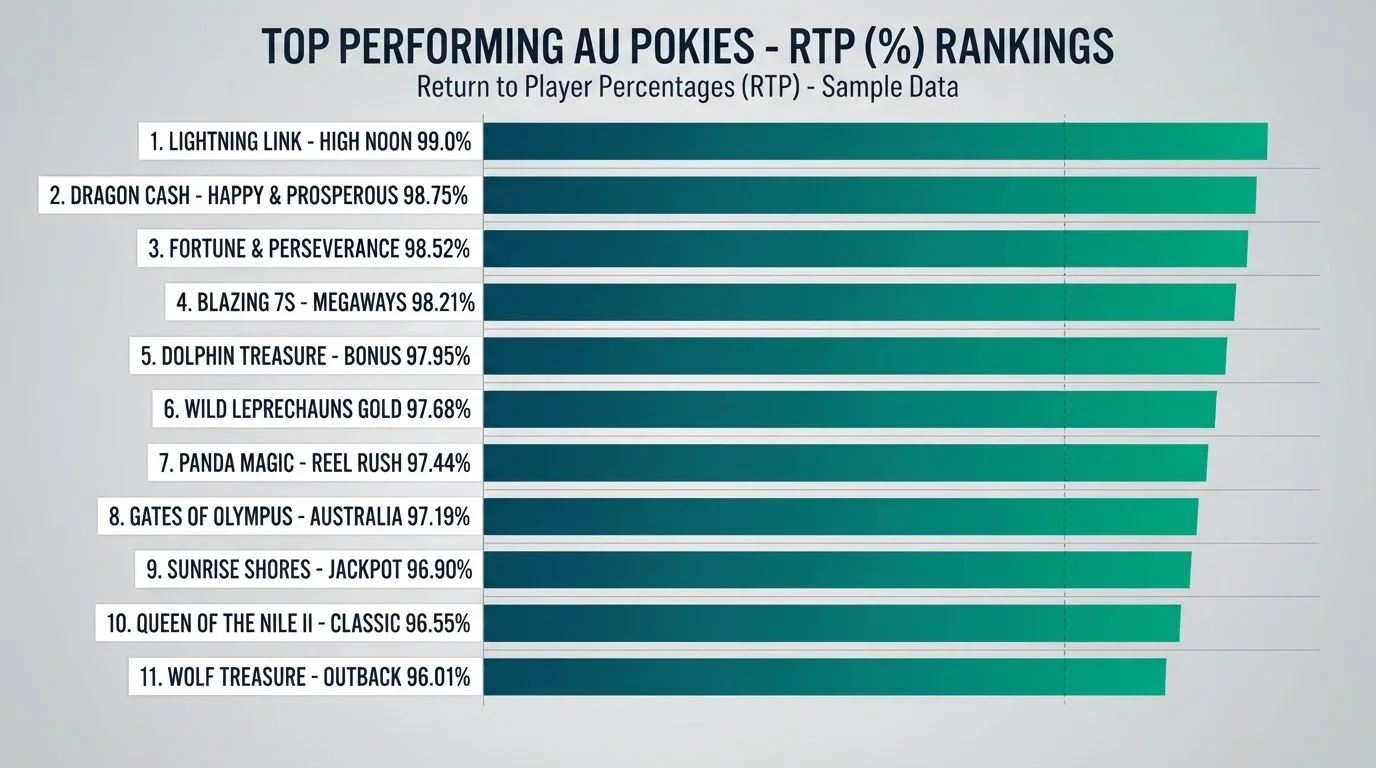
The volatility dimension is where the high-RTP leaderboard is incomplete. Gates of Olympus (Pragmatic Play) carries multipliers up to 500x and is rated extremely high volatility, which means the 96.5% RTP is paid out in concentrated sequences rather than steady returns. Sweet Bonanza’s free-spin round carries random multipliers up to 100x. Thunderstruck II has a 4-level bonus chamber. Book of Dead’s expanding symbol bonuses drive the high-volatility profile. The volatility is what the max-win titles on the next section rely on, and it is the same mechanism that makes a high-RTP title pay out in long quiet stretches punctuated by large hits.
Progressive jackpots and max-win machines
The max-win pokies are the titles where a single spin can return 12,500x to 150,000x the stake, and the volatility that makes those returns possible is the same volatility that makes them exceptionally rare. The leaderboard is short because the ceiling is the differentiator, not the RTP.
Wanted Dead or a Wild (Hacksaw Gaming) caps at 12,500x the stake, the most accessible max-win in the set. At A$50 a spin, the maximum payable is A$625,000. The 12,500x ceiling is high in absolute terms and modest against the Nolimit City titles that sit above it. Mental (Nolimit City) extends the ceiling to 66,666x: at A$10 a spin, the maximum payable is A$666,660. San Quentin xWays (Nolimit City) reaches 150,000x at maximum stake, with bonus buy options priced from 100x to 500x the base bet. Nolimit City titles routinely carry max-win ceilings exceeding 100,000x, with Tombstone RIP and Deadwood in the same range.
The max-win ceiling is the headline figure, not the expected outcome. Nolimit City RTPs sit around 96% on these titles, in line with standard pokies, and the 150,000x ceiling sits on the long tail of a distribution that pays out small amounts most of the time. A player chasing the max-win is paying for the chance in expected-value terms: the 4% house edge applies on every spin, and the 150,000x payout is the rare event that the edge is calculated against. Bonus buy options shift the same expected value into a single purchase: a 100x bonus buy at a 96% RTP title returns A$96 of expected value on average, and the variance is concentrated into a single bonus round.
Live dealer: table limits for high-stakes play
The live-dealer ceiling at AU-accessible offshore operators is set by the studio provider, not by the operator. Evolution Gaming’s VIP blackjack tables reach A$10,000 per hand at the operators that carry the VIP table feed, which is the highest live-dealer table limit research has verified for the AU-facing market. Pragmatic Play Live runs a similar VIP-tier product, with limits that vary by operator and table.
The A$10,000/hand ceiling is the top of the live-dealer experience online. A player who wants higher per-hand limits is looking at the land-based high-roller room, which is a different product (physical chips, a human dealer, a host relationship) under a different regulatory framework. RNG table games at the same operators run lower limits than the live-dealer VIP tables, typically capping at A$1,000 to A$5,000 per hand on blackjack and roulette. The live-dealer VIP feed is the high-stakes product on the online side.
Table type affects the house edge. Baccarat’s banker bet is the lowest-edge table game at most operators, around 1.06%. Blackjack’s house edge depends on the rule set, ranging from 0.5% on a single-deck game with favourable rules to 2% or higher on a shoe game with restrictive rules. Roulette’s house edge is 2.7% on a European single-zero wheel and 5.26% on an American double-zero wheel. The house edge is what the player is paying per hand, and the table type is the player’s primary tool for managing it.
Real-money vs demo play for high-stakes practice
Demo or fun-mode play is available at most offshore operators on most pokies, and it is the right tool for testing a volatile title before committing real money. A player considering San Quentin xWays at A$10 a spin is risking A$10 per spin to find out what the bonus round looks like; the same exploration in demo mode costs nothing and gives the player a feel for the hit frequency, the bonus-round trigger rate, and the volatility pattern.
Demo mode has limits. Progressive jackpot eligibility is restricted to real-money play in most cases, so a player testing a progressive title in demo mode is seeing the base game, not the jackpot feed. Bonus clearance cannot run in demo mode: the wagering requirement is a real-money obligation, and demo play does not contribute to it. Withdrawals are obviously not available in demo mode, and the demo balance is not a real balance.
The strategy case for demo play is the volatility case. High-volatility titles pay out in long quiet stretches punctuated by large hits, and a player who has not seen the quiet stretch does not know what they are committing to. Demo play lets the player run 200 or 500 spins at the target stake and see the distribution before the real-money session starts. For a high roller whose session budget runs into thousands per hour, the demo run is the cheapest due diligence available.
High-roller play on mobile: apps, browsers and what breaks
The mobile experience for a high-roller Australian player is the browser experience. Native casino apps from offshore operators are not on the Australian App Store or Google Play storefront, because the platforms do not distribute unlicensed gambling apps to Australian users, and the sideloaded alternative is a security risk the player takes on personally.
Browser-based mobile play works. The same HTML5 pokie runs in a mobile browser at the same RTP and the same stake range as the desktop version, and the cashier, the bonus activation and the withdrawal request all work through the same mobile web flow. The functional gap between a native app and a mobile browser is small for most high-roller sessions: deposit, play, withdraw, repeat. The session-stability gap is the real one, and it appears during long play sessions on older devices or on weak mobile networks.
Native apps vs browser: what high rollers actually get
Native iOS or Android apps from offshore casinos exist, but they are not distributed through the official app stores for Australian users. The installation path is a direct download from the operator’s site, which requires the player to adjust device security settings to allow installation from unknown sources. The functional benefit of the native app over the mobile browser is small: faster load times on repeat visits, push notifications for bonus offers, and a more stable session on long play.
The trade-off is the security model. A native app from an offshore operator sits on the device with the same permissions the player grants at installation, and the operator’s home jurisdiction determines what those permissions are used for. A mobile browser session is sandboxed to the browser: the operator sees what happens inside the browser tab, and nothing else. A native app has device-level access the browser does not, and that access is the surface area a security audit would flag.
The practical outcome: most high-roller players on mobile run browser-based play, and the operators on this page default to that experience. The native app exists as an option, and the player who chooses it is accepting the device-level access trade-off.
Download casinos and the risks they carry
A downloadable casino .apk (Android) or desktop client (Windows or macOS) from an offshore operator is a different product from the mobile browser. The download is a software package that runs on the device with the same permissions as any other installed application: file system access, network access, and on some platforms, the ability to run at startup or in the background.
The security implication is the perimeter of the operator’s licence. An offshore casino is not licensed in Australia, and the Australian regulator cannot audit the software the operator distributes. The software is what the operator says it is, and the player has no Australian recourse if the software does something it was not supposed to. The browser session, by contrast, runs inside a sandbox the operating system controls: the operator’s code runs inside the browser tab, and the tab is the boundary of what the operator can touch.
The ACMA’s position is that no licensed operator can offer a casino app in Australia, because no Australian casino licence exists. The download product is an offshore product by definition. Most offshore casinos default to browser-based play, and the operators on this page are not pushing downloadable clients as the primary access route. The recommendation for an Australian high roller is to stay in the browser, where the device’s own security model is the boundary the operator cannot cross.
Playing from Australia: what the law actually says
The Interactive Gambling Act 2001, strengthened by the 2017 amendments, is the federal framework. Online casino, online pokies and in-play sports betting are prohibited: no licence exists, not federally, not in any state or territory. Wagering on races and sport placed before the event is licensed, through operators licensed by a state or territory, with the Northern Territory the de facto national licensor through Licensing NT. The 2026 reform — the Interactive Gambling Amendment (Gambling Reform) Bill 2026, passed on 19 August 2026 with measures commencing 1 January 2027 — tightens the perimeter around the licensed market and the enforcement against the unlicensed one.
The Interactive Gambling Act: what is banned and what is not
The IGA prohibits providing an online casino, online pokies or in-play sports betting to a person in Australia. The prohibition is on the provider; the individual player is not prosecuted, and the Act’s penalties are aimed at the operator. The criminal penalty under section 15 is 5,000 penalty units per day of contravention. The civil penalty is 7,500 penalty units per day, which translates to A$2,475,000 per day for an individual and A$12,375,000 per day for a corporation.
The 2026 reform adds new measures from 1 January 2027. Wagering advertising is capped at no more than three wagering ads per hour between 6:00 am and 8:30 pm, with a live-sport blackout from 15 minutes before a live sporting event until 5 minutes after it ends. Athletes, celebrities and influencers are barred from promoting wagering products. Direct marketing of inducements is prohibited for 14 days after a customer signs up, for three months after a person deregisters from BetStop, and indefinitely for customers identified as at risk of gambling-related harm. Banks and payment providers gain express authority to block transactions to illegal gambling operators.
What remains licensed is pre-event racing and sport wagering through operators licensed by a state or territory regulator. The Northern Territory Racing and Wagering Commission, administered through Licensing NT, is the de facto national licensor, with licence terms of up to 20 years. Lotteries and keno are licensed at state level. The product the player is searching for — an online casino bonus — is not in the licensed set.
| Rule | What it means for Australian players | Effective date |
|---|---|---|
| Online casino, online pokies, in-play sports betting prohibited | No licence exists; offshore operators are the only route | IGA 2001, strengthened 2017 |
| Credit cards and crypto banned for online wagering | Operators cannot accept these from licensed Australian wagering accounts | 11 June 2024 |
| Criminal penalty for providers: 5,000 penalty units/day | Aimed at operators, not players; player not prosecuted | IGA 2001, section 15 |
| Civil penalty up to A$12,375,000/day for corporations | Reached through ACMA enforcement action | IGA 2001 |
| 2026 reform: advertising cap (3 ads/hour 6am–8:30pm) | Live-sport blackout, no celebrity endorsements, no inducement marketing for 14 days post-signup | 1 January 2027 |
| 2026 reform: bank blocking authority | Banks and payment providers may block transactions to illegal operators | 1 January 2027 |
| Tax: gambling winnings not assessable income | Recreational winnings are not taxable; losses are not deductible | ITAA 1997, section 6-5 |
The offshore route the player is using is not in the table. Every operator on this page is outside the licensed system, and the protections the licensed system provides are not available to the player who uses them.
Offshore vs licensed: the protections Australian players forfeit
Using an offshore casino costs the player every Australian consumer protection the licensed wagering system provides. The ACMA cannot recover a player’s money from an offshore operator, because the ACMA’s regulatory authority stops at the Australian border. There is no Australian statutory complaint body with jurisdiction over an offshore casino. BetStop does not reach an offshore casino: a self-excluded person is still served, and the offshore cashier accepts the deposit without interruption. If the operator refuses a withdrawal, voids a win, or closes the account, the player has no Australian recourse.
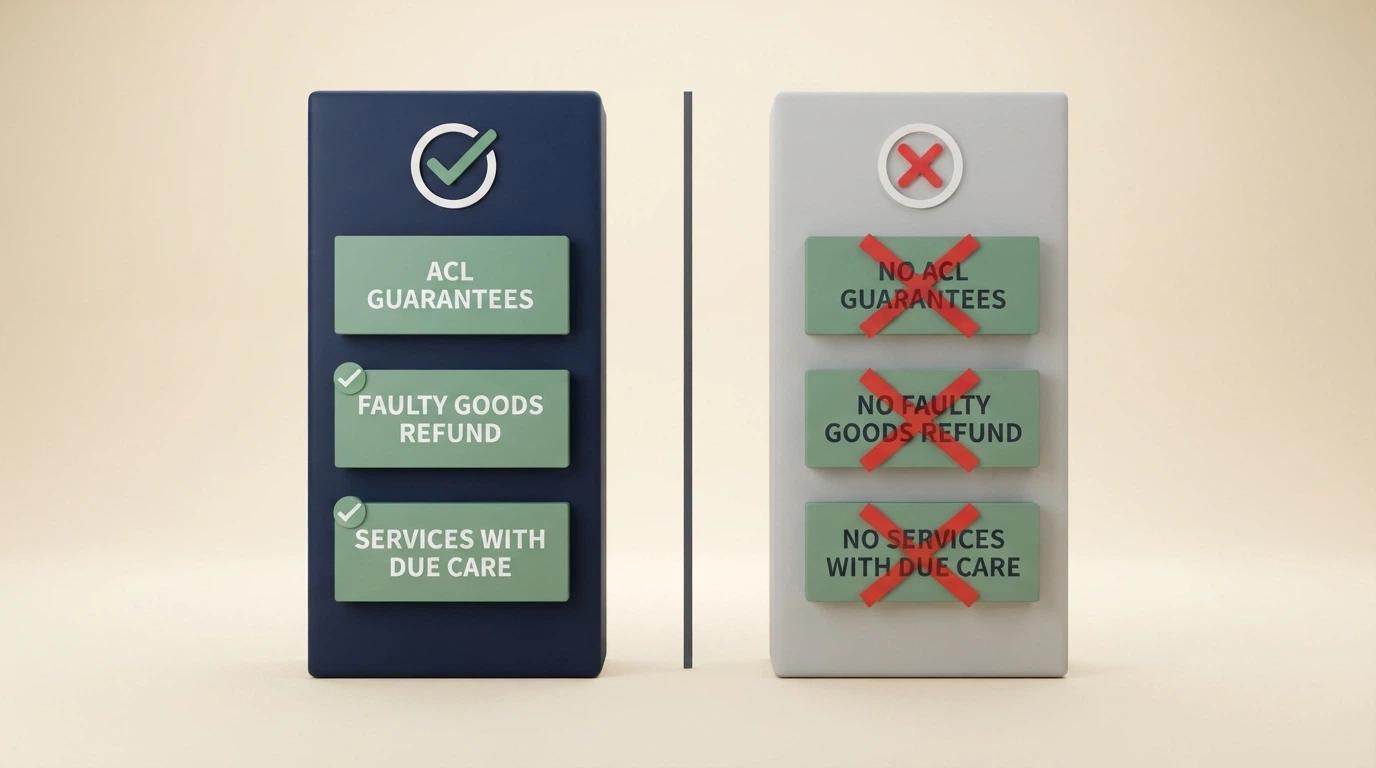
The ACMA blocking risk is the operational consequence. The site the player uses today can be blocked tomorrow. A balance sitting on a blocked site is a balance the player may not be able to withdraw, and the blocking is not a one-time event: the ACMA referred 133 sites for blocking in Q4 2025 and 109 in Q1 2026. The site rotation is a feature of the offshore market, not a bug, and the player is the one absorbing the rotation cost.
The licensed alternative — pre-event wagering through a SportsBet, bet365, Ladbrokes or Tab account — does not offer online casino. The player using an offshore casino is not choosing between an Australian-licensed casino and an offshore casino. They are choosing between no online casino and an offshore casino, and the consumer protection comparison is a comparison between the licensed wagering system the player is not using and the unlicensed casino system the player is using.
The ACMA enforcement machine: blocking, warnings and penalties
The ACMA’s enforcement against offshore operators targeting Australians runs at a quarterly cadence. In Q4 2025 the ACMA completed 23 investigations into 45 gambling sites, finding 69 breaches of the IGA, issuing 10 formal warnings and referring 133 sites for blocking. In Q1 2026 the ACMA conducted 25 formal investigations into 60 gambling websites, finding breaches in 23 cases, issuing 13 formal warnings and referring 109 websites for blocking. The 133-and-109 quarterly referral volumes are not the total of illegal sites; they are the sites the ACMA has decided to act against, and the action is a blocking request to Australian ISPs.
The 1,788 sites blocked since November 2019 is the cumulative total. The 230-plus illegal services that have voluntarily withdrawn from the Australian market since 2017 is the enforcement effect working before the blocking request. The Tabcorp penalty in January 2026 — 8 infringement notices totalling A$158,400 for providing a prohibited interactive gambling service (in-play betting) — is the civil-penalty mechanism applied to a licensed Australian wagering operator, and it sets the precedent for how the regulator uses the penalty provisions. Offshore operators, with no domestic presence to penalise, are reached through ISP blocking rather than infringement notices.
The enforcement scale means the site the player uses today is a site the ACMA may refer for blocking in a future quarter. The blocking is not a warning and not a negotiation: the site stops resolving on Australian ISPs, and the player has to find a new cashier.
Self-exclusion and verification at offshore casinos
KYC at an offshore casino is the operator’s identity check, run against the operator’s own documentation requirements. It is not the same product as the identity verification an Australian-licensed wagering operator runs against the ACMA’s identity-verification framework, and it does not connect to BetStop.
BetStop — the National Self-Exclusion Register — launched on 21 August 2023. By 31 December 2025 it had 54,859 registrations, with 35,135 active exclusions. By 31 July 2026 the figures had risen to 67,480 registrations and 41,290 active exclusions, with 78% of registrants under 40 and 38% choosing lifetime exclusion. The register excludes a person from every Australian-licensed online and phone wagering service in a single registration, and the effectiveness data is strong: 77% of registrants surveyed reported better quality of life after self-exclusion, 79% reported improved mental health, and 96% had completely stopped or decreased their betting.
BetStop binds only Australian-licensed wagering services. An offshore casino is not connected to the register, and a self-excluded person who deposits at an offshore casino is served without interruption. The protection that works at a SportsBet or bet365 account does not work at an offshore cashier, and the gap is the most concrete single harm of the offshore route. Only 26.5% of Australian adults know BetStop exists, and only 33.5% of wagerers, with younger adults less likely to know about it.
When the stakes outrun the player: harm, limits and where to get help
A high-roller session is the segment of online play where the financial harm surface is largest, because the deposit size, the spin speed and the VIP “perks” all amplify the dollar figure at risk per hour. The responsible-gambling tools available at offshore casinos are not the same tools an Australian-licensed wagering operator is required to provide, and the help resources exist independently of where the player is playing.
Bankroll and loss-limit tools: what offshore casinos actually offer
Offshore casinos offer a standard set of limit tools: deposit limits, loss limits, session limits, and wager limits. The tools are typically settable from the account page, and the player’s ability to remove or raise a limit varies by operator. An Australian-licensed wagering operator is required to provide a tighter framework: deposit ceilings, mandatory activity statements, time-out and self-exclusion options, and the BetStop registration pathway. The offshore casino is not bound by the Australian framework, and the limit tools it provides are voluntary from the operator’s side.
The enforceability gap is the structural difference. A player at an Australian-licensed operator who sets a deposit limit cannot have the limit removed without a cooling-off period, and the operator is required to enforce the limit. A player at an offshore casino who sets a deposit limit can typically request the limit’s removal, and the operator’s response is a commercial decision, not a regulatory one. For a high-stakes player whose session losses can run into thousands per hour, the difference between an enforced limit and a request-based one is the difference between a circuit breaker and a suggestion.
The IGA does not impose deposit, loss or stake ceilings on the player side, because the product those ceilings would govern is banned outright. The federal framework relies on the prohibition rather than on per-player limits, and the offshore route the player is using exists precisely because the prohibition does not stop the supply.
BetStop and why it will not protect you at an offshore casino
BetStop works for licensed Australian wagering. A single registration excludes the person from every Australian-licensed online and phone wagering service, and the registration figures — 67,480 by July 2026, with 41,290 active exclusions — describe a register that has been live since August 2023. The 77% better-quality-of-life figure, the 79% improved-mental-health figure and the 96% reduced-or-stopped-betting figure describe a register that works for the people who use it.
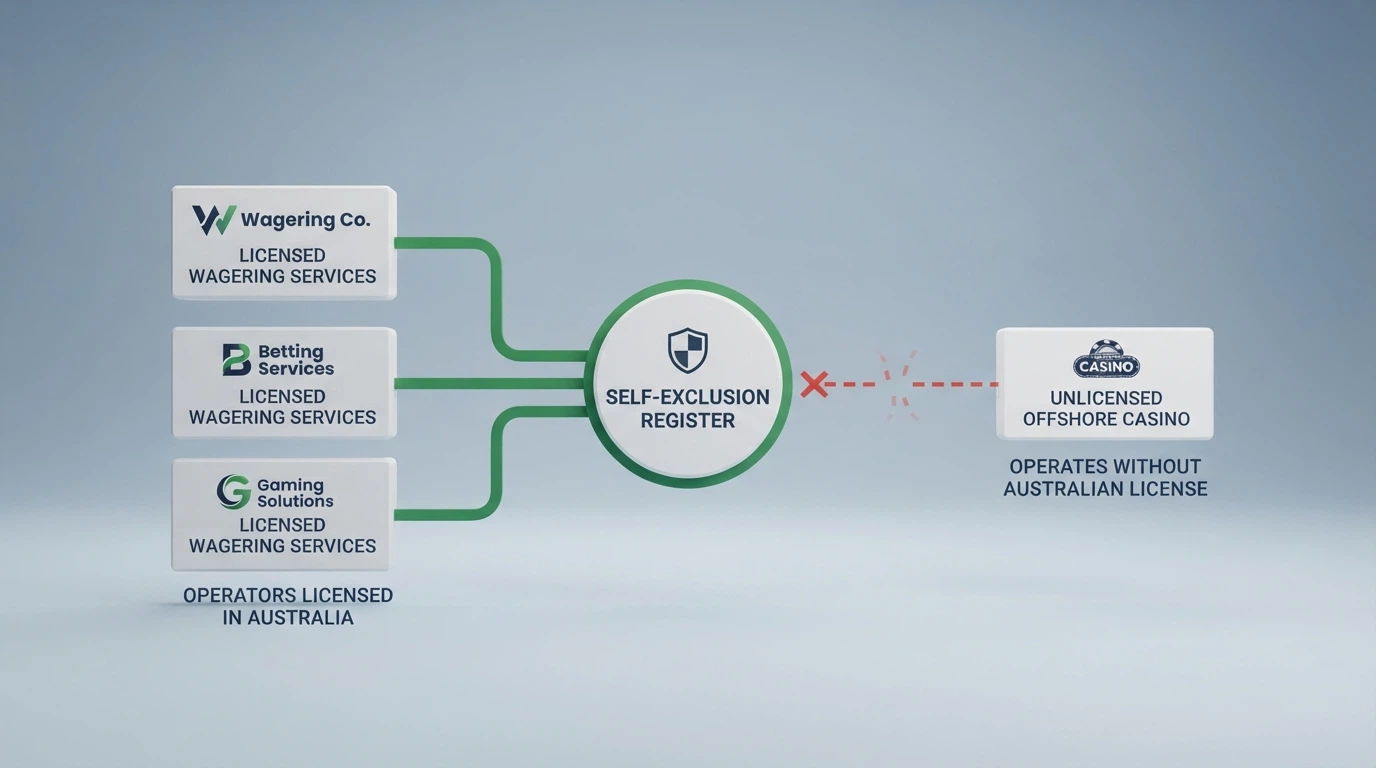
The offshore boundary is the limit. BetStop does not connect to offshore casinos, and an offshore casino will keep accepting a self-excluded person’s deposits without interruption. The protection is real at a SportsBet or Ladbrokes account, and it is absent at an offshore cashier. The gap is the most concrete single cost of the offshore route, and it falls on the player the offshore route is most likely to harm.
The awareness gap compounds the protection gap. Only 26.5% of Australian adults know BetStop exists, and only 33.5% of wagerers. Younger adults (18–35) are less likely to know about it than those aged 55 and older. Dr Kei Sakata, Executive Manager of the Australian Gambling Research Centre, has put the gap in numbers: “Despite an estimated five million wagerers nationwide, including 400,000 high-risk gamblers, just 30,000 have registered with BetStop.” The register works for the people who find it. The people who do not find it are playing at offshore cashiers that the register does not reach.
Help resources and the harm numbers that should give you pause
The National Gambling Helpline is 1800 858 858, free, confidential, and staffed 24 hours a day, 7 days a week. Gambling Help Online (gamblinghelponline.org.au) provides online chat and counselling. The two services are the front line of the Australian help infrastructure, and they are reachable regardless of where the player is playing.
The harm prevalence data is the scale of the problem the help infrastructure is responding to. Roy Morgan’s March 2026 data shows 13.0% of the Australian population (approximately 2,857,000 people) experiencing some form of gambling harm from their own gambling behaviours, and 5.4% (1,177,000 people) from other people’s gambling, totalling 15.1% (3,320,000 people). The problem-gambling incidence has risen year-on-year: 1.9% in 2022-23, 2.4% in 2023-24, 2.9% in 2024-25, approximately 620,000 problem gamblers, with the majority aged under 35. Gambling participation slightly declined to 58.8% in 2025, but risky gambling increased from 13.7% in 2024 to 19.4% in 2025, and online gambling increased with 56.1% of gamblers mainly participating online.
The numbers are not abstract. The 1.9% to 2.9% rise in problem-gambling incidence over three years describes a population that is getting worse, not better, and the online share of that population is growing. A high-roller session is at the top of the dollar-at-risk distribution, and the help resources exist for the player at any point in that distribution who decides the stakes have outrun them.
How we chose and ranked these high-roller casinos
The ten operators on this page were chosen from the AU operators skill shortlist and from archived affiliate audit data as brands actively reaching Australian high-roller players with casino products. The ranking criteria are bonus value scaled to high-roller deposit sizes, withdrawal caps and processing speed, VIP programme depth and cashback terms, and payment-method breadth for Australian players. The legal baseline is the same for every operator: no Australian casino licence exists, and none of the ten holds one, because none can.
The sources consulted are the ACMA register and enforcement publications, operator terms-and-conditions pages, affiliate audit data and testing results (payout speeds, payment-method coverage, withdrawal caps), and the AU operators skill shortlist. The ranking does not imply any operator is licensed in Australia. The ranking compares bonus and limit terms, not safety or consumer protection, and no operator on this page scores well on the consumer-protection axis because the consumer-protection system is not the system the operator is in.
The ranking’s strength is the bonus and limit data. The ranking’s blind spot is the operators for which research did not confirm specific bonus, withdrawal or VIP terms this run: Rocket Play, Stake, Royal Reels, Scream Casino and FairGO carry their market position rather than a verified offer. A player choosing one of those operators should treat the terms check as the first step, the same way they would for any operator they had not previously used.
The offshore high-roller trade-off: what you gain and what you give up
The offshore high-roller route offers what the Australian licensed market does not: welcome packages up to A$20,000, withdrawal caps up to A$50,000 a month, VIP cashback with no wagering, and a payment-method breadth that includes crypto. The route costs what the licensed market does provide: no Australian consumer protection, no statutory complaint body that can recover funds, no BetStop coverage, no withdrawal recourse if the operator refuses to pay, and the ACMA blocking risk with a balance still on the site.

The trade-off is the entire content of this page. The bonus and limit upside is real and it is verifiable. The protection gap is real and it is the legal structure the offshore market operates inside. The question the trade-off poses is one only the reader can answer: whether the bonus and limit upside outweighs the protection gap for the player’s own play, at the player’s own deposit size, under the player’s own appetite for the risk that the operator refuses a withdrawal, voids a win, or gets blocked with a balance still on the site.
A high roller with a four-figure deposit budget and a 50x wagering tolerance can clear the Wild Tokyo high-roller bonus in five days. A high roller with a six-figure annual turnover and a 96% RTP preference can shrink the house edge on the Mega Joker or Book of 99 leaderboard. A high roller who values deposit anonymity can fund the account with crypto at Stake or N1Bet. The offers are real, the terms are readable, and the route is reachable from an Australian IP address.
The protection gap is the same for every offer. BetStop does not reach the offshore cashier. The ACMA cannot recover a player’s money. The site the player uses today can be blocked tomorrow, and the balance can sit on a blocked site. The 1,788 sites already blocked is the cumulative evidence that the blocking happens, and the 109 sites referred for blocking in Q1 2026 is the evidence that it keeps happening.
The player’s call. The arithmetic is on the page, and the protection gap is on the page, and the rest is the player’s own.
Frequently asked questions
How much can I withdraw from a high roller casino in Australia per week?
Withdrawal caps at the featured operators range from A$4,000 per day at Lucky Ones (with a A$30,000 monthly ceiling) to A$10,000 per week standard at Wild Tokyo, rising to A$50,000 per month for verified VIP accounts. N1Bet sits at A$25,000 per week, and StoneVegas at A$30,000 per month. None of these are Australian-licensed limits; they are the operators’ own terms, and they vary by account tier.
Are offshore casino winnings taxable in Australia?
Recreational gambling winnings are not assessable income under section 6-5 of the ITAA 1997, and gambling losses are not deductible under section 8-1. No Australian case has held the winnings of an ordinary punter assessable. The exception is a person carrying on a business of betting or gambling, which most recreational players are not. The operator pays tax where the customer is; the player does not.
What do VIP programmes actually give high rollers?
VIP programmes at offshore casinos give higher withdrawal caps (Wild Tokyo’s A$50,000/month VIP ceiling versus A$10,000/week standard), higher-value reloads (Skycrown’s A$1,000 to A$3,000 VIP reloads versus A$200 to A$500 standard), cashback on net losses (StoneVegas’s 10% to 25% across six tiers, N1Bet’s 8% from the second tier), faster support response, and a dedicated account manager. The exact terms vary by operator and tier, and the higher tiers typically require sustained deposit volume to maintain.
What is the wagering requirement on a high roller casino bonus?
The featured high-roller bonuses carry wagering requirements of 40x at Lucky Ones (on bonus plus free spins, 7-day clearance) and 50x at Wild Tokyo (on cash and free spins, 5-day clearance). At the maximum match, the 40x turns A$3,000 of bonus into A$120,000 of required turnover, and the 50x turns A$2,500 into A$125,000. The bonus winnings are capped at A$5,000 at Lucky Ones, regardless of what the play produces.
Can I use a credit card to deposit at an Australian gambling site?
No. Credit cards, credit-related products and digital currency (crypto) are banned as payment for online wagering since 11 June 2024, with penalties of up to A$247,500 for non-compliant operators. The ban applies to licensed Australian wagering operators. An offshore casino asking for a credit card is operating outside the Australian rules, and the payment method is the visible tell of that fact. Legal deposit routes for licensed wagering are debit card, bank transfer, PayID/Osko and BPAY.
What is BetStop and does it cover offshore operators?
BetStop is the National Self-Exclusion Register, live since 21 August 2023. By 31 July 2026 it had 67,480 registrations with 41,290 active exclusions. A single registration excludes a person from every Australian-licensed online and phone wagering service. BetStop does not cover offshore operators — an offshore casino is not connected to the register and will keep accepting a self-excluded person’s money. The protection that works at a SportsBet or bet365 account does not work at an offshore cashier.