
What a $100 No Deposit Bonus Is Actually Worth at Australian Casinos in 2026
 Available in AU
Data current as of 18 October 2026 and verified against the ACMA register.
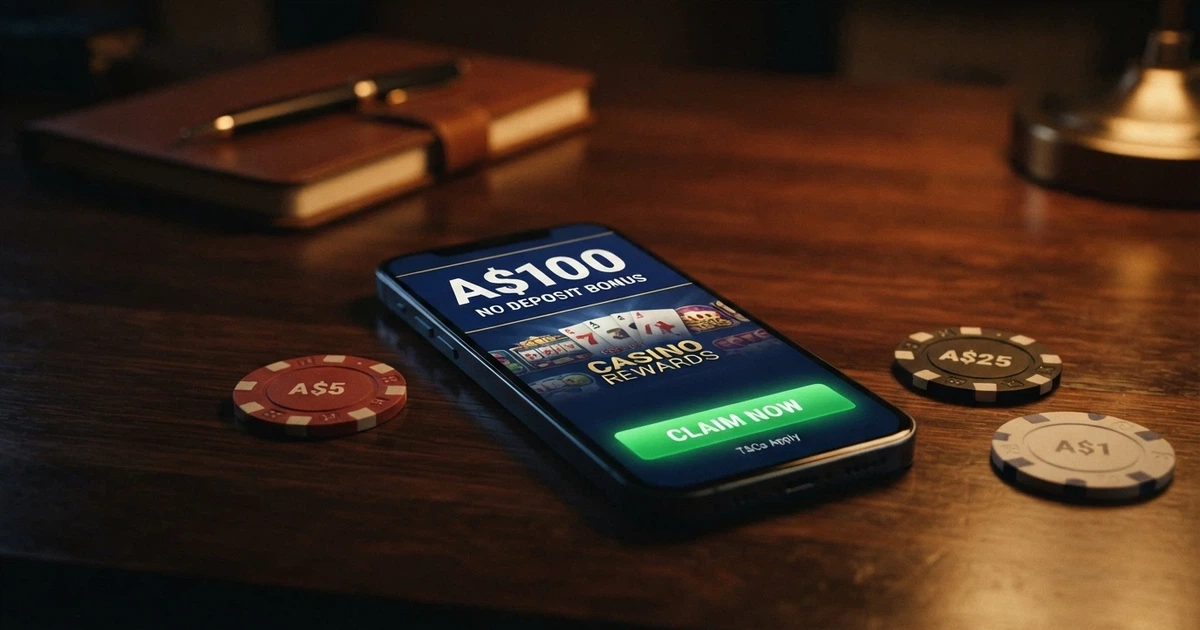
The phrase “$100 no deposit bonus” lands in Australian inboxes and onto dozens of affiliate pages every week, and for most readers it carries one simple promise: a hundred dollars in real money, free, no card needed. The reality in 2026 is much smaller and more expensive. Genuine A$100 free chips at Australian-facing online casinos are vanishingly rare. The offers that use the figure usually mean something else, and the terms that follow turn a “free” headline into a turnover obligation most players underestimate by a factor of ten or more. None of this is hidden. It is printed plainly on the bonus terms pages nobody reads. It is just buried under a marketing word.
This page is the long version of what those terms pages actually say. It traces the A$100 figure across the three shapes it takes in the market today (free chip, free spins, deposit match), unpacks what it costs to clear, and lists ten offshore casinos an Australian player is most likely to see when they search the term. Every claim ties to a primary source: the ACMA register, the Interactive Gambling Act, the operators’ own bonus pages, and the responsible-gambling data the Australian Institute of Health and Welfare publishes. The honest starting point: anyone who has read this far expecting a single casino to recommend should know now that the data won’t deliver one. The page is the argument for why.
Table of Contents
- Why a $100 no deposit bonus is smaller than it looks in 2026
- Where the $100 online casino bonus actually sits in 2026
- Getting your $100 in and out: PayID and the real payout timeline
- The 2026 $100-casino shortlist: what each brand actually offers
- Playing from Australia: what the law actually says in 2026
- When the bonus chase runs the numbers: responsible play in 2026
- How we picked and checked every casino on this page
- Your $100 no-deposit casino bonus decision in 2026
- Frequently asked questions about $100 no deposit bonuses in Australia
Why a $100 no deposit bonus is smaller than it looks in 2026
The “no deposit” half of that phrase is doing more work than the dollar half. In 2026, an Australian player who searches “$100 no deposit bonus casino australia” is most often shown one of three things, and only the first of them actually matches the words: a small free chip worth A$10 to A$25, a free-spins bundle whose true theoretical value runs closer to A$20, or a deposit match that requires the player’s own cash before the headline number appears at all. One tracker counted 31 offers advertised as “$100 no deposit bonus Australia” in a recent quarter and found that 11 of them were US-only and silently rejected Australian IPs at registration, while another 9 were 200-free-spin bundles with a theoretical value closer to A$20. The market for a literal A$100 free chip has nearly vanished since 2023.
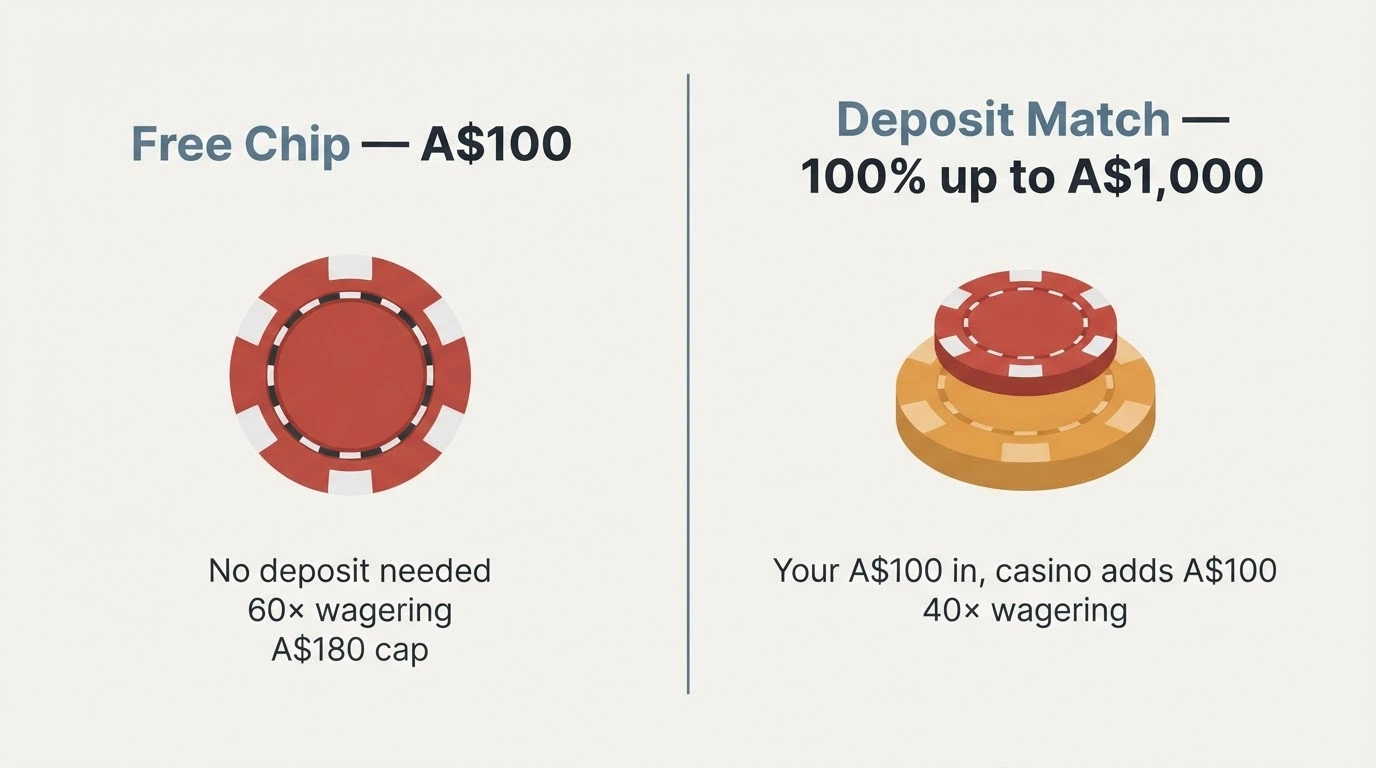
The phrase itself keeps the dream alive, and the operators behind it rely on the reader not checking. A free chip is casino credit, locked behind wagering, with a withdrawal cap that almost always sits below the headline. A deposit match needs the player’s own A$100 to release another A$100 of bonus money. A “welcome package up to A$8,000” is a four-deposit ladder where the headline number is the sum of every tier, not the starting balance. Same dollar figure, three different products, three different costs to clear. That is the chapter the rest of this section unpacks.
What “no deposit” actually means — and why it is never free money
The mechanics are simple once you see them. A “no deposit” bonus means the casino credits a small amount of bonus money to a new account without the player making a deposit first. The credit is not real cash. It is bonus funds with conditions attached. The first of those conditions is wagering. The player must bet a multiple of the bonus amount before any winnings become withdrawable. The second is a cashout ceiling. Even after the wagering is cleared, the casino caps how much can be taken out, typically somewhere between A$50 and A$200. The third is time. Most no-deposit bonuses expire within 7 to 30 days, and free-spin offers often inside 24 to 72 hours.
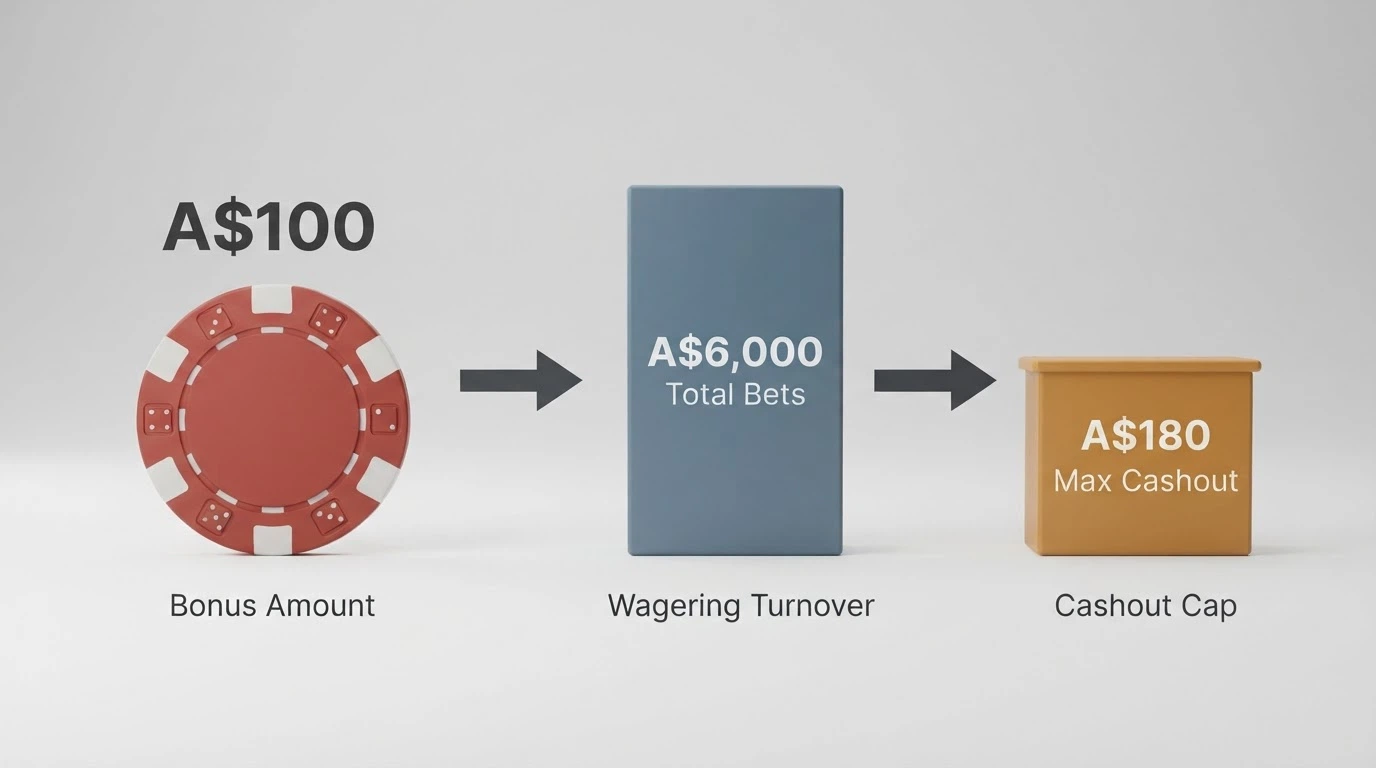
At FairGO, the closest thing to a true A$100 no-deposit chip currently circulating, the headline A$100 arrives with 60× wagering attached. Sixty times one hundred dollars is A$6,000 in total bets before any winnings can leave the account. The cashout ceiling sits around A$180. Even a player who runs the bonus brilliantly, doubling their balance on a single spin, can only withdraw A$180 of it. The other A$1,820 of theoretical winnings evaporates. That is not a bug. It is the structure.
The arithmetic runs cold. A$5 to A$10 per spin is the typical bet ceiling while bonus funds are active. At A$5 a spin, A$6,000 of turnover is 1,200 individual spins. At five seconds per spin, that is one hundred minutes of focused play — well over an hour and a half of continuous betting on the same game. The “$100 free” chip is in fact a sixty-hour commitment compressed into a single session, with an upside capped at A$180. The arithmetic is not generous. The marketing is.
The $100 deposit-match bonus: why the percentage matters more than the headline
A first-deposit match is the cleaner deal sitting next to the no-deposit chip, and the biggest trick in this market is conflating the two. A 100% match up to A$1,000 means the casino doubles whatever the player deposits, up to a ceiling. Deposit A$100, play with A$200. Deposit A$500, play with A$1,000. The percentage matters more than the cap, because the percentage determines the player’s own skin in the game. A 100% match is symmetric — the casino gives as much as the player gives. A 50% match up to A$500 is asymmetric in the other direction: a A$200 deposit returns only A$100 of bonus money.
RocketPlay’s first-deposit offer is a clean illustration. A 100% match up to A$1,000 plus 100 free spins on Aztec Magic, with 40× wagering on bonus funds and a maximum bet of A$7.50 per round during the wagering period. Bonus validity is 14 days. SkyCrown is more aggressive on the first deposit: 120% up to A$1,200 plus 125 free spins on Wolf Treasure, on a minimum deposit of A$30, with 40× wagering on bonus funds and the same A$7.50 max-bet rule. The percentage difference looks small but it matters in the player’s favour. A$100 deposited at SkyCrown returns A$120 of bonus money. RocketPlay returns A$100.
The wagering multiplier on the bonus funds is where the deposit match starts to bite. Forty times the bonus amount, on a A$100 bonus, is A$4,000 in turnover before the bonus money and any winnings from it can be withdrawn. A$4,000 at A$7.50 per round is roughly 533 spins. At five seconds each, about 45 minutes of play. Add the original A$100 deposit, which the player keeps outright, and the picture sharpens: deposit-match bonuses cost the player time and have a hard cashout on bonus winnings that mirrors the no-deposit structure. The difference is the player’s own deposit sits inside the bonus balance until wagering clears.
The $100 welcome package: sign-up bundles that spread the value
The “$100” on the banner often points to a number that lives four deposits away. Welcome packages are ladder offers that aggregate across the player’s first four or five deposits, and the headline figure is the sum of every rung, not the deposit that kicks things off. SkyCrown’s package totals up to A$8,000 plus 400 free spins across four deposits, with the first rung at 120% up to A$1,200 plus 125 free spins and the fourth at 150% up to A$4,000 plus 150 free spins. Royal Reels’ package is up to A$4,500 plus 250 free spins across three deposits. Both are typical of the multi-deposit structure those headline figures regularly point at.
The real first-deposit value is much smaller than the headline implies. At SkyCrown, the first rung alone delivers 120% up to A$1,200 on a minimum deposit of A$30. A player who deposits A$100 receives A$120 of bonus money plus 125 free spins on Wolf Treasure. The fourth rung requires a minimum deposit of A$50 and adds 150% up to A$4,000 plus 150 free spins — but to get there the player has already deposited at least A$30 plus matching minimums across the first three tiers. By the fourth tier the player has typically deposited several hundred dollars of their own money to chase the headline A$8,000.
The cost to clear a multi-deposit package compounds across stages. Each tier carries its own wagering requirement, its own validity window, and its own set of game-weighting rules. SkyCrown gives 14 days per stage to clear the wagering, with a A$7.50 max bet during wagering and free-spin winnings capped at A$300 per stage. A player who treats the package as a single bonus usually finds that the first deposit’s wagering is still active when the second deposit arrives, and the cap on free-spin winnings is per tier rather than across the package. The headline is generous. The mechanics reward a slow, steady approach, not a player who races to clear one tier and immediately deposits the next.
$100 pokies bonuses: what spins, titles and wagering you actually get
A pokies-labelled bonus looks like a slot player’s dream and reads like a slot player’s contract. The bonus is the free-spins allocation. The title is the slot the spins are tied to. The contribution rate is how much of every A$1 wagered on the title counts toward clearing the wagering. For pokies the contribution rate is almost always 100% — every dollar wagered on a slot counts as one dollar toward the turnover. For table games it is typically 0%. A player who burns through a pokies bonus on blackjack clears nothing.
The titles matter because the casino chains the bonus to specific games. RocketPlay’s 100 free spins are on Aztec Magic, a BGaming title. SkyCrown’s 125 first-deposit spins are on Wolf Treasure, an IGTech game. Neither operator states the spin value clearly on its promotional page; that detail is usually tucked inside the bonus terms. A spin value of A$0.10 means 100 spins has a theoretical value of A$10. A$0.20 means A$20. The headline number is consistent across operators. The value of a single spin is not. The volatility of the tied title matters as much as the spin value, because high-volatility pokies deliver most of their return in rare large payouts that often fall outside bonus cashout caps.
At FairGO the bonus landscape looks different, because FairGO is RTG-only and the chip works only on RealTime Gaming titles. Pokies count 100% toward wagering. Table games count 0%. A player with the A$100 free chip has, in practice, an A$100 bankroll locked to a single software provider’s library, with the standard A$5 to A$10 per spin bet ceiling during bonus play. The shape is more restrictive than a multi-provider casino’s free-spin allocation. The chip itself is larger than most no-deposit free-spin bundles’ theoretical value.
Bonus codes and how to pick the best $100 casino deal
A bonus code is a key, not a guarantee. It triggers a specific offer — usually a no-deposit chip or a free-spin bundle — and the offer it unlocks carries the same wagering, cap and expiry rules as any other version of the bonus. Some operators run their entire bonus portfolio through codes; others attach codes to specific promotions while leaving the main welcome offer open to any new account. Either way, the code is the thinnest part of the decision. The terms are what matter.
The three-number test is the simplest way to compare any bonus offer: the wagering multiplier, the maximum cashout, and the validity period. On the wagering side, anything between 30× and 60× is the typical range for Australian-facing no-deposit pokies offers; below 30× is a solid deal, above 50× is hard to clear. On the cashout side, A$50 to A$100 is typical, with A$200 the rough ceiling outside the rare FairGO-style chip. On validity, most no-deposit bonuses expire within 7 to 30 days, and free-spin offers inside 24 to 72 hours. A bonus with 30× wagering, a A$100 cashout cap and a 30-day window beats a bonus with 60× wagering, a A$50 cap and a 7-day window on the same dollar figure every time.
One variable is rarely mentioned but matters as much as the other three: which games count toward wagering. A 30× bonus on pokies is fundamentally different from a 30× bonus that lets the player choose between pokies and table games, because most table games contribute 0% to wagering. The same multiplier on a tighter game list is a tougher clear. Reading the terms page once, before typing in a code, takes two minutes and saves an afternoon.
Bonus types at a glance: what each shape looks like
The five bonus shapes the Australian market currently offers, set against the same four numbers the three-number test uses:
| Bonus Type | Typical Value | Typical Wagering | Typical Max Cashout | Typical Validity |
|---|---|---|---|---|
| No-deposit free chip (FairGO-style) | A$10–A$100 | 30×–60× | A$50–A$200 | 7–30 days |
| No-deposit free spins | 20–200 spins | 25×–30× on winnings | A$40–A$300 | 24–72 hours |
| First-deposit match | 100%–150% up to A$1,000–A$1,500 | 40× bonus | — | 5–14 days |
| Multi-deposit welcome package | A$4,500–A$8,000 + 250–400 FS | 40× bonus | A$300 (FS winnings) | 14 days per stage |
| Cash bonus (rare) | A$100 per deposit | 0× | — | — |
The “cash bonus” line at the bottom is the rarest shape on the page — the one type that has no wagering attached, because the credit is real cash rather than bonus funds. Most AU-facing offshore casinos do not offer it. The few that do treat it as a competitive edge, because the absence of wagering means anything the player wins on the bonus money is theirs to withdraw on the next cashout. The line itself is empty across three of the four comparison columns because the offer type is rare enough that no standard cashout ceiling or validity window has settled into a market norm.
Where the $100 online casino bonus actually sits in 2026
The A$100 figure means two different things to two different readers. An online-casino player who searches “$100 no deposit bonus” is looking for a casino sign-up offer. A general gambling reader who searches the same phrase without the “online” qualifier often lands on the same pages but with a different mental model: the A$100 they expect is closer to a land-based casino promo chip, a sportsbook free bet, or a poker room tournament credit. The market has only one of those products available to Australians — and it is the offshore online casino, not the licensed venue.
The licensed AU market does not have what that headline describes. There is no AU-licensed online casino. The Interactive Gambling Act 2001 prohibits the supply of online casino games to a person physically in Australia, and the prohibition has been tightened twice, most recently in 2017, to close the loopholes offshore operators used to argue they were not serving Australian customers. The wagering products that are licensed — sports and racing — run through Northern Territory-licensed bookmakers, and they do not offer free chips, free spins or no-deposit casino credits. The “$100” in any licensed AU wagering context would be a free bet or a deposit match on a sportsbook, and the structure of those products is meaningfully different from what the casino offers promise.
That is the gap the offshore AU-facing casinos live inside, and the rest of the page lives inside it with them.
Online casino vs any-casino: where the $100 offer lands
The phrase “$100 casino bonus” can mean two things, and they describe two different products. The online-casino version is a digital bonus credited to a player’s account after sign-up, wagered through the casino’s software, and (if the player clears the turnover) withdrawn through the same platform. The land-based version is a promo chip a player receives at the cashier’s cage, plays through on physical machines, and cashes out at the same cage. The Australian licensed casino market (Crown, The Star and the state-licensed venues) is physical only. There is no AU-licensed counterpart to the digital product.
For an Australian player chasing that A$100, only the offshore online-casino variant is available. The promotion is delivered by email or shown on the casino’s homepage, accepted at registration, and tied to software from a non-AU game provider (Pragmatic Play, BGaming, IGTech, RTG and similar). The experience is functionally similar to a land-based promo chip — bonus money, wagering, a cashout cap — but the regulatory environment is not. A land-based AU casino is state-licensed, regulated by the state gaming authority, and answers to an Australian complaints body. An offshore online casino is none of those things.
This is the reason the licence table further down the page lists every featured operator as “Licensed in AU: No.” It is not a per-operator gap. It is a market gap. The product described here does not exist inside the licensed AU market, and every operator offering it is offshore.
The bare $100 cash value: what it buys and what it doesn’t
The number itself is the trap. A$100 is round enough to sound like free money and small enough to feel like a no-risk test drive. It is neither. Sixty-times wagering on a A$100 chip is A$6,000 in bets; thirty-times wagering on a A$100 chip is A$3,500. Both numbers are larger than most casual players’ session budgets, and both are the amount the player must put through the casino’s games before any winnings can be withdrawn.
The cashout ceiling sits on top. Even after the player has run A$6,000 through the casino’s pokies at FairGO, the most they can withdraw from the chip’s winnings is around A$180. A player who turns A$100 into A$5,000 mid-session cannot take A$5,000 out. They take A$180. The arithmetic that the bonus page omits is the difference between theoretical winnings and withdrawable winnings, and that difference is usually 90% or more.
This is what the marketer calls “free.” The phrase works because the dollar figure is round, the offer requires no deposit, and the bonus is technically a credit rather than a fee. It is also a structure designed to give the player an evening of play in exchange for a turn of the house edge on a few thousand dollars of action, with a hard cap on what they can ever take home. The honest framing is that the A$100 free chip is a paid trial in everything but the upfront cash. The player pays with time, with turnover, and with most of anything they win.
Getting your $100 in and out: PayID and the real payout timeline
Payment rails decide whether the bonus is a clean test or a long wait. Three facts matter: PayID is the fastest AU-facing deposit rail; offshore operators vary on whether they offer it; and the gap between deposit speed and withdrawal speed is the part of the experience most readers underestimate. The $100 headline sits comfortably inside most bank PayID limits and most casino minimum-deposit thresholds, which means the rail is the right shape for this offer. What the rail cannot do is compress the verification queue at the other end.
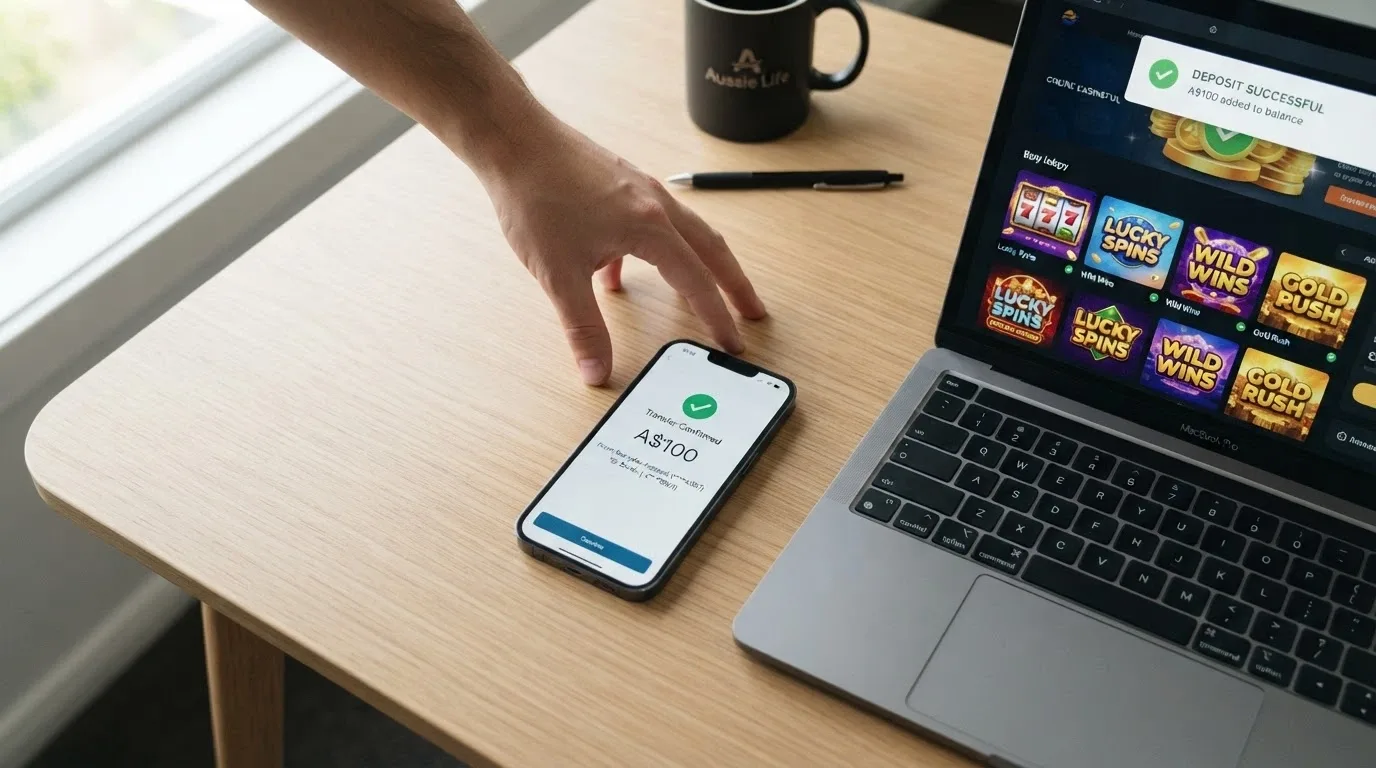
One recent test of a A$100 PayID deposit at an AU-friendly offshore casino landed instantly in a CommBank account. PayID withdrawals at three offshore operators cleared in 25, 28 and 35 minutes once verification was complete. The casino-side processing is fast once the verification queue is clear, but verification is the variable most readers miss. Offshore operators run know-your-customer checks before the first withdrawal, and player-report samples put the median verification lag between 24 and 96 hours when documents pass cleanly — longer when the documents do not. The licensed AU benchmark settles inside published service-level agreements once KYC is complete, commonly under 24 hours for PayID rails.
PayID deposit at AU-facing casinos: how it works and what to expect
PayID is Australia’s instant-deposit rail, run through the New Payments Platform and most commonly branded as Osko. The player links a mobile number or email to a bank account, then uses that identifier as the destination for a transfer instead of a BSB and account number. The transfer settles inside seconds, twenty-four hours a day, seven days a week. For an Australian casino player, it is the closest equivalent to a card deposit without the card — no credit-card ban issues, no bank-statement delays, no third-party processor.
The minimum deposit on the casino side is typically A$20, set low enough to be below most bonus eligibility thresholds but high enough to cover the operator’s processing fee. A$100 sits comfortably above that floor and below most bank-imposed daily PayID transfer limits, which run A$1,000 to A$5,000 on most retail accounts. The casino does not set its own maximum PayID deposit cap, because the limit is set by the player’s bank and by NPP’s underlying transfer ceiling. Some accounts go up to A$50,000 a day; others sit at the retail default.
The practical experience is one of the smoothest parts of the offshore casino flow. A player opens the casino’s deposit page, selects PayID, copies the casino’s PayID (or scans a QR code), confirms the amount in their banking app, and the balance updates inside seconds. From the player’s side the rail feels native. The offshore status of the casino does not change PayID’s mechanics — the transfer is just an NPP transfer to whatever account the casino has nominated.
$100 deposit bands: what your bank allows and what the casino accepts
The A$100 deposit sits in a sweet spot. Below A$20, most AU-facing casinos will not accept the transfer. Above A$1,000, most retail bank accounts start to push against the daily PayID ceiling. A$100 is well above the casino floor and well below the bank cap, which is why it is the round number so many bonus offers pivot around. A bonus that requires a A$100 minimum deposit is the easiest one to action from a standard AU bank account.
Bank-side limits vary by account type. Standard transaction accounts at the major banks carry daily PayID limits of A$1,000 to A$5,000. Premium accounts, business accounts and accounts that have been specifically configured for higher NPP limits can go up to A$50,000 a day. For most Australian players the A$100 deposit is well inside any of those limits. The constraint they hit is the bonus side rather than the bank side, where minimum deposits climb with each stage of a multi-deposit welcome package.
SkyCrown’s first stage is the floor case: minimum deposit A$30 to qualify for the 120% match plus 125 free spins. The fourth stage is the higher case: minimum deposit A$50 to qualify for the 150% match plus 150 free spins. A player chasing the full A$8,000 headline has to clear four deposit minimums, each sitting somewhere in the A$30 to A$50 range, before they unlock the largest rung. The deposit math is the part the welcome package hides in plain sight.
PayID across pokies-first casinos: why the payment method follows the game
The user searching “PayID pokies $100 deposit” wants the game first and the rail as proof that it works. The order is correct. A casino that accepts PayID, accepts a A$100 deposit and offers pokies is functionally meeting the search, and most AU-facing offshore casinos meet at least the first two of those three. The third — pokies specifically — narrows the list further, because not every offshore brand runs a pokies-first product. Some are table-game heavy, others are live-dealer heavy, and a small number are sportsbook-casino hybrids.
Per-operator PayID coverage is uneven across the featured set. The top four confirm PayID on either the deposit or withdrawal side, with withdrawal times ranging from 25 to 35 minutes. Per-brand PayID confirmation is patchy for operators beyond that group, and the gap should be read as a gap. Where a featured brand’s PayID status is unknown, the responsible move is to check the cashier page before signing up. Most AU-facing offshore casinos do support PayID, but “most” is not “all,” and a brand that accepts only crypto and cards will reject a PayID deposit silently.
The shape of the rail matters beyond speed. PayID is a bank-to-bank transfer. The deposit leaves the player’s account and arrives in the casino’s account under the player’s own name, which means the deposit is tied to the player in the casino’s records. A crypto deposit, by contrast, leaves no bank trail and complicates the KYC process at withdrawal. The 11 June 2024 ban on credit cards and crypto for online wagering in Australia is itself a tell — a casino that still accepts credit or crypto is operating outside the licensed AU rules entirely.
Payment methods at AU-facing casinos at a glance
The payment methods an Australian player typically meets at an offshore AU-facing casino, set against deposit speed, withdrawal speed and the limits each method carries:
| Payment Method | Deposit Speed | Withdrawal Speed | Min/Max Deposit | Available at AU Casinos |
|---|---|---|---|---|
| PayID / Osko | Instant | 25–35 min (tested offshore) | A$20 min; bank caps A$1,000–A$5,000/day; NPP ceiling A$5,000–A$50,000 | Most offshore AU-facing |
| POLi | Instant | — | A$20 typical | Some offshore AU-facing |
| BPAY | 1–2 business days | — | — | Some AU-facing |
| Debit card | Instant | 1–3 days | — | Most offshore (credit banned in AU) |
| Crypto | Instant | ~14 min (tested offshore) | — | Offshore (banned in AU licensed market) |
| Bank transfer | 1–3 business days | 2–5 business days | — | Most offshore |
The credit-card and crypto ban that took effect on 11 June 2024 is the quiet column in that table. Both methods appear widely at offshore casinos. Both are banned at every AU-licensed operator. A player who is asked for a credit card or a crypto deposit by a gambling site is being served by someone outside the Australian rules, and the payment method is itself a tell.
The 2026 $100-casino shortlist: what each brand actually offers
Ten offshore casinos, ranked by AU market presence, sit on the list below. All ten operate from Curaçao. All ten lack an AU online casino licence because no such licence can exist. All ten have been assessed against that $100 no-deposit promise. The honest summary sits at the top of the table: no featured brand currently runs a genuine ongoing A$100 no-deposit bonus. The closest thing is FairGO’s periodic A$100 free chip. Most of the rest run deposit-triggered welcome packages and a mix of smaller no-deposit free-spin offers.
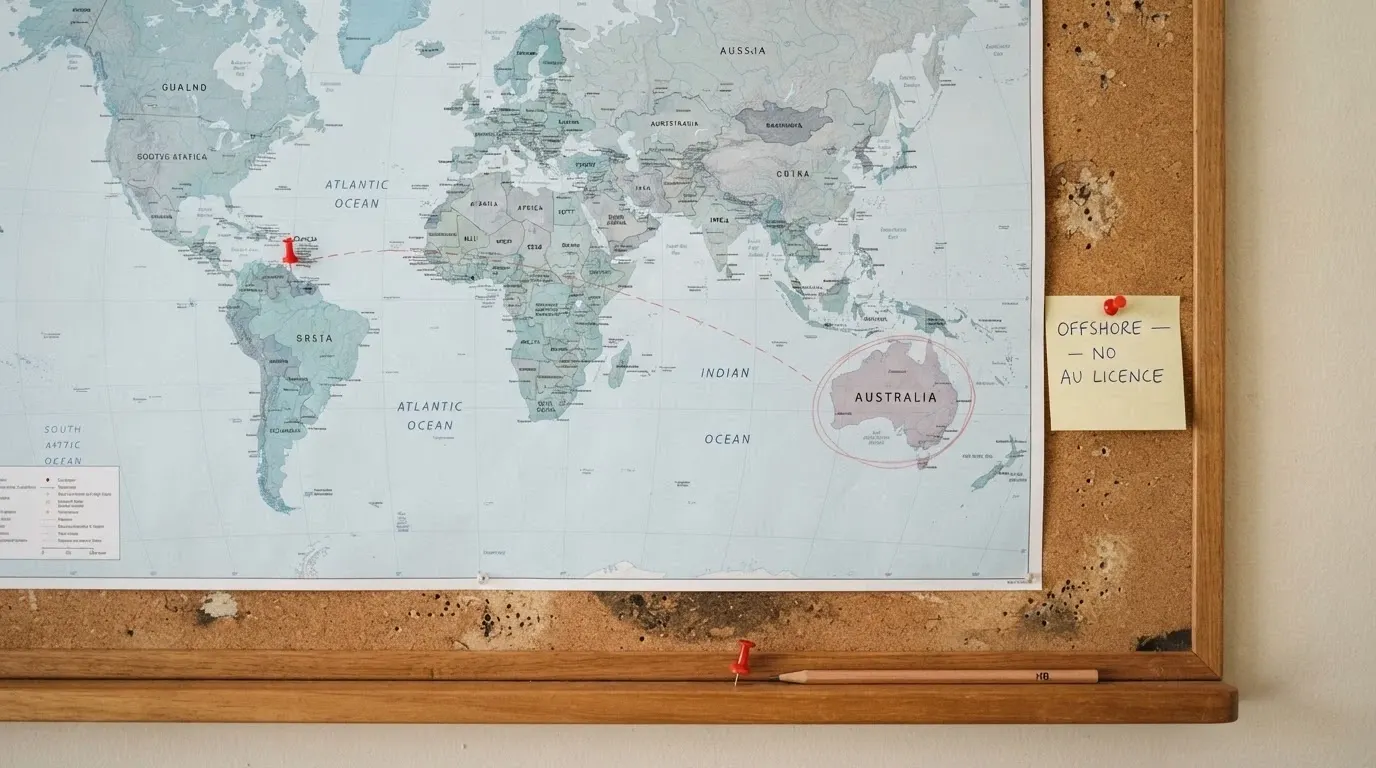
The ranking reflects market presence rather than bonus quality. A brand higher on the list is a brand an Australian player is more likely to encounter on a comparison site, in search results, or via word of mouth — not necessarily a brand offering a better deal. Several operators further down the list could out-bonus the ones at the top on any given week. The market is fluid enough that promotional offers shift faster than the ranking can track.
The shortlist at a glance
| Operator | Licence Jurisdiction | Licensed in AU |
|---|---|---|
| Rocket Play | Offshore (Curaçao) | No |
| SkyCrown | Offshore (Curaçao) | No |
| Royal Reels | Offshore (Curaçao) | No |
| FairGO | Offshore (Curaçao) | No |
| Bizzo Casino | Offshore (Curaçao) | No |
| Rocket Casino | Offshore (Curaçao) | No |
| Stake | Offshore (Curaçao) | No |
| WinSpirit | Offshore (Curaçao) | No |
| Scream Casino | Offshore (Curaçao) | No |
| Rainbet | Offshore (Curaçao) | No |
Every operator on this list is unlicensed for online casino in Australia, by federal law. The 1,564 sites blocked by the ACMA since November 2019 and the 225-plus services withdrawn from the market since 2017 are the background the list sits against.
FairGO
FairGO is the rare exception on this list. The brand runs a periodic A$100 free chip with no deposit required, and the chip carries 60× wagering and an approximately A$180 max-cashout cap. Pokies count 100% toward wagering; table games count 0%. The library is RTG (RealTime Gaming) only, which is both a constraint and a feature — a player who likes the RTG catalogue knows exactly what they are getting, and a player who does not should not sign up for the chip.
The 60× multiplier is the highest figure on this page, and it is high on purpose. Sixty times A$100 is A$6,000 in turnover before any winnings become withdrawable. At a A$5 spin ceiling, that is roughly 1,200 spins. At five seconds per spin, about 100 minutes of focused play. The cashout ceiling of around A$180 means a player who runs the chip brilliantly still cannot withdraw more than that ceiling. The chip is a paid trial, not a gift, and the rarity of the offer is itself part of the marketing.
Availability is the second caveat. FairGO does not run the A$100 chip as a permanent public offer. The chip appears periodically, often tied to specific promotions or to a player’s tenure on the platform. A new player who registers today should not expect to see the A$100 chip on the welcome page tomorrow. They should check the promotions tab and the email welcome series, then decide whether the rest of FairGO’s product justifies the registration without the headline chip. FairGO is the rare exception on this list — the brand to try when the A$100 chip is circulating, and the brand to skip when it isn’t.
SkyCrown
SkyCrown is the most aggressive bonus brand on the list. The welcome package totals up to A$8,000 plus 400 free spins across four deposits, with the first stage at 120% up to A$1,200 plus 125 free spins on Wolf Treasure and the fourth at 150% up to A$4,000 plus 150 free spins. The package is deposit-gated — every rung requires a real-money deposit first, with minimum deposits rising from A$30 at the first stage to A$50 at the fourth. The wagering on bonus funds is 40×, with a A$7.50 maximum bet during wagering and a 14-day per-stage validity window. Free-spin winnings are capped at A$300 per stage.
The no-deposit offer is the part the SkyCrown brand leans on hardest in marketing, and it is also the smallest part of the package in dollar terms. The no-deposit free spins carry a A$3 maximum bet and winnings capped at A$40 — far below the headline A$8,000. The free spins are a way to test the casino’s software with house money, not a way to win a meaningful withdrawal. A player who signs up chasing the headline and treats the no-deposit spins as the actual offer is in for an unpleasant surprise when the A$40 cap kicks in.
SkyCrown is the right fit for a player who has a deposit budget and time to clear four wagering stages. It is the wrong fit for a player chasing a no-deposit promise. The deposit math is honest: the minimum total deposit across the package is around A$160 to clear all four minimums, and the wagering obligation runs 40× of the bonus received at each stage, assuming the player takes the smallest eligible bonus each time and only the bonus amount is wagered. Heavy on the deposit side, thin on the no-deposit side.
Rocket Play
Rocket Play is the market-share leader on this list and the operator an Australian player is most likely to encounter first. The welcome package is 100% up to A$1,000 plus 100 free spins on Aztec Magic (BGaming), with 40× wagering on bonus funds, a A$7.50 maximum bet during wagering and a 14-day bonus validity window. There is no no-deposit bonus currently listed. The minimum deposit is A$20.
The clean structure is Rocket Play’s edge. One deposit, one bonus, one wagering obligation, one game tied to the spins. The player knows what they are claiming. The 5-day validity window is the tight end of the market — players who do not clear 40× of bonus funds inside five days forfeit the bonus and any winnings from it. At the A$1,000 bonus ceiling and the A$7.50 max bet, that is roughly A$40,000 of turnover, or about 5,333 spins at five seconds each, or close to seven and a half hours of continuous play inside a 5-day window. Players with full-time jobs will find the 5-day window tight.
Rocket Play is the right fit for a player who wants a single deposit, a clear wagering obligation, and a brand with significant AU-facing market presence. It is the wrong fit for a player chasing the “$100 no deposit” headline — there is no no-deposit offer on the welcome page, and the brand’s strength lies in deposit-triggered value rather than free-chip generosity. Strong on market presence, absent on the headline promise.
Royal Reels
Royal Reels’ welcome package is up to A$4,500 plus 250 free spins across three deposits. The headline number is the sum of all three stages, not the starting balance. Wagering, validity and max cashout are not confirmed this run — the per-stage terms are not surfaced on the brand’s main bonus page, and the verification this research pass could do was limited.
The package looks similar in shape to SkyCrown’s, with the same multi-deposit ladder structure that the offshore AU-facing market has settled into. A player considering Royal Reels should treat the headline number as the maximum possible bonus across a specific deposit pattern, not as the offer that lands on a single A$100 deposit. The minimum deposit per stage is the number to confirm first, followed by the wagering multiplier on bonus funds, the maximum bet during wagering, the per-stage validity window, and the cap on free-spin winnings.
Royal Reels is the right fit for a player willing to verify the current terms directly on the brand’s site before depositing. It is the wrong fit for a player who needs the terms published up front on a comparison page. The headline looks fine; the gaps are what you need to verify.
Bizzo Casino
Bizzo is a top-tier AU offshore brand by traffic and a familiar name in the Australian-facing casino market. Licence jurisdiction is Curaçao offshore. Bonus terms are not confirmed this run — the per-stage wagering, the maximum bet during wagering, the validity window, and the maximum cashout on no-deposit or free-spin offers have not been verified against the brand’s current bonus page in this research.
A player considering Bizzo should check the brand’s current welcome package directly on its site. The minimum deposit per stage, the percentage match, the wagering multiplier, the free-spin allocation and the spin titles are details that change frequently in the offshore market. The structure is most likely a multi-deposit welcome package with a high headline figure, in line with the rest of the market — but “most likely” is not “confirmed,” and the responsible move before depositing is to read the bonus terms on the brand’s own site. Bizzo suits a player who already has the brand on their shortlist and is willing to do the verification work themselves.
Rocket Casino
Rocket Casino shares a name with the market leader but is a separate offshore brand. Licence jurisdiction is Curaçao offshore. Bonus terms are not confirmed this run. A player who lands on Rocket Casino while hunting that offer should not assume it is the same brand as Rocket Play. The two share little beyond the first word and the offshore licence jurisdiction.
Rocket Casino is the right fit for a player who has the brand on a comparison shortlist and is doing their own verification. It is the wrong fit for a player who treats the name “Rocket” as a single brand. The name is shared. The substance is not.
Stake
Stake is a major global crypto-casino brand with significant AU traffic. Licence jurisdiction is Curaçao offshore. This run did not confirm the bonus terms, and Stake’s product historically has not leaned on traditional welcome bonuses the way the rest of this list does. The brand has built its reputation on sports betting, original games and crypto rails rather than no-deposit chips or first-deposit match packages.
A player considering Stake should check the brand’s current promotional terms directly on its site. The brand’s product mix is materially different from the rest of this list, and a reader expecting a SkyCrown-style welcome package will find Stake’s promotional structure unfamiliar. The crypto focus carries the same caveat the licensed AU market applies to crypto payments. A global crypto brand with AU traffic — the casino-side welcome bonus is the part to verify before depositing.
WinSpirit
WinSpirit is an AU-facing offshore casino on the list, with Curaçao offshore as the licence jurisdiction. Bonus terms are not confirmed this run — the wagering, validity, free-spin titles and maximum cashout have not been verified against the brand’s current bonus page in this research.
A player considering WinSpirit should check the brand’s current welcome package directly on its site before depositing. The minimum deposit per stage, the percentage match, the wagering multiplier and the free-spin titles are the numbers to confirm first. WinSpirit is the right fit for a player who has the brand on a shortlist and is willing to do the verification. Off the page, the offer details are unverified.
Scream Casino
Scream Casino is a smaller AU-facing offshore brand on the list, with Curaçao offshore as the licence jurisdiction. Bonus terms are not confirmed this run. Smaller brands carry the same bonus structures as larger ones in most cases — first-deposit match, multi-deposit welcome package, free-spin allocation — but the per-stage terms shift more often and the promotional pages are less consistently maintained.
Scream Casino works for anyone already carrying the brand on a comparison shortlist and verifying directly on the operator’s site. It is the wrong fit for a player who treats the smaller brand as identical to the larger ones. Smaller brand, same verification gap.
Rainbet
Rainbet is the tenth name on this list, rounding out the top ten AU-facing offshore casinos by market presence. Licence jurisdiction is Curaçao offshore. Bonus terms are not confirmed this run. The gap between the brand’s market position and the visibility of its current bonus terms is a feature of the smaller end of the offshore market, where promotional pages change more often than comparison sites can refresh.
Rainbet earns its place on the list only for readers who will check the brand directly. The page cannot close the question for a brand whose current terms were not surfaced this run. Closes the list, doesn’t close the question.
Playing from Australia: what the law actually says in 2026
The Australian position on online casino is harder than the promotions suggest. There is no licence for online casino anywhere in the country, federally or in any state or territory. The Interactive Gambling Act 2001 prohibits the supply of online casino games, online pokies and in-play sports betting to a person in Australia. The Interactive Gambling Amendment Act 2017 strengthened that prohibition, closing loopholes offshore operators had used to argue they were not actively targeting Australian customers. The Australian Communications and Media Authority is the federal regulator that enforces the prohibition, with the power to investigate complaints, issue formal warnings, refer operators for civil penalty proceedings, and direct Australian internet service providers to block illegal sites.

The practical enforcement is well documented. Since November 2019, the ACMA has directed Australian ISPs to block 1,564 illegal gambling and affiliate websites. More than 225 illegal gambling services have withdrawn from the Australian market since the 2017 amendments strengthened enforcement. The pace of blocking has not slowed, and the list of blocked sites continues to grow. The legal picture for the player is narrower than the marketing picture for the operator: the individual player is not prosecuted under the IGA, but the Act targets the provider, and a player who engages with an offshore casino is engaging with an unlicensed product that the regulator is actively trying to remove from the Australian internet.
From 1 January 2027, the picture tightens further. The Interactive Gambling Amendment (Gambling Reform) Bill 2026 passed Parliament on 19 August 2026 and commences on 1 January 2027, introducing an hourly advertising cap of three wagering ads per hour between 6:00 am and 8:30 pm, a live-sport blackout from 15 minutes before a live sporting event until 5 minutes after it ends, restrictions on direct marketing of inducements for 14 days after sign-up and three months after a person deregisters from BetStop, and — most relevant to offshore operators — express authority for banks and payment providers to block transactions to illegal gambling operators. The advertising rules apply to licensed wagering; the bank-blocking authority is the lever that touches offshore casinos directly.
The licensing gap: why no “AU-licensed online casino” actually exists
The phrase “licensed online casino in Australia” is everywhere in affiliate content. It is also false. The Interactive Gambling Act 2001 prohibits the supply of online casino games, online pokies and in-play sports betting to a person physically in Australia. There is no exception for state-licensed operators, no grandfathered licence, no path to compliance. The closest the licensed market gets is wagering on sports and racing, which is licensed federally by the Northern Territory Racing and Wagering Commission and operates through bookmakers like Sportsbet, bet365, Ladbrokes and TAB. None of those brands offers online casino games. None of them offers free chips, free spins or no-deposit casino credits.
A player who lands on a casino page claiming to be “AU-licensed” should read the claim literally. The licence is for wagering, not casino, and the casino product on the same site is either not offered or is offered by an offshore parent company under a different licence. The Curaçao offshore licences that the entire shortlist on this page operates under are real licences, issued by a real regulator — but they are not Australian, they do not bind the operator to Australian consumer law, and they do not connect the operator to BetStop, the ACMA complaints process or any Australian dispute resolution body. The licence is not the same as the consumer protection the player might assume.
This is why the licence table on this page lists every featured operator as “Licensed in AU: No.” It is not a per-operator failure. It is the shape of the market.
What you forgo outside the licensed market: BetStop, recourse and the payment tells
The offshore status costs the player three things that the licensed market provides. The first is BetStop coverage. BetStop, the National Self-Exclusion Register, has been live since August 2023 and lets a single registration exclude a person from every Australian-licensed online and phone wagering service. As at 31 July 2026, BetStop had 67,480 registrations across three years of operation, of which 41,290 exclusions were still active — more than 60% of every registration. The register is a real consumer-protection tool. It binds Australian-licensed wagering services only. An offshore casino is not connected to the register and will keep accepting a self-excluded person’s money, real-money deposit and bonus play alike. The BetStop gap is the most serious safety cost of the offshore market, and it is invisible until a player is already in trouble.
The second is recourse. A licensed AU wagering operator answers to a state or territory regulator. The ACMA handles complaints and referrals. A player with a dispute over a non-payment can escalate. An offshore operator answers to its own regulator, most commonly Curaçao, and the player’s practical recourse is the casino’s own support team, then an affiliate site’s intervention if the player came through one, then nothing. The median verification lag on offshore cashouts sits between 24 and 96 hours when documents pass cleanly; rejection loops extend beyond 14 days. The licensed AU benchmark settles inside published service-level agreements once KYC is complete, commonly under 24 hours for PayID rails. The verification queue is where the offshore experience most often breaks down.
The third is the payment tells. Credit cards and crypto have been banned as payment for online wagering in Australia since 11 June 2024, with penalties of up to A$247,500 for non-compliance. The legal deposit routes for licensed wagering are debit card, bank transfer, PayID/Osko and BPAY. A casino asking for a credit card or a crypto deposit is operating outside the Australian rules, and the payment method is itself a tell. Players are not prosecuted under the Act. Offshore operators are exactly where the Act points.
When the bonus chase runs the numbers: responsible play in 2026
The arithmetic on the page is honest about what a bonus costs in time and turnover. It has been quieter about what it costs in harm. About 2.1% of Australian adults — roughly 430,000 people — experience problem gambling, and the Australian Institute of Health and Welfare put high-risk gambling at 1.8% in 2022. A model-based national estimate published in 2026 put the broader figure at approximately 3.29 million Australians aged five and over affected by gambling harm through their own gambling, another person’s gambling, or both. Of those, 1,970,000 adults were classified as having at-risk or problem gambling, and approximately 1,381,000 adults were affected by another person’s gambling. In Victoria alone, approximately 440,000 Victorians (8.5%) were classified as being at some risk of experiencing problem gambling. These are not the figures of a fringe activity. They are the figures of an industry with mainstream reach.
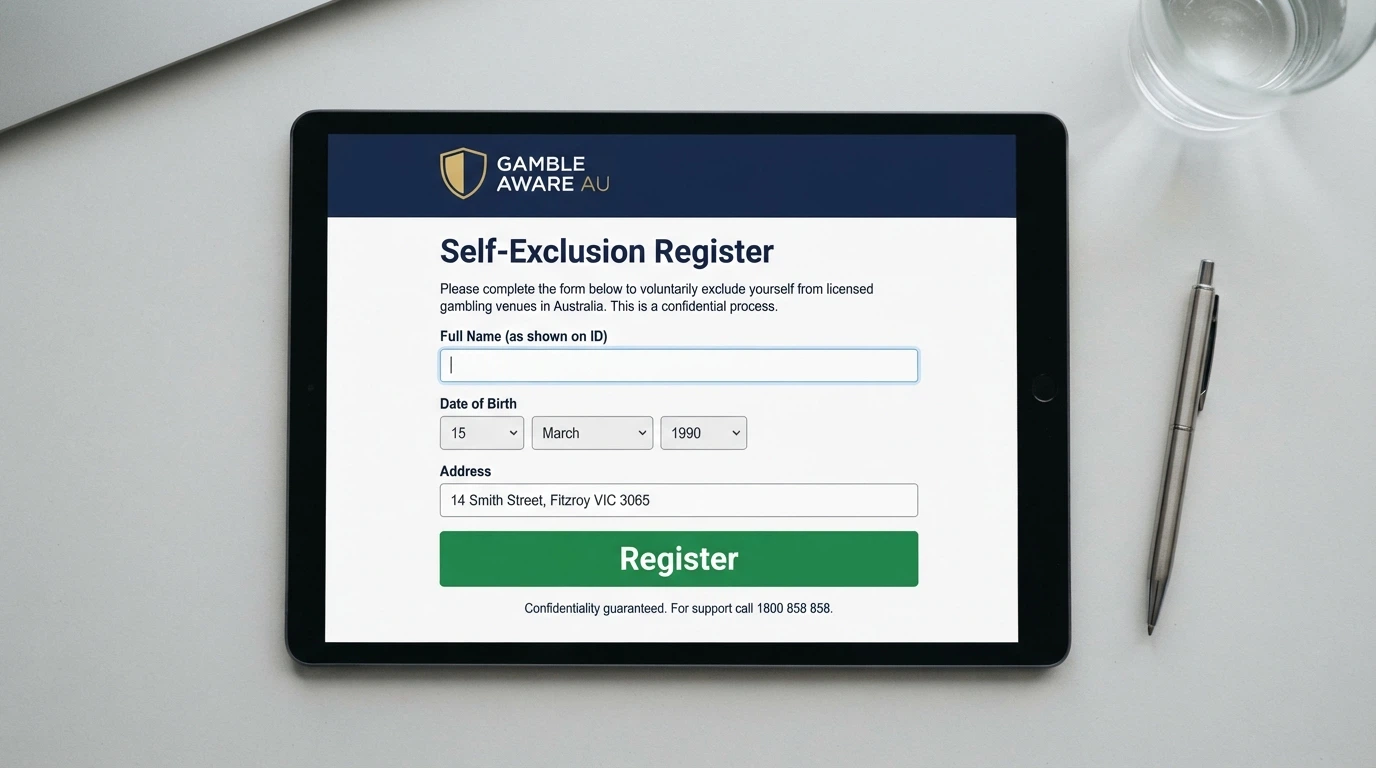
The bonus-chase behaviour described here is a particular kind of risk. A player who optimises for the largest welcome bonus, the lowest wagering, and the longest validity window is a player whose attention is on the offer rather than the play. The offer is structured to encourage exactly that focus. A 60× wagering requirement on a A$100 chip is 1,200 spins, roughly 100 minutes of continuous play. A 40× wagering requirement on a A$1,000 deposit match is roughly 5,300 spins, well over seven hours of continuous play. The bonus carries the player through a session that would otherwise end, and the session is where most of the gambling harm in the prevalence data above actually lives.
Help is available. The National Gambling Helpline is 1800 858 858 — free, confidential, staffed 24 hours a day, 7 days a week, with online chat and counselling through Gambling Help Online. The Victorian Gambler’s Help line is the state-level equivalent. The NSW GambleAware service runs the same role on the other side of the Murray. None of these require the player to have quit first. They are staffed for the call that happens before, during or after a session that has gone too far.
Deposit limits, loss caps and self-exclusion: the tools that actually work
The licensed AU wagering market has a real consumer-protection stack, and it is worth describing because the offshore market does not have it. BetStop, the National Self-Exclusion Register, has been live since August 2023. A single registration excludes the person from every Australian-licensed online and phone wagering service. The minimum exclusion period is three months; the maximum is lifetime. Of the 67,480 registrations as at 31 July 2026, 78% of registrants were under 40, and 38% chose lifetime exclusion. The register is a commitment device, and it works for the players who use it — the 41,290 still excluded are the proof.
Customer-set deposit limits are the second tool. Licensed AU wagering operators offer configurable deposit caps at the account level, with daily, weekly and monthly windows. A player who sets a A$100 weekly cap cannot deposit more than A$100 in that window, regardless of the operator’s bonus offers. The cap is enforced by the operator and audited by the regulator. Offshore casinos rarely offer comparable controls, and the controls they do offer are typically set in the bonus terms rather than at the account level — a max bet during wagering is not the same as a daily deposit cap.
BetStop does not cover offshore casinos, and the offshore market has no equivalent self-exclusion register. A player who registers with BetStop and then opens an account at an offshore casino is doing both: excluding themselves from every licensed wagering operator and creating a new exposure at an unregulated one. The offshore status of the bonus offer is the safety gap the responsible-gambling tools cannot reach.
The real cost of chasing a $100 bonus: what the harm data says
The dollar figure on the offer is round, the wagering multiplier is high, and the cashout cap is low. The harm data behind the offer is bigger than all three. The Australian Psychological Society puts national problem gambling at 0.4% to 1.2% of adults and moderate-risk gambling at an additional 1.9% to 3.7%. Gambling harm in the past year was reported by 7.8% of Australian adults in a national study; legacy harms by 7.1%. These figures describe the population the bonus is marketed to.
A player who has set out to chase a $100 bonus is, by definition, the kind of player the offer is designed to retain. The free chip turns into a session; the session turns into a deposit; the deposit turns into a second deposit; the second deposit clears the first stage of the welcome package and prompts the second. The structural similarity between bonus-chasing and the harm data is not a coincidence. It is the offer’s design. The wagering requirement is the mechanism that converts the headline number into the time and turnover the casino needs to earn its edge.
The help infrastructure exists, and the call is free. The National Gambling Helpline is 1800 858 858, free and confidential, 24 hours a day. Gambling Help Online runs live chat and self-help tools. The 1800 number does not require the player to have decided to stop gambling. It is staffed for the call that happens in the middle of a session that has gone further than the player meant it to.
How we picked and checked every casino on this page
Ten operators sit on the shortlist above, drawn from AU market-share tracking data that ranks brands by tracked traffic and revenue. The ranking is a market-presence ranking, not a bonus-quality ranking — a higher position means a brand an Australian player is more likely to encounter, not necessarily a brand offering a better deal. The top two positions reflect the brands with the largest tracked AU-facing share; positions further down the list reflect smaller share but real market presence. Several brands were excluded from the list because they are AU-licensed wagering operators rather than casino operators, and do not offer the casino product in question.
The checks ran along four lines: licence jurisdiction, bonus relevance to the $100 NDB query, terms availability, and the IGA backdrop. On licence jurisdiction, every operator was checked against the ACMA register and the IGA’s online casino prohibition. All ten are offshore. None holds an AU online casino licence, because no such licence can exist. The Curaçao jurisdiction is the common AU-offshore pattern; individual licences were not separately verified against the Curaçao Gaming Authority register this run, and the Curaçao label here reflects the operators’ own footer disclosures and the common offshore pattern rather than a regulator confirmation. On bonus relevance, each operator’s current welcome package was assessed against that $100 no-deposit claim, and the gap between the headline and the actual offer was flagged. On terms availability, wagering multiplier, maximum bet during wagering, validity window, max cashout and free-spin titles were checked against each operator’s own bonus page where possible. Where they were not confirmable, the gap is stated plainly. On the IGA backdrop, the ACMA enforcement record, the credit-card and crypto ban (effective 11 June 2024), and the 2026 reform package (passed 19 August 2026, commencing 1 January 2027) were cross-checked against the regulation skill and the Parliament of Australia record. No invented weightings, no fabricated percentages, no operator recommended.
The honest gap in this methodology is the per-brand PayID and bonus-terms coverage on the lower half of the list. The top four have confirmable current bonus terms. The bottom six do not have full bonus terms confirmed this run, and the responsible framing is to recommend that the reader check the brand’s own bonus page before depositing. A gap named is a gap a reader can navigate. A gap papered over is a mistake downstream.
Your $100 no-deposit casino bonus decision in 2026
The honest summary: the genuine A$100 no-deposit bonus at an Australian-facing online casino is nearly extinct, replaced by smaller no-deposit chips (A$10 to A$25), free-spin bundles with capped winnings, and deposit-triggered match bonuses that require the player’s own cash before the headline number appears. The market shifted between 2023 and 2026, and the page above is the picture of where it has settled.
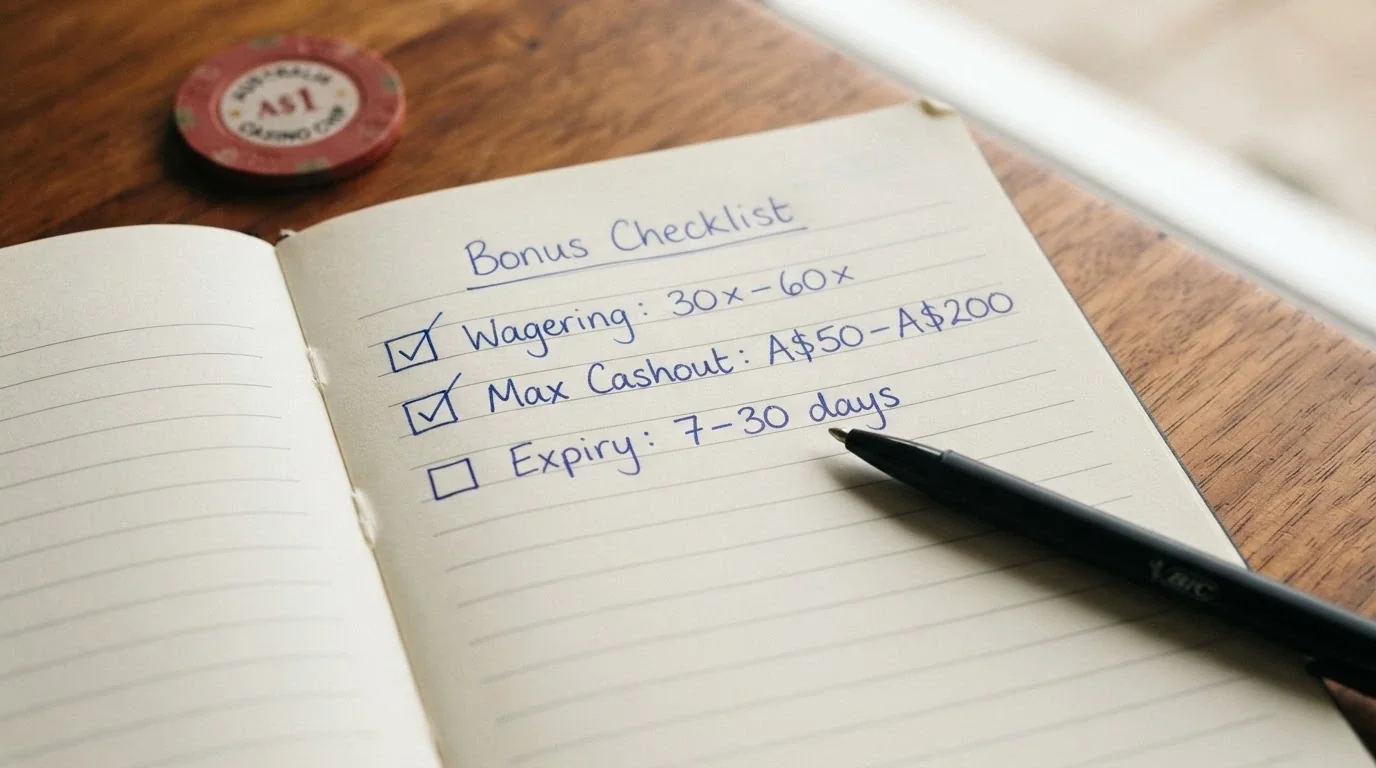
Three checks run before claiming any bonus on this page. The wagering multiplier (30×–60× is the typical range; below 30× is solid, above 50× is hard to clear), the maximum cashout (A$50–A$100 is typical, with A$200 the rough ceiling), and the validity window (7–30 days for no-deposit, 24–72 hours for free spins). The game-weighting check sits beside them: pokies count 100% toward wagering at most AU-facing casinos, table games count 0%, and a bonus that restricts the player to a single software provider is more restrictive than a multi-provider bonus on a like-for-like dollar figure. The payment-method check is the third: a casino asking for credit or crypto is operating outside the AU rules entirely, and the payment method is itself a tell.
The fourth check — the one no bonus page puts on its front — is the licensed-market reality. There is no AU online casino licence, because no such licence can exist under the Interactive Gambling Act 2001. Every operator on this page is offshore. Every consumer protection the licensed AU wagering market provides (BetStop self-exclusion, ACMA complaints recourse, deposit limits enforced by a regulator) does not apply. The player is not prosecuted under the IGA. The player is also not protected. Offshore status is the cost of the offer. The dollar figure on the welcome page is the benefit. The trade is the player’s to make, and it should be made with eyes open.
The arithmetic on this page is not a recommendation. It is the data behind the trade. A player who decides to proceed should do so with the payment rails and the deposit limits they control — a PayID account with a daily cap at the bank, a deposit ceiling set at the casino before any bonus is claimed, and a session length that does not exceed the time the player would have spent at a poker machine in a Crown or The Star venue with the same budget. The bonus is not free. The choice is the player’s.
Frequently asked questions about $100 no deposit bonuses in Australia
Is a $100 no deposit bonus really free, or do you have to deposit first?
A genuine no-deposit bonus requires no deposit up front, but the bonus itself is not free. The casino credits a small amount of bonus money to the new account, and the credit carries wagering requirements, a maximum cashout cap and a validity window before any winnings can be withdrawn. FairGO’s periodic A$100 chip is the closest thing to a true no-deposit A$100 currently circulating at an AU-facing casino, and it carries 60× wagering and an approximately A$180 max-cashout cap. Free at the cashier, paid at the wagering counter.
What wagering requirements apply to a $100 no deposit bonus in Australia?
Wagering on A$100 no-deposit bonuses at AU-facing casinos typically sits between 30× and 60× the bonus amount. At 30×, a A$100 bonus means A$3,500 in turnover before withdrawal. At 60×, A$6,000. Anything below 30× is a solid deal. Anything above 50× is hard to clear on the dollar figure alone. Most no-deposit pokies offers in Australia sit inside that 30× to 60× band, with the typical bet ceiling during wagering set at A$5 to A$10 per spin.
How much can you actually cash out from a $100 no deposit bonus?
Maximum cashout on no-deposit bonuses at AU-facing casinos typically sits between A$50 and A$100, with A$200 the rough ceiling outside rare exceptions like FairGO’s A$180 chip. Even after a player has cleared the full wagering requirement, the cashout cap is the hard ceiling on what can be withdrawn. Theoretical winnings above the cap do not transfer to a real-money balance — they remain bonus money and are forfeited at withdrawal.
Which pokies can you play with a $100 no deposit bonus?
The pokies titles depend on the casino and the specific bonus. RocketPlay’s free spins are tied to Aztec Magic (BGaming); SkyCrown’s first-deposit spins are tied to Wolf Treasure (IGTech). FairGO’s A$100 chip works on RealTime Gaming (RTG) titles only. The bonus terms page on each operator’s site lists the eligible titles, and players should check that list before claiming because some bonuses restrict play to a small subset of the casino’s full library. Contribution rates are almost always 100% on pokies and 0% on table games.
What is the difference between a free chip and free spins at Australian online casinos?
A free chip is a no-deposit bonus credited as casino money, locked behind wagering, and played across the casino’s eligible games (typically a single software provider’s pokies library). Free spins are a no-deposit bonus credited as a fixed number of spins on a specific slot title, with winnings from those spins treated as bonus money subject to its own wagering and cashout cap. Free chips are usually larger in headline value and harder to clear; free spins are smaller per spin and tied to a single game’s volatility.
How long do you have to clear the wagering on a $100 no deposit bonus?
No-deposit bonuses at AU-facing casinos typically expire within 7 to 30 days, and many free-spin offers are valid for only 24 to 72 hours. RocketPlay’s deposit-triggered bonus carries a 5-day validity window; SkyCrown’s multi-deposit package gives 14 days per stage. Players should check the specific validity window on the bonus terms page before claiming, because the wagering requirement has to be cleared inside that window or the bonus and any winnings from it are forfeited.
What happens if an offshore casino refuses to pay out my winnings?
The player has limited practical recourse. An offshore casino operating under a Curaçao licence answers to its own regulator and to its own terms; the ACMA does not handle complaints about offshore operators, and BetStop does not bind them. The first move is the casino’s own support team, escalated to a formal complaint. The second is the payment-rail chargeback path if the deposit was made by debit card or PayID and the dispute fits the bank or card issuer’s fraud or non-delivery framework. Beyond those two, the player’s options narrow to public complaint channels (affiliate sites, dispute forums) and the time cost of the chase. The licensed AU benchmark is materially different: withdrawals settle inside published service-level agreements once KYC is complete, commonly under 24 hours for PayID rails.
Published by the Microgaming Casinos AU team.