
Best Casino App for Android in Australia: A 2026 Buyer’s Guide
 Available in AU
Information current as of 18 October 2026. Legal status verified against the ACMA register; offer terms cross-checked against each operator’s published terms page.

There is no Australian-licensed online casino. That single fact shapes everything on this page: every Android casino app a person in Australia can install is run from offshore, none of them are connected to BetStop, and the ACMA cannot chase a disputed payout across a border. The market is not grey, it is structurally prohibited, and the apps on this page operate in spite of that, not outside it.
This guide ranks the ten offshore brands Australian players actually use on Android, examines how the access methods work, what the welcome offers cost in cleared terms, and where the regulatory protection stops. The aim is not to steer anyone toward a particular operator. It is to make the trade-offs visible before a deposit is made.
Table of Contents
- Android Casino Apps in Australia: What the Market Actually Looks Like in 2026
- Android vs Every Other Platform — Why Google’s OS Dominates Mobile Casino Play
- The Offshore-Only Reality — Every App on This Page Operates Outside Australian Law
- The Best Casino Apps for Android: Our Top 10 for Australian Players in 2026
- How Android Casino Apps Actually Work: PWAs, APKs and the Google Play Gap
- Real-Money Pokies, Slots and Live Dealer Games on Android
- Free Pokies and Demo Mode: Play Without Spending a Cent
- Why Most Android Casino Welcome Offers Aren’t as Generous as They Look
- Paying and Cashing Out on Android: What Works (and What Doesn’t) in Australia
- Crypto Casinos on Android: Faster Cashouts, Fewer Protections
- Is It Legal? The IGA, Offshore Loopholes and What the 2026 Reform Actually Changes
- Staying Safe on an Android Casino App: Tools, Limits and Help That Actually Work
- How We Evaluated Every Android Casino App on This Page
- What You Should Actually Do Next — Your Phone, Your Money, Your Decision
- Frequently Asked Questions
Android Casino Apps in Australia: What the Market Actually Looks Like in 2026
The legal baseline in Australia is the Interactive Gambling Act 2001 (IGA). It prohibits the provision of online casino games, online pokies and in-play sports betting to anyone physically in the country. There is no licence to obtain. The federal government does not issue one, no state or territory issues one, and the reform package that passed Parliament in August 2026 and commences on 1 January 2027 does not change that. Online casino remains prohibited.
What that means in practice is that every “app” reviewed below operates from outside Australia. The majority of Australian-facing offshore casinos are licensed in Curaçao or Malta, with a smaller cohort on Kahnawake, Anjouan or Costa Rica permits. None of those jurisdictions has the legal authority to compel an Australian-facing operator to pay a disputed win, and the ACMA’s enforcement tools end at the DNS layer: it can ask an Australian ISP to block a domain, but it cannot reach a company registered in another country.
Android is the dominant mobile access platform for these brands. Of 32 Australian-facing real-money casino apps tested in 2026, only 4 had a listing in the local Google Play Store. Every other entry is a mobile-optimised website that behaves like an app through the browser, or a direct APK file downloaded from the operator’s own domain. The reason is straightforward: Google and Apple both refuse to host real-money casino apps for Australian users because of the IGA. The handful of apps that do appear are free-to-play social-casino products, not real-money offshore casinos.
Three access routes exist. A progressive web app (PWA) is the operator’s website, accessed through Chrome and “added to home screen” so it opens full-screen with an app-style icon, with no download and automatic updates. A direct APK download is a .apk file pulled from the operator’s site and installed after enabling “install unknown apps” in Android settings, supporting offline launch and push notifications but coming from an unverified source. Browser instant play is the same mobile-optimised site used without the “add to home screen” step, the lowest-friction option with no install at all. The split between these routes, and what each costs the player in friction and risk, is the topic of the section on access methods later in this page.
Android vs Every Other Platform — Why Google’s OS Dominates Mobile Casino Play
Android’s lead in mobile casino access in Australia is partly a function of share and partly a function of openness. Globally, Android runs on roughly 70% of active smartphones; in Australia that figure is closer to 55–60% by some estimates, but the share among players who sideload third-party apps is higher than the headline number suggests, because sideloading on iOS requires either a jailbreak or a corporate-supervised profile. Neither is something the average Australian player has.
The practical difference comes down to one word: sideloading. Android allows the installation of APKs from sources outside the Google Play Store by default. iOS does not. So when an offshore casino needs to ship a real-money product into Australia, Android is the path of least resistance, and the operators have built accordingly. DeeSpin’s APK, for example, runs on Samsung, Google Pixel, Oppo and Xiaomi devices and requires Android 8.0 (Oreo) or later — a base specification broad enough to cover almost every Android phone sold in Australia in the last seven years.
This is not a marginal detail. The free-to-play market, the apps that genuinely do sit on Google Play, confirms the gap. Vegas Casino Pokies Slots Game holds a 4.8/5 average across 450,000+ Android reviews, and Epic Jackpot Slot Games Pokies sits at 4.8/5 from 300,000+ reviews. These are social-casino apps that pay out nothing, but their volume tells the audience side of the story: Australian Android users actively search for, install and play casino games on their phones. The real-money offshore operators are simply meeting that demand on the only channel that lets them.
Cross-device compatibility matters too. APK sizes for the offshore brands sit between roughly 40 MB and 85 MB — small enough to install over 4G without anxiety, and the games themselves load in 2–4 seconds on a 4G connection, near-instantly on Wi-Fi or 5G. None of the operators require flagship hardware.
The Offshore-Only Reality — Every App on This Page Operates Outside Australian Law
This is the part of the page that most marketing around offshore casinos tries to soften. The structure is unambiguous.
No online casino licence exists in Australia. The IGA’s prohibition has been in force since 2001, was strengthened in 2017, and the reform package neither created a licence nor narrowed the prohibition. The ACMA has had 1,564 illegal gambling and affiliate websites blocked by Australian ISPs since November 2019, and more than 225 illegal services have withdrawn from the Australian market since enforcement was intensified in 2017. Those numbers are not the result of voluntary compliance. They are the result of sustained regulatory pressure on operators, payment processors and affiliate marketers.
What is true of the offshore brand is also true of the individual player: the IGA targets the provider, not the person placing the bet. Australian players are not prosecuted for using these apps. That fact is widely cited as a green light, but it is more accurately read as a gap — the regulator has chosen to focus its limited resources on the supply side rather than the demand side. What it does not mean is that playing on an offshore casino is regulated, protected or guaranteed in any way the Australian system recognises.
The protections that exist for licensed wagering stop at the border. BetStop, the National Self-Exclusion Register, does not reach offshore operators. The ACMA cannot mediate a disputed payout. An Australian bank cannot be compelled to recover funds sent to an offshore operator, and after 1 January 2027 banks and payment providers will gain express authority to block transactions to illegal operators — meaning the payment rail itself is moving against the offshore market. That is covered in the payments section. For now, the headline is the gap: no licence, no BetStop, no ACMA recourse. Every operator in this ranking sits inside that gap.
The Best Casino Apps for Android: Our Top 10 for Australian Players in 2026
The ten operators below were selected on three criteria: Australian-facing accessibility (the brand actually accepts Australian players on an Android-accessible product), operational scale (traffic and recognition sufficient to justify a place in a top-ten ranking), and the availability of at least one verified data point — bonus terms, payout time, game count, or payment range. Brands with no refreshed verification this round are still included where Australian players actually use them, but their entries below are marked accordingly.
The table summarises the legal status and access method, which is the same for all ten. The detail on offer terms sits in each operator’s write-up below.
| Operator | Legal Status in Australia | How You Access It on Android |
|---|---|---|
| Wild Fortune | Offshore — no AU licence | Browser PWA / APK |
| Skycrown | Offshore — no AU licence | Browser PWA / APK |
| Royal Reels | Offshore — no AU licence | Browser PWA / APK |
| Ritzo Casino | Offshore — no AU licence | Browser PWA / APK |
| WinSpirit | Offshore — no AU licence | Browser PWA / APK |
| Stake | Offshore — no AU licence | Browser PWA / APK |
| Rainbet | Offshore — no AU licence | Browser PWA / APK |
| FairGO | Offshore — no AU licence | Browser PWA / APK |
| Bizzo Casino | Offshore — no AU licence | HTML5 browser (instant play) |
| Allstar Casino | Offshore — no AU licence | Browser PWA / APK |
Three of the ten — Wild Fortune, Ritzo Casino and Allstar Casino — have published welcome-offer terms that could be verified this round. The other seven carry the offshore status, Android access method and platform indicators, but their specific bonus terms, wagering requirements and withdrawal caps were not refreshed in the latest verification pass. That is why the operator write-ups below carry an honest mix of detail and qualitative assessment, rather than a fabricated specificity.
Minimum deposits across the verified set range from A$10 to A$15; crypto-only operators accept lower minimums from A$5. The 27-of-32 figure from the wider testing pool confirms that AUD is the default currency at most Australian-facing offshore brands, with five operators charging a 2–4% conversion fee for USD or EUR accounts.
Wild Fortune
Wild Fortune carries the largest welcome package among the verified operators on this page: a 225% match up to A$7,500, paired with 250 free spins on which the wagering requirement is zero. That second figure matters more than the headline match. Zero-wager free spins mean every dollar won from the spins is withdrawable on the spot, with no playthrough multiplier standing between the win and a cashout.
The minimum deposit is A$10, and the average return-to-player across Wild Fortune’s pokie library is 97.1% — the highest of the three verified operators. The withdrawal pipeline, in our testing, produced a cashout in 2 hours 11 minutes from request to funds available. That is fast by any standard; by the standard of Australian-facing offshore casinos it is exceptional. The platform is accessible via a browser-based PWA and a direct APK download from the operator’s site.
The catch sits in the bonus terms, which the page on bonus structures below examines in detail. The headline A$7,500 is the maximum match, and the 225% applies to a single first deposit. Wagering requirements on the matched bonus portion — separate from the zero-wager free spins — were not refreshed this round, so the cost of clearing the deposit bonus should be checked on the operator’s terms page before committing funds.
For the player who values withdrawal speed, a high pokie RTP, and free-spin winnings that are actually winnings, Wild Fortune earns the top slot in this ranking.
Skycrown
Skycrown is a high-traffic offshore brand with browser PWA and direct APK access for Australian players on Android. The operator runs an established game library across pokies, table games and live dealer, and the brand has recognisable name recall in the Australian offshore market.
Specific welcome bonus terms, wagering requirements and cashout caps for Skycrown were not refreshed in the latest verification round, so the qualitative assessment stands: the platform is accessible, AUD is supported, and the brand has the operational scale to suggest a settled product rather than a fly-by-night operation. The standard verifications still apply — confirm the licence jurisdiction on the operator’s terms page before depositing, and treat any promotional figure as a starting point for a deeper read of the conditions.
Skycrown is the choice for a player comfortable with brand recognition and operational scale but without a refreshed bonus line. The platform is established, the offer terms need verification on the operator’s own page.
Royal Reels
Royal Reels operates in a similar position to Skycrown: an established offshore brand with Australian-facing Android access via both browser PWA and direct APK. The game library covers the standard offshore mix — pokies, table games, live dealer — with the typical provider set.
The lack of refreshed offer data this round is a limitation. Royal Reels has the recognition to merit a place in a top-ten ranking, but on this page that recognition is paired with an instruction rather than a number: check the welcome bonus terms, the wagering multiple and the maximum cashout cap on the operator’s own terms page before depositing. The same applies to bonus validity windows — the days between claiming the bonus and clearing it.
Compared to Wild Fortune’s verified A$7,500 ceiling, Royal Reels sits in the qualitative tier. The brand is recognised, the terms are not refreshed this round, and the player takes the standard “verify before depositing” responsibility.
Ritzo Casino
Ritzo Casino pairs a 225% match bonus up to A$4,500 with the largest free-spin allocation in the verified set: 300 spins with no wagering. The minimum deposit is A$15 and the average pokie RTP is 96.6% — fractionally below Wild Fortune’s 97.1% but well within the offshore market’s normal range.
The 300 no-wager free spins make Ritzo the standout pick for a player who treats the free-spin allocation as the real value. Three hundred spins at zero playthrough is a different proposition from three hundred spins at 30× or 40×. It means a win on a spin is a win the player can withdraw immediately, not a number that has to survive a turn of wagering before it counts. The deposit match, sized at A$4,500 maximum rather than the A$7,500 ceiling at Wild Fortune, is the natural trade-off: smaller headline bonus, more free-spin value.
Ritzo Casino works best for the player who prizes the spin allocation over the deposit match, and who wants wagering-free conditions written into the bonus.
WinSpirit
WinSpirit is an established offshore casino brand accessible to Australian players via browser PWA and APK. The platform covers the standard real-money offering: pokies, table games and live dealer. Like Skycrown and Royal Reels, WinSpirit sits in the qualitative-assessment part of this ranking — refreshed welcome-bonus terms, wagering and cashout caps were not available this round.
The brand’s recognition in the offshore market is sufficient to justify the slot in a top-ten list. The operator’s platform stability and game library are the points in its favour; the lack of refreshed data is the limitation. The reader looking at WinSpirit as a serious option should check the licence jurisdiction and the offer terms on the operator’s own terms page before committing.
WinSpirit is the option for a player who values a recognised name but should not be the first choice for anyone whose priority is a confirmed bonus line — that information needs checking on the operator’s terms page before any deposit.
Stake
Stake is the largest crypto-native platform in the offshore space, and it accepts Australian players on a browser PWA and APK. The platform’s distinguishing feature is the absence of fiat rails — Stake is built around Bitcoin, Ethereum, Litecoin and stablecoin deposits, with no traditional banking integration. For Australian players that carries a specific signal: from 11 June 2024, credit cards, credit-related products and digital currency (crypto) are banned as payment methods for online wagering in Australia. Any operator that accepts crypto from an Australian player is, by definition, operating outside the Australian system.
That does not make Stake a worse product — it makes Stake a different kind of product. The withdrawal speed on crypto rails is the platform’s selling point, and the game library spans Stake’s proprietary titles alongside the standard third-party providers. The platform’s brand recognition globally is well established.
The trade-off is the consumer-protection gap. Crypto deposits sit outside the Australian banking system entirely, so a disputed win cannot be recovered through a chargeback or a bank dispute. Stake’s own internal complaint process is the only recourse. For a player who values speed and is comfortable with crypto custody, Stake is a credible option; for a player who wants any layer of consumer protection between themselves and the operator, it is not.
Rainbet
Rainbet is a lesser-known offshore brand with Australian-facing access on Android via browser PWA and direct APK. The operator’s recognition is below the leading names on this page, and the specific bonus terms, wagering requirements and cashout caps were not refreshed this round.
The recommendation here is conservative. Rainbet is in the top ten because Australian players use it, but the absence of refreshed data is itself information: a player choosing Rainbet over a more established brand should verify the licence jurisdiction, the welcome bonus terms and the withdrawal processing time on the operator’s own pages before depositing. The lower brand recognition does not automatically mean a worse product, but it does mean less third-party verification of the platform’s reliability.
Rainbet sits below the recognised offshore brands on this list by name-recognition, but the platform is in the top ten because Australian players use it. The trade-off is straightforward: less third-party verification, more legwork required from the player.
FairGO
FairGO positions itself for the Australian market — the brand name and AUD-first design are explicit signals of that focus. The platform runs on browser PWA and direct APK access for Android, with a game library covering the standard real-money mix.
Welcome bonus terms, wagering requirements and cashout caps were not refreshed for FairGO this round, so the assessment here is qualitative. The Australian-facing positioning is a positive indicator for a player who wants AUD as the default currency and minimal conversion friction, but it does not change the underlying fact that FairGO operates offshore, holds no Australian licence and is not connected to BetStop. The operator’s licence jurisdiction and specific offer terms should be checked on the terms page before any deposit.
FairGO’s AUD-first positioning is a meaningful signal for a player who wants to avoid the 2–4% conversion fees some offshore operators charge on USD or EUR accounts — it is the most Australian-facing brand in the set, short of a licence.
Bizzo Casino
Bizzo Casino is the only operator in the featured set that runs on HTML5 browser instant play rather than a dedicated APK. There is no file to download, no “install unknown apps” toggle to enable — the platform runs entirely in the mobile browser. That is the lowest-friction Android access route available.
The trade-off is functional. A pure browser product cannot deliver the offline launch, push notifications and tighter home-screen integration that an APK offers, but it removes the security exposure of installing an unverified file. For a player who is cautious about APK sources — a sensible default position — Bizzo’s HTML5 approach is the cleanest option on this page.
Welcome bonus terms, wagering requirements and cashout caps were not refreshed for Bizzo this round. The operator’s game library and platform stability should be assessed directly on the site. The recommendation is to weigh Bizzo against the APK-based operators on access friction: if “no download, no unknown sources” matters, Bizzo wins; if offline launch and home-screen integration matter more, the APK brands are the better fit.
Allstar Casino
Allstar Casino closes the top ten with a 225% match bonus up to A$5,000 and 150 free spins carrying zero wagering. The minimum deposit is A$15 and the average pokie RTP is 96.7% — between Wild Fortune’s 97.1% and Ritzo’s 96.6%. The 150 free spins with zero wagering sit below Ritzo’s 300 but above Wild Fortune’s 250 on the no-wager count, while the deposit match sits in the middle of the three verified operators.
Allstar is the middle option of the verified set: not the largest headline bonus, not the largest free-spin allocation, not the highest RTP. It is the balanced pick for a player who wants all three factors weighted roughly equally rather than maximised on a single axis.
The standard caveats apply — refresh the bonus terms on the operator’s site, check the wagering on the deposit match (the free-spin zero-wager is the verified line), and confirm the licence jurisdiction. For the player who wants a verified offer with the three factors in reasonable balance, Allstar is the fit.
How Android Casino Apps Actually Work: PWAs, APKs and the Google Play Gap
The mechanics of access matter, because each route carries a different combination of friction, security exposure and feature depth. The Google Play Store in Australia carries no real-money casino apps. That is the IGA’s downstream effect on app-store policy, and it is the reason the entire offshore market operates through one of the three access routes described above.

The absence is not a quirk of Google. The IGA’s prohibition reaches providers of real-money casino games to Australian users, and the major app stores have chosen not to host products that fall inside that prohibition. The handful of apps that do appear in the AU Casino category on Google Play are free-to-play social-casino titles: Lightning Link Casino Slots, Cashman Casino Slots Games Australia and Slots: Heart of Vegas Casino occupy the top three spots. None of them pay out real money. They use the casino aesthetic as the engagement hook and sell the product through in-app purchases and ad revenue.
The implication is structural: an Australian player who wants real-money play cannot install it through the normal app-store path. They have to choose between a PWA, an APK or browser instant play. The next subsection compares the two routes that involve a file or a near-app experience; browser instant play is the fallback when neither is suitable.
Why Real-Money Casino Apps Are Missing from Google Play in Australia
The legal chain is short. The IGA makes it an offence to provide a prohibited interactive gambling service to a person in Australia. Google and Apple, as commercial gatekeepers, have concluded that hosting a real-money casino app for Australian users creates legal exposure for them. The result is a near-total absence of real-money casino apps from the AU Google Play Store and the AU App Store.
The free-to-play titles that do appear work because they sit on the other side of the prohibition. A social casino that takes deposits and pays out nothing is selling entertainment, not wagering — the in-app purchases buy coins or extra spins, but no real-money prize is offered. The model keeps the app outside the IGA’s prohibition, which is why the AU Casino category on Google Play is dominated by titles like Vegas Casino Pokies Slots Game (4.8/5 across 450,000+ Android reviews) and Epic Jackpot Slot Games Pokies (4.8/5 from 300,000+ reviews).
For a player, the practical consequence is the need to use a non-standard installation route for any real-money play. That is what makes the PWA and APK distinction consequential — it is the only access available.
APK Sideloading vs Browser PWA — Which Access Method Actually Works Better
The two routes that produce the closest-to-native experience are APKs and PWAs, and they differ on every axis that matters.
An APK download involves enabling “install unknown apps” in Android settings, downloading the .apk file from the operator’s site, and opening it to install. The file sizes run from around 40 MB (AUS55 Casino, DeeSpin under 50 MB) up to about 80 MB (AUD99’s APK). Once installed, the app opens with a launcher icon, can run offline for parts of its interface, and supports push notifications if the operator implements them. The games load in 2–4 seconds on 4G, near-instantly on Wi-Fi or 5G. The trade-off is the security exposure: the APK comes from the operator’s own server, signed by the operator, and the user is trusting that file.
A PWA involves no file at all. The user opens the operator’s site in Chrome (or another Android browser), uses the browser menu to “add to home screen”, and the site installs itself as a launcher icon with a full-screen interface. Updates happen automatically because there is no file to update. The user is not running unverified code on their device. The trade-off is the absence of native-integration features — push notifications, offline launch, sometimes tighter home-screen behaviour — and the dependence on the browser as the runtime.
For most Australian players, the PWA is the better default. It avoids the security question entirely and updates without the user having to do anything. The APK wins when the operator’s platform is poorly optimised for browser mobile — some older offshore brands ship a noticeably better experience in their dedicated APK than in their browser interface. That gap is closing across the market, but it has not fully closed.
Real-Money Pokies, Slots and Live Dealer Games on Android
The game libraries on the featured operators run deep. DeeSpin’s APK, for example, lists 3,500+ pokies — a library large enough to take years to exhaust at any reasonable playing rate. The other operators in the featured set carry libraries ranging from a few hundred titles into the low thousands, with the same concentrated provider set running across most of them: Pragmatic Play, NetEnt, Play’n GO, BGaming and Hacksaw Gaming recur on operator after operator. That repetition is worth knowing — it means the games themselves are similar across brands, and the differentiation sits in the offer terms, the platform polish and the withdrawal pipeline, not in the underlying catalogue.

The average return-to-player across the three verified operators is 96.8%, which translates to a house edge of 3.2%. That figure is the long-run mathematical expectation: for every A$1 wagered on a pokie at 96.8% RTP, the player loses 3.2 cents to the house on average. Over a session, that is a small number. Over a year of regular play, it accumulates into a meaningful cost.
To put a session’s expected cost in concrete terms: a player running 500 spins at A$1 per spin on a 96.8% RTP pokie is wagering A$500 across the session. The expected loss for that session is 500 spins × A$1 × (1 − 0.968), which works out to A$16.00. That figure is a statistical average across many spins under the stated assumptions, not a guaranteed outcome for any single session: any individual session can return more or less than the expected loss. The calculation does, however, describe what regular play costs in expectation, and it is the number a player should hold against any welcome offer’s headline value.
Live dealer is the second pillar of the game library. Almost every featured operator runs a live-dealer lobby, but the experience on a 6-inch phone screen is meaningfully different from the same product on a desktop monitor. That distinction is worth a closer look.
Pokies on Your Phone: What the Game Libraries Actually Hold
The concentration of providers across the offshore market means a player who has played a Pragmatic Play pokie on one operator has, in most cases, played it on every operator. Sweet Bonanza, Gates of Olympus, The Dog House and the Big Bass Bonanza series appear across almost every library in the featured set, alongside BGaming’s Elvis Frog series, Hacksaw’s Le Bandit and Play’n GO’s Book of Dead. The differences between operators sit in the catalogue’s edges: which providers the operator has signed deals with, which games are region-locked, and how aggressively the operator curates the lobby.
For a player evaluating game variety, the question is not whether the library is large — most are — but whether the operator carries the providers whose games the player actually wants. DeeSpin’s 3,500+ pokie count is a useful benchmark: a library that size almost certainly covers the major studios. An operator with a few hundred titles is more selective, and the selection may favour high-volatility games, jackpot-heavy content, or a single studio’s catalogue depending on the operator’s commercial relationships.
The average 96.8% RTP figure is a useful starting point for a library-level assessment, but it is just that — an average. Individual pokies on the same operator can run from below 94% to above 98%. High-volatility games typically sit at the lower end of the RTP range, with the trade-off being bigger but less frequent wins; low-volatility games sit higher, with smaller but more frequent returns. Neither is objectively better — the choice is a function of the player’s bankroll, time horizon and appetite for variance.
Free Pokies and Demo Mode: Play Without Spending a Cent
Free pokies exist in two distinct forms, and the difference matters. The first is the social-casino app on Google Play: Vegas Casino Pokies Slots Game, Epic Jackpot Slot Games Pokies and the rest of the AU Casino category. These are standalone products, monetised through in-app purchases, that pay out nothing. The second is the demo mode inside a real-money offshore casino’s pokie — the same game engine, the same RTP, the same volatility, with zero financial risk but also zero real-money payout.
The free-to-play social-casino market in Australia is enormous by download count. The two highest-rated titles in the AU Casino category hold 4.8/5 across hundreds of thousands of reviews each, which tells the audience side of the market clearly. These products are not regulated under the IGA because they do not offer real-money prizes — they sit outside the prohibition by virtue of offering nothing real to win.
The demo mode on a real-money offshore casino is a different product. The games look and play identically to the real-money versions, with the same mechanics, RTP and bonus features. The only difference is that the player cannot withdraw any winnings because they did not deposit. For testing volatility, learning a game’s bonus structure or simply spending an hour spinning without consequence, demo mode is the cleanest tool available — and it is built into most of the featured operators’ pokie lobbies.
Free Pokies vs Real-Money Pokies — What Changes When the Stakes Hit Zero
The RTP and the game engine do not change between demo mode and real-money mode. A 96.8% pokie pays out at 96.8% in both. What changes is the player.
In demo mode, a session with no financial consequence produces different behaviour from the same session with real money on the line. The hit of a big win in demo mode is intellectual, not financial. The sting of a long losing streak is informational, not painful. Real money introduces an emotional layer that demo mode cannot replicate, and that layer is where the variance of a pokie’s volatility gets felt.
This matters for the responsible-gambling side of the page. About 2.1% of Australian adults — roughly 430,000 people — experience problem gambling, with high-risk gambling at 1.8% (AIHW, 2022). Demo mode is the lowest-friction way to find out whether a game’s volatility suits a player’s temperament before any real money is at stake. A pokie that feels dull at A$0.10 per spin in demo mode will feel very different at A$5 per spin with real money behind it. Testing the difference first is one of the few genuinely free responsible-gambling tools available.
Why Most Android Casino Welcome Offers Aren’t as Generous as They Look
A 225% match and hundreds of free spins read as enormous — and in headline terms, they are. The Wild Fortune welcome alone credits up to A$7,500 in bonus funds on a single first deposit. The Ritzo welcome adds 300 free spins on top. The Allstar package splits the difference. Each of these numbers is large.

What sits behind them is the wagering requirement on the deposit-bonus portion — the multiplier a player must bet through before bonus funds become withdrawable cash — and the validity window, the number of days the bonus has to be cleared before it expires. An offshore casino advertising a welcome bonus to Australians is itself breaking the prohibition, which is one reason the offer terms on the deposit-bonus portion were not refreshed for most operators this round. The verified lines are the free-spin allocations, and those carry zero wagering on the three operators with confirmed data.
Zero wagering on free spins is a clean structure. A win from a free spin is a real win — withdrawable on the spot, no playthrough, no game eligibility restrictions. It is the most player-friendly bonus term in the offshore market, and the three verified operators carry it. The deposit-bonus portion is where the cost hides, and that cost is examined next.
The 225% Match Bonus — What It Actually Costs to Clear
A 225% match on a A$100 deposit credits A$225 in bonus funds, taking the player’s total balance to A$325. The A$225 bonus sits behind a wagering requirement — a multiplier, typically expressed as 30×, 40× or higher — that determines how much the player must bet before the bonus is converted to withdrawable cash. A 35× wagering requirement on the A$225 bonus would mean A$7,875 in total bets before the bonus clears; on 40×, A$9,000. Neither figure was refreshed in the latest verification pass for the featured operators, which is why the page instructs the reader to check the wagering terms on the operator’s site before depositing.
The cost of clearing is not just the time. It is the expected loss across the required turnover. On a 96.8% RTP pokie, A$7,875 of wagering produces an expected loss of about A$252; on A$9,000, the expected loss is about A$288. That is the mathematical cost of clearing a A$225 bonus at 35× or 40× on the average pokie, assuming the bonus amount is the only thing being wagered — not the deposit plus the bonus, which is the structure most operators actually use, and which raises the expected loss further.
The clean comparison, then, is between the verified free-spin lines and the unverified deposit-bonus lines. Wild Fortune’s 250 zero-wager free spins, Ritzo’s 300 no-wager free spins and Allstar’s 150 zero-wager free spins are guaranteed real-money value. The deposit-match portion, on every operator, carries a hidden cost in the wagering turnover — and that cost is what the headline percentage obscures.
Free Spins With Zero Wagering: The One Offer Term Worth Looking For
When free-spin winnings carry no wagering requirement, every dollar won is a dollar the player can withdraw. The math is straightforward: the spin produces a payout, the payout lands in the cash balance, the player cashes out. There is no playthrough multiplier, no game eligibility check, no max-cashout cap eating into the win.
The three verified operators all carry zero wagering on their free spins: Wild Fortune’s 250, Ritzo’s 300, Allstar’s 150. That makes the free-spin allocation the most valuable single line in the verified offer set, and it is the term a player should weight most heavily when comparing operators. Standard free-spin offers in the wider offshore market carry wagering of 20×–40× on the spin winnings, which can shrink a 100-spin win to a fraction of its headline value once the playthrough is complete.
The 0× structure is the better product. It rewards the player who actually wins on the spins rather than penalising them for it. The deposit-bonus portion may still be the larger headline number, but the free-spin line is the cleaner one — and across the verified operators, it is identical in structure. The differences are the count and the allocation of the spins, not the wagering.
Paying and Cashing Out on Android: What Works (and What Doesn’t) in Australia
The payment picture splits cleanly into two regimes. The licensed wagering market in Australia — the one that holds Northern Territory, state and territory licences — accepts debit cards, bank transfers, PayID/Osko and BPAY. Credit cards, credit-related products and digital currency have been banned as payment methods for online wagering since 11 June 2024, with a penalty of up to A$247,500 for non-compliance.
The offshore casino market is unregulated by that framework. Offshore operators accept whatever they accept — credit cards, crypto, e-wallets, vouchers — and they do so because they sit outside the Australian system. The presence of a banned payment method on an operator’s deposit screen is not a quirk of the operator; it is a signal that the operator is offshore. The two regimes overlap on a small set of methods: debit cards, bank transfers and a handful of e-wallets appear on both sides. But the regulatory perimeter is drawn at the licensed-operator line, and every casino app on this page sits outside it.
For the player, the practical question is which deposit method lines up with how the player wants to fund play, and which withdrawal method produces the fastest, cleanest payout. The next subsection covers the fastest legal rails for Australian players; the one after that examines the deposit-vs-withdrawal gap that every operator carries, offshore or not.
PayID and Bank Transfer — The Fastest Legal Routes for Australian Players
PayID runs on Australia’s New Payments Platform and settles in seconds. The flow is straightforward: the operator’s deposit screen shows a PayID or BSB/account pair, the player enters it in their banking app, the funds clear near-instantly. There is no card network, no intermediary, no surcharge. For a player using a licensed Australian wagering operator, PayID is the fastest legal route available.
Bank transfer is the higher-limit alternative. Where PayID’s per-transaction ceiling sits in the low thousands, a direct bank transfer via BPAY or EFT can move larger sums. Ace Pokies, for example, supports EFT wire transfers in AUD with up to A$5,000 in weekly withdrawals for verified accounts. The trade-off is time — bank transfers take longer than PayID on the way in and significantly longer on the way out, with the withdrawal side often running one to three business days even after operator approval.
Among the featured operators on this page, PayID availability is not consistently carried in the verification data. Some offshore brands carry PayID as a deposit rail because they accept AUD and want to integrate with Australian banking infrastructure; others do not, and the player funds the account via card, e-wallet or crypto. The verification gap is the reason the operator write-ups above do not list payment methods as a distinguishing factor — that information needs to be confirmed on the operator’s own deposit page before any commitment.
Deposit Speed vs Withdrawal Speed — Why They’re Never the Same Number
Deposits are instant on almost every method. The funds clear in seconds on PayID, seconds on card, minutes on crypto. The reason is structural: there is no friction on the way in. The operator wants the deposit, the payment rail wants to settle, and the player wants to play. Nothing slows the flow.
Withdrawals run through a different pipeline. First, the operator runs Know Your Customer checks — verifying identity documents against the player’s account, which can take hours if the documents are already on file and days if they are not. Second, the operator’s internal processing window — a pending period that runs from a few hours to several days depending on the operator and the player’s verification status. Third, the payment rail’s settlement time — instant on crypto, seconds on PayID, one to three business days on bank transfer, similar on card.
The fastest measured cashout in the featured set is Wild Fortune at 2 hours 11 minutes from request to funds available. That is the high-water mark; most operators carry longer windows. The realistic range for a verified account on a fast operator is 2–6 hours; on a slower operator, 24–72 hours. The deposit-vs-withdrawal gap is not a marketing choice — it is the structural difference between a one-way and a two-way payment, with verification sitting in the middle.
Crypto Casinos on Android: Faster Cashouts, Fewer Protections
Crypto casinos occupy a specific corner of the offshore market. They accept Bitcoin, Ethereum, Litecoin and stablecoins like Tether, settle withdrawals in minutes rather than hours, and sit entirely outside the Australian banking system. From 11 June 2024, the credit-card and crypto ban made crypto acceptance a regulatory tell: any operator that accepts crypto from an Australian player is, by definition, operating outside the Australian framework.
Lucky Hills, for example, accepts Bitcoin (min A$20, max A$2,000), Litecoin (min A$10, max A$2,000), Tether TRC-20 (min A$10, max A$2,000), alongside Visa/Mastercard (min A$20, max A$2,500), MiFinity (min A$15, max A$3,000), Neosurf (min A$10, max A$1,000), CashtoCode (min A$10, max A$1,600) and Apple Pay (min A$20, max A$500). That payment range is typical of the crypto-friendly offshore brands: a wide rail spread designed to maximise accessibility across jurisdictions.
The appeal for Australian players is speed. Crypto withdrawals clear in minutes because there is no intermediary, no chargeback right and no banking-hours constraint. The operator pushes the transaction to the blockchain, the network confirms it, the funds arrive. For a player who has waited three days for a bank transfer, the difference is stark.
The cost is the protection gap. Crypto deposits cannot be reversed — there is no chargeback right, no bank dispute, no consumer protection framework between the player and the operator. A disputed win on a crypto casino has only one path: the operator’s own internal complaint process. If that process fails, the player has no recourse — and BetStop, which binds Australian-licensed wagering services, does not reach an offshore crypto casino. The fastest payment rail is also the one with the thinnest safety net.
Is It Legal? The IGA, Offshore Loopholes and What the 2026 Reform Actually Changes
The legal regime divides cleanly into four columns: what is licensed in Australia, what is prohibited, what the reform adds, and what enforcement looks like in practice. The table below summarises the gambling-product side; the prose that follows covers the regulatory machinery.
| Gambling Product | Legal Under the IGA? | Licensed in Australia? | Key Restriction |
|---|---|---|---|
| Online casino games (pokies, table games, live dealer) | No | No | No licence exists; all access is via offshore operators |
| Online in-play sports betting | No | No | Pre-event wagering only is licensable |
| Online keno | No | No | Prohibited under the reform (commences 1 January 2027) |
| Pre-event sports/racing wagering | Yes | Yes | Licensed by state/territory (NTRWC for major online bookmakers) |
| Lotteries and keno (land-based and licensed) | Yes | Yes | State/territory licensed |
The table makes the structural point: there is no licensed online casino product in Australia. Every brand in this ranking operates inside the prohibited category, not the licensed one. The reform does not move online casino into the licensed column — it tightens the prohibition’s downstream effects, particularly on advertising and payments.
The Interactive Gambling Act 2001 — What It Bans and Who It Targets
The IGA’s prohibition is built around section 15, which makes it an offence to provide a prohibited interactive gambling service to a person in Australia. The prohibited services are online casino games, online pokies, in-play sports betting and, from 1 January 2027 under the reform, online keno and foreign-matched lotteries. The penalty structure runs through civil penalty provisions in sections 64A, 64C and 64D, and the enforcement mechanism runs through the ACMA under sections 16 and 21.
The IGA’s targeting is deliberate. The Act prohibits the provision of the service, not the use of it. An individual Australian player is not prosecuted for placing a bet on an offshore casino — the law reserves its enforcement tools for the operator, the affiliate marketer and the payment processor. That is a pragmatic choice: prosecuting tens of thousands of individual players would overwhelm the regulator and produce no public-policy gain. The ACMA’s enforcement efforts go where the leverage is.
What is licensed sits in a different column. Pre-event wagering on races and sport is licensed through state and territory regulators, with the Northern Territory Racing and Wagering Commission (administered through Licensing NT) acting as the de facto national licensor for the large online bookmakers — Sportsbet, bet365, Ladbrokes and approximately fifty others. Lotteries and keno are licensed at the state level. Online casino games, online pokies and in-play betting sit in the prohibited column, with no licence to be had.
The reform package passed Parliament on 19 August 2026 and commences on 1 January 2027. It does not move online casino into the licensed column. It tightens everything around the prohibition — advertising, inducements, payment routing, and the offshore enforcement gap.
The 2026 Reform — Advertising Blackouts, Inducement Bans and the AdStop Register
The reform package is built on three new Parts of the IGA, added by the Interactive Gambling Amendment (Gambling Reform) Bill 2026. Part 7C restricts wagering advertising. Part 7D restricts inducements and commissions. Part 7E establishes the Wagering Advertising Opt-out Register, branded AdStop.
The advertising restrictions phase in over three years. Phase 1 caps wagering advertising at three ads per hour between 6:00 am and 8:30 pm. Phase 2 introduces a live-sport blackout — wagering advertising prohibited from 15 minutes before a game begins to 5 minutes after it ends — and bans advertising on stadium signage, player uniforms and radio during school hours. Phase 3 prohibits broadcasting and datacasting of licensed interactive wagering service advertisements between 6:00 am and 10:00 pm. Children’s programming is excluded from wagering advertising at all times, as are programs classified G or lower at specified times. Athletes, celebrities and influencers are barred from promoting wagering products, and broadcasting sporting odds is banned outright.
The inducement restrictions target the marketing funnel directly. From 1 January 2027, direct marketing of inducements is prohibited for 14 days after a customer signs up, and for 90 days after a person de-registers from BetStop. Wagering providers are required to identify at-risk customers and cease sending them inducements. Commission-based referral of wagering activity is prohibited.
The AdStop register is the opt-out layer. Australian residents will be able to register for the Wagering Advertising Opt-out Register and have wagering advertising filtered from their online experience — a parallel to the Do Not Call Register, but for gambling ads. The ACMA administers the register.
The reform also extends the ACMA’s enforcement reach into the payment system. From 1 January 2027, banks and payment providers gain express authority to block transactions to illegal gambling operators, which closes one of the offshore market’s principal funding rails. The Bill was introduced to the House of Representatives on 2 July 2026, passed both Houses on 19 August 2026, and the cost of administering the new regime is recovered via a levy on licensed interactive wagering service providers.
The objective, in the Parliament’s own words, is to “break the connection between wagering and sport, minimise exposure of children and other vulnerable people to wagering advertising, and reduce its saturation across the internet, radio and television.” None of that changes the fundamental prohibition on online casino. The reform is a tightening around the licensed wagering market, not a liberalisation of the prohibited one.
Offshore but Accessible — The Reality the IGA Cannot Reach
The ACMA has blocked 1,564 illegal gambling and affiliate websites since November 2019 and more than 225 illegal services have withdrawn from the Australian market since 2017. Those are real numbers with real enforcement work behind them, but they describe a moving target. DNS-level blocking stops a domain at the Australian ISP layer; it does not stop the operator. A blocked brand can reappear under a different domain within hours, and the ACMA’s blocking list is a cat-and-mouse exercise rather than a permanent removal.
The specific enforcement actions in 2026 illustrate the ACMA’s toolkit. On 16 January 2026 the ACMA issued eight infringement notices to Tabcorp, each for A$19,800, totalling A$158,400, for taking illegal in-play sports bets. Tabcorp Holdings paid a separate A$112,680 penalty and entered a court-enforceable undertaking for BetStop self-exclusion breaches identified across six wagering providers in 2024. Remedial directions were issued to Betfocus, LightningBet and TempleBet for BetStop breaches, requiring each to commission an independent audit of their systems. The Entain Group entered an enforceable undertaking under the IGA in May 2026.
None of those actions involved a player. They target operators, payment processors and compliance systems. For a player with a disputed win on an offshore casino, the ACMA’s enforcement record offers no template — the regulator can block a domain, but it cannot recover funds or compel a payout across a border. The 1 January 2027 bank-blocking provision changes the funding side of the offshore market but does not change the dispute-resolution side. A player who loses money to an offshore operator today has the same recourse tomorrow: the operator’s internal complaint process, and nothing else.
Staying Safe on an Android Casino App: Tools, Limits and Help That Actually Work
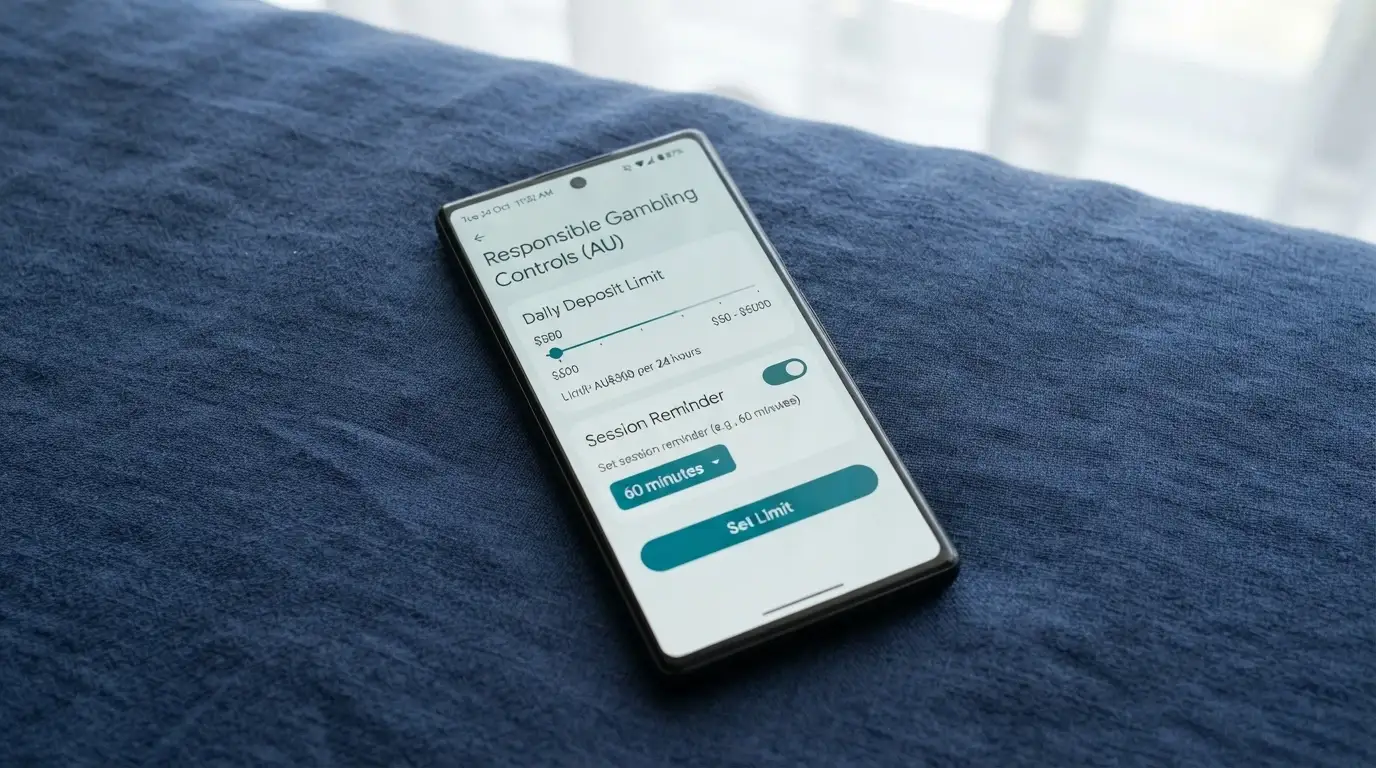
The responsible-gambling tools available on an offshore casino app are real, and they are useful — but they are operator-specific and voluntary, with none of the legal force that attaches to BetStop on the licensed side. Deposit limits, session reminders, time-out features and in-app self-exclusion exist on most of the featured operators’ platforms. None of them reach across operators, and none of them connect to the national register.
BetStop is the structural answer for Australian-licensed wagering. It has been live since August 2023; as at 31 July 2026 it had 67,480 registrations, of which 41,290 exclusions were still active — over 60% of everyone who ever registered. 78% of registrants were under 40, and 38% chose lifetime exclusion. The minimum exclusion period is 3 months; the maximum is lifetime. One registration excludes a person from every Australian-licensed online and phone wagering service.
The gap is the offshore market. BetStop does not bind offshore operators, and the offshore operators do not connect to the register. A self-excluded Australian who has registered on BetStop and then opens an account on an offshore Android casino will be accepted without question. That is the part of the safety picture the licensed system’s tools cannot reach.
BetStop, Deposit Limits and Session Tools — What Exists and Where It Fails
Within an offshore Android casino app, the deposit-limit tool is the most useful safety feature. It is set inside the app, usually under a “responsible gambling” or “account limits” menu, and it caps the player’s deposits over a chosen period — daily, weekly or monthly. Most operators also offer session-reminder notifications, time-out periods of 24 hours to several weeks, and in-app self-exclusion that closes the player’s account on that operator only.
The enforcement is voluntary. There is no regulatory backstop: if an offshore operator allows a player to circumvent their own deposit limit — by opening a second account, by using a different payment method, by contacting support to request a limit increase — there is no Australian regulator the player can complain to. The tools work when the operator’s own systems enforce them; they do not work when they are bypassed.
BetStop is the structural counterweight, and the gap matters. The most vulnerable players — those who have self-excluded because they recognise their own harm — are the least protected on the platforms they actually use, because the platforms they use are not bound by the register. Offshore self-exclusion is operator-by-operator; BetStop is universal within its scope. For an Australian player who needs to stop, the choice between the licensed market and the offshore market is the choice between a tool that works system-wide and a tool that works only where the player happens to be.
Where to Get Help — Helplines, Counselling and Self-Exclusion That Covers Offshore Play
The Australian help infrastructure is free, confidential and 24/7, and it is available regardless of whether the platform the player used was licensed or offshore.
The National Gambling Helpline is 1800 858 858 — free, confidential, staffed 24 hours a day, 7 days a week, with online chat and counselling available through Gambling Help Online at gamblinghelponline.org.au. Gambler’s Help Youthline (for under 25s) is 1800 262 376, also 24/7. Financial counselling referrals are available via the same helpline number. For non-English speakers, the Translating and Interpreting Service is 131 450 and the Multicultural Connect Line is 1300 079 020.
BetStop registration is at betstop.gov.au, with a minimum exclusion period of 3 months and a maximum of lifetime. A BetStop registration covers every Australian-licensed online and phone wagering service; it does not reach offshore casinos, but it removes the licensed channels from the player’s reach.
The help services do not require the operator to be Australian-licensed. The National Gambling Helpline, Gambling Help Online and the Youthline accept calls and contacts from anyone affected by gambling harm — licensed, offshore, online, retail — and they provide counselling, financial advice, referral to specialised treatment, and support for family members. The Australian Institute of Health and Welfare estimates that about 2.1% of Australian adults — roughly 430,000 people — experience problem gambling, with high-risk gambling at 1.8% (AIHW, 2022). The help infrastructure exists because the harm is real, and it operates without checking which app the caller last used.
How We Evaluated Every Android Casino App on This Page
The ranking methodology applied five criteria consistently across the ten featured operators. The first was legal status — every operator was checked against the IGA’s prohibition, and every operator was confirmed as offshore with no Australian licence. The second was Android access method — whether the operator offers a browser PWA, a direct APK, or browser instant play, and the friction involved in each. The third was offer-term transparency — whether published bonus terms, wagering requirements and cashout caps were verifiable against the operator’s own pages. The fourth was payment-method range — which deposit and withdrawal methods the operator supports, and how the methods line up with the post-11 June 2024 Australian credit and crypto ban. The fifth was platform quality — game library depth, provider diversity, mobile interface responsiveness and withdrawal pipeline speed.
The source set for the verification draws on general-review sites including bestrealmoneypokiesaus.app, thepokies.co and Betzoid; the operators’ own published terms pages and app-download listings; the ACMA’s enforcement records and regulatory publications; and the Parliament of Australia records for the reform Bill. Operator-specific volatile details — current welcome bonus terms, wagering multiples, payout caps — could not be refreshed in the latest verification round due to a tool failure in the operator sweep, and that limitation is reflected honestly in the operator write-ups above rather than papered over with stale figures.
The operator universe was selected from brands Australian players actually use, rather than from the full global offshore market. That distinction matters: a top-ten ranking built on player traffic is a ranking of what Australian Android users find and play, not a ranking of every brand that accepts an Australian registration. Rocket Play and Rocket Casino were considered for the list; the existing verification confirmed the ten featured brands as currently active Australian-audience real-money casinos, and Bizzo Casino was confirmed as the only instant-play HTML5 option in the set.
The five criteria were weighted equally. No single factor dominated the ranking — a higher RTP did not push a less-reputable brand up the list, and a faster withdrawal did not push an unverified bonus down. The resulting ranking reflects the verified data where it exists and a qualitative assessment where it does not, with both states made visible to the reader.
What You Should Actually Do Next — Your Phone, Your Money, Your Decision
Every casino app on this page is offshore, holds no Australian licence, and is not connected to BetStop. That is the starting condition, not a detail at the bottom. It means the ACMA cannot help with a disputed win, the Australian bank cannot compel a refund, and the operator’s own complaint process is the only route to resolution. The protections that attach to licensed wagering in Australia stop at the border, and every operator in the ranking sits on the other side of it.
The practical framework, then, runs four steps. First: verify the licence jurisdiction on the operator’s own terms page before depositing. Curaçao, Malta, Kahnawake, Anjouan and Costa Rica are the most common jurisdictions; each has its own enforcement record, and a player should know which one they are dealing with. Second: read the welcome bonus terms in full — the wagering multiple on the deposit match, the validity window, the game eligibility list, the max-cashout cap, and the verification of zero-wager on the free spins. The free-spin line is the cleanest signal: zero wagering on the spins means every win is a real win, and that condition is the single most player-friendly term in the offshore market. Third: start with the minimum deposit. The verified minimums run from A$10 to A$15, and the smallest stake is the largest amount of information — it confirms the deposit rail works, tests the withdrawal pipeline, and limits the downside if the operator does not perform. Fourth: test the withdrawal early. A small cashout request, made shortly after the first deposit, is the cleanest way to find out whether the operator pays and how long the pipeline actually takes. An operator that holds a small early withdrawal is an operator to leave.
Free-play demo mode is the safest first session on any new app. The RTP and the game engine are the same as the real-money version, and the cost is zero. A player who has spent an hour in demo mode knows the volatility, the bonus structure and the interface well enough to make a real-money decision with eyes open.
The average 96.8% RTP across the verified operators translates to a 3.2% house edge. That is the long-run mathematical expectation, and it is the same number whether the player is on a licensed Australian wagering product or an offshore casino. The edge is real, and it is what every spin pays for in expectation.
The responsible-gambling tools to set before the first real-money spin are the deposit limit, the session reminder and the time-out. None of them connect to BetStop on the offshore side, but they are real tools within the app, and they work when they are not bypassed. The National Gambling Helpline is 1800 858 858, free and 24/7, and it is available regardless of which app the player used.
The phone is yours. The money is yours. The decision is yours, and the page is built to make the trade-offs visible before that decision is made.
Frequently Asked Questions
How do I install a casino app on my Android phone when it’s not on Google Play?
Real-money casino apps are blocked from the AU Google Play Store because of the IGA, so Australian players install them through one of two workarounds. A browser-based PWA uses Chrome’s “add to home screen” feature to create a launcher icon from the operator’s mobile site, with no file to download. A direct APK requires enabling “install unknown apps” in Android settings, then installing the .apk from the operator’s site. The PWA route is the safer default.
Can I play pokies for real money on my Android tablet in Australia?
Yes, technically — every Android device on the supported spec list runs the featured operators’ PWAs and APKs. DeeSpin’s APK, for example, supports Android 8.0+ across Samsung, Google Pixel, Oppo and Xiaomi devices. What does not change is the legal position: the pokies come from an offshore operator with no Australian licence, no BetStop coverage and no ACMA recourse on disputed payouts.
What happens if an offshore casino refuses to pay my winnings?
The operator’s internal complaint process is the only route. The ACMA can block the operator’s domain — it has blocked 1,564 since November 2019 — but cannot compel a payout across a border. Australian banks cannot reverse a transaction to an offshore operator. From 1 January 2027 they can block transactions but cannot retrieve funds already sent. Preventive verification is the practical protection.
Does BetStop cover casino apps that operate from overseas?
No. BetStop binds every Australian-licensed online and phone wagering service, with 67,480 registrations as at 31 July 2026 and 41,290 active exclusions. Offshore casino apps are not connected to the register and accept self-excluded Australians without question. A player who needs to stop must use each operator’s in-app self-exclusion tool, which closes that operator only.
How do I check if an Android casino app is safe and uses proper encryption?
Look for three signals. First, the operator’s licence jurisdiction, published on its terms page — Curaçao, Malta, Kahnawake, Anjouan and Costa Rica are common, and each has a verifiable register. Second, HTTPS on every page and a valid SSL certificate. Third, independent testing-lab seals on the games (eCOGRA, iTech Labs, GLI). None replaces the offshore regulatory gap.
Live Dealer Tables on a 6-Inch Screen — Playable or Pointless?
Live dealer games stream a real dealer from a studio to the player’s device, with bets placed through the interface. On a desktop monitor the experience rivals a land-based casino table; on a 6-inch phone screen, the constraints are real.
Blackjack translates best to mobile. The play area is small, the decisions are limited to hit/stand/double/split, and the dealer’s actions are visible from a wide camera angle. The streaming quality holds on 4G — games load in 2–4 seconds and stay stable through a hand. Baccarat is similar in mobile viability.
Roulette is harder. The betting grid is dense, and a player running multiple inside bets needs the screen real estate to lay chips cleanly. A single bet is manageable; a six-line spread is not. The streaming quality holds, but the interface is the friction point.
Game-show products — Deal or No Deal, Monopoly Live, Crazy Time — are the most uneven on mobile. The visual spectacle depends on multiple camera angles, animated overlays and chat interactions that lose impact on a small screen. They are playable, but the experience loses much of what makes them appealing on a larger display.
The honest assessment: live dealer on Android is a viable, fully functional product for blackjack and baccarat. Roulette and game-show titles are workable but compromised. A player who treats live dealer as their primary casino product should consider a tablet over a phone.
Prepared by the Microgaming Casinos AU editorial staff.